
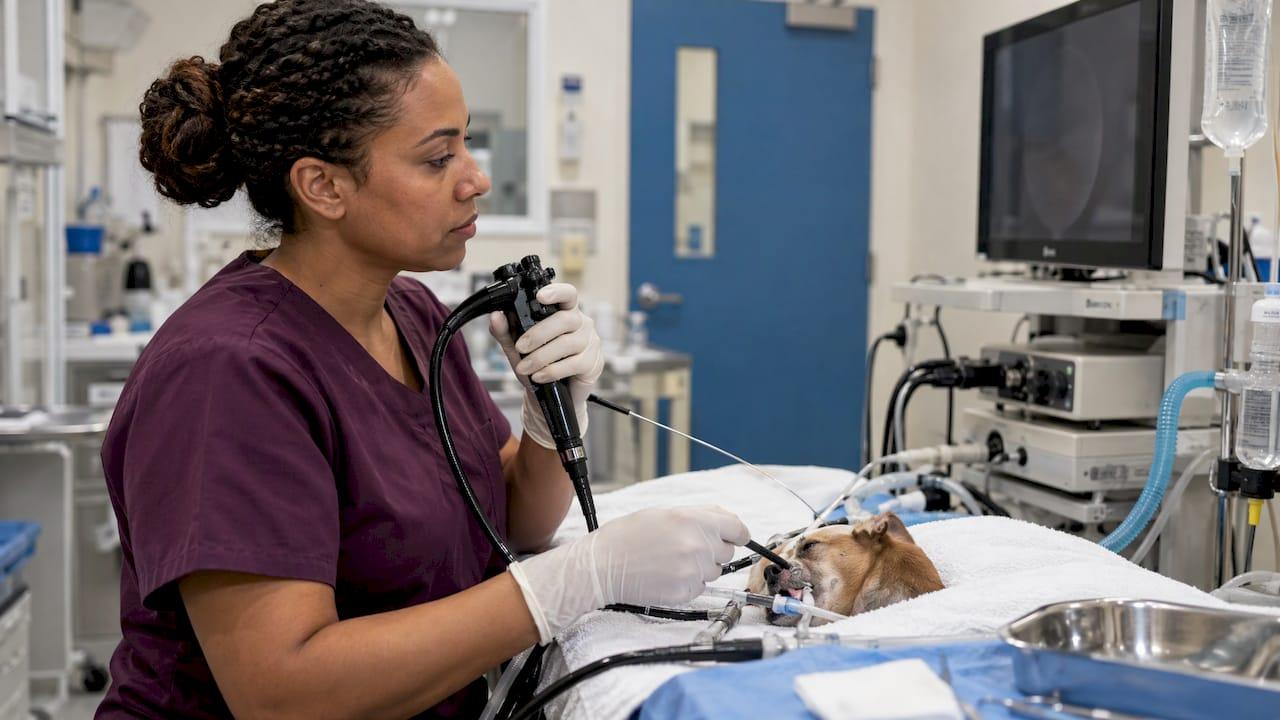
A borescope retrieval tool is a grasping, snaring or magnetic accessory that works alongside a camera probe. It lets you see an object in a hidden space, then pick it up and bring it out without taking the equipment apart. In veterinary practice, the same idea is used with an endoscope to remove swallowed foreign bodies. In industrial work, it recovers dropped screws, washers, tools and debris from engines, housings, pipes and cavities.
This guide covers what these tools are used for, which types suit which objects, how to check compatibility, and how to handle retrieval safely.
TL;DR
- Retrieval tools turn an inspection scope into a repair tool: you find the object, grasp it and remove it in one pass.
- Common types are forceps, snare loops, baskets, nets and magnets. Match the tool to the object's shape, material and location.
- The instrument must fit the scope's accessory channel. Never force it through a deflected tip or against resistance.
- In veterinary work, retrieval is routine for esophageal and gastric foreign bodies. In industry, it supports foreign object debris (FOD) control.
- Withdraw slowly, keep sharp ends protected, and clean and inspect every tool after use.
Table of Contents
- What a borescope retrieval tool does
- Veterinary uses
- Industrial uses
- Types of retrieval tools and what they pick up
- Check compatibility before you start
- How to retrieve an object safely
- Cleaning, storage and avoiding new debris
- Perspective
- Equipment to build a retrieval set
- Borescope or endoscope for retrieval?
- FAQ
- Sources
What a borescope retrieval tool does
A borescope is a long, narrow probe with a light and a camera at the tip. An endoscope is built on the same principle, but it is the term used for medical and veterinary work. The practical difference matters for retrieval in three ways:
- Channel. Veterinary and medical endoscopes usually have an accessory channel running through the insertion tube. Forceps, snares and baskets pass through it. Many small industrial borescopes have no channel, so their retrieval accessories are usually built into the probe tip, such as a grabber, a magnet or a hook.
- Cleanliness. Anything that enters an animal must be cleaned and disinfected between patients. Industrial probes face oil, fuel and metal shavings instead.
- Construction. Industrial scopes are built to resist heat, abrasion and chemicals. Veterinary scopes are built for cleaning protocols and tissue contact.
So "borescope retrieval tool" can mean two things. It can be a channel-passing instrument such as forceps or a snare. It can also be a purpose-built grabber probe with a camera and claws or a magnet. Both do the same job: bring a visible object out of a place your hand and eyes can't reach.
Veterinary uses
The most established use of endoscopic retrieval is removing swallowed objects from dogs and cats, and from other species on larger scopes. Coins, bones, hair ties, toy fragments, fishhooks, rawhide and cloth are typical examples. In practice, a clinic with a flexible scope and the right forceps can often avoid surgery.
The evidence supports that. A retrospective study of 92 animals reported successful endoscopic extraction in 88% (81 of 92), with 11 animals needing surgery. Success depended on where the foreign body was, the equipment, and operator experience. That last point is why instrument choice and practice time matter as much as the scope itself.

For esophageal cases, the MSD Veterinary Manual says diagnosed foreign bodies in small animals should be removed promptly, usually per os with a flexible endoscope and forceps. Rigid endoscopy is an alternative, but it calls for care to avoid laceration or perforation.
If you want the clinic-protocol view, see our write-up on endoscopy for pet foreign bodies.
Other veterinary retrieval and sampling tasks
Forceps are not only for swallowed objects. The same accessory family is used to take biopsies, lift small fragments, and clear debris from airways or nasal passages. Our guide to stocking 1.8 and 2.4 mm veterinary biopsy forceps explains which sizes small animal clinics tend to keep on hand. For general technique, see small animal endoscopy tips.
Industrial uses
In industrial inspection, retrieval tools solve a very common problem: you find the cause of a fault, and it is a loose item you can't reach. Typical jobs include:
- Automotive and engine work. Recovering a dropped nut, washer or fastener from a cylinder, intake or engine bay crevice.
- Aerospace and turbine maintenance. Removing stray hardware or debris found during an internal inspection, where leaving it behind is not an option.
- Plumbing and pipework. Pulling out a ring, a fitting or a clump of debris seen on a pipe camera.
- Manufacturing and assembly. Clearing swarf, fragments or a lost component from a housing or cast cavity.
- Building and HVAC. Retrieving items that have fallen behind walls, into ducts or under fixed units.
In aviation especially, retrieval ties into foreign object debris control. The NTSB recommends tool and personal-item inventories before and after maintenance work, controlled storage of hardware and consumables, cleaning as work proceeds, a FOD container nearby, and a second-person visual check after the task. A retrieval tool is one step in that system, not a substitute for it.
Types of retrieval tools and what they pick up
For dogs and cats, a veterinary guide in Today's Veterinary Practice lists the common foreign-body instruments: long-arm two-prong forceps, snare loops, raptor forceps, basket forceps, four-prong forceps, Roth nets and rat-tooth forceps. It recommends choosing among them based on how the object looks and where it sits. The same logic carries over to industrial work, with magnets and hooks added.
| Tool | Best for | Notes |
|---|---|---|
| Two-prong grasping forceps | Flat or thin items, cloth, edges you can pinch | Common first choice when there is something to grip |
| Rat-tooth forceps | Tough, slippery or fibrous items | Teeth give a firmer hold on soft material |
| Raptor and four-prong forceps | Irregular or bulky items | Multiple points spread the grip |
| Snare loop | Items with a neck or handle, such as a toy, a stick, a bolt head | Loop closes around the object |
| Basket forceps and Roth nets | Round, smooth or fragmented items | Cradle the object rather than pinch it |
| Magnetic tip | Ferrous metal in an industrial space | Fast and gentle, but only for steel and iron |
| Hook or claw grabber | Rings, wire, clips, loose hardware | Typical on grabber-style industrial probes |
A few simple rules help you pick:
- Shape first. Round items slip from pinching forceps, so use a net or basket. Items with a loop or neck suit a snare.
- Material second. A magnet only works on ferrous metal. Aluminum, brass, plastic and rubber need mechanical grasping.
- Location third. A tight bend or narrow passage limits tool size and stiffness. Deep or angled spots need a more flexible instrument.
Check compatibility before you start
A retrieval tool that doesn't fit the scope is useless, or worse, a source of damage. Veterinary endoscopy guidance states that accessories pass through the scope's accessory channel, and the instrument diameter must not exceed the channel diameter. Check it before insertion, every time.
A short pre-use checklist:
- Channel diameter versus instrument diameter. Read both specifications rather than assuming. Our guide to accessory compatibility walks through how to match them.
- Working length. The instrument must extend past the scope tip enough to open and close its jaws or loop.
- Scope size versus the space. A small animal or a narrow cavity limits the scope diameter, and that in turn limits channel size. See our endoscope diameter guide and the notes on choosing a small animal endoscope size.
- Instrument condition. Test the opening and closing action outside the scope. Look for bent jaws, kinked sheaths or frayed wire.
- Lens protection. Metal tools passing the tip can scratch the lens. We cover that in our lens scratch prevention guide.
How to retrieve an object safely
The steps below follow the controlled-extraction approach described in veterinary guidance, and they adapt sensibly to industrial scopes with a channel or grabber.
- Look before you grab. Confirm what the object is, whether it is embedded, whether it has ridges to hold, and whether it has sharp edges.
- Choose the tool for that object. Use the table above. If the first tool can't get a hold, change tools rather than increasing force.
- Insert without forcing. The veterinary endoscopy source warns against pushing an instrument through a deflected tip or when you meet resistance. Straighten the tip, then try again.
- Seat the grip firmly. Make sure the instrument has a secure hold before you move anything.
- Bring the object to the scope tip. Draw the instrument back until the object sits at the tip.
- Withdraw slowly. The veterinary retrieval guide advises removing the object and scope together, slowly, with minimal force.
- Handle sharp items deliberately. For sharp veterinary foreign bodies, the same guide recommends orienting the sharp end caudally or inside the retrieval instrument. If that isn't possible, an overtube should encase the object during removal.
- Confirm the space is clear. Inspect again with the camera to make sure nothing remains.
Industrial teams add a record step: log what was retrieved, where it was, and who verified the area afterward.
Cleaning, storage and avoiding new debris
Retrieval instruments are the parts most likely to carry residue, because they touch the object. In a veterinary setting, follow your clinic's reprocessing protocol after each case. Narrow channels need correctly sized brushes, which is why we wrote the guide on brush sizing from 1.2 to 2.8 mm.

In industrial and airfield work, the aim is also to avoid creating the problem you are solving. The FAA's 2024 airport FOD advisory says removal equipment should collect debris rather than just relocate it. It also warns that collection systems and brushes can become FOD themselves if damaged or left unchecked. The same principle applies to a small retrieval tool: count it out, count it back, and check the jaws, tips and magnets for missing pieces.
Good habits for any setting:
- Inspect the tool under magnification after every use.
- Retire any instrument with a cracked jaw, a kinked sheath or a loose tip.
- Store tools in a labeled case so each size matches its scope.
- Keep spare retrieval tools on hand for the sizes you use most.
Perspective
We see the same pattern in clinics and shops. A scope is bought for looking, and the first time it earns its keep is when someone finds something they can remove on the spot. That is why we think of retrieval accessories as part of the system, not an add-on.
Our approach is to offer portable, high-resolution scopes and the accessories that go with them at prices that make a full set realistic: the scope, the forceps, the valves and the cleaning tools. A practice that owns a well-matched set tends to use it more often, and use builds the operator experience that the research links to better retrieval results.
Our advice is simple. Choose the scope for the channel size you need, choose forceps to fit that channel, and keep a couple of tool shapes on hand so you are never forced to improvise with the wrong one.
Endoscope
Equipment to build a retrieval set
We sell veterinary and industrial scopes together with the accessories that make retrieval possible. These pages are a sensible starting point:
- Flexible biopsy forceps for grasping and sampling through a scope channel.
- Veterinary rigid endoscopy for rigid scopes, arthroscopes and otoscopes.
- Borescopes, SD-card videoscopes and micro fiber scopes for industrial inspection and pipe work.
- Endoscopic accessories and medical endoscopes for valves, pumps and related items.
If you want a compact system with a built-in monitor and SD-card recording, look at our portable 6 mm airway inspection endoscope. For equine work, there is the 8 mm USB airway field scope. We also repair endoscopes, so a damaged scope doesn't have to be replaced.
Browse the full range on 1800endoscope.com, or see our videos of scopes in use for operation and cleaning procedures.
Borescope or endoscope for retrieval?
The words overlap, so the choice comes down to the work, not the label.
- Animal or patient work: use an endoscope designed for that purpose, with an accessory channel sized for the forceps you need, and one that can go through your reprocessing routine.
- Mechanical or structural work: use a borescope with the right probe diameter, length and articulation. If the object is metal and loose, a magnetic or claw-style tip may be enough. If you need a true forceps grip, choose a model with a channel.
- Mixed use: a clinic or workshop doing both should keep the two kinds separate. Don't use a probe that has been in an engine bay on an animal.
FAQ
What are the main uses of a borescope retrieval tool?
They recover objects from spaces you can see into but can't reach by hand. In industry that means dropped hardware, debris and fragments in engines, pipes and housings. In veterinary medicine, the same approach removes swallowed foreign bodies through an endoscope.
What is the difference between an endoscope and a borescope?
Both are narrow probes with a light and a camera. Endoscopes are used on bodies, so they are designed for cleaning and disinfection and usually have an accessory channel. Borescopes are used on machinery and structures, and are built for heat, oil and abrasion.
Which retrieval tool should I use for a round object?
A net or basket usually works better than pinching forceps, because it cradles the object instead of squeezing it. For a loop-shaped or necked item, a snare may do better. Choose by shape, material and position.
Can any retrieval tool go through any scope?
No. The instrument's diameter must not exceed the accessory channel's diameter, and its length must reach past the scope tip. Check both specifications before insertion, and never force an instrument that meets resistance.
Sources
- Endoscopic retrieval of esophageal and gastric foreign bodies (retrospective study)
- MSD Veterinary Manual: Esophageal Foreign Bodies in Small Animals
- Today's Veterinary Practice: Endoscopic Foreign Body Retrieval in Dogs and Cats
- Today's Veterinary Practice: Endoscopic Equipment for the Veterinary Practitioner
- NTSB Safety Alert: Control Foreign Object Debris
- FAA Advisory Circular 150/5210-24A: Airport Foreign Object Debris Management