
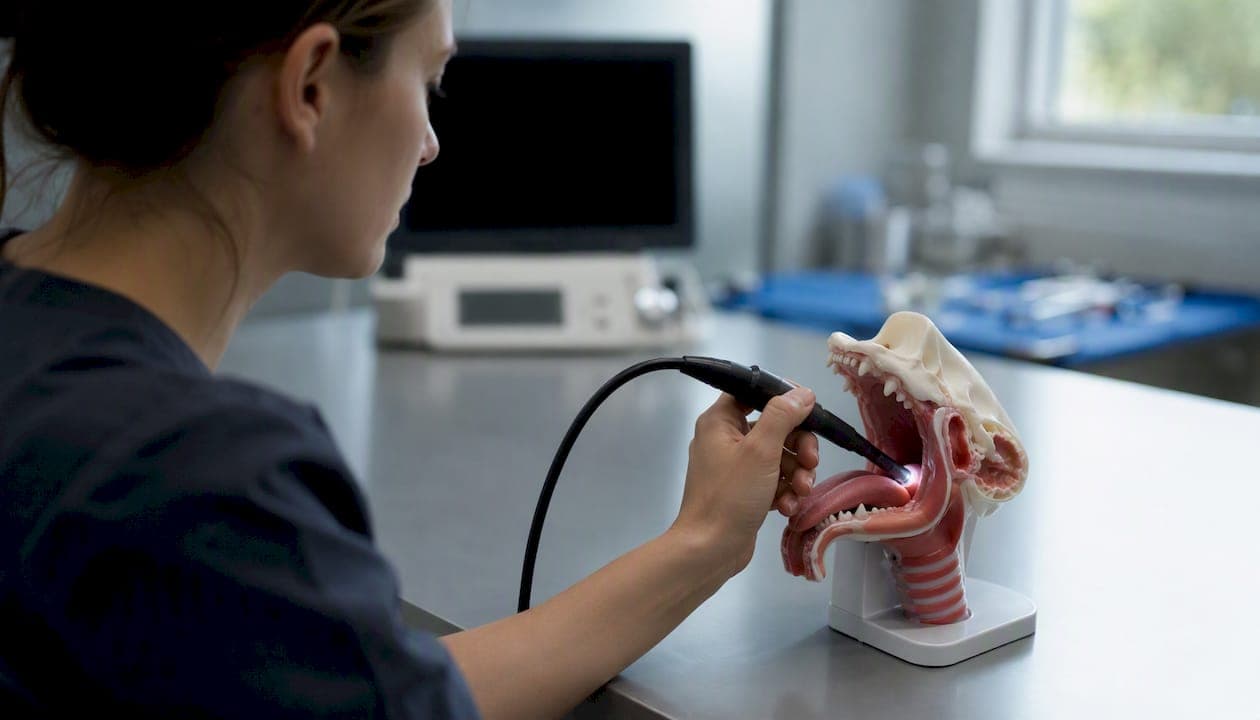
A borescope is an optical instrument built for one job: letting you see inside narrow, hard-to-reach cavities without taking anything apart. It consists of a rigid or flexible tube with an objective lens or camera at the insertion end and an eyepiece or display at the other, almost always paired with a built-in light source. Similar devices used in human medicine go by the name endoscope, though the two terms overlap more than most people realize.
The main types you'll encounter:
- Rigid borescope — straight tube, best image clarity, requires direct line-of-sight access
- Flexible borescope (fiberscope) — fiber optic relay, navigates bends, slightly lower resolution
- Semi-rigid borescope — manually shapeable, a practical middle ground for shallow curves
- Video borescope (videoscope) — onboard digital camera at the tip, live display, recording capability, often with articulation
Key Takeaways
A borescope is the most practical first-line inspection tool for any confined cavity: use the largest rigid probe that fits for the sharpest image, and choose a videoscope when documentation or articulation is required.
| Point | Details |
|---|---|
| Core definition | A borescope inspects narrow, inaccessible cavities optically, without disassembly. |
| Diameter vs. image quality | The largest rigid probe that fits the access point always delivers the best optical image. |
| When to choose a videoscope | Choose a videoscope when the path curves, articulation is needed, or inspection records are required. |
| Sterilization for clinical use | Medical and veterinary scopes require validated sterilization cycles; industrial probes are not substitutes. |
| 1800endoscope | Stocks rigid, flexible, and veterinary-grade scopes with accessories; browse the catalog or contact for application-specific guidance. |
Table of Contents
- How does a borescope create an image?
- What are the main types of borescopes?
- Where are borescopes actually used?
- Is a borescope the same as an endoscope?
- How do you choose the right borescope?
- What does a borescope cost, and where do you buy one?
- How do you run a borescope inspection?
- Maintenance, cleaning, and basic troubleshooting
- What are the limits of borescope inspection?
- Expert guidance from 1800endoscope: what actually matters in the field
- A practical perspective on borescope value
- 1800endoscope carries the right scope for your application
- Sources
How does a borescope create an image?
Every borescope, regardless of type, shares the same core architecture: an insertion probe, an objective lens or image sensor at the tip, an illumination source, a relay system carrying the image back, and a display or eyepiece at the operator end. The differences between models come down to how each of those elements is implemented.
Optical fiber relay vs. digital camera tip
In a traditional fiberscope, thousands of optical fibers run the full length of the probe. The objective lens at the tip focuses an image onto the fiber bundle, and that image travels back fiber by fiber to an eyepiece or camera head. The resolution is limited by the number of fibers in the bundle, and the characteristic pixelated "honeycomb" pattern is a known trade-off. Fiber bundles also degrade over time as individual fibers break.
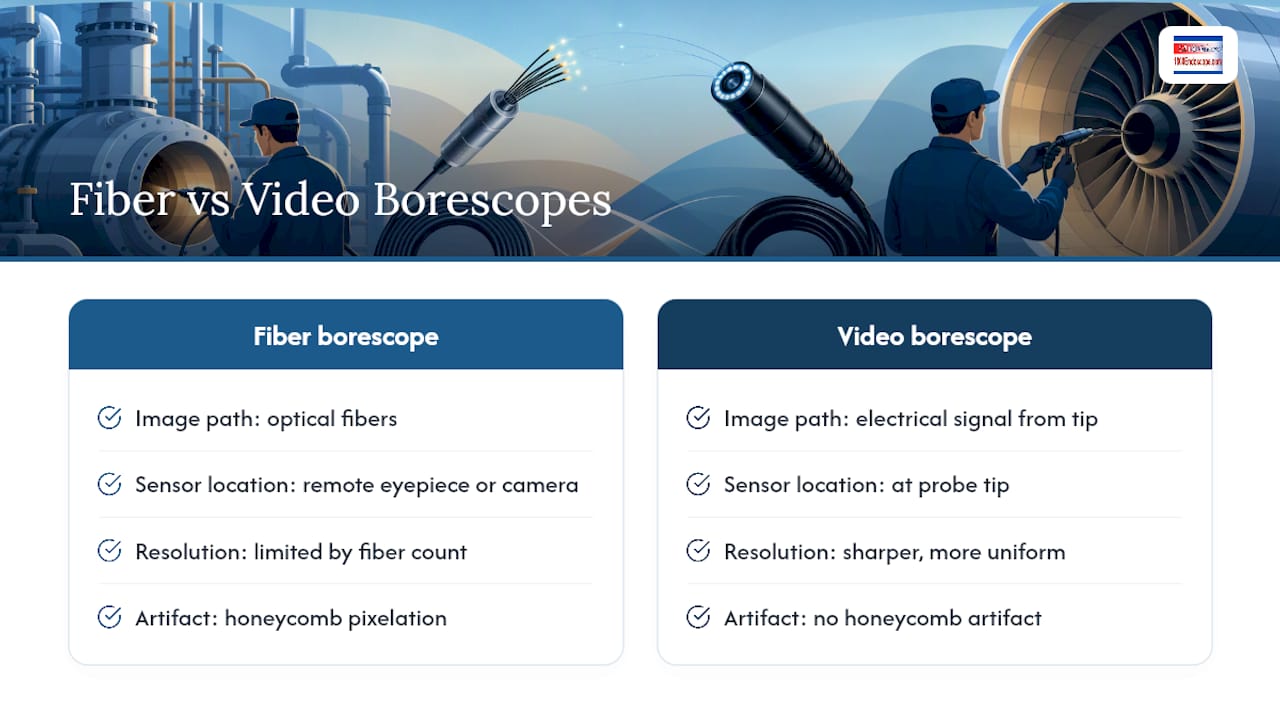
A video borescope takes a different approach: a miniaturized digital image sensor sits right at the probe tip, and the signal travels back as an electrical feed rather than an optical relay. The result is sharper, more uniform images with no honeycomb artifact, and the display can be a dedicated monitor, a tablet, or even a smartphone app. Higher-end units add image capture, video recording, articulation, and ruggedized housings built for field work.
Illumination: fiber optic vs. LED at the tip
Older designs route light from an external source down fiber optic strands alongside the image bundle. LED-at-tip designs, now common in videoscopes, place the light source directly at the inspection point. LED placement eliminates light loss along the cable run and produces more even illumination, which matters when you're looking for subtle surface defects. The trade-off is heat management inside a very small probe diameter.
Probe construction and IP ratings
Probe materials range from stainless steel on rigid scopes to braided stainless or polymer-jacketed flexible shafts. Ingress protection (IP) ratings tell you how well a probe resists dust and liquid. An IP67-rated probe survives brief submersion; IP68 handles continuous immersion. For pipeline inspection or outdoor field work, the IP rating is often as important as camera resolution.
Key spec to check: For any inspection involving liquids or outdoor environments, confirm the probe's IP rating before purchase. IP67 is the practical minimum for most field applications.
| Component | Fiberscope | Videoscope |
|---|---|---|
| Image relay method | Fiber optic bundle | Digital sensor + electrical cable |
| Typical image artifact | Honeycomb pixelation | None |
| Resolution ceiling | Limited by fiber count | Limited by sensor size |
| Illumination source | External light via fiber | LED at tip |
| Recording capability | Requires add-on camera head | Built-in |
Pro Tip: When comparing specs, check whether the stated resolution refers to the sensor or the effective output at the display — some vendors quote sensor resolution that the fiber bundle or cable compression can't fully deliver.
What are the main types of borescopes?
Choosing the wrong type for your access geometry wastes time and can damage the probe. Here's how each type performs in practice.
Rigid borescopes
Rigid scopes use a series of relay lenses (Hopkins rod lenses, achromatic doublets, or gradient-index rod lenses for very small diameters under roughly 3 mm) to carry the image from tip to eyepiece. They deliver the sharpest, brightest images of any borescope type, but only when the inspection path is a straight line. A cylinder bore, a gun barrel, or a straight pipe section are ideal. Any bend in the path and the rigid scope simply won't reach.
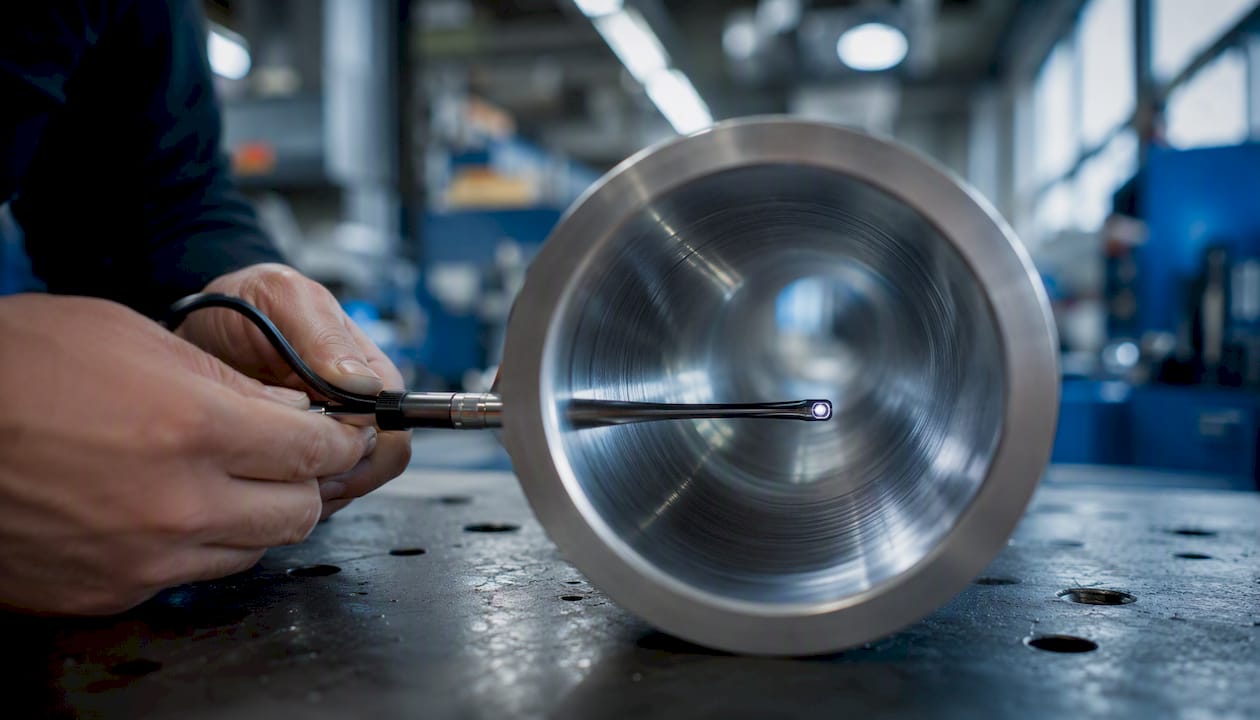
Best for: Engine cylinder inspection, firearm barrel inspection, straight pipe sections, precision optical measurement tasks.
Flexible fiberscopes
The fiber optic bundle gives these scopes the ability to navigate curves and corners that would stop a rigid probe cold. HVAC duct inspections, turbine blade root inspections, and veterinary airway checks all benefit from the flexibility. The resolution trade-off is real but acceptable for most go/no-go inspection decisions. Fiber bundles are also more fragile than rigid tubes; tight bends repeated over time break individual fibers and create dark spots in the image.
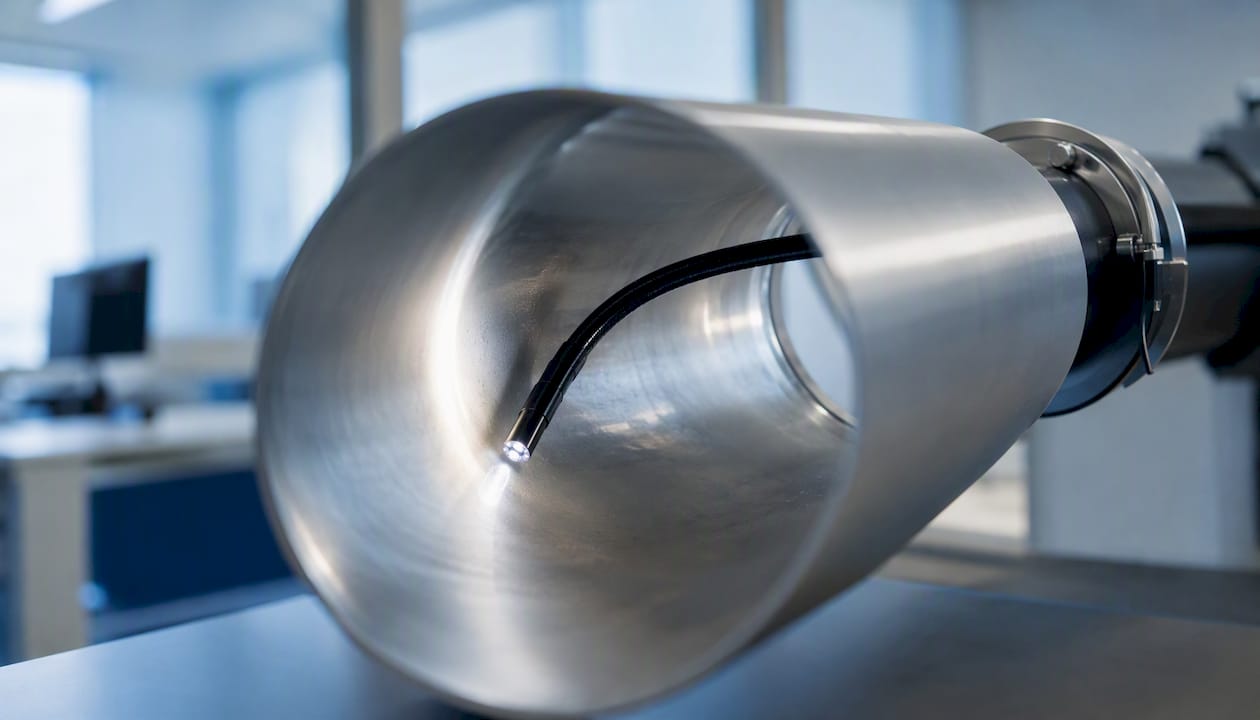
Best for: Curved access paths, HVAC systems, veterinary airway visualization, any geometry with multiple bends.
Semi-rigid borescopes
These are manually shapeable probes that hold their form once bent. They work well for shallow, predictable curves where you need to set the probe angle once and leave it. They're not articulated, so you can't steer them remotely, and they're not as flexible as a true fiberscope. For technicians who inspect the same geometry repeatedly, a semi-rigid probe pre-bent to that geometry is a fast, low-cost solution.
Best for: Repetitive inspections of known, shallow-curve geometries; automotive inspection of accessible cavities.
Video borescopes (videoscopes)
The videoscope is the current workhorse for serious industrial and veterinary inspection. The onboard digital camera streams live images to a display, and most midrange and above units include onboard recording, still capture, and increasingly, wireless connectivity for remote collaboration. Articulated tip models (2-way or 4-way) let the operator steer the tip around corners without physically repositioning the probe. Onboard recording and low-latency streaming are increasingly standard on midrange videoscopes, which changes the selection calculus for teams that need traceable inspection records.
Best for: Complex geometries requiring articulation, any inspection requiring documented evidence, remote collaboration, plumbing and pipeline inspection.
| Type | Image quality | Navigates bends | Recording | Typical diameter range |
|---|---|---|---|---|
| Rigid | Highest | No | External only | 1 mm–20 mm |
| Fiberscope | Moderate | Yes | External only | 2 mm–12 mm |
| Semi-rigid | Moderate | Limited | External only | 3 mm–6 mm |
| Videoscope | High (digital) | Yes (articulated) | Built-in | 2 mm–10 mm |
- 2-way articulation steers the tip up/down; adequate for most pipe and duct inspections.
- 4-way articulation adds left/right control; necessary for complex turbine or structural cavities.
- Probe diameter directly affects where you can go: a 6 mm probe fits most automotive and HVAC applications; a 2 mm probe is needed for micro-inspection of small-bore components.
Where are borescopes actually used?
Borescopes belong to the non-destructive testing (NDT) family of technologies, which means they let inspectors find cracks, corrosion, blockages, and foreign objects without disassembling the equipment under inspection. That single capability drives adoption across a wide range of industries.
- Aviation and aerospace: Technicians inspect turbine blades, combustion chambers, and airframe cavities between scheduled maintenance intervals. A borescope finding can determine whether an aircraft continues service or goes to the shop, making traceable image metadata and compliance with standards like ASTM E2578-21 a practical requirement rather than a nice-to-have.
- Automotive: Mechanics check cylinder walls for scoring, inspect valve seats, and verify foreign object removal after repairs, all without pulling the engine. A 6 mm rigid or semi-rigid scope handles most cylinder bore checks in minutes.
- Manufacturing and NDT: Weld inspection inside pipes and pressure vessels, casting inspection for porosity, and quality checks on machined bores are routine. Fiber optic borescopes for NDT and video borescopes both see heavy use here, with the choice driven by access geometry and documentation requirements.
- Plumbing and HVAC: Pipeline inspection borescope uses include locating blockages, checking pipe condition, and confirming joint integrity without excavation. A flexible videoscope with a long insertion tube is the standard tool.
- Veterinary and medical: Veterinarians use flexible videoscopes for airway visualization, gastrointestinal inspection, and equine dental checks. Scopes used in these contexts must meet sterilization and biocompatibility requirements that industrial tools do not. Veterinary practices integrating borescope-based diagnostics into their workflow benefit from purpose-built equipment with validated cleaning cycles.
- Firearms and gunsmithing: Bore inspection for erosion, fouling, and rifling condition is one of the oldest borescope applications. Rigid scopes sized to caliber are the standard choice.
- Utilities and civil infrastructure: Sewer line inspection, bridge cable inspection, and dam conduit checks all rely on ruggedized, often crawler-mounted videoscopes with long insertion tubes and IP68-rated probes.
Each industry adds its own layer of requirements. Aviation demands traceable metadata. Medical and veterinary use demands sterilization validation. Field utilities demand ruggedized, waterproof housings. Knowing your industry's specific constraints narrows the selection considerably before you ever look at a spec sheet.
Is a borescope the same as an endoscope?
Practically speaking, many practitioners use the terms interchangeably in casual conversation. Technically, the distinction is domain-based, not mechanical.
| Dimension | Borescope | Endoscope |
|---|---|---|
| Primary domain | Industrial, mechanical inspection | Medical, veterinary clinical use |
| Sterilization requirement | Not required | Mandatory; validated cycles |
| Biocompatibility | Not required | Required for patient contact |
| Regulatory controls | Industry standards (ASTM, etc.) | FDA (medical), USDA/AVMA (veterinary) |
| Typical probe features | IP-rated, ruggedized | Biocompatible materials, sterilizable channels |
The mechanical architecture is often identical. A flexible videoscope sold for industrial pipeline inspection and one sold for veterinary gastroscopy may share the same basic sensor and articulation design. What differs is the materials validation, sterilization compatibility, and regulatory pathway the device has been through.
Pro Tip: Never substitute a consumer-grade or industrial borescope for a medical or veterinary procedure. Industrial probes are not validated for biocompatibility, and their cleaning agents may leave residues unsafe for animal or human tissue contact. Always use purpose-built, facility-approved scopes for clinical applications.
How do you choose the right borescope?
Start with the physical constraints of the inspection, then layer in documentation and budget requirements. The largest rigid probe that physically fits the access point will always give you the best optical image; only move to a flexible or articulated design when the geometry demands it.
Checklist before you buy or rent:
- Probe diameter: Measure the access opening. Leave margin for maneuvering.
- Insertion length: The probe must reach the inspection point with some slack. Longer probes lose stiffness and are harder to control.
- Articulation: Do you need to steer around corners? 2-way covers most cases; 4-way for complex cavities.
- Image resolution and sensor type: Digital sensors outperform fiber bundles for detail; check effective output resolution, not just sensor spec.
- Light source: LED at tip for even illumination; fiber-delivered light for very small diameters where tip space is limited.
- Probe material and IP rating: IP67 minimum for wet environments; stainless steel for chemical resistance.
- Recording and connectivity: Onboard SD card, USB output, or wireless streaming? Match to your documentation workflow.
- Battery life: Field inspections away from power need at least 3–4 hours of runtime. Check whether the battery is replaceable.
- Accessories: Measurement overlays, mirror attachments, interchangeable probe tips, and biopsy channels (for veterinary use) all extend capability.
Questions worth asking any vendor:
- What is the warranty and what does it cover for probe damage?
- Is calibration required, and does the vendor provide calibration certificates?
- For medical/veterinary buyers: what sterilization methods are validated, and are cleaning cycle records available?
- Does the system export image metadata compatible with your audit or maintenance management software?
The practical decision matrix comes down to three axes: access geometry (straight vs. curved), documentation need (none vs. traceable record), and budget. A rigid scope handles straight access with no documentation need at the lowest cost. A videoscope with articulation and onboard recording handles everything else, at a higher price.
What does a borescope cost, and where do you buy one?
Borescopes range from inexpensive phone-attached cameras for simple checks to modular, audit-capable industrial systems with regulated data logging and IP-rated housings. The spread is wide, and the factors that move price are predictable.
Rough price bands:
- Entry-level consumer units (phone-attached or basic handheld display): under $100. Adequate for home plumbing checks or casual inspection. Limited IP rating, fixed focus, no articulation.
- Midrange industrial videoscopes: $500–$3,000. Onboard recording, adjustable focus, IP67 or better, some articulation. The practical choice for most professional technicians.
- High-end articulated inspection systems: $5,000–$30,000+. Full 4-way articulation, high-resolution sensors, ruggedized for aviation or pharma environments, traceable metadata, compliance-ready.
What drives price up: smaller probe diameter (harder to manufacture), 4-way articulation, higher sensor resolution, IP68 rating, compliance documentation, and longer insertion tubes. Veterinary-grade scopes add biocompatibility validation costs.
Where to buy or rent:
- Specialty NDT and industrial inspection suppliers carry the widest range of professional-grade units and can advise on compliance requirements.
- Veterinary device resellers stock biocompatible, sterilization-validated scopes with appropriate accessories.
- Rental is worth considering for one-off inspections: a $15,000 articulated videoscope rented for a day costs a fraction of purchase, and the rental house handles calibration and maintenance.
- For a browsable catalog of both industrial and veterinary options, the 1800endoscope borescope catalog covers rigid scopes, flexible videoscopes, and accessories in one place.
How do you run a borescope inspection?
A clean, well-documented inspection follows a consistent sequence. Skipping steps, especially at the preparation and decontamination ends, is where most errors and equipment damage happen.
- Prepare the equipment. Charge the battery fully. Clean the probe tip and insertion tube. Select the correct probe diameter and length for the access point. Confirm the display or recording system is functioning.
- Plan the entry point and route. Identify where the probe enters, what bends it will navigate, and where the target inspection zone is. For complex geometries, sketch the path.
- Insert and advance slowly. Feed the probe in steadily without forcing it. Watch the live image continuously; never advance blind. Use articulation controls gently to steer around corners.
- Adjust lighting and focus. Once at the inspection zone, optimize the light level to avoid glare on reflective surfaces. Adjust focus if the scope allows it. Use a mirror attachment for perpendicular surface views.
- Document findings. Capture still images and video clips of every relevant finding. Note probe position (depth markings on the insertion tube help). For regulated inspections, confirm that image metadata (timestamp, operator ID, equipment ID) is being recorded.
- Withdraw carefully. Pull the probe back slowly, watching for snagging. Never yank a flexible probe out under tension.
- Decontaminate and store. Wipe the insertion tube with the appropriate cleaning agent. For medical or veterinary scopes, follow the facility's validated sterilization protocol. Coil flexible probes loosely to avoid kinking.
Pro Tip: Stabilize the probe at the entry point with a guide tube or foam collar when possible. A probe that moves at the entry shifts the image and makes it nearly impossible to get a sharp, usable still frame.
For a deeper walkthrough of flexible scope technique, the flexible borescope diagnostics guide covers clinical and field scenarios in practical detail.
Maintenance, cleaning, and basic troubleshooting
A borescope is a precision optical instrument. Treating it like a screwdriver shortens its life fast.
Cleaning checklist after every use:
- Wipe the external insertion tube with a lint-free cloth dampened with mild detergent solution. Never submerge the control head unless it is rated for it.
- Clean the objective lens with a lens-safe wipe or cotton swab. Avoid abrasives.
- For medical and veterinary scopes, follow your facility's infection-control protocol exactly. Enzymatic detergents, high-level disinfectants, and sterilization methods (EtO, autoclave, liquid chemical) must be validated for the specific scope model.
- Dry the probe completely before storage. Moisture trapped inside a flexible probe degrades the fiber bundle and corrodes electrical contacts.
Storage:
- Coil flexible probes in large-radius loops, never tight coils. A kink in a fiber bundle is permanent damage.
- Store rigid scopes in padded cases to protect the relay lenses from impact.
- Keep the probe tip covered with the supplied cap to protect the objective lens.
Quick troubleshooting:
- No image: Check the connection between probe and display unit. Confirm battery charge. Inspect the objective lens for contamination or physical damage.
- Poor contrast or washed-out image: Reduce light intensity. Check for lens fogging (temperature differential between probe and environment). Clean the objective lens.
- Stuck articulation: Do not force it. Check for debris at the bending section. If the articulation cable is jammed, forcing it will snap the wire.
- Intermittent recording: Check the storage card format and available space. Confirm the recording button sequence for your specific unit.
What are the limits of borescope inspection?
A borescope is a visual tool. It shows you surfaces it can reach with light and a line of sight. That's powerful, but it has clear boundaries.
- Access constraints: If the entry hole is smaller than the probe, or the path has bends tighter than the probe's minimum bend radius, the inspection simply can't happen. No amount of force fixes a geometry mismatch.
- Reflective surfaces: Polished metal bores reflect the illumination back at the camera, washing out surface detail. Angled lighting or a diffuser attachment helps, but some surfaces remain difficult to read.
- No dimensional measurement beyond visual: Standard borescopes give you a view, not a measurement. Stereo measurement videoscopes and laser measurement attachments add quantitative capability, but they're a separate product category and add significant cost.
- Depth-of-field limits: Most borescope optics have a fixed or limited focus range. Objects very close to the lens or far from it may be out of focus, and there's no way to inspect what you can't focus on.
- Image quality vs. probe diameter: Smaller probes mean smaller lenses and sensors, which means less light and lower resolution. A 2 mm probe image will never match a 10 mm probe image under the same conditions.
When a borescope can't answer the question, the alternatives are ultrasonic testing (for wall thickness and subsurface defects), X-ray or CT scanning (for internal geometry and density variations), or disassembly. Each of those alternatives is more expensive and more disruptive, which is exactly why borescope inspection is always the first step when access allows it.
Expert guidance from 1800endoscope: what actually matters in the field
At 1800endoscope, we work with veterinary clinics, industrial inspection teams, and field technicians across a wide range of applications. A few practical rules come up constantly.
Diameter and image quality are inseparable. The largest rigid probe that fits the access point will always outperform a smaller flexible one on image clarity. This isn't a preference; it's physics. Gradient-index rod lenses in sub-3 mm rigid scopes partially close the gap, but for critical inspection decisions, use the biggest probe the geometry allows.
Articulation is not always better. A 4-way articulated videoscope is a remarkable tool, but it's also more expensive, more fragile, and harder to clean than a rigid scope. If your inspection path is straight, buy rigid. If you're inspecting turbine blade roots or navigating a complex pipe network, articulation earns its cost.
Metadata matters as much as the image. For regulated inspections, an image without a traceable timestamp, operator ID, and equipment record is nearly useless for audit purposes. Systems that integrate with field data management and comply with standards like ASTM E2578-21 protect you when a finding is disputed.
Pro Tip: Before purchasing, ask the vendor specifically: "What sterilization methods are validated for this probe?" For veterinary or medical buyers, an answer of "wipe with alcohol" is not sufficient. You need a validated high-level disinfection or sterilization cycle documented by the manufacturer.
Common procurement pitfalls:
- Buying a 4-way articulated system for inspections that only ever need a straight rigid scope.
- Ignoring service and calibration options until the probe fails mid-inspection.
- Mixing industrial-grade and medical-grade probes in a clinical setting because they "look the same."
- Underestimating insertion length: a probe that's 30 cm too short for your deepest inspection point is useless.
For veterinary buyers specifically, the best borescopes for clinical use guide covers validated options and what to ask your supplier before committing.
A practical perspective on borescope value
The professionals who get the most out of borescopes are the ones who treat them as a decision tool, not just a camera. A good inspection image either confirms that a component is serviceable or triggers a repair before a failure happens. That's the return on the investment, and it's substantial whether you're a veterinarian checking an equine airway or a technician clearing a turbine for continued service.
When advising buyers, the criteria I weight most heavily are probe diameter relative to the actual access geometry, the quality of the display (a sharp sensor paired with a dim or low-resolution screen wastes the hardware), and the cleaning and sterilization pathway for the intended use. Budget matters, but a scope that can't be properly cleaned for its application, or that can't reach the inspection point, is worth nothing regardless of price.
1800endoscope carries the right scope for your application
If you've worked through the selection criteria above and know what you need, the next step is straightforward. 1800endoscope stocks portable videoscopes, rigid scopes, flexible fiberscopes, and veterinary-specific endoscopes with the accessories and cleaning supplies to match.
The portable airway inspection videoscope is a strong starting point for veterinary and field inspection buyers: 6 mm diameter, 150 cm insertion length, direct monitor output, and onboard SD card recording at a price point that makes sense for clinics and field teams alike. For veterinary rigid endoscopy, the veterinary rigid endoscope catalog covers the full range of clinical applications. Browse the complete borescope and endoscope catalog to compare options by diameter, length, and application, or contact the team directly with your access geometry and inspection requirements for a specific recommendation.
Sources
The sources below were used in preparing this article and are worth bookmarking for deeper study.
- Borescope
- What Is a Borescope? A Plain-Language Guide - InspectandTest
- Video Borescopes | Industrial Inspection Cameras | Waygate
- What is a Borescope? A Guide to Industrial Borescopes