
For most small-animal work, choose an insertion tube outer diameter (OD) of roughly 5.8–9.2 mm with a working length of at least one meter and a working channel of 2.2 mm or larger. For exotic patients, airway procedures, and narrow-cavity work, call for ultra-slim scopes in the 2.2–4.0 mm range, but that smaller profile trims your working channel down with it, often to 1.2–2.0 mm, which restricts which biopsy forceps or retrieval baskets will actually fit through the scope.
The math is straightforward once you see it laid out:
- Ultra-slim/exotic scopes: 2.2–4.0 mm OD, 60–100 cm working length, channel often 1.2–2.0 mm.
- Small-animal gastroscopes: 5.8–9.2 mm OD, working length of 100 cm minimum (often 125–150 cm for a single scope that handles both dogs and cats).
- Working channel targets: at least 1.2 mm for airway or exotic diagnostic tools; 2.2–2.8 mm preferred when you need real biopsy or therapeutic capability.
A versatile GI endoscope that runs 125 cm or longer, stays under 9 mm OD, and carries a 2.2 mm channel handles the bulk of general-practice cases without forcing you to stock three different scopes. The trade-off never disappears, though: a slimmer tube gets you into a cat's pylorus or a ferret's trachea, but it caps the size of every forceps, snare, and cytology brush you can pass through it.
Key Takeaways
The right endoscope size depends on matching outer diameter, working length, and channel diameter to both the procedure and the patient, never picking the smallest scope by default.
| Point | Details |
|---|---|
| Match OD to procedure | Use 2.8–5.0 mm for airway/rhinoscopy and 5.8–9.2 mm for gastroscopy in dogs and cats. |
| Size length to patient | Choose a working length around one meter minimum for standard GI work, and longer scopes around 140 to 150 cm or more for giant breeds. |
| Prioritize channel for therapy | Reserve channels around 2.2 to 2.8 mm or larger whenever biopsy or retrieval tools are likely needed. |
| Test accessories before scheduling | Confirm forceps and baskets pass through the actual channel, not just the advertised spec. |
| Request specs directly from 1800endoscope | Ask for OD, channel ID, and working length on models like the PVSM6150 before ordering. |
Table of Contents
- What Size Endoscope Do You Need for Each Procedure?
- How Do You Balance Outer Diameter, Channel Size, and Working Length?
- How Do You Verify Scope Fit Before You Buy or Book a Case?
- What Does This Guide Get Right That Most Buying Advice Misses?
- Where Should You Buy Your Next Small Animal Endoscope?
- Frequently Asked Questions About Small Animal Endoscope Sizing
- Sources
What Size Endoscope Do You Need for Each Procedure?
Picking a scope by procedure, not by brand catalog, keeps you from buying equipment that looks impressive on a spec sheet but can't do the job in front of you. Bronchoscopy and rhinoscopy in cats, small dogs, and exotic patients demand the narrowest tubes in veterinary practice: SioMedical's sizing guidelines put the OD range at about 2.8 to 5.0 mm, working lengths roughly 60 to 100 cm, and channel diameter approximately 1.2 to 2.0 mm. Anything wider and you risk airway trauma or simply can't advance the scope past the larynx in a five-pound patient.
Gastroscopy is where most general practices spend their budget, and the specs widen accordingly. SioMedical's data recommends 5.8 to 9.2 mm OD with a working length of about one to one and a half meters and a channel diameter valued at 2.4 mm or larger for dogs and cats. Vet Times reports that pediatric-style flexible gastroscopes commonly used in cats and small dogs run about 6 to 10 mm in diameter with working lengths near one meter, while adult scopes built for larger dogs and for colonoscopy stretch between roughly 125 to 200 cm with diameters from 10 to 14 mm.
Colonoscopy and foreign-body retrieval in medium and large dogs push both dimensions further. You need OD in the approximately 8 to over 12.8 mm range to accommodate a channel wide enough for grasping forceps or a retrieval basket, and giant-breed patients (Great Danes, Mastiffs) often require working lengths of about 140 to 150 cm or more to reach the ileocecal junction. Today's Veterinary Practice confirms that many veterinary GI endoscopes are built with working lengths in the range of 140 to 150 cm specifically to serve larger dogs without swapping equipment mid-caseload.
Cystoscopy sits in its own category, and this is where rigid scopes still outperform flexible ones. A 2.7 mm rigid telescope covers rhinoscopy, cystoscopy in female dogs, and laparoscopy in cats and small dogs, while a 5 mm forward-viewing rigid scope handles larger female dogs and general laparoscopic work, according to a WSAVA congress review of small-animal endoscopy.
| Procedure | Patient class | OD range | Min. working length | Channel diameter |
|---|---|---|---|---|
| Bronchoscopy/rhinoscopy | Cats, small dogs, exotics | 2.8–5.0 mm | 60–100 cm | 1.2–2.0 mm |
| Gastroscopy | Cats, medium dogs | 5.8–9.2 mm | 100–150 cm | 2.2–2.8 mm |
| Colonoscopy | Medium to large dogs | 8–12.8+ mm | 125–150 cm | 2.8 mm+ |
| Colonoscopy | Giant breeds | 10–14 mm | 140–150 cm+ | 2.8 mm+ |
| Cystoscopy (rigid) | Female dogs, cats | 2.7 mm telescope | Varies by scope | N/A (rigid) |
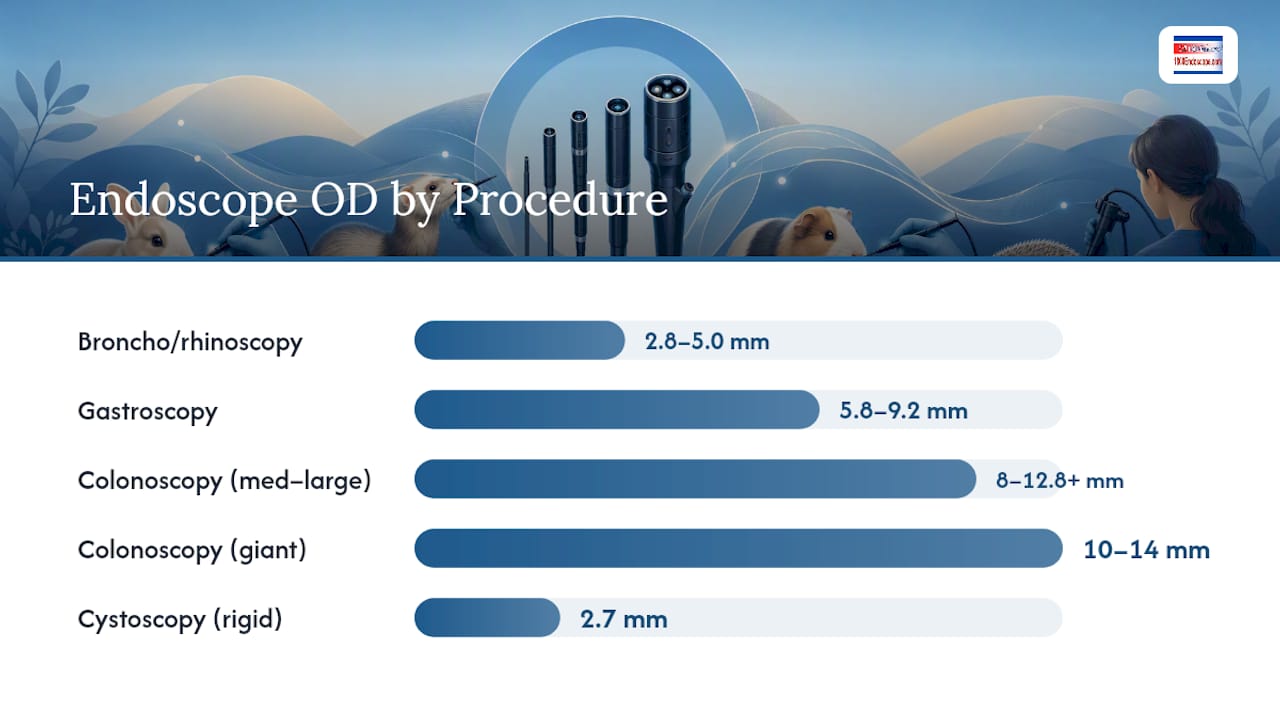
Manufacturer sizing charts organize these same figures by patient weight class, which is a faster reference point when you're triaging a caseload rather than a single procedure. Use both frameworks together: procedure type tells you the family of scope, and weight class tells you where in that range to land.
How Do You Balance Outer Diameter, Channel Size, and Working Length?
Every millimeter you shave off a scope's outer diameter comes out of somewhere, and that somewhere is almost always the working channel. VeterianKey's endoscopy guidance and SioMedical's equipment standards both point to the same physical constraint: the channel, the light bundles, and the imaging fiber all share a fixed cross-section, so a slimmer tube forces a smaller channel unless the manufacturer sacrifices something else, usually image resolution or angulation range.
Two decision rules cut through most of the guesswork.
- Favor the smallest feasible OD for airway work, rhinoscopy, and exotic patients where the anatomy simply won't accept anything larger. Diagnostic yield matters less here than getting the scope in at all.
- Prioritize channel size whenever therapeutic intervention or foreign-body retrieval is even a possibility. A scope that can't pass a 2.2 mm biopsy forceps or a retrieval basket turns a same-day procedure into a referral.
Consider a feline pyloric biopsy: a 5.8 mm OD gastroscope with a 2.2 mm channel gets the job done cleanly, and the smaller frame reduces gastric distension time under anesthesia. Now consider a medium-breed dog that swallowed a sock. That case calls for an 8.7 mm or larger scope to provide sufficient channel width for the retrieval basket, and you'd rather size up on OD than discover mid-procedure that your forceps won't fit.
Pro Tip: When a case could go either diagnostic or therapeutic, buy toward the larger channel. It's far easier to advance a slightly wider scope through a stable airway or GI tract than to abort a retrieval because the tool you need won't clear the channel.
How Do You Verify Scope Fit Before You Buy or Book a Case?
Run through this checklist before you place an order or schedule a procedure that depends on borrowed equipment:
- Confirm your target patient weight range and whether you're covering cats only, dogs only, or both.
- List every procedure you plan to run on the scope, since one versatile model rarely covers airway and colonoscopy equally well.
- Check the minimum channel inner diameter needed for your actual instrument set, not just the scope's advertised spec.
- Match required working length to your largest anticipated patient, adding margin for giant breeds if you see them regularly.
- Verify deflection/angulation degrees against the anatomy you'll be navigating (pylorus, ileocecal valve, nasal turbinates).
- Ask about sterilization compatibility and repair turnaround before the scope becomes part of your regular caseload.
For quick physical estimates, a sterile urinary catheter of known French size can approximate urethral or pyloric diameter in the exam room before you commit to a scope purchase. When a vendor offers trial units, run a dry pass with your actual biopsy forceps and retrieval devices, not just the demo accessories they ship with the loaner.
When you contact a supplier, request specs in this order: OD, working channel inner diameter, working length, and maximum angulation in degrees. Ask directly whether your existing forceps and baskets are compatible with the channel size quoted, since "universal fit" claims on generic listings rarely hold up in practice.
Pro Tip: Order your accessory set sized to the scope's channel, not the other way around. Assuming interchangeability between two scopes with similar-sounding specs is one of the most common and preventable procurement mistakes in small-animal endoscopy.
What Accessories Depend on Your Scope's Dimensions?
Biopsy forceps typically need a 2.0–2.2 mm channel minimum; retrieval baskets and larger grasping forceps often require 2.8 mm or more. A channel under 2.0 mm limits you to cytology brushes and fine diagnostic tools only, per VeterianKey's compatibility guidance.
- Check angulation specs separately from channel size. Insufflation and suction capability matter for maneuvers around the pylorus or ileocecal valve. Generic product listings frequently omit these figures entirely.
- Confirm accessory shaft length against your scope's working length. A forceps set with insufficient shaft length won't reach the working end of a longer colonoscope.
- Verify valve type and camera/light-head interface compatibility before assuming any accessory from a prior scope will transfer over.
What Should You Ask 1800endoscope Before You Buy?
1800endoscope specializes in veterinary endoscopes and stocks portable HD video systems built for exactly this kind of size-driven decision-making, alongside educational content on small-diameter scope selection. For airway and small-patient work, the PVSM6150 is the product page worth requesting specs on directly.
- Ask for the full spec sheet: OD, channel ID, working length, and angulation range.
- Request an instrument-compatibility list for forceps, baskets, and cytology tools before ordering.
- Browse the borescope and endoscope catalog if you're comparing multiple models for a mixed-species caseload.
What Does This Guide Get Right That Most Buying Advice Misses?
Most sizing charts treat outer diameter as the headline number and channel size as an afterthought. That ordering is backward for general practice. The scope that actually earns its price tag isn't the one with the smallest OD on the shelf. It's the one whose channel still lets you finish the job once you're inside the patient.
The conventional advice to "get the smallest scope that fits" works fine for airway and rhinoscopy cases, where anatomy leaves no choice. It falls apart the moment a diagnostic case turns therapeutic, which happens more often than most sizing guides admit. A vet who buys strictly on OD ends up referring cases that a 2 mm wider scope, with a proper channel, would have handled in-house.
If you take one thing from this guide, prioritize channel diameter for any scope that might see foreign-body work, then let OD and working length follow from the procedures and patients you actually see. Buy for the case you'll regret not being ready for, not the one that's easiest to spec on paper.
Where Should You Buy Your Next Small Animal Endoscope?
1800endoscope built its catalog around exactly the sizing decisions this guide walks through, so you're not choosing between a scope's advertised diameter and whether it'll actually pass your forceps. The PVSM6150 is a 6 mm, 150 cm portable video system priced for practices that need reliable airway and small-cavity access without the overhead of a full hospital-grade tower. It records directly to SD card, which means no separate processor unit to budget for or maintain.
If your caseload spans rhinoscopy, cystoscopy, and general soft-tissue work, the rigid endoscopy catalog covers the 2.7 mm and 5 mm telescope sizes this guide discussed for female-dog cystoscopy and small-patient laparoscopy. Request the full spec sheet for OD, channel ID, and working length on any model before you order, and confirm your existing forceps and retrieval tools against the quoted channel diameter. Visit the PVSM6150 product page to check current availability and get exact procurement specs for your next purchase.
Frequently Asked Questions About Small Animal Endoscope Sizing
What is the best endoscope size for a cat gastroscopy? A 5.8–9.2 mm OD scope with a working length of at least one meter and a 2.2 mm or larger channel handles most feline gastroscopy cases, per SioMedical's guidelines.
Can one endoscope cover both dogs and cats? A versatile GI scope around 125–150 cm long, under 9 mm OD, with a 2.2 mm channel covers general practice needs across both species, though giant-breed dogs may need a longer scope for full colon access.
What working channel size do I need for foreign-body retrieval? Plan for 2.8 mm or larger. Test your specific retrieval basket or grasping forceps against the scope's channel before scheduling the case, since advertised compatibility doesn't always hold in practice.
Do exotic patients need a different scope entirely? Usually yes. Exotic and airway work typically requires an ultra-slim scope in the 2.2–4.0 mm OD range, which limits you to diagnostic tools rather than larger therapeutic instruments.
Are rigid or flexible scopes better for small-animal cystoscopy? Rigid scopes, particularly the 2.7 mm telescope, remain the standard for cystoscopy in female dogs and cats, according to a WSAVA review of small-animal endoscopy techniques.
Sources
- Endoscopic equipment for the veterinary practitioner — Today's Veterinary Practice
- Endoscopy — Veterian Key
- Probe into small animal upper gastrointestinal endoscopy — Vet Times (PDF)