
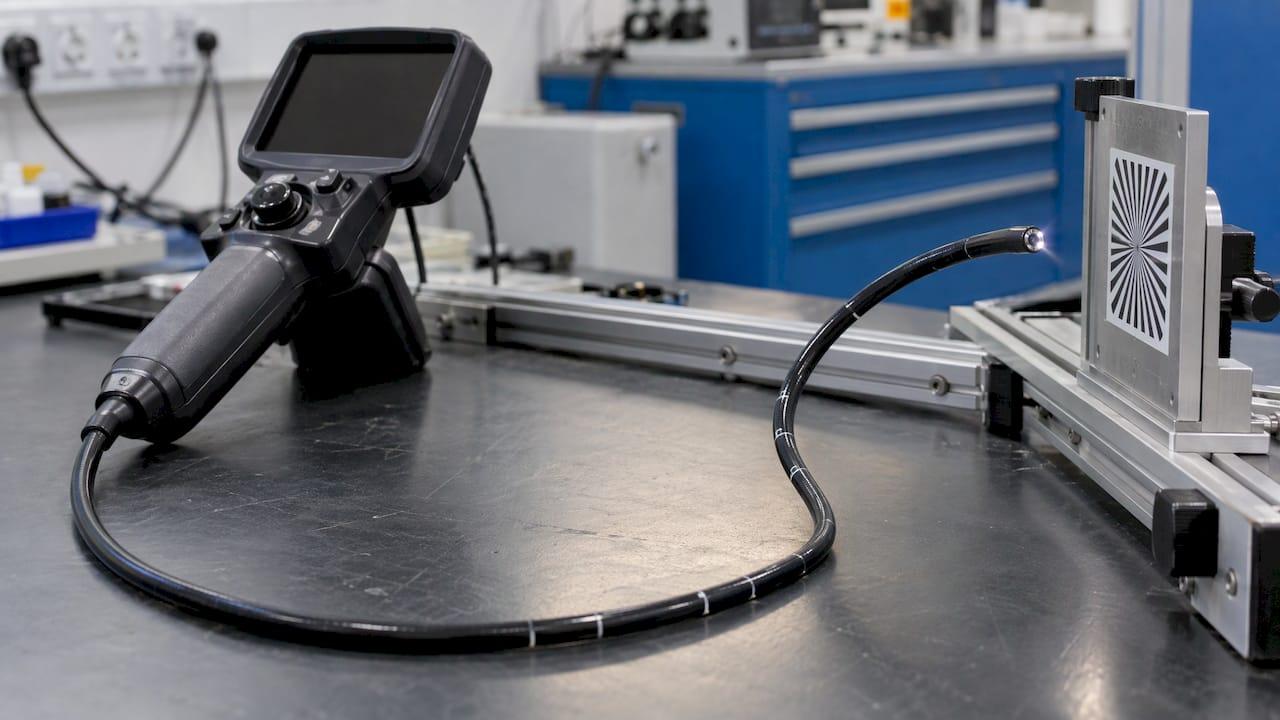
An autofocus videoscope is a camera scope whose lens adjusts itself, through a small motor and image analysis, until the target looks sharp. You skip the focus ring and the guesswork when the distance to the target keeps changing. It is not the right tool for every job, though. Whether it fits depends on your working distance, your lighting and how fast you need to move. This guide covers all three, plus the specs that matter when you buy for a clinic or an inspection crew.
TL;DR
- Autofocus lenses keep a moving or variable-distance target sharp by analyzing the image and driving a focus motor. Fixed-focus lenses are set for one range and respond faster.
- Focus quality depends on light. Dim, glare-heavy or low-contrast targets make any autofocus system slow or unstable, so illumination matters as much as the lens.
- Match the focus approach to the task: a set working distance in a trachea or a pipe run often suits a well-chosen fixed range, while varied distances favor autofocus.
- Before buying, check working distance, depth of field, resolution, recording format, insertion tube size and length, and how the scope is cleaned.
- Our portable SD-card and monitor-type videoscopes for veterinary and industrial work are on our borescopes page and veterinary endoscope pages.
Table of Contents
- What autofocus means in a videoscope
- How autofocus finds the sharp image
- Autofocus, fixed focus and manual focus compared
- Where autofocus videoscopes are used
- Specs to check before you buy
- Perspective: why we start with the job, not the label
- Matching the scope to your work
- Getting a sharp image: technique that works with any scope
- Promo: equipment for veterinary and industrial teams
- FAQ
- Sources
What autofocus means in a videoscope
A videoscope puts a tiny camera at the tip of a flexible or rigid tube and sends the picture to a monitor or recorder. Focus is the setting that decides which distance looks crisp. With autofocus, the scope decides that for you.
The Edge AI and Vision Alliance describes autofocus lenses as ones that dynamically adjust so the target subject stays sharp, using sensors and algorithms that detect the best focus point. It places them in applications from industrial automation to medical devices, including a medical endoscope moving through the body.
In practice that means three things during an inspection:
- You point the tip at a weld, a bore wall or a mucosal surface.
- The system measures how sharp the image is.
- A small motor shifts the lens until the picture is at its clearest.
If you have used a phone camera, the idea is the same. The difference is that a videoscope tip is tiny, lit by its own LEDs or fiber light, and often only millimeters from what it is looking at.
How autofocus finds the sharp image
Two methods dominate in cameras generally. Contrast detection looks for the focus position where edges in the image are most distinct. Phase detection compares light from different parts of the lens to work out how far and in which direction to move. Both depend on usable light: a photography explainer on low-light autofocus notes that these systems analyze contrast or phase differences, and when light is scarce that information becomes unreliable. It also describes the typical symptom, called hunting, where the focus motor moves back and forth without settling.

A dedicated inspection instrument shows the same logic. The operation manual for the Anritsu G0382A autofocus video inspection probe, a fiber end-face inspector, explains that autofocus drives a motor to find the clearest image, and that auto exposure holds brightness at a suitable level because autofocus may not work properly when the brightness of the target varies. That is a fiber optics tool, not a veterinary or pipe scope, but the principle carries over: stable, even lighting is what lets autofocus do its job.
What affects focus in the field
| Condition | Effect on autofocus | What helps |
|---|---|---|
| Dim cavity or long pipe | Slow focus or hunting | Raise light output, shorten the distance |
| Glare from wet or shiny surfaces | Focus locks on a reflection | Change the angle, reduce LED brightness |
| Featureless target (smooth tube wall) | Not enough contrast to lock on | Aim at a visible edge or seam first |
| Fluid, mucus or debris on the lens | Blurred picture that no motor can fix | Clean the tip, flush gently |
| Constant tip movement | Focus lags behind the view | Move slowly, pause on the area of interest |
None of these are defects. They are the physics of focusing a very small camera in a dark, wet or reflective space, and they are the reason the way you light and approach a target is part of the technique.
Autofocus, fixed focus and manual focus compared
The Edge AI and Vision Alliance article draws a clear line. A fixed-focus lens has a focal length calibrated at design or manufacture for a specific application or distance. Autofocus adjusts dynamically. It also states that fixed-focus lenses typically work faster than autofocus ones because they never need to adjust.
That trade-off is the whole decision:
| Autofocus | Fixed focus | Manual focus | |
|---|---|---|---|
| Best for | Varied or changing distances | One known working range | Operators who want full control |
| Speed | Slower while it refocuses | Fastest, nothing to adjust | Depends on the operator |
| Operator effort | Low | Lowest, if the range matches | Higher, one hand is busy |
| Risk | Hunting in poor light | Soft image outside the range | Missed focus when moving |
A scope with a well-matched fixed range can be the faster, simpler choice when your targets always sit at about the same distance. A scope that adjusts is the better fit when you move between a close look at a fitting and a view down a long run. Neither is better in general. The right one is the one that matches your distances.
A simple way to decide
Write down the nearest and farthest distance you actually look at in a typical week. If they sit inside one band, you have a fixed-range job. If they span a wide range, or you cannot predict them, autofocus earns its place.
Where autofocus videoscopes are used
The Edge AI and Vision Alliance places autofocus lenses across industrial automation and medical devices, from robots inspecting objects of different sizes and distances to endoscopes moving through the body. For inspection and veterinary teams, the practical uses look like this.
Industrial inspection
- Engine and machinery checks: the tip moves between nearby components and deeper surfaces, and distance changes constantly.
- Pipe and duct runs: the camera travels and the wall distance shifts with bends and fittings.
- Weld and surface review: you may want close detail on a seam, then a wider view of the surrounding area.
- Connector and fiber end faces: purpose-built probes use autofocus plus auto exposure so each image is centered and sharp.
Veterinary examinations
In animal work, the camera travels through airways, the upper GI tract or other passages. The distance to tissue changes with every movement, and lighting is the scope's own. Image clarity matters because it supports what you see, record and discuss with the owner or referring colleague. Our guide on how video imaging supports animal diagnosis walks through that in clinical terms, and remote visual inspection for veterinary diagnostics covers how scope imaging fits a workup.
Application limits to plan for
- Variable brightness can confuse autofocus, as the Anritsu manual notes, so use the scope's exposure control where it exists.
- Autofocus needs a moment to settle. For quick passes, slow your movement down.
- Very close or very distant targets can fall outside the lens range of any scope. Check the stated working distance.
- A dirty tip defeats focus entirely. Keep cleaning tools in your kit.
Specs to check before you buy
When a professional evaluates any videoscope, autofocus or not, these are the numbers and features that decide how useful it will be.
- Working distance and depth of field. The range over which the image stays acceptably sharp. It matters more than the autofocus label. For a fixed-focus scope, it tells you whether the lens suits your distances.
- Resolution and image processing. More pixels help only if the optics and light support them. Our piece on how HD video improves inspection accuracy explains the practical gain.
- Light output. Autofocus depends on it. Adjustable brightness lets you handle glare and dark runs.
- Insertion tube diameter and length. A 6 mm scope reaches places a 12 mm one cannot. Length decides how deep you can go. Match both to the animal or the pipe.
- Articulation and tube type. Flexible, semi-rigid or rigid, and whether the tip bends in one plane or several.
- Recording and output. SD card, USB, monitor or PC. Direct-to-card recording keeps the workflow simple in a barn or on site. See how to optimize endoscope video recording for vets.
- Portability and power. Battery life, weight and whether the system fits a field kit.
- Cleaning and reprocessing. Compatibility with your cleaning chemistry and process, and a waterproof, sealed tip where you need one. Always follow the manufacturer's reprocessing instructions for the specific model.
- Service and repair. What happens when the scope is dropped or a fiber breaks.
A quick worked example
Say a mixed practice scopes horses in the barn and sees small animals in the clinic. The airway scope needs length, a field-ready monitor and SD recording. The small-animal work needs a narrow tube. A single autofocus feature changes neither requirement. Start from tube size, length and portability, then ask how each candidate handles focus across your actual distances.
Perspective: why we start with the job, not the label
We sell veterinary and industrial endoscopes every day, and the same pattern repeats: buyers ask first for a feature, then discover that what they needed was a scope that fits their routine.
Focus is a good example. Autofocus is attractive because it takes a variable out of the procedure. But a clear image in a real exam comes from several things together: the right tube diameter, enough light, a clean tip, a steady hand and a recorder that is simple to use in the field. We build our range around that whole picture, with portable, SD-card and monitor-type systems at prices that make a second scope or a backup realistic for a working clinic.
Our approach is to keep equipment practical and affordable for small animals, horses and industrial inspection, and to back it with support that is available around the clock and fast shipping. If you tell us which animals you scope, or what you inspect and at what distances, we can point you to a configuration that suits it.
Endoscope
Matching the scope to your work
Once you know your distances and your light, the choice narrows quickly.
- Equine airway work: our field scopes in the 8 mm class, such as the 8 mm airway field scope with monitor and SD card and the 8 mm USB version, are built for portable use around the barn.
- Smaller airways: the 6 mm by 150 airway system is a direct-monitor SD-card unit.
- Upper GI work: the 3-meter monitor gastroscope and the portable 3.5 meter gastroscope cover longer reach.
- Industrial inspection: borescopes, pipe videoscopes and micro fiber scopes for engines, pipes and tight assemblies.
If you are still getting oriented, our overview of what a videoscope is and what it does and the basics of endoscopic equipment for vets and inspectors are good starting points. For a broader view of how scopes serve both fields, read how inspection cameras transform veterinary and industrial diagnostics.
Getting a sharp image: technique that works with any scope
Whatever focus system you use, the same habits produce better pictures.
- Check the tip before every use. A smear or droplet looks like a focus failure.
- Set light before you chase focus. Raise brightness in dark areas and lower it where glare appears.
- Advance slowly. Stop on the area you want to record, and let the image settle.
- Aim at structure. Edges, seams and vessels give focus something to lock onto.
- Record a short clip at each stop. Stills pulled from video are easier than catching one perfect frame.
- Log what you saw. Date, site and settings help when you compare later.
If an image stays soft after this, our videoscope troubleshooting guide for vet professionals lists the usual causes in order. If you work with airway cases, the video laryngoscopy guide covers a related technique.
Promo: equipment for veterinary and industrial teams
We supply portable veterinary endoscopes, videoscopes, rigid scopes, flexible biopsy forceps, light sources, accessories such as pumps, valves and cleaning tools, and industrial NDT borescopes, and we repair endoscopes as well. Browse the full range on our main store page, or go straight to medical endoscopes and accessories.
Tell us your animals or your inspection targets and the distances involved, and our team will help you choose. Our FAQ and inspection procedures page is also worth a look before you order.
FAQ
Is an autofocus videoscope better than a fixed-focus one?
Not in every case. Autofocus suits work where the distance to the target keeps changing. Fixed-focus lenses are calibrated for one range and typically respond faster, so they fit routine jobs where distances stay similar. Pick by your actual working distances.
Why does my videoscope image keep going in and out of focus?
Usually it is light, contrast or a dirty tip. Autofocus systems struggle when light is scarce or the target has no clear edges, and the focus motor can hunt back and forth. Clean the lens, adjust the illumination and aim at a visible edge before moving on.
What working distance should I look for?
Choose a range that covers the nearest and farthest distances you inspect most often. Depth of field, the span over which the image stays sharp, is as important as the autofocus label. Check the manufacturer's stated working range for the model.
Can the same scope serve veterinary and industrial work?
The imaging principles are the same, but tube diameter, length, cleaning requirements and sealing differ. Veterinary use calls for reprocessing suited to patient contact. Choose a scope designed for the use you have in mind and follow its manufacturer's cleaning instructions.
What should I check first when comparing models?
Start with tube diameter and length, then working distance, light output, recording method and portability. Add cleaning compatibility and repair support. Resolution matters, but only when the optics and lighting support it.
Sources
- Fixed-focus vs. Autofocus Lenses: How to Choose the Best Lens for Your Application, Edge AI and Vision Alliance
- G0382A Autofocus Video Inspection Probe Operation Manual, Anritsu
- Why Autofocus Struggles in Low Light, Daily Photo Tips