
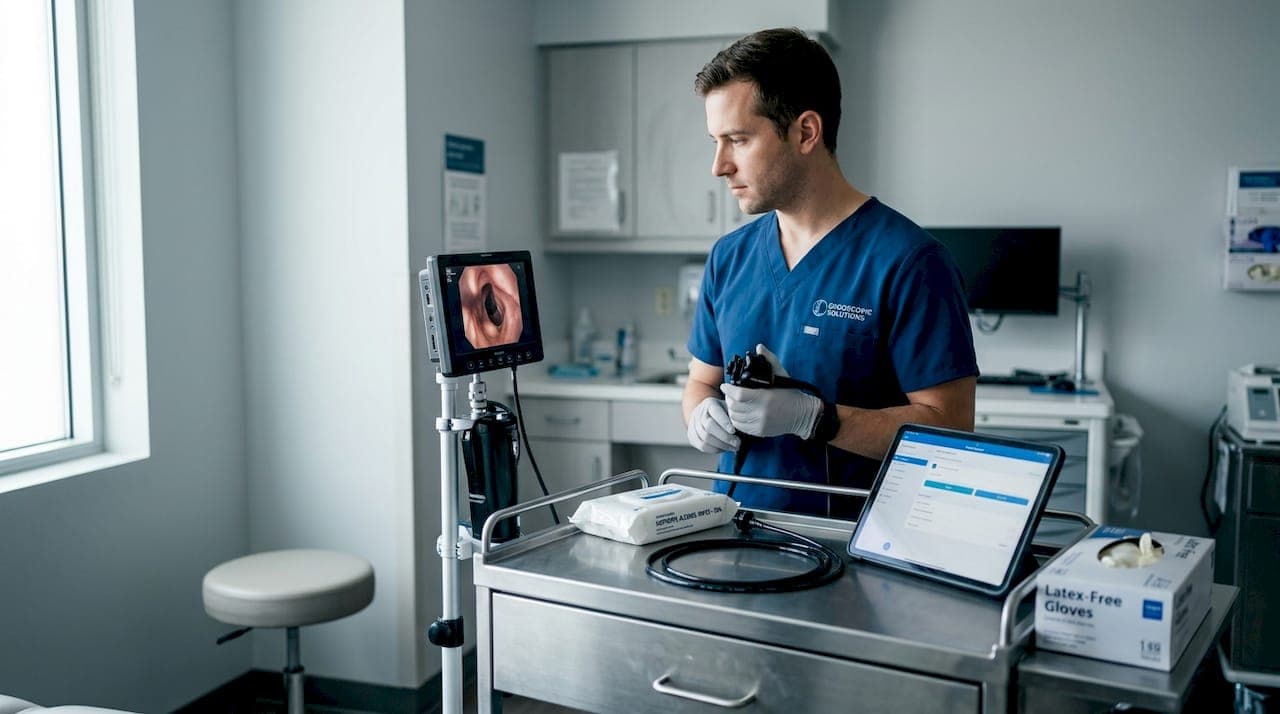
Many professionals assume a videoscope is just a fancy camera on a flexible stick. That assumption costs them diagnostic accuracy and inspection efficiency every time. A videoscope is a precision endoscopic tool that places a miniaturized camera and light source at the distal tip of an insertion tube, transmitting real-time, high-definition video to an external monitor for live diagnostics or inspection. Whether you're evaluating a horse's airway or inspecting a turbine blade cavity, understanding exactly what a videoscope is and what it can do separates a confident diagnosis from a costly guess.
Table of Contents
- What is a videoscope? The core definition
- Key features and advanced capabilities
- How videoscopes are used: Veterinary and industrial applications
- What to consider when selecting a videoscope
- Perspective: What most professionals miss about videoscopes
- Explore professional videoscopes for your needs
- Frequently asked questions
Key Takeaways
| Point | Details |
|---|---|
| Core definition | A videoscope is an advanced inspection tool delivering real-time internal visuals via a camera and light at the tube's tip. |
| Distinctive features | Modern videoscopes offer high-definition imaging, video recording, and options for sampling—setting them apart from simpler scopes. |
| Practical applications | Videoscopes are vital for both animal diagnostics and industrial system inspection, providing minimally invasive access. |
| Selection criteria | Choosing the right videoscope depends on your task's need for image clarity, tube size, portability, and accessory compatibility. |
| Expert perspective | Maximizing a videoscope's potential requires professional interpretation and aligning features to workflow challenges. |
What is a videoscope? The core definition
A videoscope is an endoscopic inspection instrument that uses a small camera and integrated light source mounted at the distal end of a flexible or semi-rigid insertion tube. The camera captures live images and transmits them in real time to a display screen, giving clinicians and technicians an unobstructed view of internal structures that are otherwise completely inaccessible. This is the key distinction: the camera is at the tip, not at the eyepiece.
According to the Cleveland Clinic endoscopy explanation, a videoscope uses a small camera and light at the distal end to deliver real-time video to a screen for visual inspection and diagnostics. That tip-mounted architecture is what separates it from older fiberscopes, which transmit light through bundled glass fibers and suffer from image degradation over distance. With a videoscope, image quality is determined by the sensor at the tip, not by fiber bundle density.
Here's how the three main scope types compare:
| Feature | Videoscope | Fiberscope | Borescope |
|---|---|---|---|
| Image source | Tip-mounted camera | Fiber optic bundle | Rigid rod lens or basic camera |
| Image quality | HD or near-HD video | Pixelated, limited resolution | Variable, often lower quality |
| Flexibility | High (articulating tip) | Moderate | Low to none (rigid) |
| Real-time video | Yes, direct to monitor | Limited, via eyepiece | Sometimes, depends on model |
| Working channel | Available in medical models | Limited | Rarely available |
| Best use | Vet/medical diagnostics, precision industry | Basic inspection | Simple industrial inspection |
Key features that define modern videoscopes include:
- Tip-mounted CMOS or CCD sensors for high-resolution live imaging
- LED illumination at the distal end for consistent, shadow-free lighting
- Articulating insertion tubes that bend in multiple directions for navigation
- Integrated or external monitors for real-time display
- Working channels for passing instruments like biopsy forceps or sampling tools
- Digital recording for image capture, video storage, and case documentation
If you want to review common questions about scope selection and use, the videoscope FAQs page covers a broad range of practical scenarios for both veterinary and industrial users.
Key features and advanced capabilities
Understanding the definition is only the starting point. What truly matters to professionals is how the features of a modern videoscope translate into better outcomes, whether that's a more accurate biopsy or a faster turbine inspection.
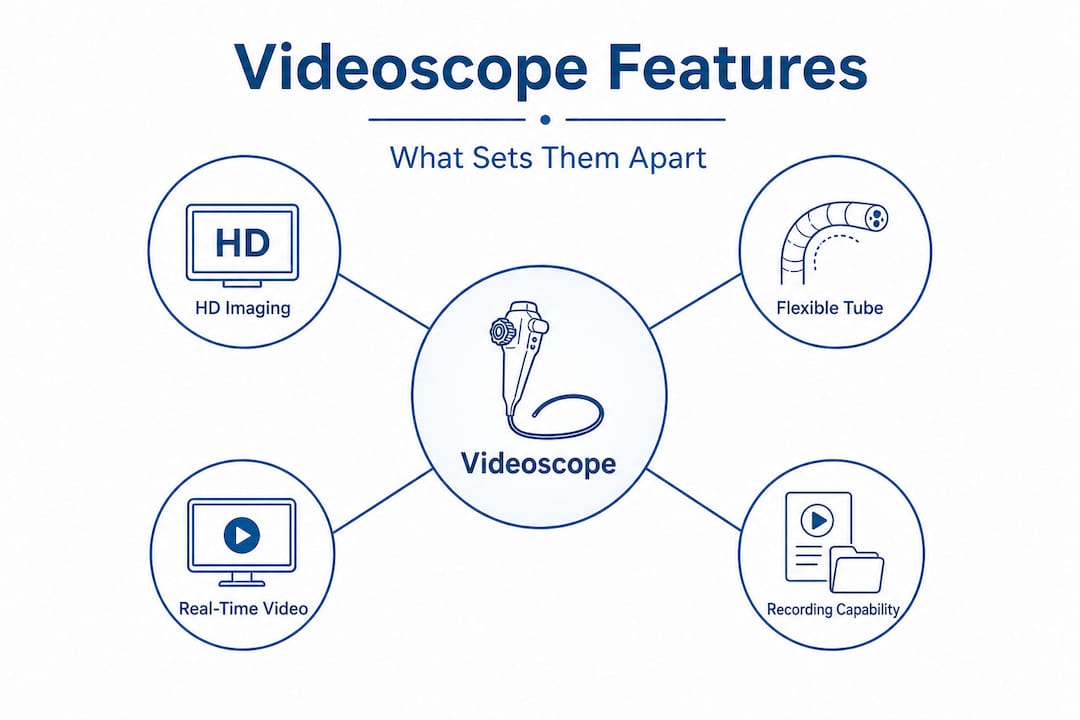
Imaging quality is the most immediate differentiator. Modern tip-mounted sensors deliver full HD or near-HD resolution, which means fine tissue detail in a horse's trachea or hairline cracks in a weld seam are clearly visible. This level of clarity is critical when you're making a clinical decision or writing an inspection report that will determine whether a machine stays online.
Real-time video display and recording changes how professionals document and communicate findings. You can record the entire procedure, capture still images, and share footage with colleagues or clients without needing to re-enter the patient or the pipe. This is especially valuable in equine practice, where a video of a dynamic airway collapse during exercise is far more informative than a static photograph.
As noted by VetSouth on videoscopy in animals, video-endoscopy in medical and veterinary contexts enables direct visualization of internal tube-like or cavity structures using a thin flexible tube with a high-definition camera and real-time display, and may support biopsy or sampling through the scope. That last point matters enormously. A working channel allows you to pass biopsy forceps, cytology brushes, or fluid aspiration tools through the scope itself, eliminating the need for a separate procedure.
Here's how veterinary and industrial videoscopes typically compare in feature sets:
| Feature | Veterinary videoscope | Industrial videoscope |
|---|---|---|
| Insertion tube diameter | 3.8mm to 9.8mm | 4mm to 12mm |
| Insertion length | 60cm to 3m | 1m to 10m+ |
| Working channel | Yes (for biopsy, sampling) | Rarely |
| Articulation | 4-way tip control | 2-way or 4-way |
| Recording | Integrated or USB output | Integrated display and SD card |
| Sterilization | Required, high-level disinfection | Not required |
| Portability | Portable, battery-operated options | Handheld, rugged housing |
The numbered list below shows how features build on each other in a well-specified videoscope system:
- Sensor quality determines base image resolution and low-light performance
- Insertion tube diameter determines where the scope can physically access
- Articulation range determines how well you can navigate curves and bends
- Working channel size determines what instruments can pass through
- Recording format determines how easily you can share and archive findings
- Battery life and portability determines whether field use is realistic
Pro Tip: For equine respiratory work, a portable airway videoscope with a 6mm insertion tube and integrated recording is often the best balance between image quality and patient comfort. For dental cavity inspection in horses, a dedicated equine dental videoscope with a shorter, angled insertion tube gives you far better access than a general-purpose scope.
Portability has evolved dramatically over the past decade. Early videoscope systems required cart-mounted processors and dedicated monitors. Today, battery-powered units with built-in LCD screens and SD card recording are standard, making field diagnostics at a barn or a remote industrial site genuinely practical.
How videoscopes are used: Veterinary and industrial applications
Features only matter when they're matched to the right application. Here's where videoscopes prove their value in real-world scenarios.
In veterinary medicine, the primary use cases center on visualizing internal structures without open surgery. Harvard Health's endoscopy guide defines video-endoscopy as a camera-and-light delivery system inserted into an animal to visualize internal structures and guide sampling such as biopsies without open surgery. That non-invasive access is transformative. You can evaluate the GI tract for ulcers, foreign bodies, or masses; inspect the upper and lower airways for inflammation, polyps, or dynamic collapse; and examine the urogenital tract or nasal passages in small animals.
A typical small animal GI endoscopy procedure follows this sequence:
- Patient preparation: Fasting, sedation or general anesthesia, positioning
- Scope insertion: Guided entry through the mouth or rectum depending on target area
- Navigation and visualization: Real-time video display as the scope advances
- Targeted sampling: Biopsy forceps passed through the working channel to collect tissue
- Documentation: Video and still image capture for the medical record
- Scope withdrawal: Careful retraction while monitoring for any missed findings
- Post-procedure care: Scope cleaning, patient recovery monitoring
For large animals, particularly horses, the equine airway videoscope is used to assess conditions like laryngeal hemiplegia, epiglottic entrapment, and exercise-induced pulmonary hemorrhage. Dynamic endoscopy, where the horse is scoped during treadmill exercise or immediately after a gallop, is only possible with a portable, real-time video system. Static images simply don't capture the movement-dependent conditions that affect performance horses.
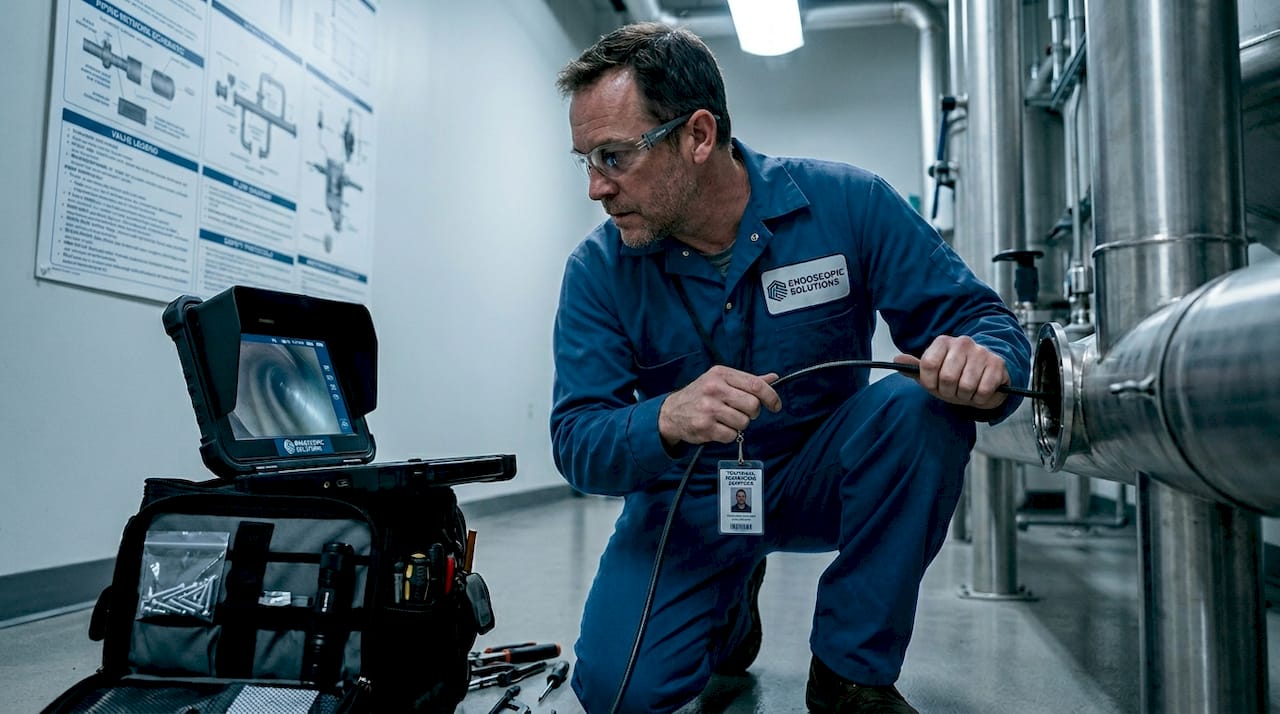
Industrial applications are equally demanding but structurally different. In manufacturing, maintenance, and NDT (non-destructive testing), videoscopes are used to:
- Inspect internal combustion engine cylinders without disassembly
- Evaluate weld integrity inside pressure vessels or pipelines
- Check turbine blade condition in aviation and power generation
- Assess corrosion or blockage inside HVAC ducting and conduit
- Verify assembly quality in sealed mechanical components
The rigid endoscopes for veterinarians page illustrates how even rigid scope configurations serve specific high-precision needs, a principle that applies equally to industrial inspection where a rigid borescope gives superior image stability in a straight-line access path.
Best practices for both fields share common principles: match insertion tube diameter to the access point, use the minimum necessary light intensity to avoid thermal artifacts, document every procedure with video, and clean and inspect the scope after every use.
What to consider when selecting a videoscope
Choosing the wrong scope is an expensive mistake. Here's what to evaluate before you commit to a purchase.
Tube diameter and insertion length are your first constraints. A 9.8mm veterinary scope that works perfectly for equine gastroscopy is useless for inspecting a 6mm industrial port. Map your access points before you evaluate anything else.
Camera and display quality directly affect diagnostic confidence. Minimum acceptable resolution for clinical veterinary use is 720p, though 1080p is now standard in newer units. For industrial inspection where you're measuring crack dimensions or checking weld profiles, image sharpness is non-negotiable.
Recording and portability matter more than many buyers anticipate. A scope that requires a cart-mounted processor limits you to the clinic or workshop. Battery-operated units with onboard recording give you flexibility that changes how and where you work.
Accessory compatibility is often overlooked until it's too late. If you anticipate needing biopsy capability, verify the working channel diameter matches your existing forceps. If you're in an industrial setting, check whether the scope supports measurement software or articulation locking.
Sterilization and cleaning requirements are critical in veterinary and medical settings. High-level disinfection with glutaraldehyde or peracetic acid is standard, but not all scopes tolerate every chemical. Check compatibility before purchase.
Key selection criteria at a glance:
- Insertion tube diameter matched to your access requirements
- Insertion length adequate for your deepest target structure
- HD imaging with low-light performance for dark cavities
- Integrated recording with sufficient storage capacity
- Working channel if biopsy or sampling is anticipated
- Articulation range appropriate for the anatomy or structure
- Sterilization compatibility for clinical environments
- Battery life and portability for field deployment
Pro Tip: Prioritize the feature most critical to your specific field. For veterinary diagnostics, a working channel for biopsy is often the deciding factor. For industrial NDT, four-way articulation with tip locking is what separates a productive inspection from a frustrating one. Review the full endoscope catalog to compare specifications across multiple models before deciding.
According to the Cleveland Clinic, the real-time video delivery capability of a videoscope is what defines its diagnostic value, which means any compromise on imaging quality or display performance undermines the core purpose of the instrument.
Perspective: What most professionals miss about videoscopes
Here's the uncomfortable truth: most professionals who own a videoscope are using about 60% of its capability. The recording function sits unused. The biopsy channel is reserved for "serious" cases. The articulation controls are operated on default settings. And then the same professionals wonder why their diagnostic confidence hasn't improved as much as they expected.
The scope is not the bottleneck. The workflow is.
A videoscope's value multiplies when you build systematic documentation into every procedure. Recording every airway exam, every GI pass, every industrial inspection creates a baseline. That baseline is what lets you detect subtle progression in a recurring condition or catch early-stage corrosion before it becomes a failure. Without that record, you're starting from zero every time.
There's also a persistent underestimation of how much scope-to-task matching matters. We've seen clinicians use a large-diameter gastroscope for nasal passage work and wonder why visualization is poor. We've seen industrial technicians use a veterinary flexible scope in a high-vibration environment and damage a tool that was never designed for that stress. The equine dental case is a good example of why purpose-built scopes outperform general-purpose ones in specialized applications.
Finally, videoscopic evidence is only as useful as the person interpreting it. A clear, well-lit video of an equine larynx is meaningless without the clinical knowledge to grade the movement pattern. An HD image of a turbine blade surface requires trained eyes to distinguish acceptable wear from a reportable defect. Invest in the scope, yes. But also invest in the training and protocols that make the scope's output actionable.
Explore professional videoscopes for your needs
If this article has clarified what you need from a videoscope, the next step is finding the right tool for your specific application. Whether you're managing equine respiratory diagnostics or conducting precision industrial inspections, the right scope makes a measurable difference in outcomes.
For portable airway work in equine or small animal practice, the affordable portable airway videoscope offers HD imaging, integrated recording, and battery operation in a field-ready package. For dental cavity inspection in horses, the dental inspection videoscope is purpose-built for the access angles and image clarity that equine dental work demands. Browse the full endoscope catalog to explore the complete range of veterinary, medical, and industrial videoscope solutions, each with detailed specifications to help you match the right tool to your exact requirements.
Frequently asked questions
How is a videoscope different from a borescope?
A videoscope transmits real-time HD video via a tip-mounted camera to an external monitor, while basic borescopes typically use rod-lens optics or lower-resolution sensors with limited live video capability. Videoscopes also offer articulation, working channels, and recording functions that most borescopes lack.
Can videoscopes be sterilized for repeat use in animals?
Yes, medical and veterinary videoscopes are designed for high-level disinfection between procedures using approved chemical agents, and some models support full immersion cleaning. Always verify chemical compatibility with your specific scope model before sterilizing.
What types of procedures benefit most from videoscopic inspection?
Veterinary video-endoscopy is essential for GI, respiratory, and urogenital diagnostics, as well as guided biopsy collection without open surgery. In industrial settings, videoscopes are most valuable for inspecting inaccessible engine components, pipelines, pressure vessels, and weld seams.
Are videoscopes portable enough for field use?
Many modern videoscopes are purpose-built for field deployment, with integrated LCD displays, onboard SD card recording, and battery operation that supports full procedures away from a clinic or workshop. Portability has become a baseline expectation rather than a premium feature in current-generation models.
Recommended
- Videos of PVS PortaScopes in use, Operation and Cleaning Procedures
- EQUINE 8mm USB AIRWAY INSPECTION FIELD SCOPE MONITOR TYPE SD-CARD VIDEOSCOPE
- Medical Veterinary Endoscope Endoscopy Systems, Light Sources, Accessories, Industrial NDT Borescopes
- Medical Veterinary Endoscope Endoscopy Systems, Light Sources, Accessories, Industrial NDT Borescopes