
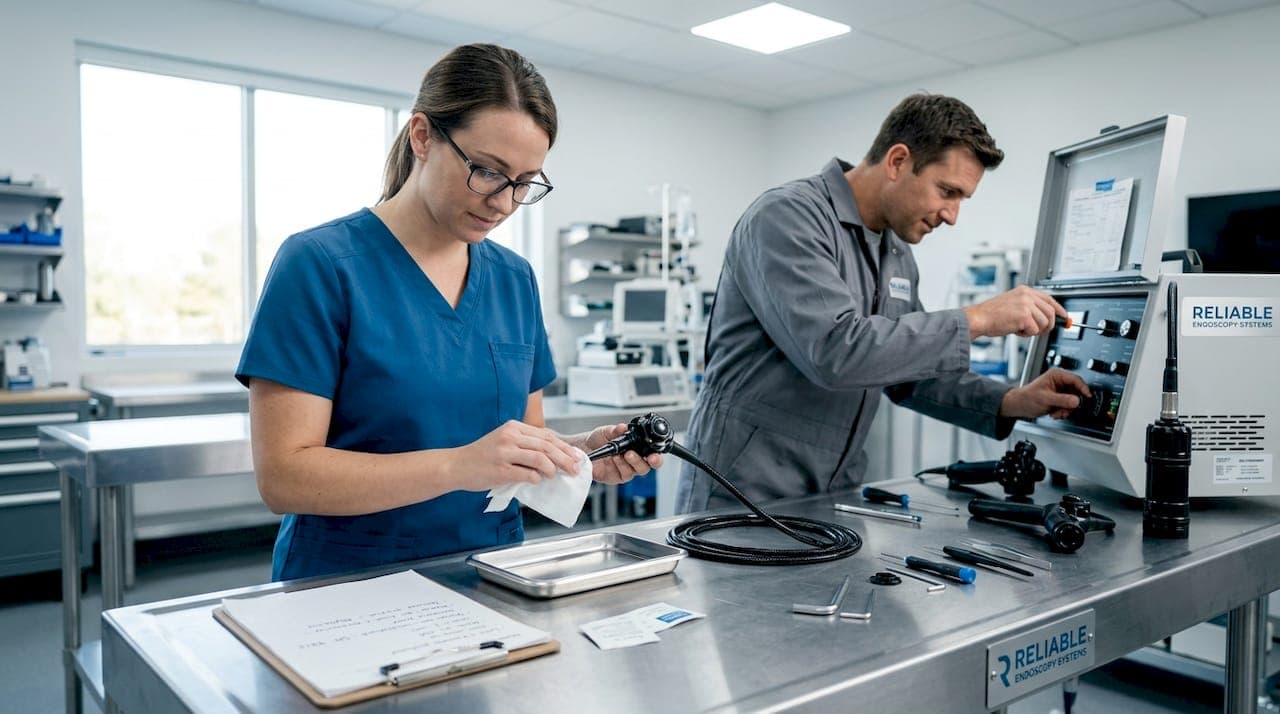
Inspection cameras can save an animal's life one hour and prevent a catastrophic machinery failure the next, yet the technology operating under both scenarios demands entirely different design philosophies, operator skill sets, and validation frameworks. Most professionals assume that a camera capable of peering inside a turbine engine is just a few millimeters away from one suited for equine airway evaluation. That assumption leads to poor purchasing decisions, diagnostic errors, and overlooked safety hazards. Understanding what truly separates these two worlds gives veterinary clinicians and industrial technicians the edge they need to select the right tool, apply it correctly, and trust their results.
Table of Contents
- Defining inspection cameras in veterinary and industrial contexts
- Unique demands and constraints: Veterinary vs. industrial scenarios
- Benchmarking and validating advanced inspection camera solutions
- Actionable best practices and future developments
- What most practitioners miss about inspection camera technology
- Explore advanced inspection camera solutions with 1800Endoscope.com
- Frequently asked questions
Key Takeaways
| Point | Details |
|---|---|
| Role divergence | Inspection cameras serve distinct purposes and must address unique constraints in veterinary and industrial settings. |
| Technique matters | Operator skill and procedural choices influence imaging reliability and diagnostic success. |
| Evidence-based validation | Advanced camera solutions should be rigorously validated using statistically significant benchmarks. |
| Practical tips | Following best practices ensures greater diagnostic accuracy and operational safety. |
| Future outlook | Emerging trends like AI integration are shaping next-generation inspection camera opportunities. |
Defining inspection cameras in veterinary and industrial contexts
Inspection cameras are specialized optical instruments designed to visualize spaces that are otherwise inaccessible to the naked eye. Beyond that shared purpose, the two fields diverge sharply in terms of what the camera must do and what it must avoid doing.
In veterinary medicine, the camera enters a living biological environment. Tissue safety is non-negotiable. The insertion tube must be flexible enough to navigate a trachea, a colon, or a uterine horn without causing trauma. The outer materials must be biocompatible, capable of withstanding repeated chemical sterilization, and sized to pass safely through an animal's natural orifices or a small surgical port. Working channels for biopsy forceps, lavage fluid, and suction add mechanical complexity. Anesthesia depth, patient positioning, and physiological monitoring all interact with how the camera is used during a procedure. As veterinary endoscopy literature notes, these constraints shift the entire design logic from tissue safety and working channels to illumination, access geometry, and measurement fidelity depending on the context.
Industrial inspection cameras, by contrast, operate in metal pipes, engine compartments, weld seams, and turbine blades. Their constraints are mechanical and optical rather than biological. Key requirements include:
- High-output LED illumination to reveal surface defects in dark, enclosed metalwork
- Articulating tips that can navigate 90-degree or tighter bends inside machine components
- Measurement overlays for quantifying crack length, pit depth, or wall erosion
- Rugged housings rated for exposure to oils, coolants, and high-temperature surfaces
- Sufficient working length to reach inspection zones inside large industrial assemblies
A portable veterinary endoscope and an industrial borescope may look superficially similar on a product page, but their design priorities are separated by the fundamental difference between a living patient and a steel structure.
"The same 'inspection camera' concept behaves differently across veterinary and industrial use because constraints shift from tissue safety, working channels, and anesthesia management to illumination, access geometry, and measurement fidelity." This distinction is what drives every procurement and protocol decision.
Browsing a rigid endoscopy catalog alongside an industrial videoscope catalog side by side makes this divergence immediately obvious. Diameter tolerances, shaft rigidity, and tip articulation angles serve completely different masters in each domain.
Unique demands and constraints: Veterinary vs. industrial scenarios
Having defined the basics, we can now explore the contrasting demands and operational realities shaping how inspection cameras are deployed in veterinary and industrial contexts.
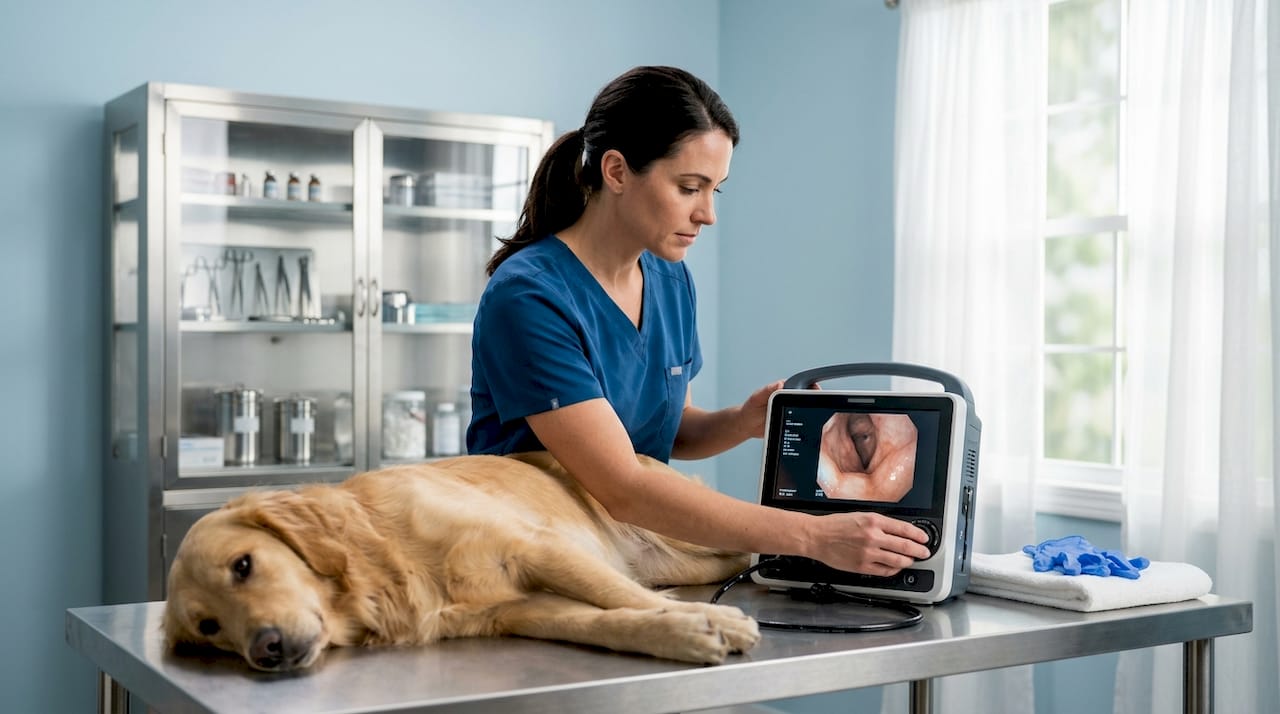
Real-time visualization is a foundational strength of inspection cameras in both fields, but it comes with important caveats in each. In veterinary settings, real-time visualization is valuable but does not guarantee objectivity. Operator technique and sampling decisions directly influence what gets seen and what gets missed. A clinician performing small animal respiratory endoscopy may pass by a subtle mucosal lesion if the tip is advanced too quickly or if the field of view is partially obscured by secretions. The camera records what the operator points it at. Clinical training, procedural protocols, and systematic organ-by-organ examination patterns are what bridge the gap between equipment capability and diagnostic accuracy.
Industrial inspection reliability faces a parallel challenge. Image quality factors including lighting angle, working distance, and surface texture all affect whether a defect registers clearly. A corroded weld bead photographed with a direct axial light source may appear nearly defect-free, while angled side-lighting reveals clear discontinuities. Whether a crack measurement meets or fails an acceptance criterion can hinge on these subtle setup decisions.
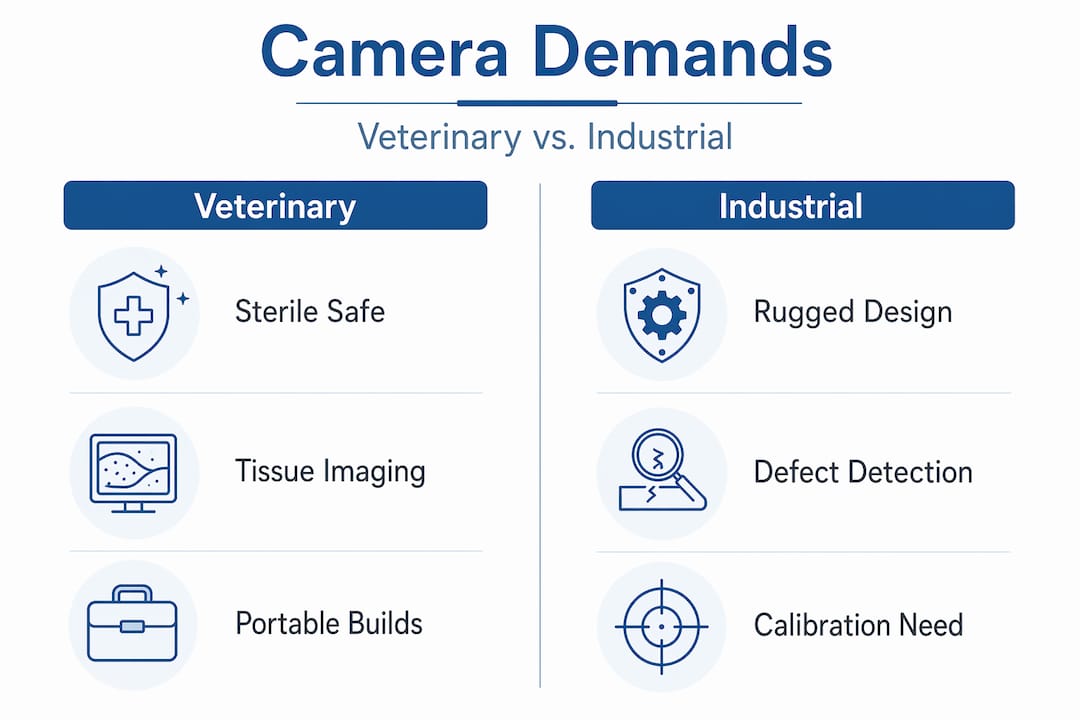
Here is a direct comparison of core operational demands:
| Factor | Veterinary use | Industrial use |
|---|---|---|
| Primary safety concern | Tissue integrity, sterility | Worker safety, structural failure prevention |
| Camera material requirements | Biocompatible, sterilizable | Oil-resistant, heat-tolerant |
| Working channel need | Required for biopsy, lavage | Rarely needed |
| Lighting approach | Diffuse, tissue-adapted LED | High-intensity directional LED |
| Measurement priority | Lesion size, mucosal appearance | Defect depth, crack length |
| Operator skill focus | Anatomical navigation, sampling technique | Positioning, illumination angle control |
| Validation benchmark | Clinical outcome correlation | NDT acceptance criteria compliance |
Practical procedural steps differ just as sharply. When using an equine dental inspection camera, for instance, a systematic approach should include:
- Confirm anesthesia depth and patient stability before scope insertion
- Irrigate the oral cavity to clear food debris that would obscure visualization
- Systematically examine all tooth surfaces from a consistent distance
- Document abnormal findings with still images and video clips before any intervention
- Record the date, scope ID, and operator name in the patient record to support longitudinal comparison
In industrial inspections, a comparable sequence includes pre-inspection calibration, documented illumination settings, and measurement verification against reference standards.
Pro Tip: In veterinary endoscopy, resist the urge to advance the scope faster when the field of view looks clear. Paradoxically, rapid advancement through apparently normal tissue is exactly when small polyps, fistulae, or early inflammatory lesions get missed. Slow, deliberate navigation yields better diagnostic returns.
Consulting inspection camera FAQs before a procedure or industrial job is a practical way to verify scope compatibility, cleaning protocols, and accessory requirements before you are in the field.
Benchmarking and validating advanced inspection camera solutions
With a clear grasp on use requirements, the next challenge is ensuring advanced camera solutions are properly evaluated and validated for clinical or industrial reliability.
The endoscope and borescope markets have seen rapid integration of AI-assisted defect detection, automated measurement overlays, and image enhancement algorithms. These tools can genuinely improve diagnostic sensitivity, but only when their performance claims are grounded in rigorous validation. When evaluating next-generation inspection camera systems, especially those with AI-driven detection features, performance claims must consider statistical significance rather than relying solely on point metrics like AP50 (a single accuracy threshold common in object detection benchmarks).
What does this mean in practice? A camera vendor might claim their AI model achieves 92% detection accuracy. But that number means very little without knowing the dataset size, the variance of results across different lighting conditions and defect types, and whether the model was tested on data it had never seen before. A statistically robust evaluation reports confidence intervals, tests on diverse sample populations, and demonstrates that accuracy holds across the real-world range of inspection conditions you will encounter.
The following table outlines key validation criteria that purchasing professionals should apply when assessing advanced inspection camera solutions:
| Validation criterion | Why it matters | Red flags to watch for |
|---|---|---|
| Dataset size and diversity | Small datasets produce inflated accuracy figures | Fewer than 500 test samples in AI claim |
| Statistical significance testing | Confirms results are not due to chance | No confidence intervals reported |
| Cross-condition performance | Real-world lighting varies; accuracy must hold | Single lighting setup in test protocol |
| Clinical or NDT correlation | Outcomes must link to real diagnostic/structural decisions | Bench testing only, no field validation |
| Operator independence | Results should not vary dramatically by user | No inter-rater reliability data |
A practical checklist for benchmarking camera technology before purchase should include:
- Request independent third-party validation data, not just manufacturer test reports
- Ask for performance results stratified by defect size, tissue type, or material composition
- Verify that the AI training set did not include the same samples used for accuracy testing
- Confirm that the camera's physical optics meet your minimum resolution and field-of-view requirements independently of any software enhancement
- Check validation FAQs or request a demo under your specific operating conditions
This level of scrutiny might seem excessive for a camera purchase, but in both veterinary diagnostics and industrial NDT (non-destructive testing), a false negative is not just a missed data point. It is a missed lesion or an undetected crack that continues to grow until it causes a serious outcome.
Actionable best practices and future developments
To bridge evidence with practice, let's outline actionable tips and future-proof strategies for maximizing the value of inspection camera technology.
Proper device selection is foundational. The right field inspection videoscope for a pipeline inspection has a very different specification profile than the right scope for evaluating a cat's lower airway. Diameter, working length, tip articulation range, and accessory compatibility must all be matched to the specific anatomy or structure you are inspecting. Choosing a scope that is even one millimeter too wide for a small animal patient creates real trauma risk. Choosing a borescope with insufficient illumination for a dark turbine cavity means defects will be invisible regardless of image resolution.
Best practices for both fields converge on several universal principles:
- Match scope diameter to access geometry before purchasing or deploying any camera
- Standardize image capture protocols so that follow-up inspections can be directly compared to baseline images
- Maintain detailed records including operator identity, scope ID, date, and procedural settings
- Clean and inspect the insertion tube before every use to detect wear, fluid ingress, or optical degradation that would compromise image quality
- Calibrate measurement tools against known reference standards before any session where dimensional data will drive a clinical or structural decision
The endoscope systems catalog is a practical starting point for matching these specifications to specific product options across both veterinary and industrial lines.
Future developments in this space are converging around three themes. First, AI-assisted real-time defect and lesion flagging is moving from research into commercial products, but adoption should remain evidence-gated as discussed above. Second, wireless and USB-connected videoscopes are reducing the equipment footprint for both field industrial inspections and portable veterinary use, which has meaningful implications for equine field work and remote industrial sites. Third, enhanced visualization modes including narrow-band imaging for veterinary mucosal assessment and 3D measurement overlays for industrial defect sizing are raising the standard for what "thorough inspection" means in both fields.
Pro Tip: As AI-assisted visualization tools become more prevalent, your most durable professional asset is not familiarity with any single software platform. It is the systematic procedural knowledge that lets you recognize when a tool is giving you a false result and correct for it. Hardware changes fast. Diagnostic judgment accumulates slowly and compounds over years.
What most practitioners miss about inspection camera technology
The most common misconception among both veterinary clinicians and industrial technicians is that upgrading to a newer or more expensive camera is the primary lever for improving diagnostic or inspection outcomes. The evidence does not support this as a standalone strategy.
Real-time visualization is valuable but does not guarantee objectivity. As dvm360 research clearly articulates, operator technique and sampling decisions influence outcomes in veterinary settings, while industrial inspection reliability can still hinge on image quality factors like lighting, working distance, and surface texture. A clinician with a $600 portable scope who follows a rigorous, systematic examination protocol will consistently outdiagnose a less disciplined operator using a premium HD system. Similarly, an industrial technician who understands lighting geometry and takes the time to position the borescope tip at the correct angle will find defects that a faster, more casual operator misses on the same equipment.
This matters for how you invest your professional development budget. Spending time mastering examination technique, studying normal anatomical or structural baselines, and building systematic protocols delivers compounding returns that no hardware upgrade can replicate on its own. The dental camera insights available for equine dental work are a useful example: the value is not just in the camera resolution but in the trained eye that knows what tooth resorption, enamel fractures, and periodontal pocketing look like at various stages.
There is also a validation gap that most practitioners accept too passively. New systems, especially AI-enhanced models, arrive with performance data that has rarely been stress-tested against the specific patient populations, lighting conditions, or defect categories that a given clinic or inspection firm actually encounters. Demanding field-representative validation data is not bureaucratic caution. It is basic professional due diligence. The practitioners who build this habit are the ones who avoid purchasing equipment that performs brilliantly in vendor demonstrations and falls short in day-to-day clinical or industrial reality.
Explore advanced inspection camera solutions with 1800Endoscope.com
The evidence and best practices reviewed throughout this article point toward one practical conclusion: the right camera, properly matched to your specific application and operated with disciplined technique, is a genuinely powerful tool for both diagnostic and industrial work.
At 1800Endoscope.com, you will find a broad catalog of solutions built for exactly these professional demands. The portable airway endoscope is a strong option for small animal respiratory and GI work, combining portability with clinical-grade optics. For equine field diagnostics, the equine airway inspection videoscope delivers the working length and tip flexibility that large animal practitioners need. And for facilities that need a full range of procedure-specific tools, the rigid endoscopy options catalog covers laparoscopy, cystoscopy, arthroscopy, and more. Every product is supported by knowledgeable staff who understand both the veterinary and industrial sides of endoscopic inspection.
Frequently asked questions
What makes veterinary inspection cameras different from industrial cameras?
Veterinary inspection cameras are designed for tissue safety and biocompatibility, including sterilizable materials and working channels for biopsy instruments, while industrial cameras prioritize rugged construction, high-intensity illumination, and dimensional measurement overlays for structural defect analysis.
How do operator techniques affect outcomes in veterinary endoscopy?
Operator technique and sampling decisions directly influence what is visualized and documented, meaning a systematic, unhurried examination protocol is as critical to diagnostic accuracy as camera resolution.
Why is statistical significance important when validating new inspection camera technologies?
Statistical significance ensures that accuracy claims for AI-enhanced systems hold across diverse real-world conditions and are not inflated by small, non-representative test datasets or single-threshold metrics like AP50.
What best practices should technicians follow when using inspection cameras?
Technicians should match scope specifications to access geometry, standardize image capture and record-keeping protocols, and verify measurement calibration before any inspection session where dimensional data will drive acceptance or rejection decisions.
Recommended
- Equine Dental Inpection Videoscope
- FULLY PORTABLE 6mm X 150 AIRWAY INSPECTION DIRECT MONITOR SD CARD VIDEO AFFORDABLE LOW COST ENDOSCOPE ENDOSCOPY SYSTEM!
- Medical Veterinary Endoscope Endoscopy Systems, Light Sources, Accessories, Industrial NDT Borescopes
- Medical Veterinary Endoscope Endoscopy Systems, Light Sources, Accessories, Industrial NDT Borescopes