
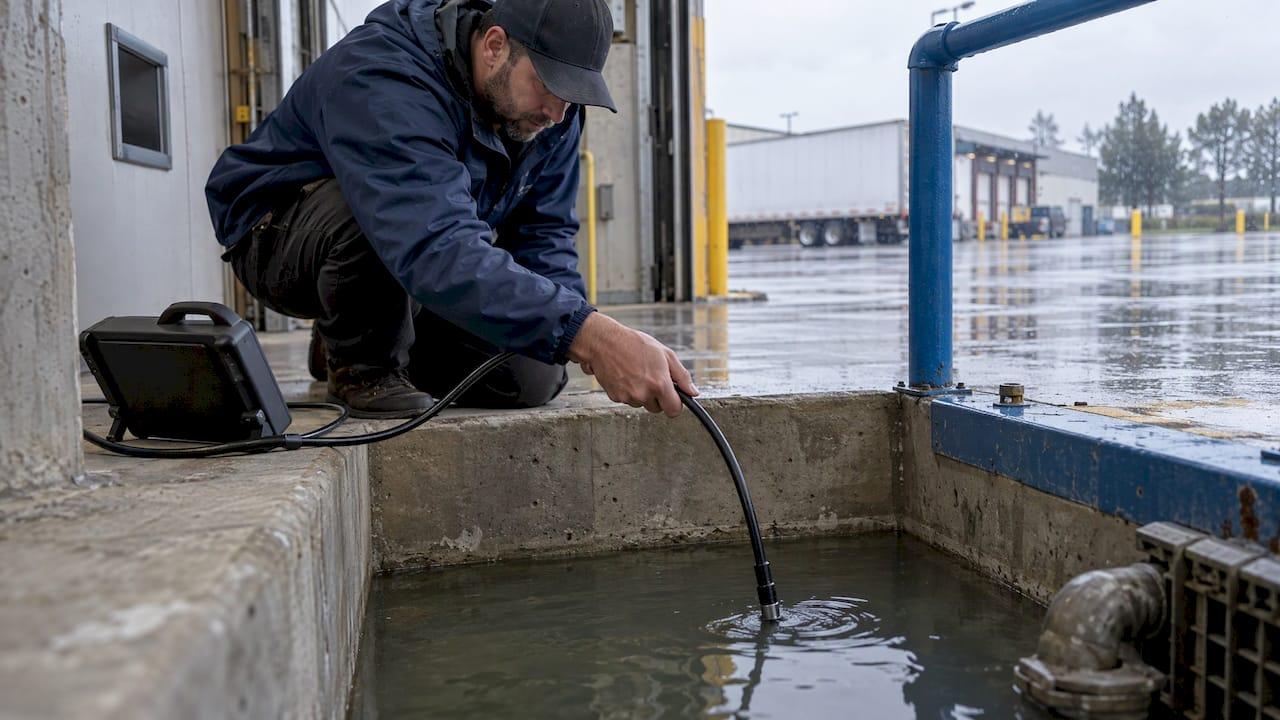
A waterproof borescope is built to be put into water. A weatherproof one is built to be used outdoors or in damp air, where it will see rain, spray, dust and humidity but is not meant to go under. The words carry no fixed definition on a product page. The only way to know what a scope survives is the IP code, what part of the instrument it covers, and how that matches your inspection. Check all three before you buy for a clinic, a plant or a field crew.
This guide is for veterinary teams, industrial inspection technicians, NDT firms and procurement managers who have to decide which scope to specify. It explains the two terms, the IP digits, the parts of a scope a rating usually leaves out, and how to compare a spec sheet with real conditions.
TL;DR
- "Waterproof" suggests immersion and "weatherproof" suggests rain, splash and dust. Neither word is a rating. The IP code is the number to read.
- In an IP code the first digit covers dust and the second covers water. IP67 means dust-tight and a short immersion test. IP68 means longer immersion under conditions the manufacturer sets.
- On most borescopes the rating applies to the probe tube, not the monitor, battery compartment or connectors.
- IP tests use clean fresh water. Oils, coolants, salt water, heat and disinfectants are separate questions.
- A water rating says nothing about whether a scope can be disinfected or sterilized between animals. That depends on the reprocessing instructions for the instrument.
Table of Contents
- Waterproof vs weatherproof: the practical difference
- Reading the IP code on a borescope
- Why a US buyer may also see NEMA ratings
- What the rating actually covers: probe, not system
- What water ratings do not test
- Veterinary use: water rating is not a disinfection rating
- Matching the scope to the job
- Care that keeps a seal working
- Our perspective
- Find the right scope for your conditions
- FAQ
- Sources
Waterproof vs weatherproof: the practical difference
Think of it as a question of what the water does. Weatherproof describes exposure: rain on a horse barn doorway, spray on a loading dock, condensation inside a duct, dust on a job site. Water arrives, but the instrument is not sitting in it. Waterproof describes submersion: a probe pushed into a flooded line, a tank, a drain or a sump.
A scope sold as weatherproof may handle splashes well and still fail when dunked. A scope sold as waterproof may handle a dunk and still have a monitor that cannot tolerate a spray. The vocabulary on listings is loose, which is why a technician should translate it into a code.
The code is defined in the IEC 60529 standard. According to Element's explainer on IEC 60529 and NEMA 250, the first IP digit rates protection against solids, where 6 is total dust protection, and the second rates protection against liquids. That gives you a common language, whatever adjective the seller used.
Reading the IP code on a borescope
An IP code such as IP67 is two separate tests printed together. The first digit is dust. The second is water. They are independent, so you read them one at a time.
| Code | Dust | Water | What it means in the field |
|---|---|---|---|
| IP65 | Dust-tight | Water jets | Hosing down or heavy spray. No immersion. |
| IP67 | Dust-tight | Temporary immersion | A short dunk, then out. |
| IP68 | Dust-tight | Continuous immersion, set by the maker | Longer submersion, only within the stated depth and time. |
| IP69K | Dust-tight | High-pressure, high-temperature jets | Wash-down and steam cleaning. Not necessarily submersible. |
The definitions in the table follow Mouser's ingress protection reference. Two details matter when you buy.
IP67 has a defined limit. Element's explainer describes IP67 as protection against immersion from 15 cm to 1 m for up to 30 minutes. The Akermin technical article on IP67 describes the test in more detail: one sample, 30 minutes, still fresh water at controlled temperature, lowest point 1 m down, with no mechanical load or vibration. It also makes the point that the pass means no harmful quantity of water got in, which is a different statement from "safe to work submerged all shift."
IP68 is set by the manufacturer. Per Banner Engineering's guide to IP and NEMA ratings, 8 means continuous immersion under conditions the manufacturer sets, and those conditions are more severe than the level-7 test. Two IP68 scopes can therefore be rated for different depths and durations. Ask for the depth and the time in the spec, not just the code.
There is a trap in the higher numbers. Banner notes that a higher rating does not necessarily include the lower ones, so an IP69K unit may not be submersible. Akermin makes the same point about IP67: passing the immersion level does not imply passing the jet levels. That is why some products carry dual marks such as IP65/IP67. If a scope will be both sprayed and dunked, look for both.
Why a US buyer may also see NEMA ratings
In the United States you may see NEMA ratings on enclosures, docks and housings around the equipment, such as a charging station or a transport case. Gore's comparison of IP and NEMA ratings lists NEMA 6 alongside IP67 and NEMA 6P alongside IP68, but says the two systems cannot be converted. NEMA 250 adds requirements for corrosion, gasket aging, oil, icing and mechanical impact. In practice, a borescope's IP number tells you about dust and water ingress. It does not certify the full environmental durability a NEMA rating would.
What the rating actually covers: probe, not system
This is the point that causes most disappointment. Akermin notes that on most borescopes the IP rating covers only the probe tube, not the whole system. A monitor-type videoscope has a screen, a battery compartment, an SD-card slot and connectors. A scope with a waterproof probe can still have a handpiece that must stay dry.
So when a listing says waterproof, ask which parts:
- The probe tube and its insertion length.
- The distal tip, including the lens window and its seal.
- The connector between probe and handpiece.
- The monitor, battery door, USB or card port.
- Any wireless module or phone adapter.
The Supertek checklist for choosing a borescope asks the same: confirm whether sealing is the probe head only or the entire device, including the screen, battery compartment and connectors, and whether the connector or a phone adapter will be near water. It gives an example of this logic in practice from a Cal-Van manual, which limits its IP67 camera and cable to 3 feet of depth for no more than 5 minutes. That is a tighter statement than the code alone, and it is the one the operator should follow.
What water ratings do not test
The test water is clean, fresh and neutral. FastFixer's pro guide on waterproof borescopes points out that IP tests do not account for automotive fluids or industrial coolants. It also says that salt water should be rinsed off promptly so crystals do not form on seals, and that pressure at depth can compress gaskets and O-rings while heat can soften the adhesive on lens covers. Treat these as reasons to read the manufacturer's limits, not as exceptions to the code.
For an industrial inspector the practical list is:
- Oils, fuel and coolant. Water resistance and chemical resistance are separate specs. Our guide to oil-resistant borescope cleaning covers safe methods and the common mistakes.
- Temperature. A warm radiator or a heated process line is a different test from a room-temperature tank.
- Pressure. A deep, pressurized tank is beyond an immersion test at 1 m.
- Abrasion. Sewer and drain work scrapes the probe and lens. See our practical guide to lens scratch prevention.
If your environment combines several of these, the spec for the environment matters more than the headline code. For a wider view of how enclosures and switches are protected in harsh conditions, this explainer on IP-rated protection for harsh environments shows how ratings are applied to the control surface of equipment.
Veterinary use: water rating is not a disinfection rating
A veterinarian doing an internal exam, an airway scope on a horse or a gastroscopy on a dog, has a second question that the IP code does not answer: how the instrument is cleaned between patients. Waterproof construction helps with rinsing and wet cleaning, but it does not tell you which disinfectants or sterilization methods the scope tolerates. That comes from the manufacturer's reprocessing instructions for the specific instrument. Follow them, and treat an IP rating as a statement about water ingress only.
Our veterinary endoscopy sterilization guide and the step-by-step sterilization walkthrough cover the routine for clinics. For the days when the scope goes out of the clinic to a barn or a trailer, our notes on how to store endoscopic equipment cover drying and storage so seals stay in good shape.
Matching the scope to the job
Start from the exposure, not the label. Here is how that plays out for the readers of this page.
Equine and large-animal field work. The scope travels, the setting is dusty and damp, and the probe is cleaned with water. Dust protection (the first digit) and a sealed probe matter, and the monitor is usually kept dry. A portable monitor-type system fits this: for example the equine 8 mm airway inspection field scope and the fully portable 9.5 x 150 airway inspection videoscope are built around SD-card recording in the field.
Clinic gastroscopy and rigid scopes. The challenge is cleaning, not weather. Look at the reprocessing instructions first. Our rigid scopes, arthroscopes and otoscopes page lists those options.
Pipe, drain and tank inspection. Here the probe goes into water, so the second digit and the depth and time limits matter, along with cable stiffness and tip durability. Our borescopes page lists monitor-type SD-card videoscopes, portable pipe inspection videoscopes and micro fiber borescopes.
Engine bays, ducts and machinery. Water is a smaller concern than oil, heat and tight bends. A micro fiber borescope is the usual tool, and the chemical and temperature limits drive the choice.

A quick specification test
Before ordering, write one line for each of these and compare it with the spec sheet:
- The deepest and longest immersion the job requires, in feet and minutes.
- Which liquids touch the probe, and at what temperature.
- Whether the monitor or connector could be splashed.
- How the scope is cleaned afterward, and what the manufacturer allows.
- Whether you need a dual rating for spray and immersion.
If the job needs 10 minutes at 2 feet and the scope is limited to 5 minutes at 3 feet, the answer is clear without any argument about words.
Care that keeps a seal working
A rating describes a new sample. Seals age, and a scope that has been bent, dropped or scratched at the tip has not been tested in that state. Good habits protect the rating:
- Inspect the lens window and tip before each use, as in our inspection prep best practices.
- Rinse after salt water, and dry before storage.
- Keep caps and ports closed on any compartment the rating does not cover.
- Keep the battery charged and the compartment closed. Our borescope battery life guide explains what shortens run time in the field.
- If a video feed drops or the image fogs, work through our videoscope troubleshooting guide before assuming the unit has failed.
Fogging or moisture inside the tip after a dunk is a seal problem. A scope in that state should be taken out of service until it has been checked.
Our perspective
We hear the same question from clinics and inspection crews: which scope can take the conditions? Our answer is to describe the conditions first and read the code second. A scope that suits a horse's airway at a barn, a drain line, or a turbine casing is a different instrument in each case, and the words waterproof and weatherproof do not sort them.
That is why we organize our catalog by use: veterinary flexible and rigid scopes, portable monitor-type videoscopes, pipe inspection videoscopes, micro fiber borescopes and the accessories that go with them. We position our equipment as high-resolution and portable at lower prices than traditional hospital-grade or human-use systems, with 24/7 support and rapid shipping, so a clinic or inspection firm can equip several rooms or crews instead of one.
When you are unsure what a given scope can do, ask us before you order. We can go through your exposure list with you and point you to the right model, and we also offer endoscope repairs when a scope has been through hard use.
Endoscope
Find the right scope for your conditions
We sell veterinary and industrial endoscopes, videoscopes and borescopes, plus light sources, valves, pumps, cleaning tools and biopsy forceps. Start with the borescopes and videoscopes page for industrial and pipe work, or the veterinary endoscopy equipment page for clinic and field systems. If you already own a scope that needs attention, our endoscope repair service is listed there too.
For questions about which model fits your inspection, our endoscopy FAQ and inspection procedures page is a good place to begin. You can also compare the types of videoscope applications for veterinary and industrial use.
FAQ
Is IP67 or IP68 better for a borescope?
IP68 is built for longer or deeper immersion than IP67, but the conditions are set by the manufacturer, so two IP68 scopes can differ. IP67 covers immersion from 15 cm to 1 m for up to 30 minutes. Choose by the depth and time your job needs, and read the stated limits.
Does a waterproof rating cover the whole borescope?
Usually not. On most borescopes the rating covers the probe tube, while the monitor, battery compartment and connectors may need to stay dry. Check which parts the maker lists as sealed before taking a scope near water.
Can I disinfect or sterilize a scope because it is waterproof?
No. A water rating tells you about water ingress, not which disinfectants or sterilization methods a scope tolerates. Use the reprocessing instructions for the specific instrument, and see our sterilization guide for the clinic routine.
Can a waterproof borescope be used in oil, coolant or salt water?
The IP test uses fresh water at neutral temperatures, so it does not cover these liquids. Check the manufacturer's chemical and temperature limits for your fluid. After salt water, rinse the scope promptly so crystals do not build up on the seals.
What does weatherproof mean on a borescope listing?
It usually points to protection from rain, splash and dust rather than immersion. Because it is not a rating, ask for the IP code and the parts it covers.
Sources
- Element: Electrotechnology enclosure testing, IEC 60529 and NEMA 250
- Banner Engineering: How To Use IP & NEMA Ratings To Choose The Right Sensor
- Mouser: Ingress Protection, Where and Why it Matters
- Gore: IP & NEMA Ratings, What They Mean for Enclosures
- Akermin: What IP67 Permits and Why Soaking a Probe Is Outside It
- FastFixer: What to Look for in a Waterproof Borescope
- Supertek: Best Endoscope Camera (Borescope) 2026 Spec Checklist
- A Guide to IP-Rated Membrane Switches for Harsh Environments