
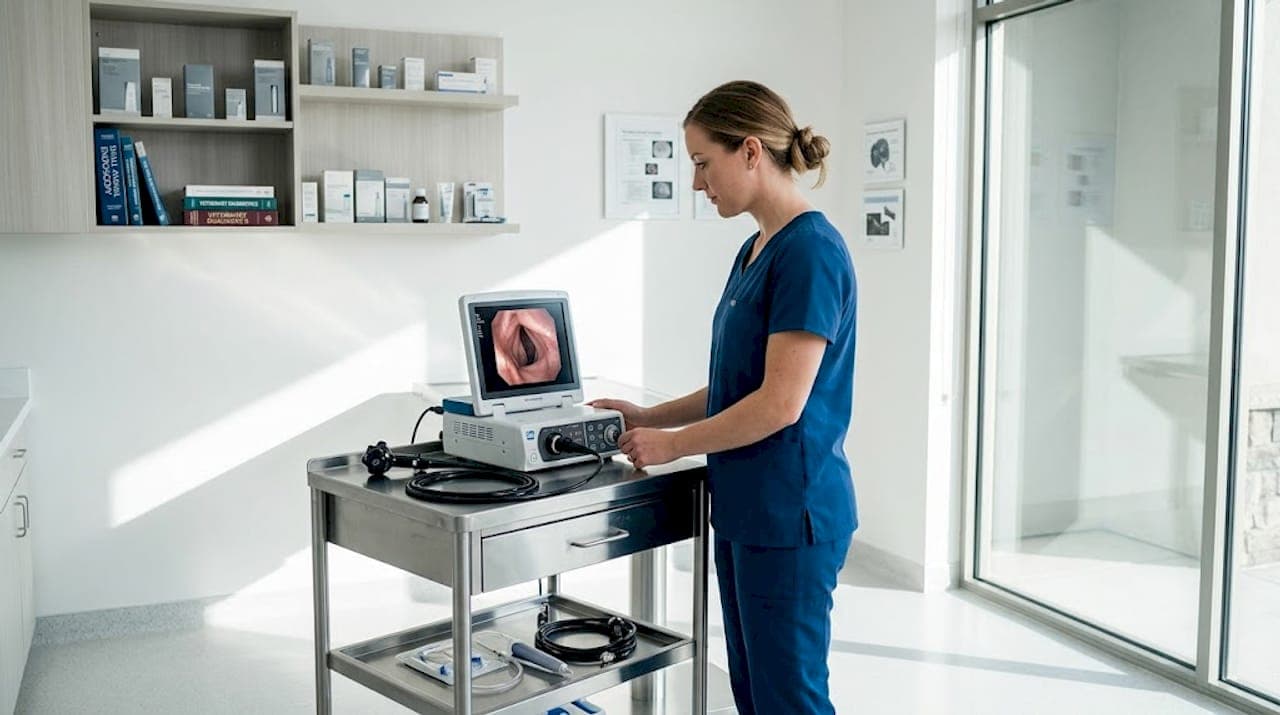
Selecting the right videoscope is not a casual equipment decision. Whether you're scoping a horse's airway before surgery or inspecting a turbine blade after 10,000 flight hours, the wrong tool means missed findings, damaged equipment, or failed procedures. The types of videoscope applications span two demanding worlds: veterinary diagnostics and industrial inspection, each with non-negotiable technical requirements. This guide breaks down what separates a good choice from a costly mistake, covering probe selection, articulation types, use-case specifics, and the operational details that experienced technicians rarely share in product spec sheets.
Table of Contents
- Evaluating key criteria for types of videoscope selection
- Veterinary videoscope applications: diagnostic and surgical uses
- Industrial videoscope applications: maintenance, quality control, and safety inspections
- Comparing videoscope types and articulation features
- Making the right videoscope choice for veterinary and industrial needs
- A nuanced view: overlooked factors and practical wisdom in videoscope use
- Explore tailored videoscopes for your veterinary and industrial needs
- Frequently asked questions
Key Takeaways
| Point | Details |
|---|---|
| Probe diameter matters | Choosing the right probe diameter ensures access and effective navigation in confined spaces. |
| Articulation affects precision | 2-way articulation suits simple paths, while 4-way offers comprehensive viewing for complex inspections. |
| Applications vary | Veterinary uses focus on minimally invasive diagnostics, industrial uses cover maintenance and quality control. |
| Maintenance extends lifespan | Thorough cleaning and proper storage prevent failures and contamination in videoscopes. |
| Videoscopes boost inspection quality | High-definition imaging and maneuverability enhance diagnostic accuracy and asset integrity assurance. |
Evaluating key criteria for types of videoscope selection
Before matching a videoscope to an application, you need to understand the variables that determine whether a scope can even do the job. The criteria are not interchangeable. What works in a canine GI exam will fail in a gas pipeline. Start with these four parameters.
Probe diameter is the single most constraining spec. Go too large and you can't access the cavity. Go too small and you sacrifice light output and image quality. HD videoscopes with probe diameters from 1.0mm to 8.0mm cover 95% of industrial applications, from aerospace fuel lines at 1 to 2.8mm to infrastructure pipes requiring 8mm probes over 10 meters. That same range applies broadly in veterinary work, where a 2.8mm scope might suit feline airway exams and a 9mm scope handles large-animal GI procedures.
Articulation capability directly affects how much of a cavity you can inspect. Two-way articulation steers the tip up and down, which is adequate for straight-to-curved paths. Four-way adds left/right control, which becomes essential when you're navigating a weld joint in a pressure vessel or rounding the pyloric sphincter in a dog's stomach. The difference between 2-way and 4-way is not a luxury upgrade. It's an access question.
Image resolution and lighting determine whether you actually detect what you're looking for. HD and 4K sensors paired with high-output LED illumination are no longer optional in professional settings. A blurry image in a gas turbine inspection or a washed-out view during a dental exam creates liability, not findings.
Environmental sealing separates field-grade tools from lab tools. An IP67 rating means the scope can withstand immersion up to one meter for 30 minutes, which matters in oil and gas, food processing, and any application where fluids or debris are present. For veterinary and industrial endoscopy systems, IP67 is typically the minimum threshold worth considering for regular clinical or field use.
- Match probe diameter to the smallest access point in the inspection path
- Confirm articulation type before purchasing for complex or multi-angle applications
- Verify IP rating against the harshest environment the scope will encounter
- Check whether the scope supports video recording, which is essential for documentation and QA
Pro Tip: Always test articulation range with the probe at full insertion depth, not just at the handle. Stiffness increases with insertion length, and some scopes that articulate freely at 20cm lock up at 150cm.
Veterinary videoscope applications: diagnostic and surgical uses
Veterinary professionals depend on videoscopes for procedures where open surgery would be unnecessarily invasive, recovery would be prolonged, or the anatomy simply can't be assessed any other way. The three primary categories are gastrointestinal, airway, and dental, each requiring different scope geometry and features.
Gastrointestinal endoscopy is the dominant use. Gastrointestinal endoscopes account for 73.5% of veterinary endoscopic procedures in 2025 and 2026, with procedures typically lasting 20 to 45 minutes under anesthesia. In dogs and cats, gastroscopy allows direct visualization of the esophagus, stomach, and proximal duodenum for biopsy, foreign body retrieval, and diagnosis of inflammatory bowel disease. Scope diameter here typically runs 6 to 9mm for medium to large dogs, and 5 to 6mm for cats and small breeds.
Airway endoscopy requires longer, thinner profiles and is particularly critical in horses. Equine upper airway examinations before and after exercise detect conditions like dorsal displacement of the soft palate and recurrent laryngeal neuropathy, conditions that simply cannot be assessed reliably any other way. A portable veterinary airway endoscope with a 1-meter working length and 5mm diameter covers most small-animal respiratory work. For horses, an equine airway inspection videoscope with 2-meter reach and sufficient image quality for recording is the standard.
Dental inspection is an area where videoscopes are underused despite clear diagnostic value. A dental examination videoscope allows visualization of subgingival pockets, tooth root surfaces, and oral lesions that a standard otoscope or dental probe misses entirely. In equine dentistry, periodontal pockets and diastemata can be assessed without the guesswork of blind probing.
- GI scopes: 5 to 9mm diameter, 4-way articulation, biopsy channel preferred
- Airway scopes: 3 to 5mm diameter, 1 to 2 meters working length, smooth insertion tip
- Dental scopes: compact, angled tip, high-brightness LED for intraoral clarity
- Species-specific sizing matters. A scope suitable for a Labrador is inappropriate for a ferret
Pro Tip: For equine treadmill endoscopy, wireless or long-cable recording capability is not optional. Standard tethered systems create drag on the scope and interference artifacts in the image. Choose scopes with onboard recording or extended cable lengths rated for movement.
Industrial videoscope applications: maintenance, quality control, and safety inspections
Industrial videoscope uses are as varied as the machinery being inspected, but several sectors define where these tools earn their keep most consistently.
Aerospace turbine inspection represents the highest technical demand. Turbine blades, combustion chambers, and fuel delivery channels require ultra-slim probes for engine inspection in the 1 to 2.8mm range to access passages without disassembly. Defects like tip oxidation, thermal fatigue cracking, and foreign object damage must be documented with HD clarity and often compared frame-by-frame to prior inspection records.
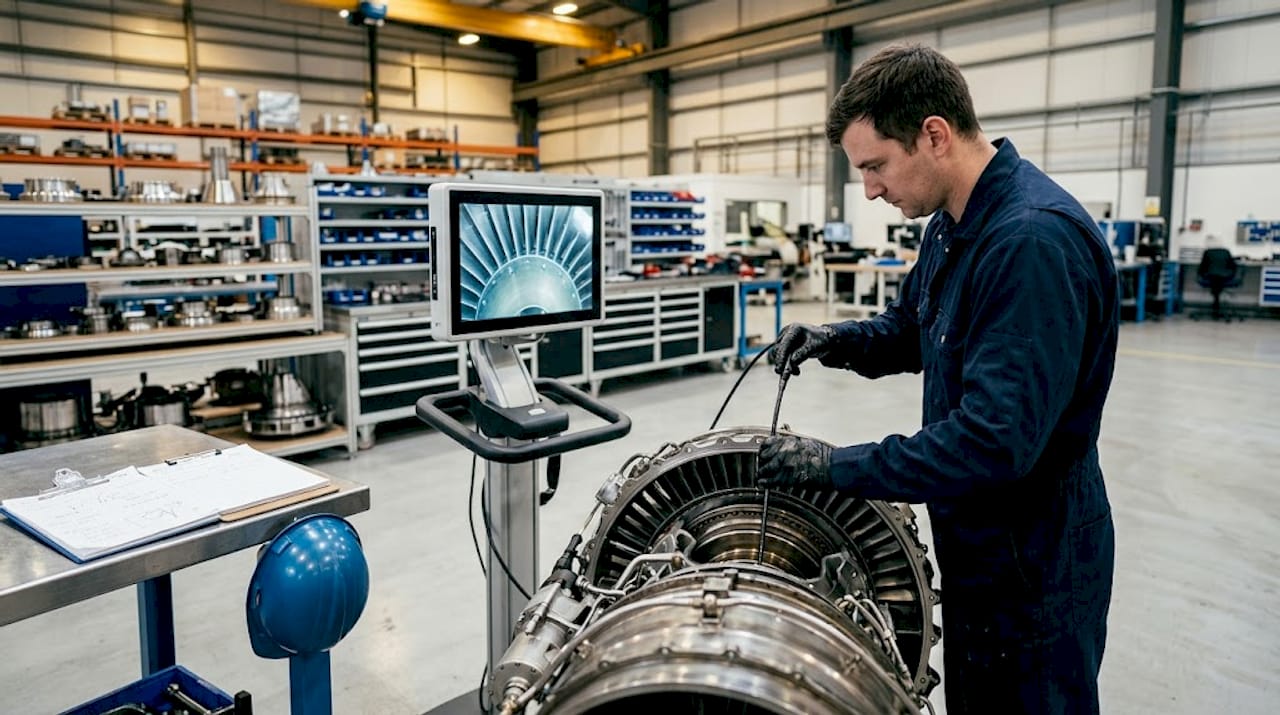
Weld inspection in pressure vessels and boilers is where articulated videoscopes have genuinely changed what's possible in the field. Videoscopes transform weld inspections by accessing confined spaces in pressure vessels and boilers to detect creep cracking early where traditional radiographic or dye-penetrant methods fail due to access limitations. Four-way articulation is essential here for viewing weld root profiles from multiple angles within a single insertion.
Oil and gas pipeline integrity demands rugged, IP67-rated scopes with tungsten-braided probes. The combination of mechanical abrasion, chemical exposure, and tight bend radii in pipeline risers is brutal on cheaper equipment. Probes without adequate braid protection fail significantly more often in this environment.
Pharmaceutical and food processing inspections have their own requirements. Hygienic design, smooth probe surfaces, and compatibility with approved disinfectants matter more than raw durability. The goal is detecting contamination, residue buildup, and seal failures in tanks, mixers, and processing lines without introducing new contamination.
| Application | Probe diameter | Articulation | IP rating | Key feature |
|---|---|---|---|---|
| Aerospace turbine | 1 to 2.8mm | 4-way | IP67 | HD/4K, compact tip |
| Pressure vessel welds | 4 to 6mm | 4-way | IP67 | Recording, measurement |
| Oil/gas pipeline | 6 to 8mm | 2 or 4-way | IP67+ | Tungsten braid, rugged |
| Food/pharma | 4 to 6mm | 2-way | IP67 | Hygienic surface, disinfection-compatible |
| Infrastructure (sewer/HVAC) | 6 to 8mm | 2-way | IP68 | Long reach, high brightness |
Browse the full videoscope catalog for industrial use and compare available borescope catalog and options to match your sector's requirements.
Comparing videoscope types and articulation features
Understanding the differences between rigid borescopes, flexible borescopes, and full videoscopes prevents the common mistake of buying the wrong category of tool entirely.
Rigid borescopes offer exceptional optical clarity because they transmit light through a solid rod lens system without signal loss. But they require a straight or nearly straight access path, which limits them to simple applications like inspecting cylinder bores or straight die cavities. They have no place in GI endoscopy or complex turbine work.
Flexible borescopes use fiber optic bundles that can navigate bends. Resolution is lower than videoscopes because the image is transmitted through thousands of individual glass fibers, and fiber breakage accumulates over time. They're lighter and less expensive, but they're not suitable when image quality drives clinical or safety decisions.
Industrial videoscopes use CCD or CMOS sensors at the probe tip, transmitting a digital video signal rather than an optical image. This means joystick articulation videoscopes set the gold standard for quantitative NDT over rigid borescopes, which are limited to straight paths. HD and 4K sensors combined with 4-way articulation make these the go-to choice for serious inspection work.
On articulation: 2-way articulation suits 70% of vertical pipe inspections, but 4-way unlocks 360-degree views around welds. The practical implication is that vertical inspections with predictable geometry can use simpler 2-way scopes, while anything requiring viewing across multiple planes needs 4-way control. And always lock the joystick after positioning to prevent image drift in vibration-heavy environments like running engines or active pipeline systems.
| Feature | Rigid borescope | Flexible borescope | Videoscope |
|---|---|---|---|
| Image quality | Excellent | Moderate | Excellent to outstanding |
| Flexibility | None | High | High |
| Articulation | None | Limited | 2-way or 4-way |
| Recording | No | No | Yes (HD/4K) |
| Best use | Straight cavities | Basic curved paths | Complex inspections |
| Cost | Low | Moderate | Moderate to high |
For procedures requiring high optical clarity in straight-path anatomy, veterinary rigid endoscopy scopes remain a practical option, particularly for joint examination and cystoscopy in smaller animals.
Pro Tip: If you're running inspections in environments with continuous vibration, 4-way joystick lock is not a minor feature. Without it, the probe tip wanders after positioning, and you lose your reference point before the image is captured or documented.
Making the right videoscope choice for veterinary and industrial needs
Knowing all the options is only useful if you apply them systematically. Here's a practical approach to selecting the right scope before committing to a purchase or rental.
- Define the access geometry. Measure the smallest access port diameter and the longest inspection path. These two numbers immediately eliminate most wrong choices.
- Identify the inspection objective. Detection, measurement, documentation, or intervention? Biopsy and retrieval require working channels. Measurement needs calibrated tip optics. Documentation needs onboard recording.
- Select articulation based on path complexity. Simple curves with predictable geometry: 2-way. Multiple planes, weld interiors, or gastrointestinal navigation: 4-way.
- Match environmental rating to the harshest condition. Don't rate the scope against average conditions. Rate it against the worst case. If there's any possibility of immersion or high-pressure washdown, IP67 is the floor.
- Build in a maintenance protocol before first use. Industrial technicians often overlook probe diameter matching, but probe care is equally neglected. Establish cleaning, drying, and storage procedures on day one.
- Follow cleaning protocols every time. Videoscopes fail 30% more often in oil and gas without IP67-rated tungsten-braided construction, and improper cleaning accelerates microbial growth during storage. Alcohol flushing of lumens after each use is non-negotiable in clinical environments.
Review the videoscope maintenance FAQ for detailed protocols, and if you're evaluating specialized scope configurations, the equine dental videoscope example illustrates how purpose-built designs differ from general-purpose scopes.
Pro Tip: Buy the maintenance kit at the same time as the scope, not after the first failure. Replacement tips, lens wipes, and storage cases are inexpensive. Probe repairs after avoidable damage are not.
A nuanced view: overlooked factors and practical wisdom in videoscope use
Here's what gets missed in spec sheets and application guides: the trade-offs within categories matter as much as the categories themselves.
The assumption that smaller probes are simply "better for tight spaces" ignores what you lose. 2.2mm 4-way articulating videoscopes navigate 89% tighter bends than 6mm probes, but sacrifice light output. In aerospace turbine inspections, that trade-off is acceptable because the geometry demands it. In a bovine rumen inspection where cavity size is not a constraint, choosing a 2.2mm probe over a 6mm scope costs you illumination quality and image sharpness for no access benefit.
The joystick locking issue is also consistently underestimated. Lock the joystick after positioning to avoid drift, especially in vibration-heavy environments like power plants. This is standard advice. The deeper problem is that most technicians learn this only after losing documented evidence of a defect because the probe wandered between positioning and image capture. In high-stakes inspections where documentation has legal or safety implications, image drift is not a minor inconvenience.
Maintenance protocols are treated as afterthoughts, but they determine total cost of ownership more than purchase price does. A scope that costs 40% less but requires probe replacement every 6 months due to inadequate cleaning practices costs more over 3 years than a mid-range scope maintained properly. The cleaning step that takes 10 extra minutes after a procedure is the difference between a scope that lasts 5 years and one that needs servicing annually.
Finally, the value of recorded video over still images is underappreciated in both veterinary and industrial settings. A still image shows what was found. Video shows the process of finding it, documents surrounding anatomy or material condition, and provides a reference baseline for comparison at the next inspection interval. If your current scope doesn't record video natively, that limitation is worth factoring into the next equipment cycle.
Explore tailored videoscopes for your veterinary and industrial needs
Whether you're performing airway exams in a busy equine clinic or running turbine inspections on a tight maintenance window, the right scope makes the work faster, more accurate, and fully documented.
At 1800endoscope.com, we carry a purpose-built selection of veterinary and industrial videoscopes sized and configured for real-world applications, not theoretical ones. From the compact portable airway inspection videoscope for small-animal respiratory work to the field-ready equine airway inspection videoscope built for large-animal clinics, our catalog matches tools to tasks. We also provide expert guidance on probe selection, articulation configuration, and accessories so you invest in what your application actually requires.
Frequently asked questions
What probe diameter should I choose for videoscope inspections?
Match the probe diameter to the smallest access port in your inspection path, then verify that the resulting diameter still delivers adequate illumination for your imaging needs. HD videoscopes cover diameters from 1.0mm to 8.0mm, covering the vast majority of both veterinary and industrial applications.
How do 2-way and 4-way articulation differ in videoscopes?
Two-way articulation controls up and down tip movement and works well for simpler, predictable inspection paths, while 4-way adds left and right steering for complex cavity navigation. 2-way suits 70% of vertical pipe inspections, but 4-way is necessary when viewing around welds or navigating multi-plane anatomical structures.
Why is maintenance important for industrial videoscopes?
Consistent cleaning, drying, and proper storage directly prevent the mechanical failures and microbial contamination that shorten scope lifespan. Videoscopes fail 30% more often in oil and gas without IP67-rated construction and proper cleaning protocols, making maintenance as critical as the initial equipment specification.
What are the main veterinary applications of videoscopes?
The primary uses are gastrointestinal diagnostics, airway examination, and dental inspection, all supporting minimally invasive procedures that reduce patient recovery time and improve diagnostic accuracy. GI endoscopes represent 73.5% of veterinary endoscopic procedures in current practice.
How do videoscopes improve industrial weld quality inspections?
Videoscopes provide direct visual access to weld roots and internal joint surfaces in confined spaces, enabling early defect detection and compliance documentation against standards like API 1104 and ASME codes. Videoscopes detect creep cracking early in pressure vessels where conventional inspection methods simply cannot reach.
Recommended
- Equine Dental Inpection Videoscope
- FULLY PORTABLE 6mm X 150 AIRWAY INSPECTION DIRECT MONITOR SD CARD VIDEO AFFORDABLE LOW COST ENDOSCOPE ENDOSCOPY SYSTEM!
- Medical Veterinary Endoscope Endoscopy Systems, Light Sources, Accessories, Industrial NDT Borescopes
- Medical Veterinary Endoscope Endoscopy Systems, Light Sources, Accessories, Industrial NDT Borescopes