
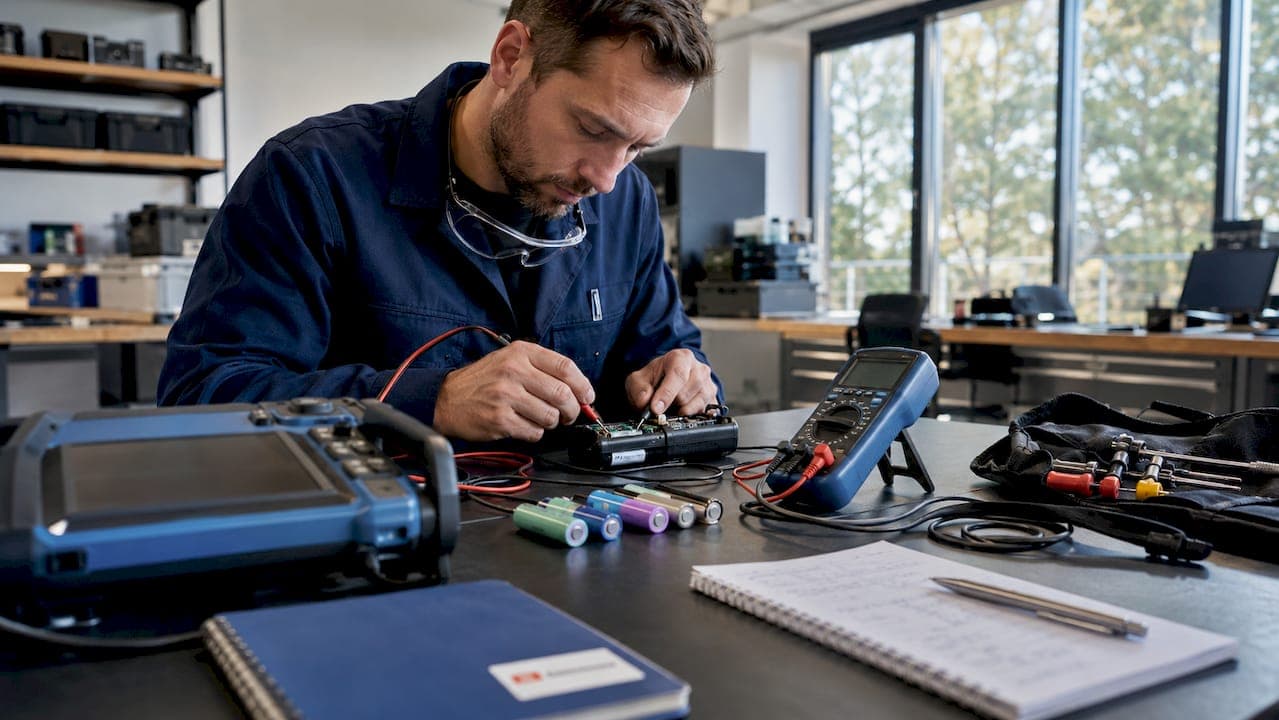
Borescope battery life is defined as the total continuous runtime a device delivers under real operating conditions, and it varies from 1.5 to 6 hours depending on battery chemistry, capacity, temperature, and usage patterns. These borescope battery life comparison factors matter most when a dead device mid-inspection means a delayed diagnosis or a failed NDT audit. Lithium-ion cells dominate professional borescopes in 2026, with typical capacities between 2,600mAh and 3,000mAh. Disciplined maintenance consistently outperforms raw capacity as the primary driver of long-term battery reliability.
1. Borescope battery life comparison factors: chemistry and capacity
Battery chemistry is the single biggest variable when comparing borescope batteries. Lithium-ion cells deliver the best energy density, recharge speed, and cycle life for professional use. Alkaline batteries appear in low-cost entry-level units but cannot sustain the current draw that LED arrays and image processors demand. Nickel-metal hydride cells sit between the two but are rarely found in modern professional borescopes.
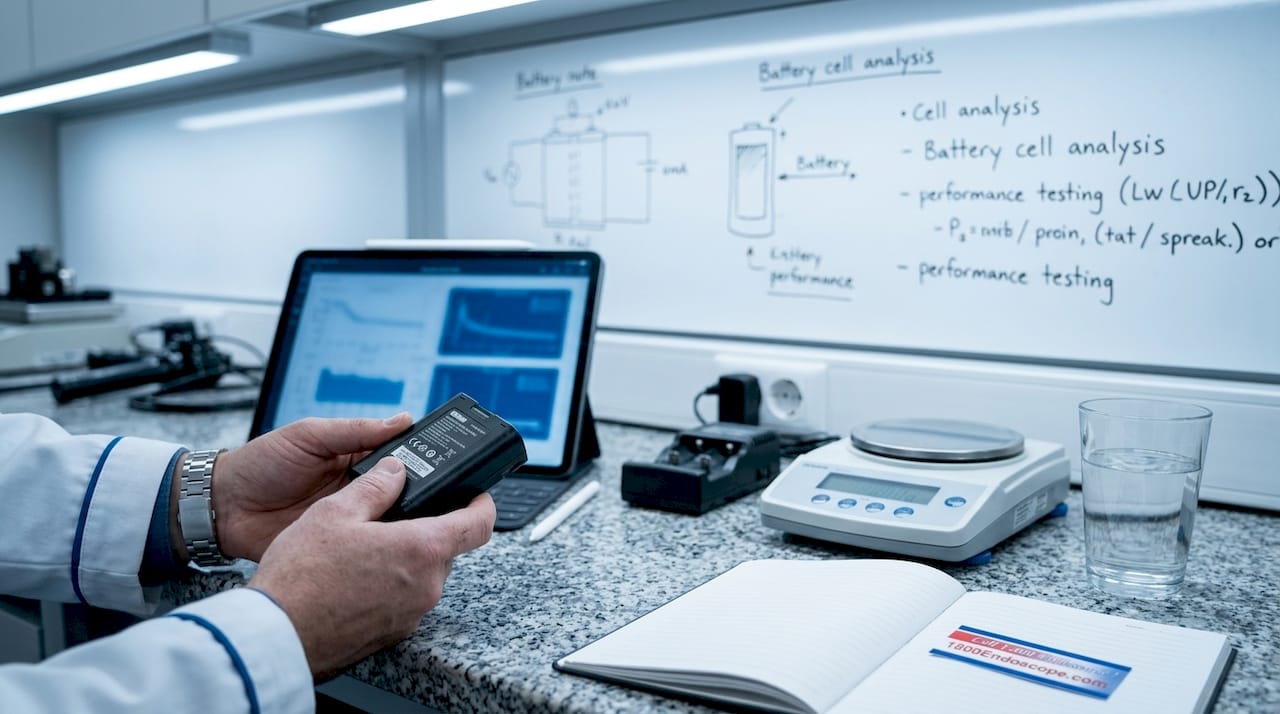
Capacity directly sets the ceiling for runtime. A 2,600mAh cell runs shorter than a 3,000mAh cell under identical load conditions. That gap matters during a multi-hour equine airway inspection or a turbine blade audit where stopping to recharge is not an option.
The choice between integrated and removable batteries creates a real workflow trade-off:
- Integrated batteries keep the device compact and sealed but require downtime when depleted.
- Removable hot-swappable batteries let technicians carry spares and swap in the field without interrupting work.
- Industrial-grade borescopes favor hot-swappable designs precisely because extended inspections cannot tolerate unplanned stops.
Pro Tip: Match battery chemistry to your workflow before buying. If you run back-to-back inspections, prioritize a removable lithium-ion system over a higher-capacity integrated cell.
2. How temperature affects battery performance and degradation
Temperature is the most underestimated factor in battery performance. Lithium-ion batteries operate optimally between 15°C and 35°C. Outside that range, both runtime and long-term health suffer in measurable ways.
Cold environments near -10°C cause an immediate voltage depression. Runtime drops 10–15% the moment the cell gets cold, even if the battery was fully charged. That effect reverses when the device warms up, but repeated cold exposure accelerates permanent capacity loss over time.
Heat above 50°C creates the opposite illusion. The battery may briefly show higher apparent capacity, but chemical aging accelerates inside the cell. Technicians working in engine bays, industrial furnace rooms, or hot summer field conditions often see their batteries degrade faster than expected.
Practical steps for temperature management:
- Store borescopes at room temperature before use in cold environments.
- Allow devices to acclimate before powering on in extreme cold.
- Avoid leaving borescopes in direct sunlight or hot vehicle interiors.
- In high-heat environments, schedule shorter inspection sessions with cooling breaks.
Pro Tip: Never trust the rated runtime spec when working outside the 15–35°C window. Build in a buffer and carry a spare battery or charger.
3. How wireless connectivity and device features drain battery power
Standalone borescopes deliver the most stable and predictable runtime. Wi-Fi connected devices experience faster battery drain from continuous wireless transmission, and the host device running the companion app adds a second power load to the system. Latency from app processing further taxes the battery by keeping the radio active longer per frame.
LED illumination is the second largest power draw after wireless transmission. High-brightness LEDs needed for deep-cavity inspections, such as checking a horse's nasal passage or a turbine's internal bore, pull significant current continuously. Image processing chips add a third layer of dynamic current draw that spikes during video recording.
Best practices for conserving battery during use:
- Use standalone mode when Wi-Fi is not required for the inspection.
- Reduce LED brightness to the minimum level that still gives a clear image.
- Disable video recording and use still capture when continuous footage is not needed.
- Close background apps on the host device when using a Wi-Fi connected borescope.
Pro Tip: For veterinary diagnostic work where animal stress limits inspection time, standalone mode preserves battery and eliminates connectivity lag simultaneously.
4. Charging routines and storage practices that extend battery life
Charging habits determine how many total cycles a battery delivers before capacity drops below useful levels. Repeated fast charging generates heat inside the cell and shortens total cycle life. Standard charging at a lower current rate extends service life, even if it takes longer per session.
Avoiding deep discharge is equally important. Letting a lithium-ion cell drop below 20% repeatedly causes accelerated internal resistance growth. That resistance translates directly into shorter runtimes and less accurate battery level readings over time.
Storage charge level matters more than most technicians realize. Storing lithium-ion batteries at 40–60% charge prevents the capacity degradation that occurs when cells sit fully charged or fully depleted for more than 30 days. Fully charged storage causes electrolyte oxidation. Zero-charge storage causes lithium plating on the anode.
USB-C charging while in use is the preferred solution for high-demand environments. Devices that support this feature let technicians maintain power during long inspections without powering down, which eliminates the downtime penalty of integrated battery designs.
Pro Tip: Schedule a monthly battery health check. Run the device to 30%, charge to 60%, and note how long each step takes. A significant change in timing signals early capacity loss.
5. Comparing battery types and workflows for veterinary vs. industrial use
The right battery system depends on the inspection environment and session length. The table below compares the key battery features technicians should evaluate when selecting or managing a borescope.
| Feature | Removable hot-swap battery | Integrated rechargeable battery |
|---|---|---|
| Typical capacity | 2,600–3,000mAh | 2,600–3,000mAh |
| Recharge time | 1–2.5 hours per pack | 1–2.5 hours (device offline) |
| Hot-swap capability | Yes, field replaceable | No |
| Typical runtime | 3–6 hours with spare packs | 1.5–4 hours per charge |
| Best workflow fit | Industrial NDT, long-duration audits | Veterinary clinics, short sessions |
Veterinary environments typically involve shorter, more frequent inspections. An integrated battery with USB-C charging covers most clinic workflows without requiring spare packs. Industrial NDT environments, such as pipeline or turbine inspections, often run for hours without access to a power outlet. Hot-swappable systems are the practical choice there.
Frequent inspection schedules also affect battery management. A clinic running 10 scopes per day needs a charging rotation plan. An industrial team running one long inspection per shift needs a spare battery protocol instead.
Key takeaways
Borescope battery longevity depends on chemistry, temperature management, usage patterns, and charging discipline far more than on raw capacity alone.
| Point | Details |
|---|---|
| Chemistry sets the baseline | Lithium-ion outperforms alkaline and NiMH for professional borescope use. |
| Temperature changes runtime immediately | Cold near -10°C drops runtime 10–15%; heat above 50°C causes permanent cell damage. |
| Wireless connectivity drains faster | Standalone mode preserves battery; Wi-Fi and LED brightness are the top power draws. |
| Storage charge level matters | Keep batteries at 40–60% charge for storage periods over 30 days. |
| Maintenance beats capacity | Well-maintained batteries outlast poorly maintained high-capacity cells. |
What I've learned about battery performance that most guides skip
The most common mistake I see technicians make is treating the battery level indicator as a precise measurement. State of Charge estimation is nonlinear and drifts under the high-current draw typical of borescope use. A device showing 30% may cut out at 22% in cold conditions or under heavy LED load. Build a 20% safety margin into every critical inspection. Do not wait for the low-battery warning.
The second thing I would tell any technician is that battery maintenance belongs in the same routine as lens cleaning and connector checks. A 3,000mAh cell that has been stored at full charge for three months in a hot equipment room will perform worse than a 2,600mAh cell that has been properly maintained. Capacity on the spec sheet is a starting point, not a guarantee.
Emerging lithium-polymer cells are showing up in newer portable borescopes and offer slightly better form factors, but the same care principles apply. The fundamentals of battery chemistry have not changed. What has changed is that devices are drawing more power from smaller cells as HD video and wireless features become standard. That makes disciplined charging and storage more important, not less.
— Endoscope
Quality borescopes with reliable power systems at 1800endoscope
Technicians who need dependable battery performance for veterinary or industrial inspections will find a practical selection at 1800endoscope. The catalog includes both portable integrated-battery models and professional-grade systems suited to extended field use.
The portable airway inspection system at 1800endoscope is built for direct monitor use with SD card video capture, making it a strong fit for clinics and field teams that need reliable power without depending on a connected device. For a broader look at available options, the full borescope catalog covers industrial NDT and veterinary models with varying battery configurations. Matching the right power system to your inspection workload is the first step toward consistent, uninterrupted diagnostics.
FAQ
What is the typical battery life of a professional borescope?
Most professional borescopes deliver 1.5 to 6 hours of continuous runtime. Industrial models with hot-swappable batteries extend effective usage time significantly beyond that range.
What battery type do most borescopes use?
Lithium-ion is the standard chemistry in professional borescopes. Capacities typically range from 2,600mAh to 3,000mAh, with USB-C recharge times between 1 and 2.5 hours.
How does temperature affect borescope battery life?
Cold near -10°C causes an immediate 10–15% voltage drop, while heat above 50°C accelerates permanent chemical aging inside the cell.
What is the best way to store a borescope battery?
Store lithium-ion batteries at 40–60% charge for any storage period exceeding 30 days. Fully charged or fully depleted storage causes permanent capacity loss within months.
Can I trust the battery level indicator on my borescope?
Battery level indicators on most mid-range borescopes are approximations. State of Charge readings drift under high-current draw, so build a 20% safety margin into any critical inspection.