
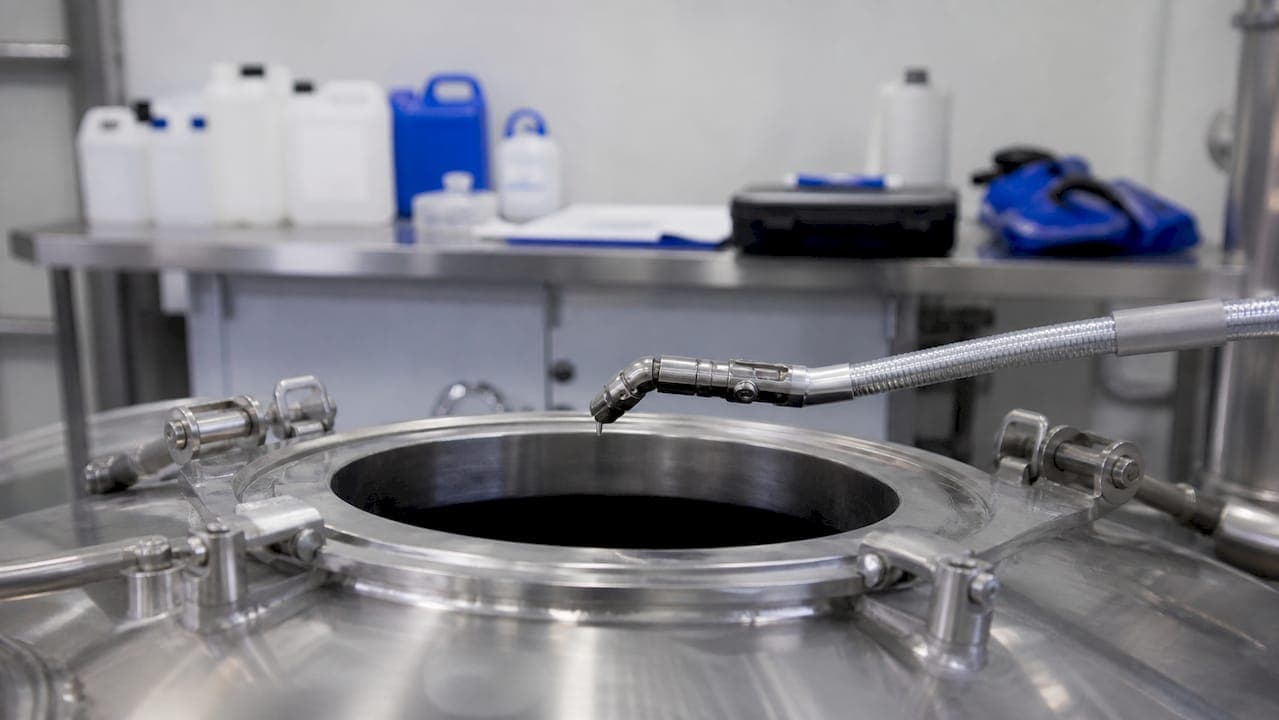
A borescope qualifies as chemically resistant when its sheath material, optical window, and seals are verified compatible with the specific chemicals it will contact, and when the unit carries documented ingress protection (IP) and temperature ratings backed by vendor test evidence. The single most important action you can take right now: request a chemical-compatibility datasheet from your vendor that covers your exact chemistries, concentrations, and exposure temperatures before you commit to any model.
Quick procurement checklist:
- Sheath material confirmed compatible with your target chemistries (PTFE, polyamide, or stainless alloy, not just "chemical resistant")
- Optical window material specified separately (sapphire or hardened glass, not polymer, for acid or alkali environments)
- IP68 minimum for immersion; IP69K if pressurized washdowns are involved
- Operating temperature range stated for both continuous and brief high-temperature exposure
- ATEX/IECEx or NEC Class I Division certification if flammable vapors are present
- Written chemical-compatibility chart or soak-test report from the vendor, not just marketing language
Pro Tip: Ask vendors to specify the optical window material and its chemical compatibility separately from the probe body. The window is almost always the first component to fail in acid or alkali environments, and most "chemical-resistant" product descriptions cover only the sheath.
1800endoscope's industrial borescope lines, both rigid and flexible, are available for immediate evaluation against these criteria. Browse the borescope catalog to compare models and request datasheets.
Key Takeaways
A borescope is only as chemically resistant as its weakest component, and that component is almost always the optical window, not the sheath.
| Point | Details |
|---|---|
| Window material is the critical spec | Require sapphire or hardened glass windows separately from sheath compatibility; acids and alkalis attack polymer and standard glass windows first. |
| IP68 is the minimum for immersion | IP67 covers brief splashes; sustained chemical-tank inspection requires IP68 with stated depth and duration, or IP69K for pressurized washdowns. |
| ATEX/IECEx required for vapor hazards | Any environment with flammable vapors alongside corrosive chemicals requires intrinsic-safety or explosion-proof certification, not corrosion resistance alone. |
| Demand test evidence, not labels | Request chemical-compatibility charts, IP/IK test certificates, and material datasheets covering sheath, window, and seals before issuing a purchase order. |
| 1800endoscope for spec-driven procurement | 1800endoscope's rigid and flexible industrial borescope lines are available for evaluation with documented specifications and datasheet support. |
Table of Contents
- When do hazardous-area certifications change your spec requirements?
- Which materials actually hold up to industrial chemicals?
- What IP, IK, and temperature specs should you require?
- How do you verify a vendor's chemical-resistance claims?
- How should you clean and decontaminate a probe after chemical exposure?
- Which probe format fits your industry and application?
- Why documentation and metadata reduce your chemical exposure risk
- How to choose the right chemical-resistant borescope for procurement
- The spec-first approach is the only one that holds up in the field
- 1800endoscope's industrial borescope lines for chemical environments
- Sources
When do hazardous-area certifications change your spec requirements?
Chemical environments and electrical hazard classifications often overlap. A solvent-storage tank, a refinery column, or a pharmaceutical reactor can contain both corrosive chemicals and flammable vapors simultaneously. When that is the case, corrosion resistance alone is not enough: you need a probe rated for the electrical hazard zone as well.
The two dominant regulatory frameworks are the North American NEC system and the international IECEx/ATEX system. They use different terminology but map to similar risk levels.
| Hazard classification | Framework | Typical chemical scenario | Requirement |
|---|---|---|---|
| Class I Division 1 | NEC (North America) | Continuous or frequent flammable vapor (open solvent tanks) | Intrinsically safe or explosion-proof rating |
| Class I Division 2 | NEC (North America) | Flammable vapor present only under abnormal conditions | Intrinsically safe preferred; some non-incendive equipment permitted |
| Zone 0 | IECEx / ATEX | Continuous explosive atmosphere (inside vessel) | Category 1 / Group IIC intrinsically safe |
| Zone 1 | IECEx / ATEX | Likely explosive atmosphere during normal operation | Category 2 intrinsically safe or explosion-proof |
| Zone 2 | IECEx / ATEX | Explosive atmosphere only under abnormal conditions | Category 3 or intrinsically safe |
Application notes from QBH Industrial show ATEX-certified, IP68-rated, and NACE MR0175-compliant probes deployed in hazardous-material inspections, with documented cost-avoidance benefits from targeted inspections that prevent unplanned shutdowns.
When to require intrinsically safe or explosion-proof certification:
- Any inspection inside a vessel, tank, or confined space where flammable vapors may be present
- Refineries, chemical plants, offshore platforms, and solvent-handling facilities
- Pharmaceutical reactors using alcohol-based or ether-based solvents
- Wastewater digesters where methane accumulation is possible
Standard corrosion-resistant probes without electrical hazard certification are appropriate only when the environment is confirmed free of flammable or explosive atmospheres. If there is any doubt, require the certification.
Which materials actually hold up to industrial chemicals?
Material selection is where most procurement mistakes happen. "Chemical resistant" on a spec sheet can mean anything from "survived a 30-second water splash" to "immersed in 30% sulfuric acid for 24 hours." The sheath, the jacket braid, and the optical window each have different vulnerabilities.
Sheath and jacket materials
PTFE (polytetrafluoroethylene / Teflon) offers the broadest chemical resistance of any common sheath material. It handles concentrated acids, alkalis, solvents, and hydrocarbons with minimal degradation. The tradeoff is stiffness: PTFE sheaths are harder to articulate in tight bends, and PTFE-jacketed probes tend to run slightly larger in diameter for a given working length.
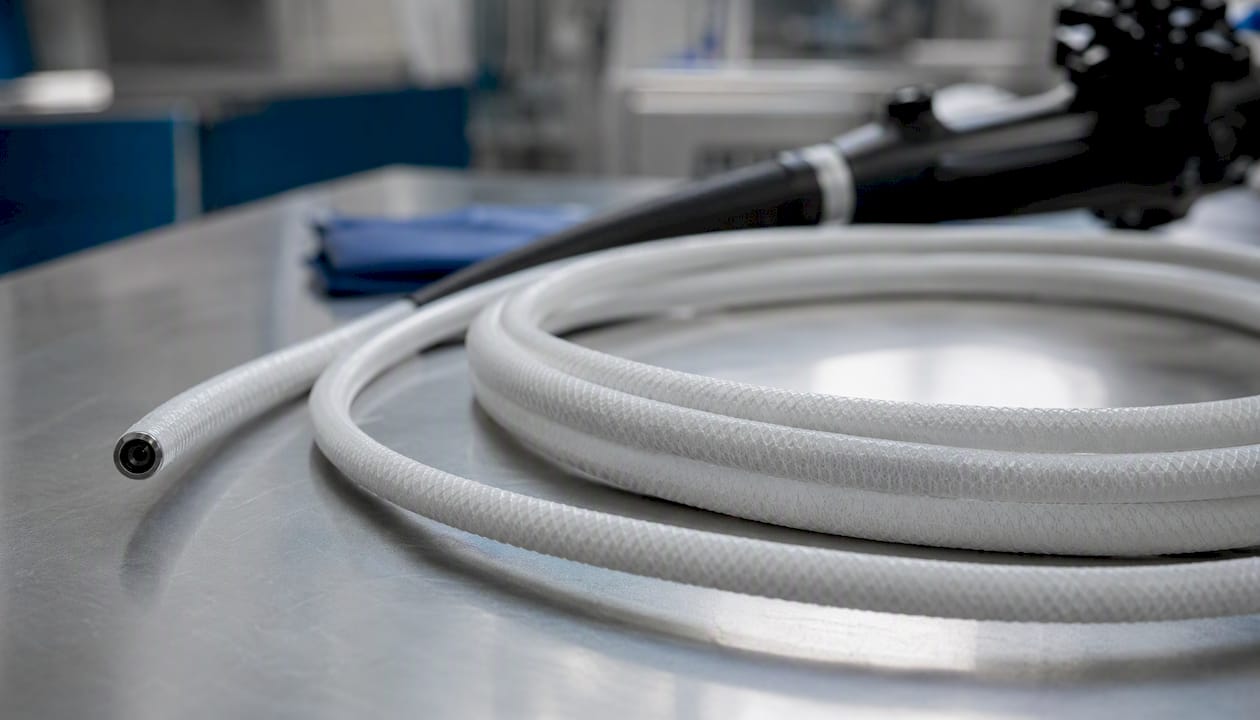
Polyamide (nylon) is the standard sheath material for many flexible borescopes. Spec tables for flexible microflex borescopes list polyamide sheaths with water resistance to 1 atm, which covers most splash and brief immersion scenarios. Polyamide handles hydrocarbons and mild alkalis well but degrades in concentrated acids and strong oxidizers.
Polyurethane (PU) jackets are common on armored flexible probes. The iLED PRO industrial video borescope uses a tungsten-braided probe with a PU jacket, rated for continuous operation from -25°C to +80°C and brief high-temperature exposure up to 140°C, with stated resistance to oils and saline solutions. PU handles hydrocarbons and mild solvents but softens in ketones and esters.
Stainless steel alloys (typically 304 or 316L) are used for rigid probe bodies and some flexible outer sheaths. 316L has better chloride resistance than 304, which matters in marine, pharmaceutical, and wastewater environments. Neither grade handles concentrated hydrochloric acid well.
Optical windows: the weak point
Manufacturer documentation for Hawkeye Pro rigid borescopes states the tube resists most hydrocarbons, including oils, gasoline, hydraulic fluid, and jet fuel, but explicitly warns that acids and strong alkali attack the optical window. Distributor listings corroborate this caveat, and it reflects a near-universal truth about borescope construction: the window is almost always the limiting component.
- Sapphire windows resist acids, alkalis, and abrasion far better than glass or polymer. They are standard on premium industrial probes and worth specifying whenever the environment contains anything beyond hydrocarbons.
- Hardened borosilicate glass handles mild acids and most hydrocarbons but degrades in hydrofluoric acid and strong alkalis.
- Polymer lenses are the most vulnerable. Avoid them in any environment with solvents, acids, or alkalis.
Pro Tip: When inspecting acid or alkali environments, specify a sacrificial tip or a replaceable distal end rather than a fixed optical assembly. Replacing a $40 tip is a better outcome than replacing a $2,000 probe.
Key material vulnerabilities by chemistry:
- Concentrated sulfuric or hydrochloric acid: avoid polyamide, PU, and glass windows; use PTFE sheath + sapphire window
- Strong alkalis (NaOH, KOH): glass windows degrade; require sapphire
- Ketones and esters (acetone, ethyl acetate): PU softens; use PTFE or stainless
- Hydrocarbons (oils, fuels, hydraulic fluid): most sheath materials perform adequately; confirm window compatibility
What IP, IK, and temperature specs should you require?
IP ratings describe protection against solid particles (first digit) and liquids (second digit). For chemical environments, the liquid rating is what matters.
IP rating targets by application:
- IP67: Immersion to 1 meter for 30 minutes. Adequate for splash exposure and brief dips in non-pressurized tanks.
- IP68: Immersion beyond 1 meter, duration and depth per manufacturer specification. The minimum for tank inspection work. Consumer-facing guides note that many midrange borescopes carry IP67 ratings and market them as oil-resistant for general use, but IP67 is not sufficient for sustained chemical immersion.
- IP69K: Resistance to high-pressure, high-temperature water jets (80°C at 80–100 bar). Required if the probe will be used in environments with pressurized washdowns or steam cleaning.
IK ratings measure impact resistance on a scale from IK01 to IK10. IK08 (5 joules) is a reasonable minimum for industrial field handling. IK10 (20 joules) is appropriate for abrasive or high-traffic environments.
Temperature limits matter more than most buyers realize. Chemical reactions generate heat, and some cleaning or decontamination processes involve hot water or steam. The iLED PRO spec sheet documents a continuous operating range of -25°C to +80°C and a brief high-temperature tolerance of 140°C. Those are useful reference points: require vendors to state both the continuous operating temperature and the short-duration maximum, not just one figure.
Chemical exposure can also cause embrittlement at low temperatures. PTFE and stainless alloys maintain flexibility well below 0°C; polyamide and PU become brittle faster in cold environments combined with chemical exposure.
Spec thresholds to write into procurement documents:
- IP68 minimum (state depth and duration); IP69K if washdowns occur
- IK08 minimum for standard industrial handling
- Continuous operating temperature range covering your process temperatures
- Short-duration maximum temperature stated explicitly
- Chemical-compatibility matrix covering your specific chemistries at operating concentration and temperature
How do you verify a vendor's chemical-resistance claims?
Marketing language is not evidence. "Resistant to most industrial chemicals" tells you nothing about whether the probe survives your specific process chemistry at your operating concentration and temperature. Here is what to request.
Documents to demand before purchase:
- Full chemical-compatibility chart listing each chemistry, concentration range, temperature, and exposure duration tested
- IP/IK test certificates (not just the IP rating stamped on the product; the actual test report)
- ATEX, IECEx, or NEC certification PDFs with certificate numbers you can verify independently
- Material datasheets for the sheath, jacket braid, seals, and optical window separately
- Field case studies or application notes from comparable environments
How to read a compatibility chart correctly:
- Locate your specific chemistry by name and CAS number, not just category.
- Check the concentration column. A material rated "resistant" to 10% sulfuric acid may fail at 30%.
- Confirm the temperature at which the test was conducted. Resistance at 20°C does not guarantee resistance at 60°C.
- Note the exposure duration. A 1-hour soak result is not equivalent to continuous immersion.
- Check whether the rating covers the full probe assembly or only the sheath material.
Red flags that indicate insufficient evidence:
- "Resistant to most hydrocarbons" with no test data or concentration/temperature conditions
- IP rating listed without a test certificate or depth/duration specification
- Chemical-resistance claim that does not mention the optical window separately
- Vendor unable to provide a material datasheet for the window assembly
Regional product listings repeat the same hydrocarbon-resistance language while noting the acid/alkali caveat on optical windows, which illustrates exactly how a blunt "chemical-resistant" label can obscure the most critical vulnerability.
When the application is critical, request a witnessed soak test: submerge a sample probe in your process chemistry at operating concentration and temperature for a defined period, then inspect the window and seals under magnification. Most reputable vendors will accommodate this for large orders.
How should you clean and decontaminate a probe after chemical exposure?
Decontamination done wrong destroys probes faster than the original chemical exposure. The goal is to neutralize and remove the process chemistry without introducing a second incompatible chemical.
Step-by-step decontamination sequence:
- Remove the probe from the chemical environment and place it in a secondary containment tray. Do not set it on unprotected surfaces.
- Rinse the exterior immediately with clean water at the lowest pressure that achieves adequate rinsing. For acid exposures, a dilute sodium bicarbonate solution (1–2%) neutralizes residual acid before the final water rinse.
- For alkali exposures, a dilute citric acid solution (1–2%) neutralizes residual alkali. Follow with a thorough water rinse.
- Wipe the probe body and connector with a lint-free cloth dampened with isopropyl alcohol (IPA, 70%). Do not submerge connectors unless the connector is rated for immersion.
- Inspect the optical window under a light source for etching, hazing, or discoloration. Any visible degradation means the window needs replacement before the next inspection.
- Allow the probe to air-dry completely before storage. Moisture trapped in connector housings accelerates corrosion.
- Log the chemical exposure, concentration, duration, and any observed window or sheath changes in the maintenance record.
Maintenance schedule template:
- After every chemical exposure: visual inspection of window, sheath, and connectors; log exposure details
- Monthly: function test (image quality, articulation range, light output); inspect sheath for cracks, swelling, or discoloration
- Quarterly: full leak test per manufacturer procedure; inspect connector pins and seals
- Annually: window replacement or professional inspection if the probe operates in acid or alkali environments regularly; sheath replacement if wear is visible
Storage and labeling:
- Store chemically exposed probes separately from standard equipment and label them with the last chemical exposure date and chemistry type.
- Use sealed, padded cases to prevent cross-contamination.
- PPE during cleaning: chemical-resistant gloves, eye protection, and a lab coat or apron appropriate for the process chemistry involved.
Pro Tip: Follow inspection preparation best practices before every deployment in a chemical environment. A five-minute pre-inspection check of the window and seals prevents a failed inspection mid-job.
Which probe format fits your industry and application?
The right probe format depends on the geometry of the inspection target, the chemistry present, and how much articulation you need. Here is how common industrial scenarios map to probe choices.
Oil and gas: Pipeline and vessel inspections in hydrocarbon environments suit flexible armored probes with tungsten-braided jackets and PU or PTFE sheaths. Diameters of 6mm–8mm cover most access ports. For tight tubing or heat-exchanger tubes, a 4mm rigid probe with a stainless body works well. Articulating tips add value when inspecting weld seams or corrosion pockets inside vessels.
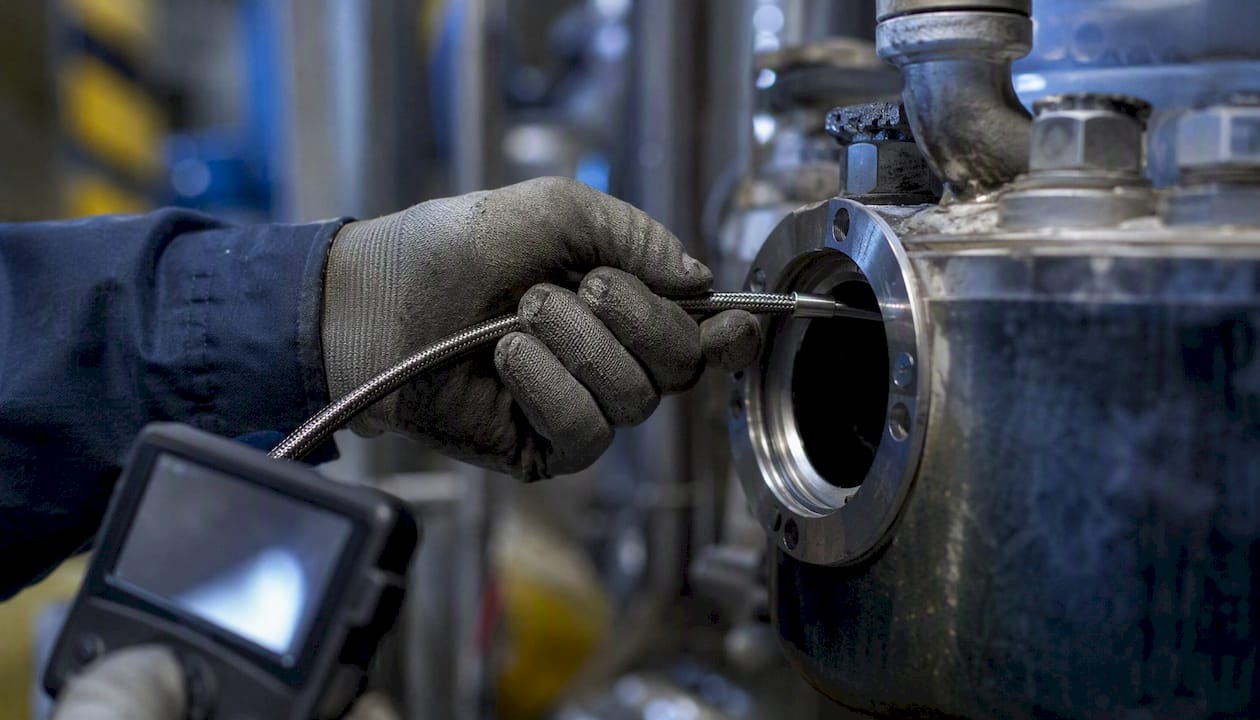
Chemical processing: Reactors and storage tanks with aggressive chemistries (acids, alkalis, chlorinated solvents) demand PTFE sheaths and sapphire windows. Flexible probes with 6mm diameters and 1.5m–3m working lengths cover most reactor access. Side-view adapters are useful for inspecting vessel walls without repositioning the probe.
Pharmaceutical: Sanitary environments require probes that can be fully decontaminated and, in some cases, autoclaved. Stainless 316L bodies with sapphire windows and PTFE sheaths are the standard. Small diameters (3mm–4mm) access sampling ports and transfer lines. Flexible probe techniques for accurate diagnostics apply directly to pharmaceutical line inspections.
Wastewater and municipal: Abrasive slurries and hydrogen sulfide environments call for armored probes with braided jackets and robust distal tips. Rigid probes work for straight pipe runs; flexible articulating probes handle bends. IP68 or IP69K is non-negotiable here given the immersion conditions.
Accessory choices that extend probe life:
- Sacrificial distal tips for acid/alkali environments
- Braided stainless or tungsten outer jackets for abrasive slurry applications
- Side-view adapters for vessel-wall and bore inspection without probe repositioning
- Protective sheaths or sleeves for probes that pass through rough access ports
For a broader view of industrial borescope applications across sectors, the use-case range extends well beyond the four industries above.
Why documentation and metadata reduce your chemical exposure risk
Hardware durability gets most of the attention in borescope procurement, but documentation quality determines whether a single inspection eliminates the need for a follow-up or whether a technician has to re-enter the same hazardous environment three weeks later.
Leading RVI experts at Waygate Technologies (Baker Hughes) advocate for systems that allow easy metadata tagging and remote collaboration specifically to reduce repeat personnel exposures and improve inspection accuracy.
Systems that support metadata tagging, secure recordkeeping, and remote collaboration reduce repeat personnel exposures and raise inspection value — buyers should require exportable metadata and standard report formats as part of any borescope procurement.
Metadata fields to capture on every chemical-environment inspection:
- Location code and asset ID
- Chemical environment type, concentration, and temperature at time of inspection
- Probe model, serial number, and last maintenance date
- Technician ID and PPE used
- Image and video timestamps with GPS or facility coordinates
- Observed findings with severity codes tied to your CMMS taxonomy
Workflow for remote collaboration and records integration:
- Export images and video in standard formats (JPEG, MP4) with embedded metadata rather than proprietary formats that require vendor software to read.
- Route inspection reports through a secure, access-controlled file system before sharing with remote engineers or clients.
- Integrate borescope outputs into your CMMS (Maximo, SAP PM, or equivalent) using the asset ID and location code as the linking fields.
- Flag any inspection where chemical exposure exceeded the probe's rated parameters so the maintenance record triggers a pre-inspection window check before the next deployment.
Documentation practices that support QA in industrial inspection follow the same logic: a well-documented inspection is a defensible one, and in chemical environments, it is also a safer one.
How to choose the right chemical-resistant borescope for procurement
A structured buying process prevents the most common mistake: selecting a probe based on a single spec (usually IP rating) while ignoring the chemistry-specific material compatibility.
Step-by-step buying process:
- Define your chemistries. List every chemical the probe may contact, with concentration ranges and operating temperatures. Include cleaning agents used during decontamination.
- Select material targets. Match sheath, window, and seal materials to your chemistry list using compatibility charts. Default to PTFE sheath and sapphire window for aggressive chemistries.
- Set IP, IK, and temperature minimums. IP68 for immersion, IP69K for washdowns, IK08 for standard handling. State continuous and brief-exposure temperature limits.
- Determine hazard classification. If flammable vapors are possible, add ATEX/IECEx or NEC Class I Division certification to the requirement.
- Demand test evidence. Request compatibility charts, IP/IK certificates, and hazard-area certification PDFs before issuing a purchase order.
- Verify with a sample if the application is critical. A witnessed soak test in your process chemistry costs less than a failed inspection or a destroyed probe.
One-page spec template for procurement documents:
- Sheath material: [specify — PTFE / polyamide / stainless 316L]
- Optical window material: [specify — sapphire / hardened borosilicate glass]
- IP rating: IP68 minimum (depth: ___ m, duration: ___ min) / IP69K if required
- IK rating: IK08 minimum
- Operating temperature: continuous ___ °C to ___ °C; brief maximum ___ °C
- Chemical-compatibility matrix: required for [list your chemistries, concentrations, temperatures]
- Hazard-area certification: ATEX / IECEx / NEC Class I Div ___ (if applicable)
- Warranty: minimum ___ years; repair policy and spare parts availability stated
- Deliverables: material datasheets, IP/IK test certificates, compatibility chart, certification PDFs
Procurement email snippet (customize and send):
"Please provide the following for the borescope model quoted: (1) chemical-compatibility chart for [your chemistries] at [concentrations] and [temperatures]; (2) IP/IK test certificates with depth, duration, and test conditions; (3) material datasheets for the sheath, optical window, and seals separately; (4) ATEX/IECEx/NEC certification PDFs if applicable. We require these documents before issuing a purchase order."
The spec-first approach is the only one that holds up in the field
The industry's default is to trust the label. "Chemical resistant" appears on hundreds of borescope product pages, and most procurement teams accept it without asking what it actually means for their specific chemistry. That is how probes fail mid-inspection, how optical windows get etched beyond recovery, and how technicians end up re-entering hazardous environments for repeat inspections that a better-documented first pass would have made unnecessary.
Verified specs and thorough documentation are not overhead. They are the mechanism by which a single inspection stays a single inspection. A probe with a PTFE sheath, a sapphire window, an IP68 certificate, and a chemical-compatibility chart covering your process chemistry costs more upfront than a generic "chemical-resistant" unit. It costs less than the alternative.
1800endoscope's industrial borescope lines are built for exactly this kind of procurement scrutiny: rigid and flexible options with documented specs, available for evaluation against your requirements.
1800endoscope's industrial borescope lines for chemical environments
When you need a corrosion resistant inspection camera that can be evaluated against real spec requirements, not just marketing language, 1800endoscope's industrial borescope catalog covers the formats that matter in chemical environments.
The catalog includes rigid borescopes for tight-bore and straight-run inspections, flexible and armored probes for confined-space and vessel work, and interchangeable video probe systems for facilities that need one controller with multiple probe diameters. Each product page lists specifications you can compare against your procurement template, and the team can provide datasheets or discuss witnessed testing for critical applications.
Browse the full industrial borescope catalog to identify models that match your IP, material, and certification requirements. For applications where documentation and image capture are part of the workflow, the portable 6mm airway inspection system is one immediately available small-diameter option worth reviewing. Contact 1800endoscope directly to request datasheets, chemical-compatibility information, or a sample probe for evaluation.
Sources
- Hazardous Material Inspections | QBH Industrial Borescope Manufacturers