
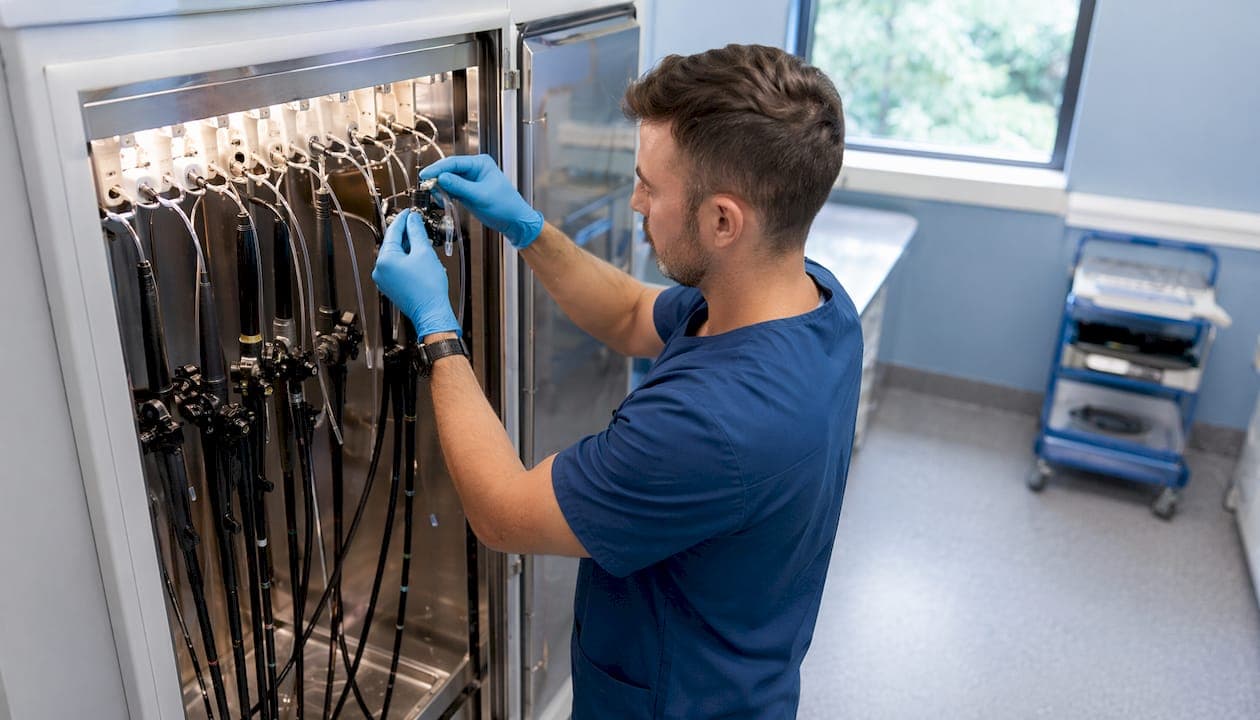
Proper endoscopic equipment storage is defined as the integration of active forced-air drying, environmental control, and physical protection to prevent microbial contamination and mechanical damage. Knowing how to store endoscopic equipment correctly is the single most important step after high-level disinfection. Standards from AAMI ST91, AORN, and EN 16442 all mandate HEPA-filtered forced-air drying cabinets as the baseline requirement. Residual moisture left inside channels after disinfection creates the conditions for microbial growth that can compromise both patient safety and equipment integrity. For veterinary clinics and industrial inspection teams, the stakes are the same: a poorly stored scope is a liability.
What tools and environments does proper endoscopic equipment storage require?
Active forced-air drying cabinets with HEPA filtration are the core requirement for compliant endoscopic equipment storage. These cabinets deliver continuous positive-pressure airflow through channels rated at ≥99.97% filtration efficiency, which validates storage times of up to 30 days. Passive storage, by contrast, leaves moisture trapped inside lumens where standard cleaning cannot reach.
Environmental parameters matter as much as the cabinet itself. Relative humidity must stay at or below 80%, with no corrosive gases present and stable temperature throughout the storage area. Placing a cabinet near a sink or autoclave introduces both humidity spikes and chemical vapor exposure that degrade optical coatings and seals over time.
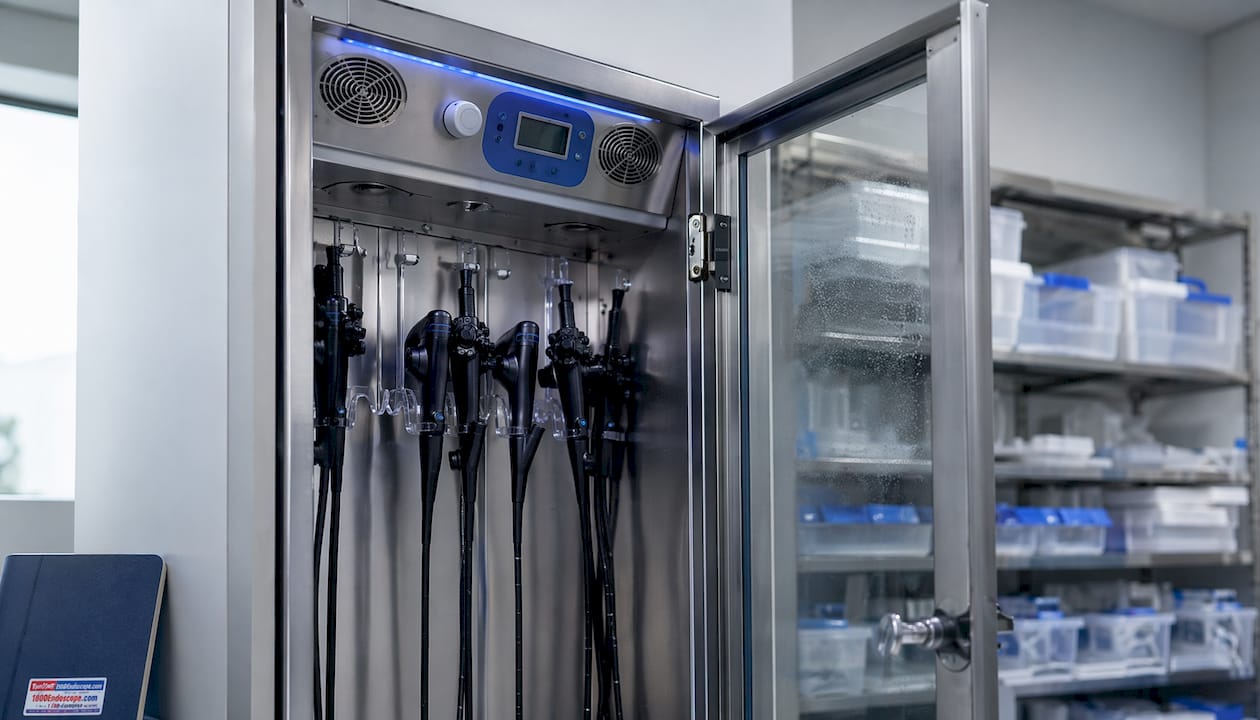
Suspension hardware is the third critical component. Scopes must hang vertically on purpose-built hooks or rails that distribute weight evenly along the insertion tube. Any lateral compression or contact point creates stress fractures in the fiber bundle or video chip wiring over repeated storage cycles.
Pro Tip: Choose a cabinet with individual channel-port connectors so forced air reaches every internal lumen simultaneously, not just the outer surface of the scope.
Critical tools and environmental specifications
| Requirement | Specification |
|---|---|
| HEPA filtration efficiency | ≥99.97% particle capture |
| Relative humidity | ≤80% at all times |
| Validated storage duration | Up to 30 days with continuous airflow |
| Insertion tube position | Vertical, no contact with walls or other scopes |
| Transport packaging | Shockproof case with soft polyurethane foam lining |
Key items every storage setup needs:
- Active forced-air drying cabinet with HEPA filtration and positive pressure
- Vertical suspension rails or hooks sized for each scope diameter
- Shockproof transport cases with foam lining for non-cabinet storage
- Humidity and temperature monitoring for the storage room
- Logbook or digital traceability system for reprocessing dates
How do you store endoscopes safely after high-level disinfection?
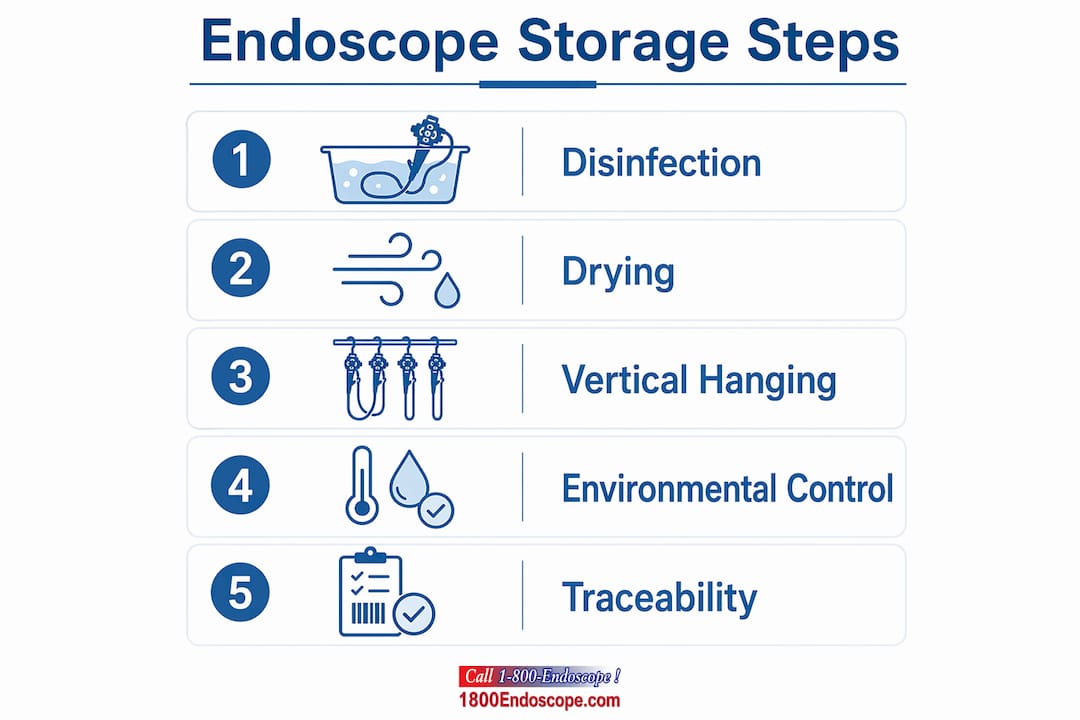
The step-by-step process for storing endoscopes safely begins the moment high-level disinfection ends. Every minute of delay before drying increases the risk of residual moisture becoming a contamination source. Active forced-air drying is the only qualified method recognized by current clinical guidelines. Manual or unfiltered ambient air drying is not acceptable under any circumstance.
Follow this sequence after every disinfection cycle:
- Transfer the scope immediately from the disinfection basin or automated reprocessor to the drying cabinet. Do not set it on a counter or drape it over a rack.
- Connect all channel ports to the cabinet's forced-air connectors. Run continuous drying for a minimum of 10 minutes, covering the biopsy channel, air/water channel, and suction channel.
- Hang the scope vertically on the suspension rail. Vertical suspension prevents the scope from touching cabinet walls or other scopes, which eliminates dead-air zones and reduces microbial contamination risk.
- Leave all valves and caps off during storage. Attaching them before the scope is fully dry traps moisture inside the channels.
- Apply lens caps only after the scope is confirmed dry, typically after the initial forced-air cycle completes.
- Keep the cabinet running with continuous HEPA-filtered airflow for the entire storage period.
- Log the reprocessing date, the technician's name, and the hang-time expiration date in your traceability system.
Pro Tip: Set a maximum hang-time label on each scope hook. If a scope reaches its expiration date without being used, reprocess it before the next procedure regardless of visual condition.
Traceability is not optional for compliant storage. Traceability systems embedded in modern cabinets log reprocessing dates and hang-time automatically, reducing the risk of human error. For veterinary practices managing multiple scopes across different species or procedures, this record-keeping also supports audit readiness and equipment lifecycle tracking.
For a detailed walkthrough of the full reprocessing workflow, the endoscope sterilization guide from 1800endoscope covers each stage from pre-cleaning through cabinet storage.
What storage mistakes damage endoscopes most often?
The most damaging storage mistake is attaching valves or caps before the scope is fully dry. Storing scopes with valves attached traps moisture inside channels, creating the warm, wet conditions that microbial growth requires. This single error can undo a complete high-level disinfection cycle.
The second most common mistake is coiling or tightly looping the insertion tube. Lateral pressure from a tight coil causes progressive internal damage to fiber bundles and wiring over time. The damage is cumulative and often invisible until the scope fails during a procedure.
Overcrowding a storage cabinet is as dangerous as skipping disinfection. When scopes touch each other or press against cabinet walls, airflow is blocked, dead-air zones form, and the cabinet's HEPA filtration cannot reach every surface. A cabinet that is too full provides no meaningful protection.
Additional mistakes that compromise storage safety:
- Using unfiltered ambient air or manual drying with a cloth or compressed air gun
- Placing cabinets near sinks, autoclaves, or chemical storage areas where humidity and vapor levels fluctuate
- Skipping regular cabinet cleaning, which allows the cabinet itself to become a contamination source
- Storing scopes in standard supply closets without humidity control or airflow
- Failing to document storage dates, which makes it impossible to enforce hang-time limits
Pro Tip: Inspect the cabinet interior monthly for biofilm, dust accumulation, or visible moisture. A contaminated cabinet contaminates every scope stored inside it.
For veterinary professionals managing small animal endoscopy, the same rules apply regardless of scope diameter. Smaller scopes have narrower channels that are even harder to dry and more vulnerable to moisture retention.
How do you maintain storage equipment for ongoing compliance?
Storage cabinet maintenance is the most overlooked part of endoscope management. Failure to maintain cabinets can cause them to become contamination sources, negating every cleaning and disinfection step that preceded storage. A well-maintained cabinet protects scopes. A neglected one contaminates them.
Maintenance tasks break down by frequency:
- Daily: Verify airflow indicator, confirm positive pressure is active, and check that all channel connectors are seated and delivering air.
- Quarterly: Test HEPA filter efficiency and airflow uniformity across all cabinet zones. Replace filters that fall below rated performance.
- Annually: Schedule professional calibration of air pressure and flow rate to confirm the cabinet still meets its validated specifications.
Traceability and monitoring technologies embedded in modern cabinets automate much of this oversight. Self-monitoring systems flag filter degradation, airflow drops, and door-seal failures before they become compliance problems. For industrial inspection teams operating in remote locations, these alerts are particularly valuable because manual checks may not happen on schedule.
Maintenance schedule summary
| Task | Frequency | Who performs it |
|---|---|---|
| Airflow and pressure check | Daily | Technician or nurse |
| Cabinet interior cleaning | Weekly | Technician or nurse |
| HEPA filter efficiency test | Quarterly | Biomedical or facilities team |
| Airflow uniformity audit | Quarterly | Biomedical or facilities team |
| Full professional calibration | Annually | Certified service provider |
Document every maintenance activity with a date, technician name, and result. Regulatory inspections in both veterinary and industrial settings increasingly require this paper trail. A cabinet with no maintenance log is treated the same as a cabinet with no maintenance.
What are the best options when a drying cabinet is unavailable?
Drying cabinets are the standard, but not every field setting or smaller veterinary practice has one. Alternative storage without specialty cabinets relies on shockproof packaging, environmental controls, and strict limits on storage duration. The goal is to reduce contamination risk, not eliminate it entirely. Professionals must understand that no alternative fully replaces an active drying cabinet.
When a cabinet is not available, apply these measures:
- Place the scope in a shockproof case lined with soft polyurethane foam immediately after drying. The foam prevents abrasion and distributes pressure evenly along the insertion tube.
- Orient the scope as vertically as possible inside the case to reduce fluid pooling in channels.
- Store the case in a clean, well-ventilated room with ambient humidity below 80% and away from chemical storage or high-traffic areas.
- Limit storage duration to the shortest interval practical. The longer a scope sits without active airflow, the higher the contamination risk.
- Reprocess the scope before use if it has been stored outside a cabinet for any extended period, regardless of when it was last disinfected.
Pro Tip: For mobile veterinary teams or field industrial inspectors, a portable dehumidifier in the equipment storage area provides meaningful humidity control at low cost. It is not a substitute for a cabinet, but it reduces the risk gap significantly.
The flexible borescope handling guide from 1800endoscope covers storage considerations specific to industrial inspection scopes, including transport case selection and field handling protocols.
Veterinary professionals working with mobile practices can also find relevant equipment care context through resources like South Tampa Mobile Vet, where field-based equipment management is a daily operational reality.
Key Takeaways
Proper endoscopic equipment storage requires active HEPA-filtered drying, vertical suspension without contact, humidity control below 80%, and documented traceability to protect both equipment and patient safety.
| Point | Details |
|---|---|
| Active drying is mandatory | Forced-air HEPA drying reduces residual moisture to safe levels; passive methods do not. |
| Vertical suspension prevents damage | Scopes must hang without touching walls or other scopes to maintain airflow and avoid mechanical stress. |
| Humidity must stay below 80% | Exceeding this threshold creates conditions for microbial growth and optical coating degradation. |
| Valves off during storage | Attaching valves or caps before full drying traps moisture and undoes disinfection. |
| Maintenance logs are required | Daily, quarterly, and annual cabinet checks must be documented to maintain compliance and catch failures early. |
What proper storage has taught me about endoscope longevity
The professionals who get storage right share one habit: they treat the cabinet as part of the reprocessing chain, not as a parking spot. The most common mistake I see is a scope pulled from disinfection and set on a counter while someone locates the cabinet key or clears space on the rail. That 90-second gap is enough to reintroduce contamination risk.
Active drying is where most of the protection actually happens. Residual moisture as low as 17.6 µL remains after 48 hours in an active drying cabinet, compared to 278.5–518.7 µL in passive storage. That difference is the difference between a scope that passes microbial testing and one that does not. The numbers make the argument better than any guideline document.
Traceability systems changed how I think about hang-time. Before electronic logging, hang-time limits were enforced by memory and sticky notes. Now a cabinet with self-monitoring software flags a scope that has exceeded its validated storage period automatically. That shift from human memory to system accountability is the single biggest improvement in storage practice over the past decade.
For veterinary and industrial teams, the investment in a compliant cabinet pays back quickly in avoided scope repairs and reduced reprocessing failures. A flexible videoscope costs far more to repair than a HEPA cabinet costs to buy and maintain. The math is straightforward once you run it.
— Endoscope
Endoscope storage solutions from 1800endoscope
1800endoscope carries a full range of veterinary and industrial endoscopes built for professionals who need reliable equipment that holds up between procedures.
Whether you work with small animals, equine patients, or industrial inspection environments, the right storage setup starts with the right scope. The portable endoscopy systems at 1800endoscope are designed for field and clinic use, with durable construction that supports compliant storage and transport. For a complete view of available equipment, the full endoscope catalog covers flexible videoscopes, rigid systems, and accessories for both veterinary and industrial applications. 1800endoscope also provides veterinary rigid endoscopy options with accessories suited to compliant storage workflows.
FAQ
What is the correct way to store endoscopes after disinfection?
Transfer the scope immediately to an active forced-air drying cabinet after high-level disinfection. Hang it vertically without valves or caps attached, and keep HEPA-filtered airflow running continuously for the full storage period.
How long can an endoscope be stored in a drying cabinet?
HEPA-filtered cabinets with continuous positive-pressure airflow validate storage times of up to 30 days. Any scope stored beyond its validated hang-time must be reprocessed before use.
Why is vertical suspension required for endoscope storage?
Vertical suspension prevents scopes from contacting walls or other scopes, which eliminates dead-air zones and allows forced airflow to reach all external surfaces and channel openings.
Can endoscopes be stored without a drying cabinet?
Short-term storage without a cabinet is possible using shockproof foam-lined cases in a humidity-controlled environment below 80% relative humidity. The scope must be reprocessed before use if stored this way for any extended period.
How often should a storage cabinet be serviced?
Airflow and pressure checks are daily tasks. HEPA filter efficiency testing and airflow uniformity audits are quarterly. Full professional calibration of air pressure and flow rate is required annually to maintain validated performance.