
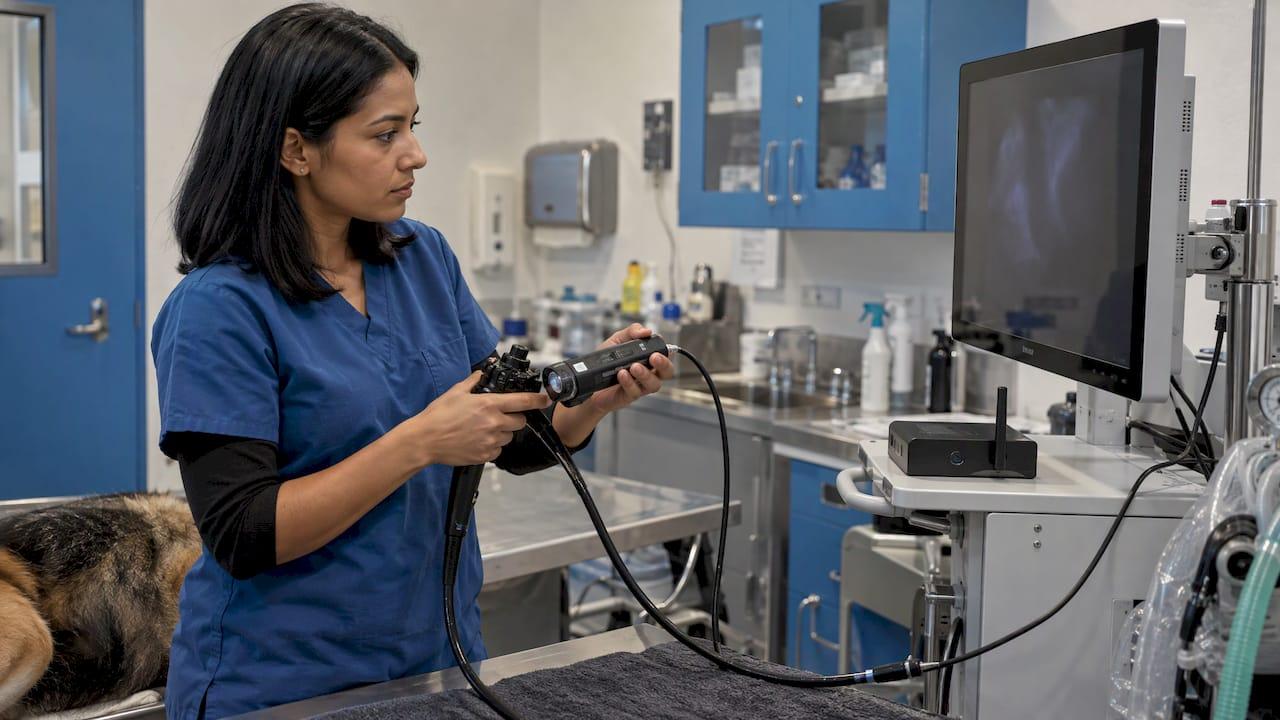
Wireless video transmitter endoscopy means sending the live image from an endoscope's camera to a monitor, recorder, tablet or phone without a video cable between them. It is not the same thing as capsule endoscopy, the swallowed "pill camera" that dominates search results for this phrase. In a clinic or on a job site, a wireless link is simply a way to free the operator from a tower or a cable run. Image quality, delay, range and battery life decide whether it works for you.
This guide is written for veterinary clinics, equine practitioners and industrial inspection teams who need a portable scope. It explains the terms, the technical numbers worth checking and the realistic uses.
TL;DR
- Wireless video transmitter endoscopy sends a scope's live image to a screen or recorder over radio, with no video cable. Capsule endoscopy is a different, human GI technology.
- Four numbers matter: latency (delay), range, resolution with frame rate, and battery runtime.
- Medical-grade transmission modules publish figures such as under 1 ms latency and 20 to 40 m range. Capsules work under much tighter limits.
- For vet and field work, a portable scope with a direct monitor and SD card recording gives a self-contained image path with nothing to pair or lose.
- Industrial borescopes are not sterile and are not cleared for human use, so keep them out of clinical work.
Table of Contents
- What the phrase means, and what it does not
- How a wireless endoscopy system moves the image
- The four numbers to check before you buy
- How wireless and portable scopes are used in veterinary work
- How wireless video is used in industrial inspection
- Safety: keep clinical and industrial tools separate
- Our perspective
- Choosing a system: a short checklist
- Find the right scope for your clinic or site
- FAQ
- Sources
What the phrase means, and what it does not
Search results for this keyword are mostly about wireless capsule endoscopy (WCE). A capsule is a disposable device a patient swallows. It carries a camera, LED lighting and a battery, and it transmits images to a recorder worn on the body. The first small intestine capsule was approved by the FDA in 2001. Capsules are a human gastroenterology tool. They are not what a veterinary clinic or an inspection firm buys when it wants a wireless scope.
What clinics and technicians mean by the phrase is a conventional endoscope or borescope, rigid or flexible, whose image reaches the display over a radio link. Three arrangements are common:
- A scope with a built-in wireless module that creates its own network and streams to a phone, tablet or laptop.
- A camera head with a separate wireless video transmitter and receiver, as used in operating-room video towers.
- A scope with a direct monitor and SD card, where the display and the recorder sit in the same handheld unit, so no link is needed.
The third option is not wireless in the technical sense, but it solves the same problem: no cable to a tower, and no stalled exam when a connection drops.
How a wireless endoscopy system moves the image
Every system, wired or wireless, follows the same chain: capture, encode, transmit, decode, display and record.
- Capture. A small CMOS or CCD sensor behind a lens at the scope tip, lit by LED or fiber-optic light, produces the image.
- Encode. The signal is compressed or sent raw. Heavier compression lowers the bandwidth you need but can add delay.
- Transmit. A radio sends the data. Common bands are 2.4 GHz and 5 GHz Wi-Fi, or a dedicated link built for video.
- Decode and display. A receiver turns the stream back into video for a monitor, tablet or phone.
- Record. Video is saved on the receiving device, on an SD card in the scope, or on a recorder.
Capsule systems follow the same logic in miniature. The ASGE Technology Committee describes three components: the capsule, a sensing system with pads or a belt plus a data recorder and battery pack, and a computer workstation with software for review. The same article notes that capsules transmit by ultra-high frequency radio telemetry or, in one design, by human body communications.
One capsule design reverses the model entirely. The CapsoCam retains its data and the patient mails it back for reading. That shows that wireless transmission is a design choice with trade-offs, not a requirement of the technology.
The four numbers to check before you buy
Latency
Latency is the delay between what the camera sees and what the screen shows. For a diagnostic look at a mucosal surface it matters little. For guiding a biopsy forceps or a retrieval tool, it matters a great deal, because you move the instrument and wait for the picture to confirm it.
Purpose-built medical video links publish very low figures. TQ's Modul No. 2 system lists lossless 4K transmission with latency under 1 ms, up to five receivers and a line-of-sight range of up to 20 meters. Its Modul No. 1 mini transmits FullHD with the same sub-millisecond latency, up to four receivers, and up to 40 m without line of sight under optimum conditions. These are OEM modules for medical equipment, so treat them as a benchmark for what a dedicated link can do. Many consumer-style Wi-Fi scopes stream through a phone app and generally cannot match that responsiveness.

A practical test: move the scope tip across a ruled surface and watch the screen. If you can see the picture lag behind your hand, expect to feel it during instrument work.
Range and interference
Range figures are quoted for open air. Stalls, metal gates, concrete walls, steel tanks and pipe runs all cut them. A 2.4 GHz link also shares its band with Wi-Fi routers, Bluetooth and microwave ovens. In a busy clinic or a plant floor, plan for a shorter working range than the spec sheet and keep the receiver close to the operator.
Resolution and frame rate
Resolution describes detail, and frame rate describes smoothness. Both cost bandwidth. A 1280×720 stream at 30 frames per second needs about 5 Mbps, according to a 2021 review. Move up to 1080p or 4K and the data rate climbs steeply, which is why cheaper wireless links often drop frames or lower resolution when the signal weakens.
Capsules show how far the compromise can go. The original PillCam SB produced 256×256 pixel images at 2 frames per second, with a 6 to 8 hour battery. A review of the technology lists poorer picture quality than wired endoscopy and 2 to 18 frames per second versus 25 as limitations. Those figures describe swallowed capsules inside a body, where power and antenna size are severely limited. They are not a prediction for a handheld scope.
Battery and runtime
A wireless scope has to power its light, sensor and radio, so runtime is often the first thing to run out. Ask how long the unit runs with the light at full brightness while streaming, whether the battery can be swapped in the field, and how long a full recharge takes. If you do back-to-back exams, a swappable battery or a unit that runs while charging is worth more than a headline resolution number.
| What to check | Why it matters | A good sign |
|---|---|---|
| Latency | Instrument guidance and biopsies | No visible lag when you move the tip |
| Range | Working distance in a barn, OR or plant | Stable picture at your real working distance |
| Resolution and frame rate | Lesion detail and smooth motion | Full-speed video, not stills or choppy frames |
| Battery runtime | A full day of cases | Runtime stated with light and radio both on |
| Recording | Records, referrals, client education | Local SD card or direct file export |
| Cleaning | Infection control between patients | Clear reprocessing instructions |
How wireless and portable scopes are used in veterinary work
Veterinary endoscopy rarely happens in a place built for it. A horse stands in a stocks. A dog is on a table with an anesthetist working alongside you. A large-animal call may be in a barn with no network. That is why portability and a simple image path matter more here than they do in a hospital endoscopy suite.
A wireless link helps in some situations:
- Teaching and consults. A second person can follow the exam on a tablet without crowding the animal.
- Equine work. A scope that is not tied to a cart lets you follow a standing horse and keep the operator free to move.
- Documentation. A phone or tablet makes it easy to attach clips to the patient record.
In other situations a self-contained unit is the more dependable choice. Our fully portable 6 mm x 150 airway inspection scope with direct monitor and SD card puts the screen and recorder in one handheld system. Our equine 8 mm USB airway inspection field scope is a monitor-type SD card videoscope for field use. For mouth exams in horses, there is an equine dental inspection videoscope.
If your clinic wants to improve the quality of the clips you save, our guide on how to optimize endoscope video recording for vets covers settings and habits that matter whatever the link type. For background on why video matters to diagnosis, see video imaging in animal diagnosis and remote visual inspection techniques for veterinary diagnostics.
Capsule endoscopy, by contrast, is a human-medicine procedure whose common indications are obscure GI bleeding, suspected Crohn's disease, polyposis surveillance, small-intestine tumors and malabsorptive syndromes such as celiac disease. Its passive movement also prevents repeated examination of a lesion. A clinician with a steerable scope can stop, insufflate, re-examine and take a biopsy. That control is why flexible and rigid scopes remain the working tools of veterinary endoscopy. If you are choosing a GI scope, read our guide to GI endoscope specs for small animal clinics.
How wireless video is used in industrial inspection
Industrial teams use wireless or monitor-type borescopes to look inside pipes, engines, turbines, welds, tanks and wall cavities. The reasons are the same as in a barn: a cable to a rack or a laptop is an obstacle when you are on a ladder, in a crawl space or inside a plant.
Three practical points apply:
- Metal blocks signal. Steel housings and pipe walls weaken radio. If the probe goes deep into metal, a unit with a local screen or SD card is more dependable than one streaming to a phone.
- Record on the device. Saving to an SD card in the unit means a dropped link does not cost you the footage.
- Match the probe to the job. Diameter, length and articulation decide what you can reach. Image sensors and radios do not fix a probe that is too thick or too short.
We stock monitor-type SD card videoscopes, portable pipe inspection videoscopes and micro fiber borescopes for this work.
Safety: keep clinical and industrial tools separate
The two worlds do not mix. An industrial borescope is not sterile, not biocompatible and not FDA-cleared for human use, so using one in a clinical setting would be a regulatory and ethical violation. Use medical or veterinary scopes for patients, and follow the manufacturer's reprocessing instructions between animals.
For human capsule endoscopy, the risks are documented and clinical. Capsule retention is defined as a capsule staying in the body for more than 2 weeks and can occur with NSAID strictures, Crohn's disease, small-bowel tumors, radiation enteritis or surgical strictures. Aspiration occurs in about 1 in 1,000 cases, more often in older patients with swallowing disorders. A physician decides who can safely swallow a capsule. If you are a patient with a pacemaker or you are pregnant, ask your gastroenterologist before any capsule study.

For electronics in a treatment area, check that a wireless transmitter is designed for it. TQ's Modul No. 2 documentation states compliance with IEC 60601-1 and 60601-1-2 for patient-near use. Ask for equivalent documentation for any transmitter you place near anesthesia and monitoring equipment.
Our perspective
In our experience, most clinics asking about wireless endoscopy want one thing: an exam that is easy to set up and that produces a clean, recordable image. A radio link is one way to get there. It is not the only way.
For a mobile equine practice or a small animal clinic with a tight budget, we think a portable scope with a direct monitor and SD card recording is often the most practical starting point. The image path is short. There is nothing to pair, no app to update and no signal to lose in a metal-sided barn. You can still move clips to a computer afterward for the patient record or a referral.
We built our offering around that idea: high-resolution, portable veterinary and industrial endoscopes and accessories at lower prices than traditional hospital-grade or human-use systems, with 24/7 support and rapid shipping. If you want a wireless option, we can help you match one to your cases. We can also help you with the accessories that make a scope useful, such as light sources, valves, pumps, cleaning tools and biopsy forceps.
When you send us your species, your typical procedures and your working environment, we can narrow the choice quickly.
Endoscope
Choosing a system: a short checklist
- Start with the case mix. List your most frequent procedures: airway, GI, ear, dental, orthopedic or pipe work. Probe diameter and length follow from this. Our veterinary endoscope buying guide walks through sizes for small animal clinics.
- Decide where the image should go. A built-in monitor, a tablet, a tower or a team on a call each imply a different link.
- Test the link in your real environment. Check the real working distance, with real walls and real equipment running.
- Plan for recording and storage. Decide who reviews the clips and where they are kept.
- Plan for upkeep. Know where cleaning supplies, spare valves and repairs come from before something fails. We offer endoscope repairs and accessories, and our troubleshooting guide covers the most common faults.
Find the right scope for your clinic or site
We sell veterinary endoscopes, rigid scopes, flexible biopsy forceps, light sources, accessories and industrial borescopes, and we repair scopes. Browse our veterinary endoscopy equipment and the New Portascope and endoscopic accessories, or open the full catalog. If you are unsure which system fits, contact us with your cases and we will point you to the right one.
Prices are listed on the product pages, and our support team is available around the clock for questions about compatibility and setup.
FAQ
Is wireless video transmitter endoscopy the same as capsule endoscopy?
No. Capsule endoscopy uses a swallowed, disposable camera that transmits to a recorder worn on the body. Wireless video transmitter endoscopy usually means a conventional scope whose live image is sent to a screen over radio. Capsules are used in human GI exams, while vets and inspection teams use steerable scopes.
How far can a wireless endoscope transmit?
It depends on the system and the surroundings. Dedicated medical video links publish 20 m line of sight for one model and up to 40 m under optimum conditions for another. Barns, walls and metal pipes shorten that. Always test at your real working distance.
Does wireless transmission lower image quality?
It can. Video needs bandwidth, and weak signals force compression or frame drops. A 720p stream at 30 frames per second needs about 5 Mbps, and higher resolutions need more. A scope with a direct monitor and SD card avoids the issue because the image never leaves the unit.
Can I use an industrial borescope for a medical or veterinary exam?
No. Industrial borescopes are not sterile, not biocompatible and not FDA-cleared for human use. For animal patients, use a veterinary or medical endoscope with proper cleaning between cases, and reserve borescopes for pipes, engines and other industrial work.
Sources
- Wireless capsule endoscopy, Gastrointestinal Endoscopy (ASGE Technology Committee)
- Video Capsule Endoscopy and Device-Assisted Enteroscopy (PMC)
- Swallowable Wireless Capsule Endoscopy: Progress and Technical Challenges (PMC)
- Video Capsule Endoscopy: The Past, Present, and Future (OMICS International)
- High Data Rate Communications In Vivo Using Ultrasound (PMC)
- TQ Modul No. 2 real-time 4K video transmission system
- TQ Modul No. 1 mini