

For a mixed small-animal practice, the smartest first purchase is a flexible video gastroscope with an outer diameter between 5.8 and 7.0 mm, a working length of at least 1.0 meter, and a working channel of 2.4 mm or larger if you plan to biopsy. The single factor that decides everything else is your procedure mix: diagnostic-only work tolerates a narrower channel, while therapeutic and biopsy cases demand more room in the channel and a sturdier tip. Everything below exists to help you turn that one decision into an actual purchase order.
TL;DR:
- Choose a flexible video gastroscope with a 5.8 to 7.0 mm outer diameter and at least 1.0 meter working length, tailored to your procedure mix.
- Verify your clinic’s caseload split between diagnostic and therapeutic work, species treated, and patient sizes to select appropriate scope specifications.
- Confirm that all system components, including processor, monitor, accessories, and compatibility, match your existing equipment and procedural needs.
- Test scope image quality, maneuverability, and cleaning ease in your own environment before purchasing, and request thorough documentation and certification.
- Implement strict reprocessing protocols with proper equipment maintenance, record-keeping, and staff training to ensure safety and operational efficiency.
Table of Contents
- Prepurchase Considerations Before You Buy a Veterinary Endoscope
- What Equipment Does a Veterinary Endoscopy System Actually Include?
- Which Endoscope Specs Fit Which Veterinary Procedure?
- How to Read a Spec Sheet and Test a Sample Endoscope
- What Sterilization and Maintenance Does a Vet Endoscope Need?
- What Does 1800endoscope Recommend Before You Buy?
- Ready to Compare Veterinary Endoscope Options?
- Sources
Prepurchase Considerations Before You Buy a Veterinary Endoscope
Before you request a single quote, write down what your clinic actually does. This sounds obvious, and almost nobody does it with any rigor before shopping for endoscopy equipment.
Start with your caseload split. What percentage of your endoscopy work is diagnostic (a look and a biopsy) versus therapeutic (foreign body retrieval, polyp removal, stricture dilation)? A practice that pulls two or three fishhooks and sock fragments out of Labradors every month needs a different working channel than a practice doing routine GI biopsies on cats. Species and patient size matter too. A clinic seeing mostly cats and small-to-medium dogs has very different scope requirements than one that also handles Great Danes, exotics, or equine referrals.
Next, price out the whole system, not just the scope. Total cost of ownership includes:
- The processor/tower, monitor, and light source, which often cost as much as the scope itself.
- Biopsy forceps, retrieval baskets, cytology brushes, and insufflation equipment.
- Staff training time and any manufacturer-led onboarding.
- Ongoing service contracts, repairs, and consumables like leak testers and cleaning solutions.
Portability is the next fork in the road. A mobile or ambulatory practice, or a clinic with limited storage space, often does better with a compact, self-contained unit than a full tower system that eats a corner of a procedure room. Power access and cart clearance in your existing rooms matter more than most buyers expect until they try to wheel a tower through a doorway.
Finally, set a testing policy before you talk to a single sales rep. Decide who on staff evaluates a loaner unit, what counts as a pass or fail, and how long you'll trial it. Clinics that skip this step tend to buy based on a slick demo video rather than how the scope handles in their own hands, on their own patients, under their own lighting.
Pro Tip: Ask your loudest skeptic on staff, usually the technician who's used the most scopes, to run the sample evaluation. If it passes their test, it will hold up in daily use.
For a deeper breakdown of what drives the price tag on a full setup, budgeting for a full endoscopy system is worth reading before you finalize a number with your practice owner or board.
What Equipment Does a Veterinary Endoscopy System Actually Include?
"Endoscope" gets used loosely, and that looseness is exactly how clinics end up underbudgeting. A functional system has several distinct components, and skipping one usually means an expensive add-on purchase six months later.
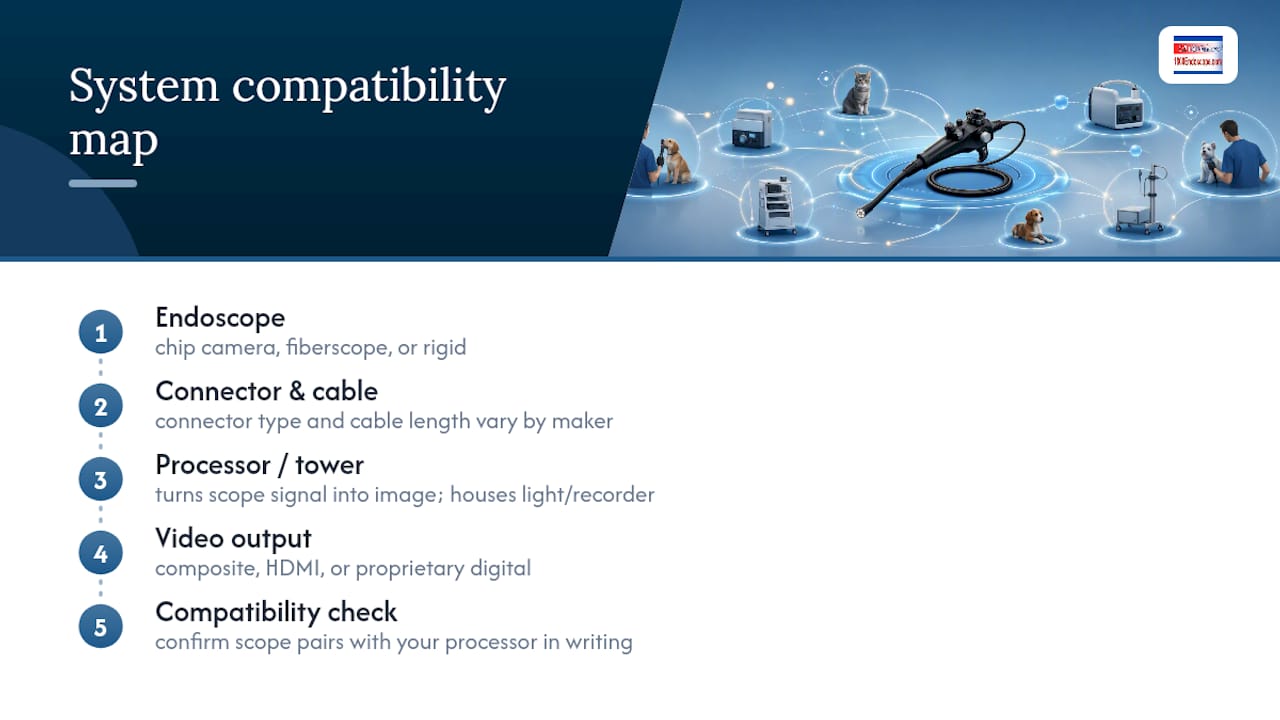
1. The scope itself. Flexible video endoscopes use a miniature camera chip at the tip and transmit a digital image to a processor, making them the standard for GI, respiratory, and urinary work in small animals. Fiberscopes use a bundle of glass fibers instead of a chip, producing a slightly lower-resolution image but often at a lower price point, and they still show up in some bronchoscopy and rhinoscopy setups. Rigid endoscopes, straight metal tubes with a lens system, dominate arthroscopy, laparoscopy, and certain urologic and equine procedures where flexibility isn't needed and image clarity at close range matters more.
2. The processor and tower. This is the box that turns the scope's raw signal into a usable image, and in most systems it also houses or connects to the light source and recording hardware. Older or budget systems separate these into distinct units; newer integrated towers combine them into one footprint. Recording matters more than buyers initially think: documenting a foreign body retrieval or a suspicious mucosal lesion protects you medically and helps client communication.
3. The monitor and storage. Some clinics run output to a dedicated medical-grade monitor; others use a standard HD display or even record straight to an SD card on portable units. Storage format and file compatibility with your existing practice management software deserve a five-minute check before purchase, not a surprise after.
4. Accessories. Biopsy forceps, grasping and retrieval forceps, cytology brushes, insufflation and irrigation pumps, and leak testers round out a working setup. None of these are optional if you're doing real diagnostic or therapeutic work, and none of them are usually included in a base scope price.
Compatibility is where good intentions go to die. Not every scope couples with every processor. Connector types, video output standards (composite vs. HDMI vs. proprietary digital), and even cable length vary by manufacturer, and a scope bought without confirming it pairs with your existing tower is a scope you can't use. If you already own a processor and are shopping for a compatible scope, get that confirmed in writing before you commit.
Which Endoscope Specs Fit Which Veterinary Procedure?
This is where a buying decision either gets sharp or stays vague. Every procedure has a rough spec range that works, and matching your shortlist to it saves you from either overbuying for diagnostic-only work or underbuying for a therapeutic case you'll regret mid-procedure.
- Feline and small-to-medium canine gastroscopy: an outer diameter in the 5.8 to 9.2 mm range with a working length around 1.0 meter handles routine upper GI work comfortably.
- Colonoscopy in large-breed dogs: you'll often need working lengths beyond 125 cm to reach the proximal colon, a length most standard gastroscopes don't offer.
- Bronchoscopy and rhinoscopy: these call for a narrower OD, frequently under 5 mm, since airway and nasal passages leave far less room than the GI tract.
- Cystoscopy: small OD and shorter working length work fine here, but channel size matters less than tip maneuverability in a tight, fluid-filled space.
- Equine GI and airway exams: adult horses require dramatically longer instruments, with gastroscopy sometimes demanding 3.0 to 3.5 meters of working length, a spec no small-animal scope comes close to meeting.
One scope rarely does all of this well. A versatile, well-built scope usable across upper and lower small-animal procedures is a smart general-practice foundation, but deep colonoscopy in a mastiff and adult equine gastroscopy are specialty jobs that a general-purpose small-animal scope simply cannot reach or maneuver through. If equine work is part of your caseload, plan for a dedicated long scope rather than hoping your gastroscope stretches far enough. Practices doing gait or lameness workups alongside endoscopy referrals may also find value in resources like this equine clinical practice guide for coordinating broader diagnostic workflows.
Toy breeds and exotics push in the opposite direction: you need a genuinely narrow OD, often under 4 mm, and accept a smaller or absent working channel as the tradeoff for fitting the scope where it needs to go at all.
How to Read a Spec Sheet and Test a Sample Endoscope
Spec sheets look authoritative. They're also easy to misread if you don't know which numbers actually predict clinical performance.
1. Verify the outer diameter against your smallest and largest patients. A scope rated for "small animal use" can still be too wide for a 4 pound cat's esophagus or too narrow to control well in a mastiff's stomach.
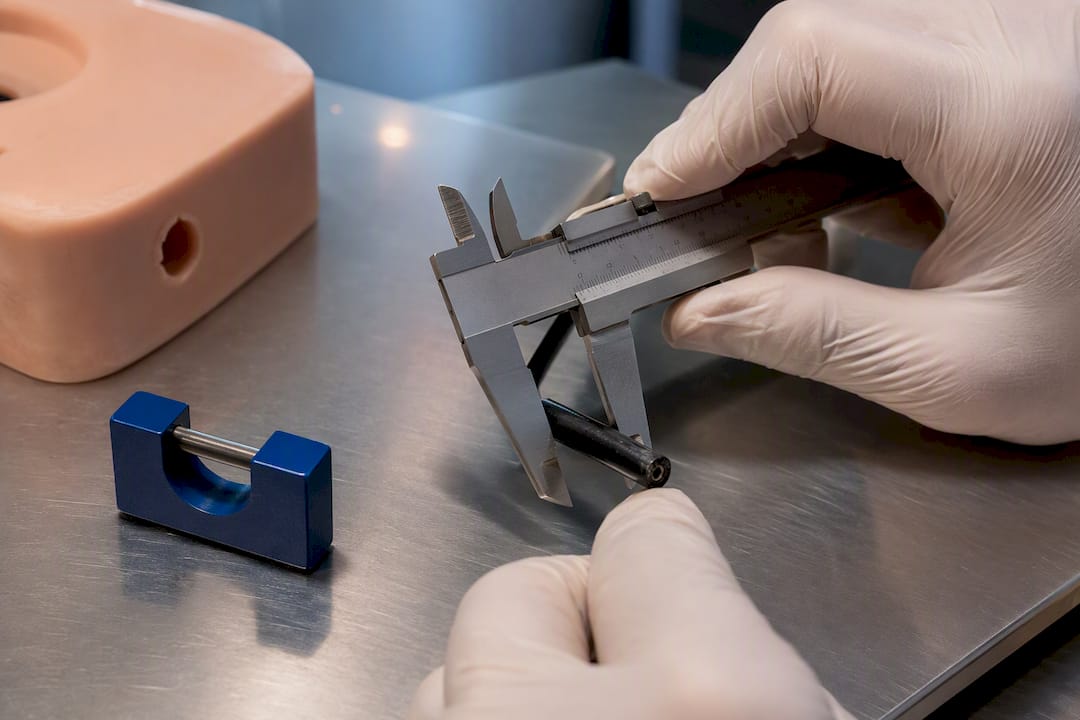
2. Check working length against your longest anticipated procedure, not your average one. Buy for the colonoscopy case, not just the routine gastroscopy.
3. Confirm working channel ID. As a practical guide, 1.2 mm channels suit micro-biopsy work in narrow cavities, 2.4 mm is the standard for routine small-animal GI biopsy, and 2.8 mm or larger is what you need for foreign-body retrieval and other therapeutic procedures.
4. Note bending angles and depth of field. A scope with poor up/down deflection range will frustrate you in the duodenum long before you notice the resolution.
5. Check video output format and resolution against your existing monitor or recording setup, and confirm ingress protection ratings if the unit will see rough handling or frequent submersion during cleaning.
Reading a spec sheet gets you a shortlist. Testing gets you a decision. Run every sample unit through the same checklist:
- Image quality under your clinic's actual procedure-room lighting, not the vendor's staged demo lighting.
- Tip articulation accuracy, meaning how precisely the image matches your control-wheel input.
- Suction and air/water supply function, checked at realistic flow rates.
- Accessory fit, actually threading your biopsy forceps and retrieval tools through the channel.
- A full leak test, since a scope that fails this after six months of use is a scope with a very short remaining lifespan.
- Cleaning ease and time, timed with a stopwatch if you want an honest number.
- Handling weight and balance during a simulated full-length procedure, not just a thirty-second grip test.
This structured approach to checking imaging, articulation, and cleaning practicality before signing anything catches problems a spec sheet will never reveal.
While you're testing, request documentation: the instructions for use (IFU), a service network map, a spare-parts list with lead times, full warranty scope, and any relevant certification documents. Ask specifically whether a certificate like ISO 13485 covers the exact model number you're buying, not just the manufacturer's product line broadly. Vague certification language is a red flag worth pressing on.
On cost tradeoffs: portable USB and WiFi-based scopes cost less upfront and suit clinics tight on space or budget, but they need the same rigorous image-quality and articulation testing as tower systems before purchase. A full HD tower system costs more but often comes with stronger service networks and longer product lifecycles, which can matter more than the sticker price once you calculate cost per year of use. For more on matching your first purchase to your caseload, guidance on first-scope selection walks through the decision in more depth.
What Sterilization and Maintenance Does a Vet Endoscope Need?
Reprocessing isn't a footnote. It's an operational cost center that shapes your daily schedule, and skipping steps is a patient-safety and liability problem, not just an inconvenience.
A standard reprocessing cycle for reusable flexible scopes runs through manual precleaning immediately after use, a leak test to catch internal damage before fluid gets where it shouldn't, high-level disinfection, thorough drying, and proper storage in a way that prevents recontamination. Each of these steps carries real workflow implications: a clinic running four or five scoped procedures a day needs either multiple scopes or a reprocessing turnaround fast enough not to create a bottleneck between patients.
Reusable flexible scopes demand the most involved cleaning protocol of any endoscope type, given their internal channels and bending sections. Rigid endoscopes are comparatively simpler since they lack the long internal channels that trap debris. Single-use or disposable scopes eliminate the reprocessing burden entirely, at the cost of a per-procedure consumable expense that adds up fast in a high-volume practice, and they're worth modeling against your actual case volume before assuming reusable is automatically cheaper.
A few practical habits reduce downtime:
- Keep a spare-parts inventory for common failure points (light guide bundles, angulation wires, valve seals).
- Set a maintenance schedule based on procedure volume, not just a calendar date.
- Log every reprocessing cycle, since these records matter for accreditation and for tracing a problem if one ever surfaces.
Manufacturer IFUs are not a suggestion. Reprocessing protocols vary by scope material and construction, and running a scope through the wrong disinfectant or drying process can shorten its working life dramatically. Step-by-step reprocessing guidance built specifically around veterinary and industrial scopes covers the procedural details worth building into your standard operating protocol.
What Does 1800endoscope Recommend Before You Buy?
This guide comes from 1800endoscope, where the day-to-day work is helping clinics match spec sheets to real caseloads rather than pushing whatever unit carries the best margin. The recommendations here reflect that same procurement-first logic: figure out your procedure mix first, then let the specs follow.
If you want a second opinion on real-world performance before committing, reviews comparing diagnostic scope options from other veterinary buyers are a useful cross-check against any single vendor's pitch. And before any purchase, request a specification sheet, a certificate tied to the exact model number, and, wherever possible, a sample unit. A vendor confident in their equipment will not hesitate to let you test it against your own patients under your own lighting.
— Endoscope
Ready to Compare Veterinary Endoscope Options?
You can access hardware options directly without a sales call standing between you and a spec sheet. Whether you need a compact, self-contained system for a space-constrained procedure room or a rigid setup for a specific surgical application, the catalog is organized by scope type rather than buried in vendor jargon.
Clinics buying their first scope often start with a fully portable option like the portable airway inspection endoscope system, which pairs a direct monitor and SD card recording in one unit, no tower required. Practices with existing rigid-optics needs, particularly for equine or orthopedic work, tend to browse the rigid endoscopy catalog instead, while clinics weighing borescope-style options for nonsterile inspection work can check the borescope catalog for comparable specs at a different price point.
If you're still narrowing down what fits your caseload, browse the current inventory and request a specification sheet or a sample unit for the model you're considering. It's the fastest way to turn a shortlist into a purchase order.
Sources
- Introduction to endoscopy in the cat - PMC - NIH
- Endoscopic Equipment for the Veterinary Practitioner
- Guidelines for Selecting Veterinary Endoscopes - SioMedical