
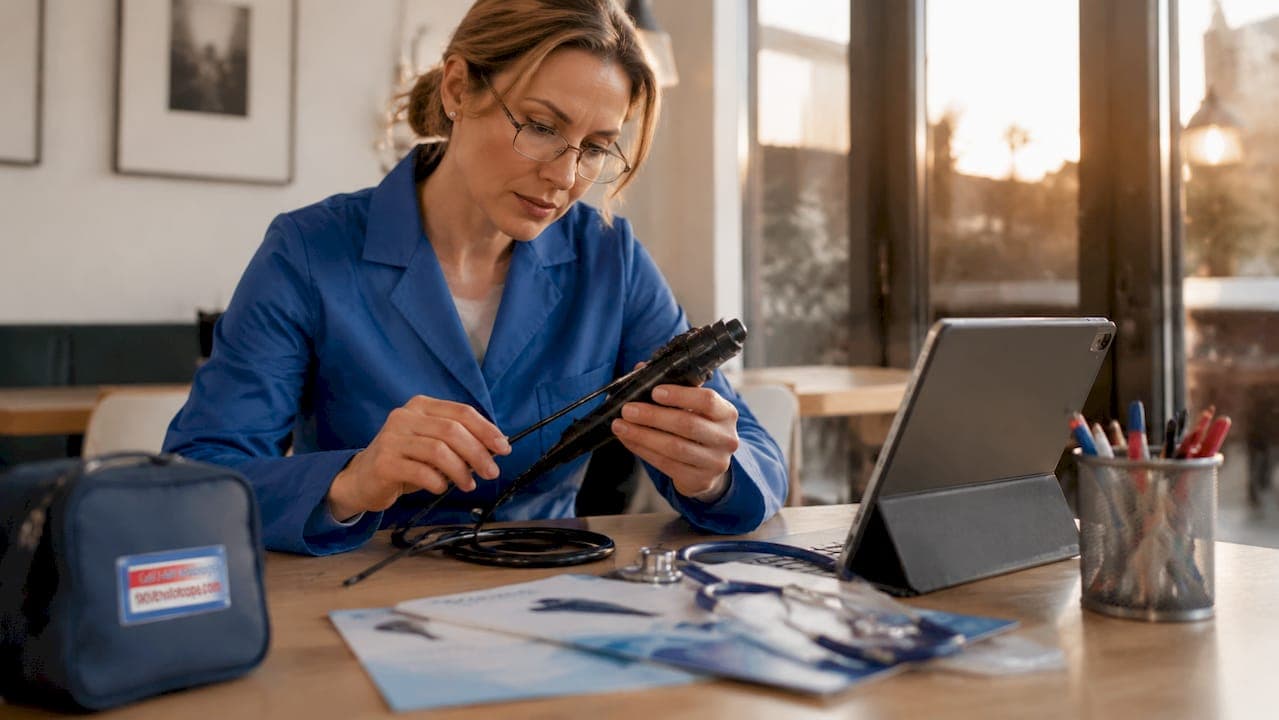
A wireless endoscope is a medical imaging device that captures internal body visuals and transmits them without physical cables, using embedded cameras, light sources, and wireless communication technology to support diagnostic and surgical procedures in both human and veterinary medicine. The term "wireless endoscope" covers two distinct device categories: wireless capsule endoscopes, which patients swallow, and wireless surgical endoscopes, which use LiFi optical communication to stream 4K video in real time. Understanding the difference between these categories matters because each serves a fundamentally different clinical purpose. For veterinary and medical professionals evaluating new diagnostic tools, this distinction shapes every procurement and workflow decision.
What is the wireless endoscopes definition and how does it differ from traditional scopes?
A wireless endoscope is defined as any endoscopic device that replaces the physical cable connecting the imaging head to an external monitor or recorder with a wireless data transmission system. Traditional wired endoscopes rely on fiber optic bundles or electrical cables to carry image data from the insertion point to the display unit, creating physical constraints on maneuverability and sterile field management. Wireless designs eliminate that tether entirely, either by housing all imaging electronics within the device itself or by transmitting data optically or via radio frequency to an external receiver.
The two recognized industry terms you will encounter in clinical literature are capsule endoscopy and wireless surgical endoscopy. Capsule endoscopy refers to a non-invasive diagnostic procedure where a patient swallows a vitamin-sized capsule containing a camera and light source that transmits images to a wearable receiver worn on the body. Wireless surgical endoscopy refers to a newer class of rigid or flexible scopes that use LiFi, a modulated LED light communication protocol, to stream high-definition video from the operating field to a monitor without any data cable. Both fall under the wireless endoscopes definition, yet they serve entirely different procedural contexts.

For veterinary professionals, the concept extends further. Portable wireless devices support remote visual inspection of animal airways, gastrointestinal tracts, and oral cavities, enabling diagnostics in field settings where running cables to a fixed monitor is impractical. The shared thread across all three categories is the absence of a physical data cable between the imaging element and the display or recording system.
How do wireless endoscopes work?
Capsule endoscopy: swallow, transmit, review
The capsule endoscope operates entirely autonomously once swallowed. The device contains a miniaturized camera, LED light source, image processor, battery, and wireless transmitter within a capsule roughly the size of a large vitamin. As it transits the gastrointestinal tract, the capsule captures thousands of high-resolution images over 8 to 12 hours, transmitting each frame wirelessly to adhesive receiver patches placed on the patient's abdomen. A clinician then reviews the compiled image set, often with AI-assisted software, after the procedure concludes.
Power management is the primary engineering constraint in capsule design. The onboard battery must sustain the camera, LED array, and transmitter for the full transit window without recharging. Manufacturers address this through aggressive image compression algorithms and duty-cycling the LED array, capturing frames at set intervals rather than continuously. The result is a device that generates a complete small bowel survey without any external power connection.
LiFi surgical endoscopes: real-time optical wireless
The LiFi wireless surgical endoscope takes a different approach. Rather than housing all electronics within a disposable capsule, it integrates a LiFi communication module and battery-operated LED light source directly into the endoscope head. The LiFi module provides hemispherical propagation over 180 degrees, maintaining a reliable optical link between the scope and a ceiling-mounted or boom-mounted receiver in the operating room. This architecture streams 4K video in real time with the low latency required for active surgical guidance.
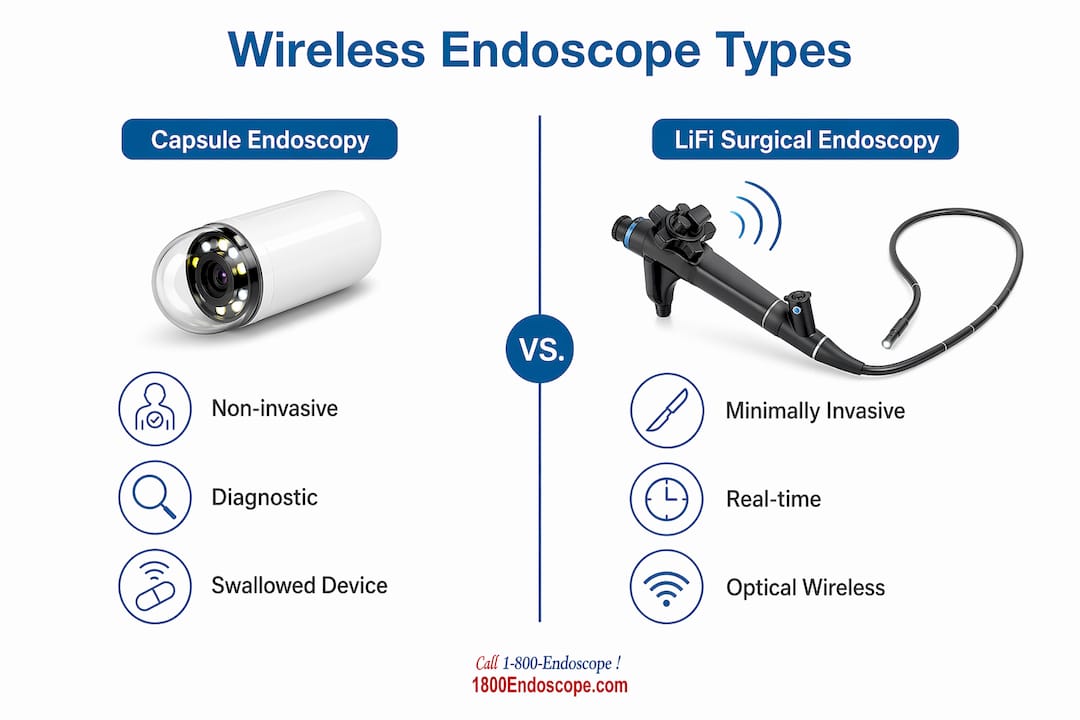
A critical technical detail: LiFi wireless endoscopes require specialized on-device microprocessors for low-latency 4K video compression, balancing power consumption and image quality during laparoscopic operations. The system also supports real-time bidirectional optical data links, meaning a surgeon can adjust camera settings from the monitor without touching the scope or any physical control cable. That bidirectional capability is what separates LiFi from simpler one-way radio frequency transmission systems.
Pro Tip: When evaluating LiFi surgical endoscopes for your OR, confirm that the ceiling receiver unit covers the full range of your boom arm's sweep. A receiver with less than 180-degree coverage will create dead zones during scope repositioning, interrupting the video feed at the worst possible moment.
What types of wireless endoscopes are available?
The market currently offers two primary categories of wireless endoscopes, each with distinct design philosophies, imaging characteristics, and clinical indications. The table below compares them across the dimensions most relevant to clinical decision-making.
| Feature | Wireless capsule endoscope | LiFi wireless surgical endoscope |
|---|---|---|
| Invasiveness | Non-invasive (swallowed) | Minimally invasive (inserted) |
| Imaging quality | High-resolution stills, ~1:8 magnification | 4K real-time video |
| Data transmission | Radio frequency to abdominal patches | LiFi optical to room receiver |
| Procedural use | Diagnostic only | Diagnostic and surgical guidance |
| Typical indications | Small bowel bleeding, Crohn's disease, tumors | Laparoscopy, cholecystectomy, general surgery |
| Veterinary suitability | Limited (size constraints) | Adaptable for large animal procedures |
Wireless capsule endoscopy excels at visualizing the small intestine, a region that flexible endoscopes cannot reliably reach. The capsule achieves approximately 1:8 magnification, sufficient to visualize individual intestinal villi and detect subtle mucosal lesions. FDA-approved AI assistants now accelerate image review, flagging abnormalities within the thousands of frames generated per examination. This makes capsule endoscopy the standard of care for suspected small bowel pathology in human medicine.
For veterinary applications, small-diameter portable scopes designed for airway and gastrointestinal inspection fill a practical gap. The equine airway videoscope from 1800endoscope, for example, provides wireless-compatible SD card video recording for field use in large animal diagnostics, where portability matters more than OR-grade connectivity. Understanding what type of wireless endoscope technology fits your specific patient population is the first step toward a sound equipment decision.
What are the benefits and challenges of wireless endoscopes?
Benefits that change clinical workflows
Wireless endoscopes deliver three categories of measurable benefit: ergonomic improvement, hygiene enhancement, and diagnostic reach. On the ergonomic side, eliminating cables reduces OR clutter and allows surgical teams to reposition freely without managing cable routing around sterile fields. Fraunhofer's LiFi endoscope development specifically targeted this pain point, integrating wireless data and power into a single cable-free unit that works with existing surgical lighting infrastructure.
For patients, wireless capsule endoscopy eliminates the discomfort of tube insertion for small bowel examination. The procedure requires no sedation, no recovery time, and no hospital admission in most cases. For veterinary patients, portable wireless scopes reduce the need for general anesthesia in diagnostic-only airway examinations, which carries real risk reduction in compromised animals.
Challenges that require planning
The limitations of wireless endoscope technology are real and worth stating directly:
- Battery life constrains capsule endoscope transit time. If a patient's GI motility is slow, the capsule may not complete small bowel transit within the 8 to 12 hour battery window, leaving the distal ileum unexamined.
- Therapeutic limitations are significant. Capsule endoscopy cannot perform biopsies or therapeutic interventions such as polypectomy or hemostasis. A wired flexible scope remains the only option when treatment is required.
- Receiver placement directly affects data completeness. Incorrect adhesion of abdominal patches can cause data loss during the examination, requiring the procedure to be repeated.
- Signal reliability in LiFi systems depends on maintaining optical line-of-sight between the scope and receiver. Smoke, blood, or scope repositioning outside the receiver's coverage arc can interrupt transmission.
- Device cost for LiFi surgical endoscope systems currently exceeds traditional wired alternatives, which affects adoption timelines in budget-constrained veterinary and rural medical settings.
Pro Tip: For capsule endoscopy procedures, have your patient wear a fitted abdominal belt over the adhesive patches rather than relying on adhesive alone. This reduces patch displacement during the 8 to 12 hour examination window and improves data capture rates, particularly in patients with high body mass index.
How are wireless endoscopes applied in clinical and veterinary practice?
Human medicine: small bowel diagnostics and surgical efficiency
Wireless capsule endoscopy is the diagnostic standard for obscure gastrointestinal bleeding, suspected Crohn's disease affecting the small bowel, small intestinal tumors, and iron deficiency anemia with no identified source on upper and lower endoscopy. The capsule's ability to image the full small intestine makes it the only non-surgical tool capable of surveying this anatomical region completely. AI-assisted review platforms now flag clinically significant findings automatically, reducing the time a gastroenterologist spends reviewing the thousands of frames each examination generates.
LiFi wireless surgical endoscopes are entering laparoscopic workflows in pilot programs across Europe and North America. The LiFi technology overcomes radio frequency limitations in latency, reliability, and security that made earlier radio-based wireless scopes unsuitable for active surgical guidance. Surgical teams in pilot studies report that the absence of data cables simplifies draping, reduces setup time, and eliminates a category of equipment that historically required sterilization between cases.
Veterinary medicine: field diagnostics and large animal care
Wireless endoscope technology adoption in veterinary practice is growing, driven by portability and the practical demands of large animal care. A portable airway inspection scope with onboard SD card recording functions as a wireless-compatible system in the field: the clinician records the examination locally and reviews footage without needing a cable connection to a remote monitor. For equine practitioners performing upper airway evaluations at the barn, this workflow is faster and less disruptive than transporting animals to a clinic with fixed endoscopy infrastructure.
Gastrointestinal inspection in small animals also benefits from compact wireless-compatible videoscopes. The ability to record and transmit findings digitally supports telemedicine consultations, where a specialist reviews footage captured by a general practitioner in a remote location. This model is expanding access to specialist-level endoscopic interpretation without requiring specialist presence at the point of care.
Future directions in wireless endoscopy include therapeutic capsule systems under active research, which would add biopsy and drug delivery capabilities to the current diagnostic-only capsule platform. When those systems reach clinical availability, the distinction between capsule and wired scope indications will narrow considerably.
Key takeaways
Wireless endoscopes are defined by the absence of a physical data cable between the imaging element and the display, with capsule and LiFi surgical systems representing the two primary technology categories in current clinical use.
| Point | Details |
|---|---|
| Two distinct categories | Capsule endoscopes and LiFi surgical endoscopes serve different clinical purposes and should not be evaluated interchangeably. |
| Capsule endoscopy reach | Capsule systems image the small bowel region that flexible wired scopes cannot reliably access, making them the standard for small bowel diagnostics. |
| LiFi advantage in the OR | LiFi optical transmission solves the latency and security problems that made earlier radio-based wireless scopes unsuitable for active surgical guidance. |
| Therapeutic limitation | Wireless capsule systems cannot perform biopsies or therapeutic interventions; wired flexible scopes remain necessary when treatment is required. |
| Veterinary portability | Portable wireless-compatible scopes support field diagnostics in large animals, reducing reliance on fixed clinic infrastructure for airway and GI inspection. |
Why wireless endoscopy is reshaping how I think about scope selection
From where I sit at 1800endoscope, the most common mistake I see professionals make when evaluating wireless endoscopes is treating the category as a single technology. A clinician who dismisses wireless endoscopy because capsule systems cannot take biopsies is missing the LiFi surgical endoscope entirely. A surgeon who evaluates LiFi scopes without considering OR receiver infrastructure is setting up an adoption failure before the device arrives.
The more interesting shift I am watching is in veterinary medicine. Large animal practitioners have always worked in conditions that make wired endoscopy awkward: barns, paddocks, field calls where a cable to a monitor is a genuine logistical problem. Portable wireless-compatible scopes are not a compromise for these practitioners. They are a better fit than the wired alternative ever was. That is a genuine technology-to-use-case match, not a marketing claim.
LiFi surgical endoscopes represent the most significant OR workflow change I have seen since HD imaging replaced standard definition. The infection control implications alone, eliminating a category of cables that require sterilization or sterile draping, justify serious evaluation by any surgical team running high case volumes. I expect adoption to accelerate as device costs normalize over the next two to three years.
— Endoscope
Explore wireless and portable endoscope solutions from 1800endoscope
Medical and veterinary professionals ready to evaluate wireless-compatible endoscopy systems will find a practical range of options at 1800endoscope, covering both portable field scopes and clinic-grade videoscope systems.
The portable airway endoscopy system at 1800endoscope supports SD card video recording for wireless-compatible field use in veterinary and human airway diagnostics. For a broader view of available systems across veterinary, medical, and industrial categories, the full endoscope catalog covers small-diameter videoscopes, fiber optic scopes, and specialty accessories. Whether you are outfitting a large animal practice or evaluating portable options for a surgical suite, 1800endoscope offers direct sourcing with no intermediary markup.
FAQ
What is the standard definition of a wireless endoscope?
A wireless endoscope is a medical imaging device that captures internal body images and transmits them to an external display or recorder without a physical data cable, using either radio frequency or LiFi optical communication technology.
How does wireless capsule endoscopy differ from wireless surgical endoscopy?
Capsule endoscopy uses a swallowed, self-contained device for diagnostic imaging of the gastrointestinal tract, while wireless surgical endoscopy uses a LiFi-enabled scope inserted by a clinician for real-time imaging during minimally invasive procedures.
Can wireless endoscopes replace wired flexible scopes entirely?
Wireless capsule systems cannot replace wired flexible endoscopes for therapeutic procedures such as biopsies or lesion removal. Wired scopes remain the standard when intervention is required alongside visualization.
What are the main benefits of wireless endoscopes in veterinary practice?
Portable wireless-compatible scopes eliminate the need for fixed monitor infrastructure, making airway and gastrointestinal inspection practical in field settings for large animals such as horses, with onboard recording supporting remote specialist review.
What is LiFi and why does it matter for wireless endoscope technology?
LiFi is a modulated LED light communication protocol that transmits data optically rather than via radio frequency, providing the low latency, high reliability, and security required for real-time 4K video streaming in surgical operating rooms.