
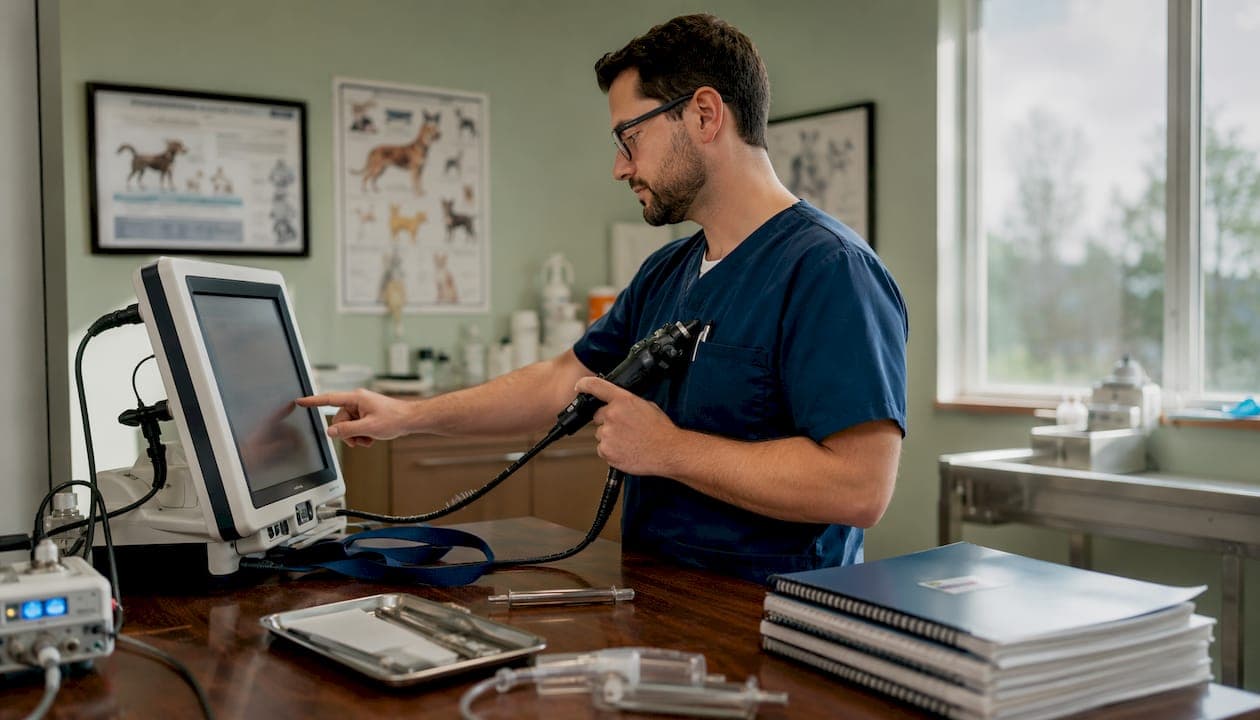
For most US professionals buying wireless endoscope tools in 2026, the 1800endoscope portable wireless videoscope line is the clearest starting point: matched probe diameters, documented IP ratings, US warranty coverage, and in-stock availability without the guesswork of gray-market imports.
Three reasons this recommendation holds up under scrutiny:
- Probe fit and access: The 6mm portable videoscope handles small-animal airways and tight industrial passages where larger probes simply cannot go. The 8mm equine variant covers large-animal work without switching platforms.
- Ingress protection and durability: IP67/IPX7-rated probes tolerate immersion for cleaning between cases, which matters whether you are disinfecting between patients or rinsing a probe after a pipe inspection.
- Wireless protocol and latency: Wi-Fi RTSP transmission streams live video to iOS, Android, and Windows devices with low enough latency for diagnostic review and field documentation, while USB fallback keeps you covered when Wi-Fi is unavailable.
The single most important buying principle in 2026: Fit-to-task beats feature count. Probe diameter, cable type, and battery strategy matter more than any headline spec on a product listing.
Table of Contents
- What specs actually decide a 2026 wireless endoscope purchase?
- How do wireless connectivity options compare in 2026?
- Which use cases call for which endoscope type?
- What do different price tiers actually get you in 2026?
- How to choose: a procurement checklist and red flags
- What cleaning and disinfection limits should you plan for?
- How should you handle recording, storage, and documentation?
- What research and 2026 trends should influence your buying decision?
- 1800endoscope portable wireless systems: what fits 2026 buyers
- Key Takeaways
- What wireless endoscope deployment actually looks like in practice
- Ready to order or request a demo from 1800endoscope?
- Useful sources and further reading
What specs actually decide a 2026 wireless endoscope purchase?
Probe diameter is the first filter, not the last. A 6mm outer diameter (OD) reaches a cat's trachea or a residential pipe elbow; a 10mm OD cannot. Once you confirm access, every other spec falls into place.
Probe length determines reach. A 750mm working length suits airway exams in small animals; gastrointestinal work in larger breeds needs 1,200mm or more. Industrial pipe runs and HVAC ducts may require 3–5 meters of semi-rigid cable.
Cable type shapes handling. Semi-rigid cables hold a set bend and push through straight runs. Flexible cables navigate curves passively. Articulating cables add active tip steering, typically 180° or full 360°, which is the difference between seeing around a corner and guessing what is there.
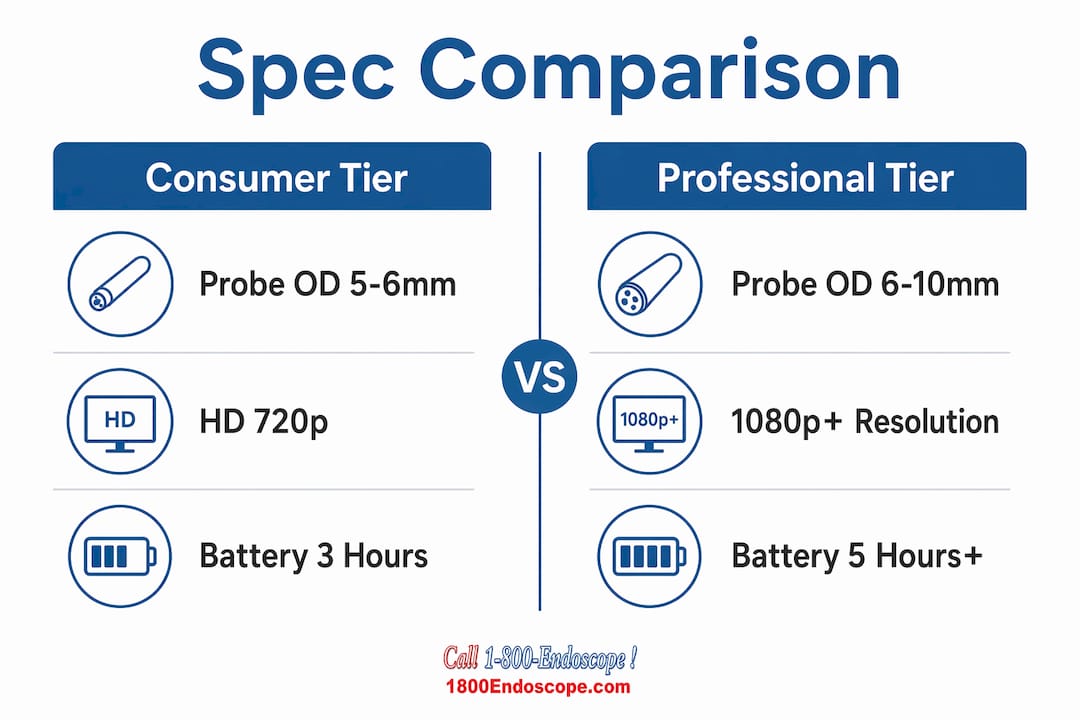
Resolution and lighting are linked. HD (720p) is acceptable for basic inspection; 1080p is the practical floor for clinical documentation; 2K and 4K sensors add diagnostic detail but demand more battery and processing. LED count and adjustable brightness matter as much as sensor resolution, especially in dark cavities. A well-lit 1080p image beats a dim 4K frame every time. For LED selection guidance, the 1800endoscope light source guide covers color balance and brightness trade-offs in detail.
Battery life on professional portable units typically runs 3–5 hours of continuous operation. That ceiling is set by high-resolution sensors and continuous wireless transmission drawing power simultaneously. Replaceable battery designs let busy clinics swap packs mid-day without downtime.
IP rating defines cleaning options. IP67 and IPX7 both allow immersion up to 1 meter for 30 minutes, which covers high-level disinfection with approved solutions. Autoclave sterilization is not realistic for flexible video probes.
| Spec | Consumer tier | Field/prosumer tier | Professional clinical/NDT tier |
|---|---|---|---|
| Probe OD | 5–8mm | 5–8mm | 5–10mm+ |
| Probe length | Up to 1m | 1–3m | 1–5m+ |
| Cable type | Semi-rigid | Flexible | Flexible or articulating |
| Resolution | 720p HD | 1080p | 1080p–4K |
| Battery life | 1–2 hrs | 2–4 hrs | 3–5 hrs, replaceable |
| IP rating | IPX4–IPX6 | IPX7 | IP67/IPX7 |
| Working channel | None | Rare | Available on select models |
| Warranty/support | Limited | 1 yr, varies | 1–2 yr, US support |
How do wireless connectivity options compare in 2026?
The dominant wireless standard for portable endoscopes in 2026 is Wi-Fi RTSP (Real-Time Streaming Protocol). It streams live video to any compatible app on iOS, Android, or Windows with latency that works well for documentation, field inspection, and teaching. USB direct connection remains the reliable fallback when Wi-Fi is congested or unavailable.
Clinical research consistently shows that healthcare professionals prioritize latency and system reliability over complete wireless freedom. That is why hybrid setups persist: wireless for diagnostics and mobility, cabled connections for high-stakes therapeutic procedures where a dropped frame is not acceptable.
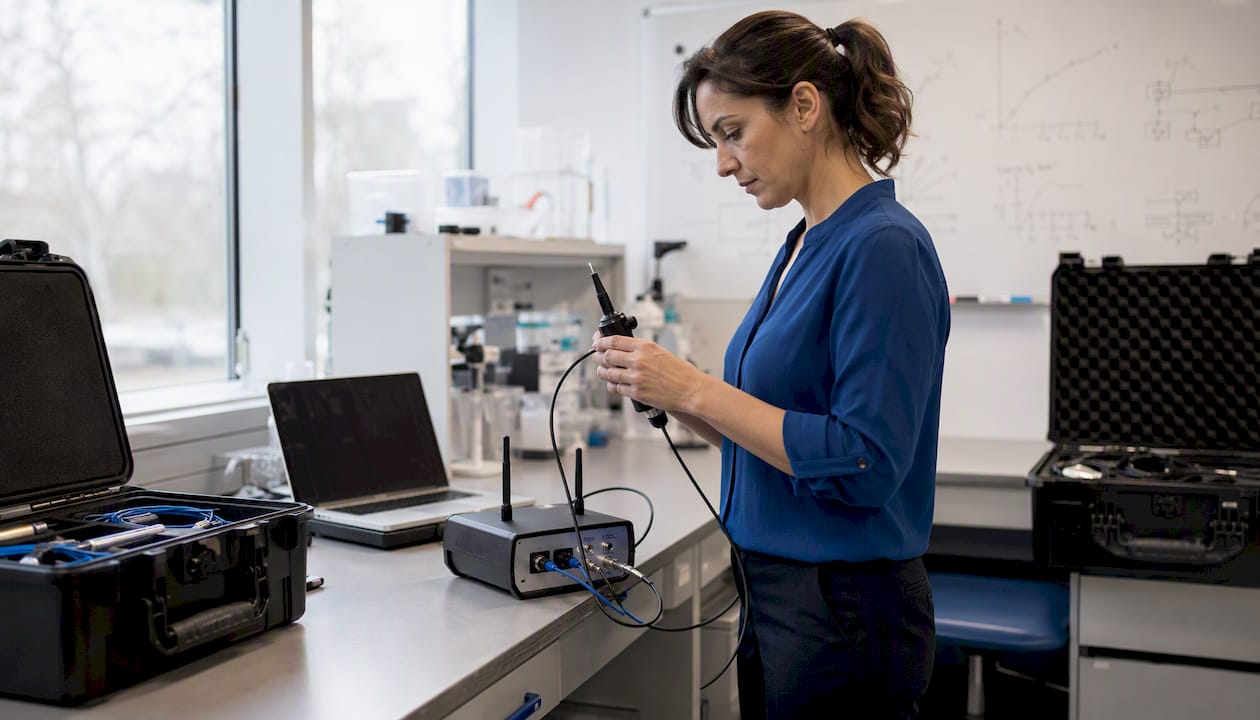
The most significant near-term development is LiFi (light-based wireless). Fraunhofer and OWIMED researchers have built prototypes that stream 4K surgical video using modulated LED transmitters integrated into surgical lights, with photodiode receivers on the scope. The localized signal propagation reduces interference and improves OR security. Surgical teams testing the prototypes in simulator environments reported positive results, though large-scale clinical validation is still pending.
Compatibility checklist before you buy:
- Confirm the app supports your OS version (iOS 15+, Android 10+, Windows 10/11).
- Verify RTSP or ONVIF support if you plan to record to a network video recorder or third-party software.
- Check multi-display capability: some systems support up to three simultaneous screens for teaching or team review.
- Ask whether USB drivers are included and whether they require installation or are plug-and-play.
Pro Tip: Before committing to a unit, run a quick latency test in your actual environment. Open the live stream on your target device, wave a finger in front of the lens, and count the delay. Anything under half a second is acceptable for diagnostic review. If the delay is longer, test on a dedicated 5GHz Wi-Fi channel before concluding the hardware is the problem.
Which use cases call for which endoscope type?
Matching the scope to the job prevents the most common buyer mistake: purchasing a capable tool that physically cannot reach or fit the target anatomy or passage.
- Small-animal airway (rhinoscopy, bronchoscopy): 5–6mm OD, 750mm working length, flexible cable, 1080p minimum. Wireless streaming is genuinely useful here for student observation and case recording. The 6mm portable videoscope from 1800endoscope is sized precisely for this application.
- Large-animal and equine airway: 8mm OD or larger, 1,000mm+ working length, flexible articulating cable. The equine 8mm scope covers field work where portability matters as much as image quality.
- Gastrointestinal exams (small to medium animals): 5.8–8mm OD, 1,200–1,500mm working length, working channel for forceps or irrigation. Wireless is useful for documentation; the working channel is non-negotiable for therapeutic procedures.
- HVAC and plumbing inspection: Semi-rigid cable, 3–5m length, 720p–1080p resolution, IPX7 rating for wet environments. Wireless streaming lets an inspector view footage on a tablet while the probe is in the duct.
- Automotive engine inspection: Flexible borescope, 5–8mm OD, 600–1,000mm, adjustable LED brightness. Wireless is convenient but not critical; USB connection to a phone or tablet works fine.
- Industrial NDT (non-destructive testing): Articulating tip, high-durability insertion tube, 1080p+, IP67, with documentation output (MP4 or still images with metadata). Wired or hybrid systems remain the safer choice for high-stakes structural inspections.
Where wireless adds the most value: mobile veterinary clinics, field service calls, teaching environments, and multi-technician inspections where several people need to see the same image simultaneously. Where wired or hybrid systems remain the practical choice: therapeutic clinical procedures requiring irrigation or biopsy tools, and NDT inspections where chain-of-custody documentation demands a direct-connected recording system.
One caveat that matters: Consumer wireless borescopes are not medical devices. They lack the regulatory clearance, sterility controls, and validated performance required for invasive clinical use. Use them for inspection and diagnostics only, and follow your facility's protocols for any procedure involving patient contact.
What do different price tiers actually get you in 2026?
Price in the wireless endoscope market is a reasonable proxy for durability and feature depth, but only within tiers. Overspending on a clinical system for a plumbing inspection job is as wasteful as buying a consumer borescope for a veterinary clinic.

| Tier | Typical price range | Probe OD | Resolution | Battery | Warranty/support |
|---|---|---|---|---|---|
| Entry-level consumer | — | 5–8mm | 720p HD | 1–2 hrs, internal | 30 days, limited |
| Field/prosumer | — | 5–8mm | 1080p | 2–4 hrs, some replaceable | 1 yr, varies |
| Professional clinical/NDT | — | 5–10mm+ | 1080p–4K | 3–5 hrs, replaceable | 1–2 yr, US support |
Beyond the unit price, budget for accessories and consumables. Spare batteries or a battery rotation kit add cost but are necessary for full-day clinical use. Sterilization-compatible sheaths, if required by your protocol, are a recurring expense. Working-channel accessories (biopsy forceps, irrigation valves, cleaning brushes) are priced separately and vary by probe diameter. Replacement probes and repair parts are the hidden cost that separates vendors with real US support from those without it. Ask about MTBF (mean time between failures) for the insertion tube before you buy.
How to choose: a procurement checklist and red flags
A structured approach to evaluation saves time and prevents expensive mismatches.
- Match probe OD and length to your access requirement. Measure the target passage or anatomy before you look at product listings.
- Confirm IP rating and sterilization method. IP67/IPX7 allows immersion disinfection. If your protocol requires autoclave sterilization, a flexible video probe will not survive it.
- Verify battery strategy. Replaceable batteries are worth the premium for any clinical or full-day field application. Internal-only batteries are a bottleneck.
- Confirm connectivity options and test latency. Wi-Fi RTSP is the standard; USB fallback is the safety net. Test both before committing.
- Check spare-parts availability and warranty terms. US-based support and documented warranty language are non-negotiable for professional procurement.
- Request a datasheet or spec sheet. Any vendor who cannot provide one is a red flag.
- Ask for a demo or loaner trial where the purchase justifies it.
Questions to ask sellers directly:
- Can you provide the manufacturer datasheet with probe OD, working length, IP rating, and sensor specs?
- What is the warranty period and who handles US-based repairs or replacements?
- What is the software update policy, and are updates free?
- What is the typical MTBF for the insertion tube under clinical or field use?
- Are replacement probes and accessories in stock in the US?
Red flags to walk away from:
- No datasheet or vague spec sheet with missing IP rating.
- Warranty language that requires shipping to an overseas service center.
- Vendor claims the device is a "medical device" without FDA registration documentation.
- No US phone or email support contact.
- Probe OD listed as a range ("5–8mm") without specifying the actual unit being sold.
Procurement principle: A vendor who cannot answer the datasheet and warranty questions in writing before purchase will not answer them after it either. Require documentation upfront.
Pro Tip: To evaluate claimed wireless latency, ask the vendor for a live demo over video call. Have them wave a hand in front of the lens while you watch the stream on your end. Real-world latency shows up immediately, and no vendor can fake it on a live call.
What cleaning and disinfection limits should you plan for?
IP67 and IPX7 ratings allow full immersion in water up to 1 meter for 30 minutes. That is sufficient for high-level disinfection using approved solutions such as glutaraldehyde-based or OPA (ortho-phthalaldehyde) disinfectants, following the manufacturer's specified contact times. What it does not allow is autoclave sterilization: the heat and pressure cycles that rigid metal instruments tolerate will destroy flexible video probe electronics and seals.
Practical cleaning guidance:
- Wipe the insertion tube with a compatible disinfectant wipe after each use before immersion.
- Soak in approved high-level disinfectant per the manufacturer's contact time, typically 20–45 minutes for OPA.
- Rinse thoroughly with sterile water and air-dry before storage.
- Never submerge the handle or connector end unless the datasheet explicitly rates those components.
- Inspect seals and O-rings regularly; replace them on the manufacturer's recommended schedule.
Battery and seal maintenance:
- Store units at room temperature; heat accelerates battery swelling and seal degradation.
- Avoid leaving batteries fully discharged for extended periods.
- Follow the manufacturer's battery replacement schedule, not just the point of failure.
The 1800endoscope clinician guide to wireless endoscopes covers clinical-use limits and disinfection considerations in more detail for veterinary and medical buyers.
In veterinary and field workflows, "wireless" refers to image transmission. Biopsy forceps, irrigation, and therapeutic tools still depend on physical working channels and external pumps. A wireless scope without a working channel is a diagnostic tool, not a therapeutic one.
Safety note: Consumer wireless borescopes are not approved for invasive medical procedures. Do not use them in any application where a regulated medical device is required by law or clinical protocol.
How should you handle recording, storage, and documentation?
MP4 is the practical default for endoscope recordings in 2026. It balances file size, compatibility, and playback across Windows, iOS, and Android without conversion. MOV works well within Apple ecosystems. AVI is still used in some industrial NDT workflows where legacy software requires it. For codec settings, H.264 at 1080p hits the right balance of clarity and file size for most clinical and field documentation; H.265 (HEVC) cuts file size roughly in half at equivalent quality but requires more processing power to play back.
Storage strategy:
- On-device SD card: Fast, simple, no network dependency. Use a high-speed card (Class 10 / U3 minimum) to avoid dropped frames during 1080p or 4K recording.
- Wi-Fi upload to a secure server: Better for multi-user access and backup, but requires a reliable network and, for clinical records, encryption in transit and US data residency compliance. HIPAA-covered entities must confirm their storage solution meets those requirements before uploading patient-adjacent records.
Documentation best practices:
- Enable automatic timestamping on the recording app; most 2026 apps include this by default.
- Include the device serial number in the file metadata or the inspection report header.
- Link still images to written inspection notes immediately after the procedure, not at the end of the day.
- For NDT chain-of-custody, export a PDF report with embedded images and timestamps before closing the job.
RTSP-capable units can stream directly to common recording software such as VLC, OBS Studio, or dedicated inspection apps, which adds flexibility for multi-display setups and archiving. Check that the app supports ONVIF if you plan to integrate with a network video recorder.
What research and 2026 trends should influence your buying decision?
The clearest pattern in recent clinical deployment research is the hybrid adoption model: wireless for diagnostics and mobility, cabled systems for therapeutic and high-stakes procedures. This is not a transitional phase. It reflects a genuine trade-off between the convenience of wireless and the reliability requirements of interventional work. Procurement decisions should account for both modes rather than assuming one system covers everything.
LiFi is the technology most likely to change that calculus. The Fraunhofer/OWIMED prototypes that stream 4K images in OR environments using modulated LED transmitters address the three main objections to wireless in clinical settings: latency, interference, and security. The signal stays within the room because light does not pass through walls, which also satisfies infection-control concerns about RF transmission hardware. Surgical teams in simulator testing responded positively. Commercial availability is not confirmed for 2026, but the technology is past proof-of-concept.
Buying implication: If your primary use is diagnostic imaging, field inspection, or teaching, current Wi-Fi RTSP systems are ready now and well-supported. If you are evaluating wireless for high-stakes therapeutic procedures in a clinical OR, waiting for LiFi-ready commercial systems is a reasonable position. The 2026 portable endoscope trends guide from 1800endoscope covers the technology timeline in more detail.
The wireless endoscopic imaging research also confirms what experienced buyers already know: the gap between professional-grade systems and consumer inspection borescopes is not closing. Professional systems add steering, irrigation channels, and regulatory-grade connectivity. Consumer borescopes optimize for handheld convenience. Buying the wrong tier for the job is the most common procurement error in this category.
1800endoscope portable wireless systems: what fits 2026 buyers
1800endoscope's portable wireless line addresses the most common professional use cases with documented specs, US availability, and clear warranty terms. The 6mm portable videoscope is the flagship for small-animal airway work and tight-access industrial inspection; the 8mm equine scope covers large-animal field diagnostics.
| Model | Best for | Probe OD | Probe length | Cable type | Resolution | Connectivity | IP rating |
|---|---|---|---|---|---|---|---|
| 6mm portable videoscope | Small-animal airway, tight industrial access | 6mm | 120cm | Flexible | HD video, SD card | Direct monitor, SD card | IPX7 |
| 8mm equine scope | Large-animal airway, field diagnostics | 8mm | 120cm | Flexible | HD video | USB, direct monitor | IPX7 |
Both units ship with direct monitor output and SD card recording, which means documentation works without a network connection. Accessories including hooks, magnets, and mirror attachments are available through the 1800endoscope catalog. Spare probes and replacement parts are stocked in the US, which matters when a probe fails mid-week and you cannot wait for overseas shipping.
For buyers who need a broader procurement overview, the full endoscope and borescope catalog covers the complete product line including rigid veterinary scopes, NDT borescopes, and accessories. The small-diameter endoscope guide explains when 6mm probes are the right call for small-animal diagnostics and what accessory compatibility looks like in practice.
Key Takeaways
Probe diameter, IP rating, and battery strategy are the three specs that determine whether a wireless endoscope actually works for your application in 2026.
| Point | Details |
|---|---|
| Match probe OD to access | A 6mm probe fits small-animal airways and tight passages; 8mm+ suits large-animal and industrial work. |
| Confirm IP rating and cleaning limits | IP67/IPX7 allows immersion disinfection; autoclave sterilization is not compatible with flexible video probes. |
| Plan your battery strategy | Professional portable units run 3–5 hours continuous; replaceable batteries prevent mid-day downtime in busy clinics. |
| Verify wireless latency before buying | Wi-Fi RTSP works for diagnostics and field use; hybrid wired backup remains necessary for high-stakes therapeutic procedures. |
| 1800endoscope for US buyers | The 6mm and 8mm portable videoscope lines offer documented specs, US warranty, and in-stock spare parts for veterinary and industrial buyers. |
What wireless endoscope deployment actually looks like in practice
Buyers consistently underestimate two things: battery rotation and probe replacement cycles. A single battery pack running all day in a busy clinic is a plan that fails by early afternoon. The clinics that get the most out of portable wireless systems are the ones that budget for two battery packs from day one and build a rotation into their morning prep. Probe replacement is the other surprise. Insertion tubes take mechanical stress with every use, and flexible probes in high-volume practices need replacement on a schedule, not just at the point of visible damage.
1800endoscope supports buyers past the purchase with datasheets, in-house troubleshooting resources, and direct phone and email access for spare-parts procurement. The animal endoscopy troubleshooting guide covers the most common field issues with portable wireless units. For buyers evaluating a system before committing, demo options and phone consultations are available to walk through spec matching and accessory compatibility.
Ready to order or request a demo from 1800endoscope?
Veterinary clinics, NDT technicians, and procurement managers who need a portable wireless endoscope with US warranty coverage and in-stock spare parts have a direct path at 1800endoscope. The 6mm portable videoscope is the right starting point for small-animal airway work and tight-access inspection; the 8mm equine scope handles large-animal field diagnostics without a tower system.
Order directly, request a phone consultation to confirm spec fit, or ask about spare-parts availability for your current system. US-based support handles orders, replacement probes, and accessory procurement. Start with the 6mm portable videoscope product page or browse the full endoscope catalog for the complete product line.
Useful sources and further reading
- A New Era: Comparing Wired to Wireless Endoscopy — Peer-reviewed narrative review covering wireless endoscope designs, mobile technology applications, and the clinical validation gaps that still exist. Essential reading for buyers evaluating professional-grade systems.
- Clinical Deployment Research on Wireless Endoscopy (Springer) — Published clinical research documenting the hybrid adoption pattern: wireless for diagnostics, cabled for therapeutic procedures. Directly relevant to procurement decisions in clinical settings.
- LiFi Wireless Endoscope: 4K Streaming in the OR (MedicalXpress) — Coverage of the Fraunhofer/OWIMED LiFi prototype that streams 4K surgical video using modulated LED transmitters. Useful for buyers tracking near-term technology that could change OR wireless standards.
- Wireless Endoscopic Imaging System: Benefits and Limitations — Practical breakdown of the professional vs. consumer tier divide, with notes on steering, irrigation channels, and connectivity differences.
- Portable Endoscope Technology Trends for 2026 (1800endoscope blog) — 1800endoscope's internal overview of emerging wireless features, battery strategies, and LiFi research relevant to 2026 buyers.
- Wireless Endoscopes: A Guide for Clinicians (1800endoscope blog) — Clinician-oriented guide covering the imaging-focused nature of wireless scopes and the limits for therapeutic work. Useful for veterinary and medical buyers clarifying what "wireless" actually covers.
- Small Diameter Endoscopes: Veterinary Benefits and Uses (1800endoscope blog) — Covers when 6mm probes are the right choice for small-animal diagnostics and what accessory compatibility looks like in practice.