
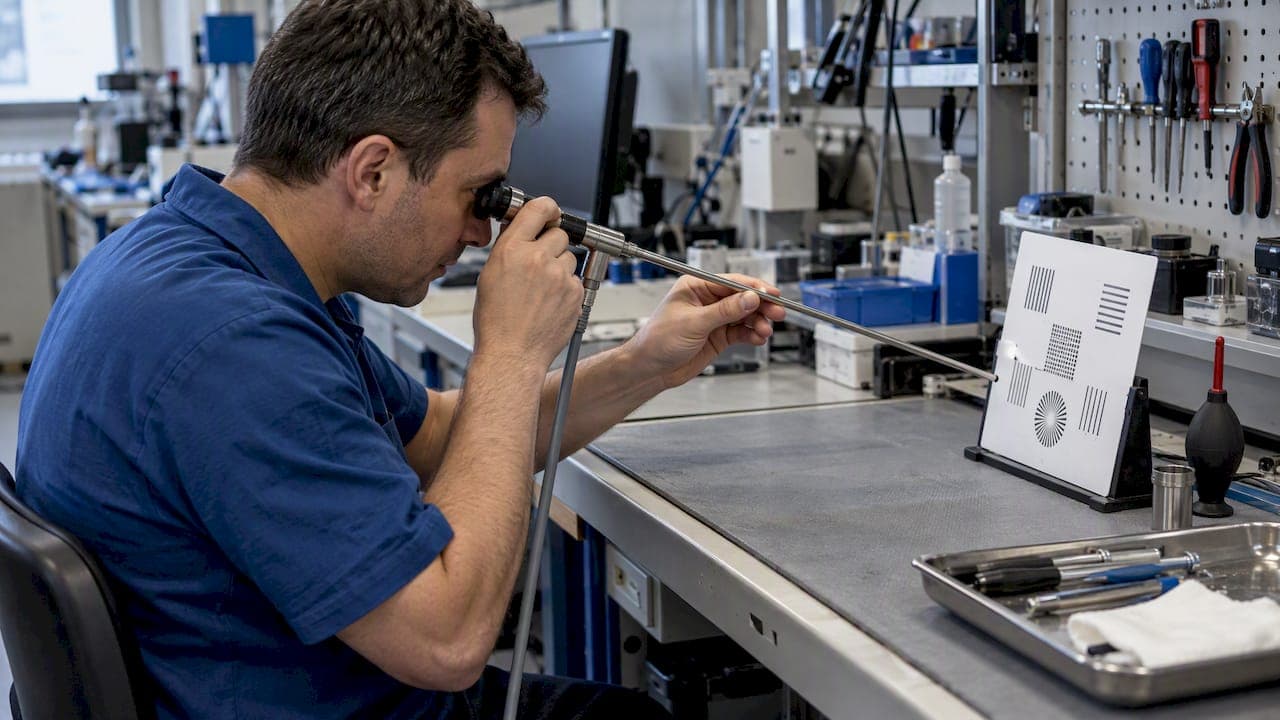
Post-repair calibration is not one adjustment. It is a receiving process: the scope is matched to its repair record, tested for image, light, angulation and leaks, reprocessed as the manufacturer requires, and then accepted or rejected in writing. The repair shop proves what it fixed. You confirm that this exact scope is safe, working and ready for your cases.
This guide is for veterinary clinics, industrial inspection teams and the buyers who sign for returned equipment. It gives you a practical acceptance routine, explains where the formal standards apply and where they do not, and closes with how to decide between repairing and replacing.
TL;DR
- "Calibrated" does not mean "ready for use." Image quality can pass while a channel is still wet or a leak remains.
- Run your own receiving inspection: serial number, paperwork, visual check, image and light test, angulation, leak test, then reprocessing.
- Rigid and flexible scopes need different checks. Rigid scopes are judged largely on optics and geometry. Flexible scopes add channels, bending section and leak integrity.
- Log every returned scope as accepted or rejected, and escalate a failure instead of releasing the unit.
- Compare repair cost with replacement cost using a written rule, so the decision does not rest on habit.
Table of Contents
- What post-repair calibration actually means
- Why a passed calibration can still be a failed repair
- Calibration checks by scope type
- A receiving inspection you can run the day the scope arrives
- What to ask the repair vendor
- Why a documented policy beats good intentions
- Repair or replace: a decision rule
- Our perspective: calibration is a shared job
- Repairs, replacements and accessories from one place
- FAQ
- Sources
What post-repair calibration actually means
In casual shop talk, calibration means the technician adjusted the scope until it looked right. In a clinic or an inspection department it should mean more than that. Procedures written for hospital endoscopy units treat a returned scope as an asset that has to be re-admitted into service. NHS National Services Scotland's repair procedure says inspection of endoscopes should be done by staff trained and competent to do it. Vanderbilt University Medical Center's endoscope QA process tells staff to notify a supervisor, lead or coordinator before sending an instrument out for repair.
Taken together, those documents describe a sequence you can borrow whether you run a three-doctor small-animal practice or an NDT crew:
- Verify the returned serial number against the repair paperwork.
- Inspect the scope using your own acceptance checklist.
- Complete the processing or decontamination required before use or storage.
- Record the result in the repair log.
- Escalate a failed inspection rather than releasing the device.
Note that your own staff do steps 1 to 5. The vendor's certificate is evidence, not a substitute.
Why a passed calibration can still be a failed repair
The clearest example comes from human medicine, but the lesson carries over to every reusable scope. In a Class 2 recall recorded by the FDA in September 2023, a manufacturer reported that a small percentage of scopes returned after repair had a wet channel, because the channel air-drying process had not been validated. Water left in a channel can support microbial growth, which is why drying is part of reprocessing standards and not an afterthought.
Image, light and angulation could all have been perfect on those scopes. The problem was invisible to an optical test. That is why we tell customers to split acceptance into two separate questions:
- Does it perform? Image, illumination, control response, dimensions.
- Is it safe to put into service? Leak integrity, channel condition and dryness, connectors, and the reprocessing steps the manufacturer specifies.
A scope has to pass both. A veterinary clinic is not governed by the same rules as a human GI unit, but a wet working channel is a problem for an animal patient or for a borescope that will later be pushed through a food-processing line, too.
Calibration checks by scope type
What "calibrated" covers depends on the instrument. The table below summarizes what is reasonable to verify on a returned unit.
| Scope type | Performance checks | Safety and condition checks |
|---|---|---|
| Rigid (arthroscope, otoscope, rigid endoscope) | Resolution, brightness, color rendition, edge-to-edge uniformity, distortion, viewing angle, dimensions | Lens clarity, cracks, fluid ingress, light post and connector fit |
| Flexible video or fiber scope | Image quality, light output, angulation range and lock, control response | Leak test, channel patency and dryness, insertion tube surface, connectors |
| Industrial borescope or videoscope | Image sharpness, white balance, articulation, measurement accuracy if the unit measures | Tip condition, seal integrity, cable, battery or monitor function |
| Light source | Output stability, lamp or LED behavior, fan noise | Cord, port fit, heat at the connector |
Rigid scopes: optics and geometry
For rigid scopes, a formal calibration can go well beyond "the picture is in focus." A 2024 specification from Jilin Province in China, JJF(Ji)136-2024, applies to rigid medical endoscopes at first use, during service and after repair. It lists items such as resolution, illumination, color rendition, edge uniformity, distortion, viewing geometry and dimensions, and it recommends recalibrating no later than every year, with a shorter interval when use or condition warrants. It also sets controlled test conditions: 20 °C plus or minus 5 °C, relative humidity below 85 percent, and a dark room.

Treat that as a technical reference, not a US rule. It is a local specification written in Chinese and it does not bind a US clinic. Its value is the list: it shows what a thorough optical check measures. If your repair vendor offers a rigid-scope test report, ask which of those parameters it covers and what the pass limits were.
You can do a basic version in-house. Look at a printed resolution target or a ruled card at your normal working distance, compare it with a good unit of the same model, and check that the image is evenly bright to the edges, with no color cast and no straight lines bowing. Our article on explaining endoscope image quality goes through the terms.
Flexible scopes: add leaks, channels and controls
For flexible clinical scopes in the United States, the release check should explicitly address leak integrity, channel condition and dryness, image quality, angulation and controls, connectors, and the manufacturer's reprocessing instructions. The reference standard for processing is ANSI/AAMI ST91:2021, which covers point-of-use treatment, transport, leak testing, cleaning, high-level disinfection or sterilization, storage and quality control for flexible and semi-rigid endoscopes. It is a paid document, so most clinics will not read it cover to cover. A professional summary in HPN walks through what changed in the 2021 update, including cleaning-verification requirements.
Be precise about scope here. ST91 is aimed at healthcare facilities reprocessing flexible endoscopes. A veterinary clinic can use it as a benchmark, but the device manufacturer's instructions for use remain the controlling document for your particular model.
Industrial borescopes and videoscopes
Industrial units rarely have infection-control concerns, but they have measurement ones. If your borescope is used to size a defect or judge a weld, then a repair that touches the optics, the tip or the imaging chip can change what you see. Check sharpness, white balance, articulation and tip condition against a known reference, and keep a reference object you can photograph every time. Light matters as much as optics here, which we cover in how light sources drive accuracy in endoscopic NDT.
A receiving inspection you can run the day the scope arrives
Use this as a template and adapt it to your manufacturer's instructions. It takes a trained person a short session for most scopes.
- Identify. Compare the serial number on the scope with the repair order and return paperwork. If the serial number changed, because a unit was swapped or a major component was replaced, update your inventory record the same day. Vanderbilt's process specifically has serial-number changes reflected in inventory.
- Read the repair report. What was replaced, what was tested, and what values or pass criteria are listed? A report that says only "repaired and tested" is a reason to ask questions.
- Inspect the exterior. Look at the insertion tube, bending rubber, distal tip, connectors, control body and eyepiece or camera coupling. Check for new scratches, kinks, loose parts or glue residue.
- Test the image. Use the same target and the same light source every time. Check focus, brightness, color, edge uniformity and any dark spots, fibers or haze.
- Test the light. Compare output against a reference scope or your records. A dim or uneven light guide often signals broken fibers or a damaged coupling.
- Test articulation. Move through the full range in every direction, then lock and release. Angulation should be smooth, symmetrical and repeatable, with no sticking or slack.
- Leak test flexible scopes. Follow the manufacturer's method. The professional summary of ST91 reports that the recommended leak-test observation time changed from 30 to 60 seconds in the 2021 edition, but your scope's instructions govern.
- Check channels. Confirm that the channel is patent, that valves and accessories fit and seat properly, and that nothing is wet. Do not accept a scope with water in a channel.
- Reprocess. Run the full cleaning and disinfection or sterilization sequence required before use or storage, as a returned scope is not automatically ready.
- Log and decide. Record the date, tester, results and the decision. Tag a failed scope clearly and take it out of rotation.
A short note on the vendor side: before you ship a scope out, clean and disinfect it, and test for leaks first if you can. SGNA's returning-a-scope guidance, published with a manufacturer, recommends dry-leak testing before wet-leak testing so you do not expose a damaged scope to more fluid, and sending documentation with it. A clean, documented outbound shipment gets you a faster, better-documented return.
What to ask the repair vendor
Your acceptance check works best when the vendor's side is also documented. Before you approve a repair, ask:
- What tests are run before the scope leaves, and are results reported per unit or only as pass or fail?
- What reference or test equipment is used, and when was it last calibrated?
- How are channels dried and verified before shipping?
- Is a repaired scope's warranty in writing, and what does it cover?
- What is the turnaround, and is a loaner available while your scope is out?
The last question matters more than it looks. When a clinic has only one scope, the pressure to accept a marginal return is high. A backup unit removes that pressure and makes it easier to reject a scope that fails.
Why a documented policy beats good intentions
A fair question is whether this much process is worth it. Evidence from hospital programs suggests tracking pays. In a published study of borescope inspection of endoscopes, the Ofstead group's 2024 analysis described borescope inspection and repair costs; we do not quote its figures here because they come from large hospital systems with different volumes than a typical veterinary or NDT shop. The broader point holds: inspection, tracking and early repair decisions are measurable, and they change repair frequency.
The same principle exists in laboratory regulation. CMS guidance on calibration says manufacturer instructions define how and when to calibrate, and that calibration should be verified after repair before testing resumes. CLIA applies to laboratory test systems, not to ordinary endoscopes or borescopes, so it is not a rule for your scope. It is a useful model: whenever a repair could change how a device performs or measures, require documented verification before it goes back to work.
Repair or replace: a decision rule
The decision is rarely about one number. We suggest writing down thresholds before the next failure, so the choice is not made in a hurry with a case waiting.
| Factor | Leans toward repair | Leans toward replacement |
|---|---|---|
| Failure type | Single, well-defined fault (a worn valve, a damaged eyepiece, a cracked cover) | Multiple faults, fluid ingress, or a damaged imaging chain |
| Repair history | First repair on this unit | Second or third repair in a short period |
| Cost | Quote is a modest share of a new equivalent | Quote approaches the price of a new unit with a warranty |
| Downtime | Loaner available, short turnaround | Long turnaround and no backup |
| Fit for the job | Scope still suits your cases | You have outgrown the diameter, length or image quality |
| Parts and support | Parts available for the model | Model discontinued or parts hard to source |
Two cautions. First, a low repair price does not help if the scope returns still leaking or dim. Second, if a unit has been repaired repeatedly, the cost of downtime and re-testing belongs in the comparison. If you are weighing a replacement, our buying guide for 5.8 to 7.0 mm veterinary endoscopes covers sizing and what small-animal clinics usually need.
Our perspective: calibration is a shared job
We sell veterinary and industrial endoscopes and accessories, and we also offer endoscope repairs, so we see scopes arrive at both ends of this process. What we have learned is that most disputes about repair quality are really disputes about what was checked. A clinic that wrote down what it expected on receipt has an easy conversation with the repair vendor. A clinic that only noticed a dim image three weeks later does not.
Three habits make the biggest difference:
- Keep a baseline. Photograph the same target with each scope when it is new or known good. Then "it looks worse" becomes something you can show.
- Separate performance from readiness. An image test tells you the optics work. It does not tell you the channel is dry or the scope is leak-free.
- Match the checklist to the scope. A rigid arthroscope, a 3-meter gastroscope and a micro fiber borescope fail in different ways, so they need different checks.
If something looks off after a repair, start with the basics before assuming the repair failed. Our animal endoscopy troubleshooting guide and videoscope troubleshooting guide cover common causes, and prepping an endoscope for inspection covers the setup steps that often explain a poor picture. Light is a frequent culprit, and choosing the best light source for veterinary endoscopy explains how to rule it out.
— Endoscope
Repairs, replacements and accessories from one place
If a scope has failed your acceptance check, or a repair quote tips toward replacement, we can help on both sides. Our repairs and veterinary endoscopy equipment page is the place to start for repair requests and veterinary scopes. For rigid instruments, see our rigid scopes, arthroscopes and otoscopes. For industrial work, our borescopes and videoscopes include monitor-type SD-card units, portable pipe inspection videoscopes and micro fiber borescopes. Valves, biopsy forceps and other endoscopic accessories are there too, and our FAQ and inspection procedures page has more on inspection routines. We do not publish repair prices, so ask us for a quote that matches your model and fault.
FAQ
How often should an endoscope be recalibrated after repair?
There is no single US rule for every scope. The Jilin specification for rigid medical endoscopes suggests a maximum interval of one year, shortened for heavy use or poor condition. For your own scopes, follow the manufacturer's instructions and test after any repair, drop or suspected damage.
Can I accept a repaired scope on the vendor's certificate alone?
We would not. A certificate shows what the vendor tested, but only you can confirm the returned serial number, the condition on arrival, compatibility with your processing and the absence of leaks or wet channels. Hospital procedures treat receiving inspection as the facility's own responsibility.
What should I do if a repaired scope fails my inspection?
Take it out of service, tag it, record the failure in your repair log and contact the vendor with your documented findings. Do not release it conditionally. Ask for a re-repair or replacement, and request test data for the failed parameter.
Is post-repair calibration different for veterinary and industrial scopes?
The principle is the same: verify performance, then confirm condition. The details differ. Veterinary flexible scopes need leak, channel and reprocessing checks, while industrial borescopes put more weight on image accuracy, tip condition and measurement reliability.
When is it better to replace a scope than repair it?
Replacement usually makes sense when the quote approaches the price of a new unit, when the same scope has failed repeatedly, or when parts are no longer available. Fluid ingress and damaged imaging components also tend to push the decision toward replacement.
Sources
- Endoscopes for Repair and Service, NHS National Services Scotland
- Endoscope QA Process, Vanderbilt University Medical Center
- FDA Class 2 Device Recall, September 25, 2023
- JJF(Ji)136-2024 Calibration Specification for Medical Rigid Endoscopes
- ANSI/AAMI ST91:2021 listing, Intertek Inform
- What's new in ANSI/AAMI ST91, HPN Online
- Calibration and Calibration Verification, CMS
- Procedures for Returning a Scope for Repair, SGNA
- Impact of Borescope Inspections on Endoscope Repair, PMC