
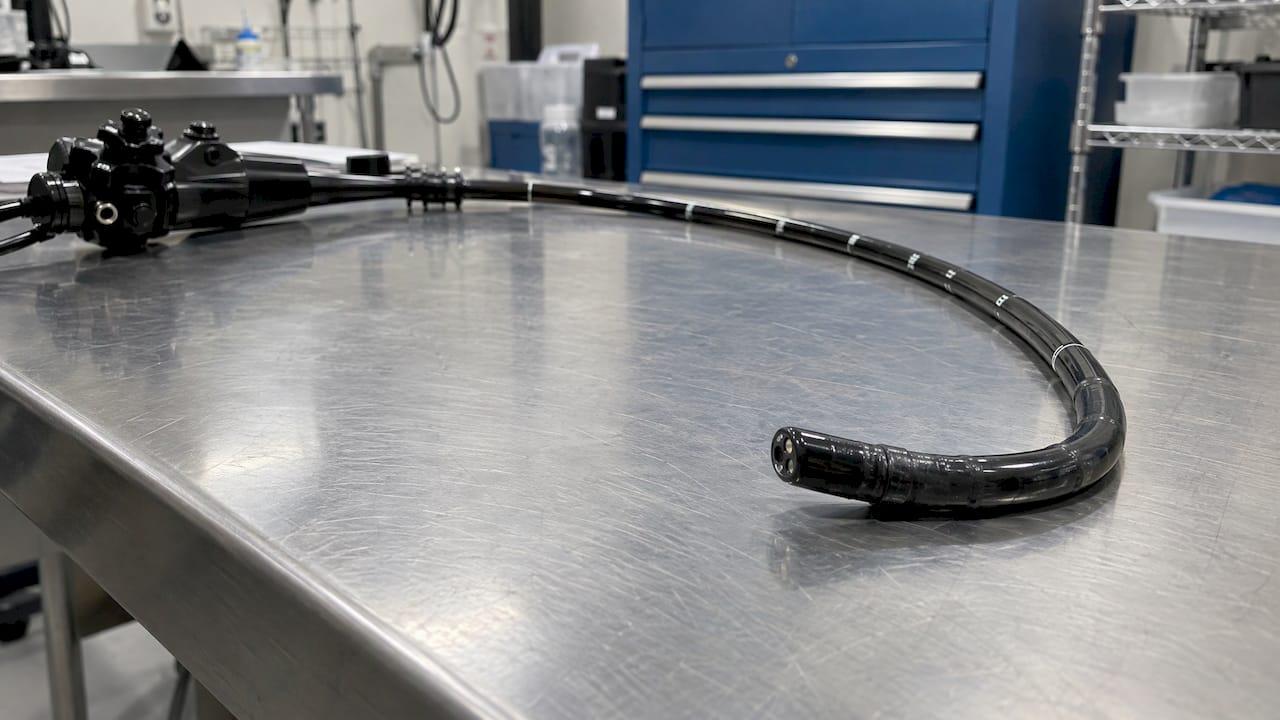
Bend radius is how tightly a flexible endoscope can curve before something inside it is damaged or stops working. It is a different number from the bending angle printed on a spec sheet, and it is the one that decides whether a scope fits a cat's airway, a pipe elbow or a storage case. If you buy, use or maintain scopes for a clinic or an inspection crew, you need to read both numbers together and keep every handling routine inside the radius the manufacturer gives. We supply veterinary and industrial scopes and repair them, and this is the rule we would hand any new technician.
TL;DR
- Bending angle says how far the tip turns, in degrees. Bend radius says how tight the curve is, in millimeters. A scope needs both numbers to be judged.
- For a simple circular curve, radius equals bending-section length divided by the angle in radians. The same 90° tip deflection needs 19.1 mm of radius over a 30 mm section and 38.2 mm over a 60 mm section.
- The insertion tube and the active bending section have different limits. The tube has a minimum radius you must never go under. The bending section is built to curve, but only as far as its control wires allow.
- Most bend damage comes from handling and storage: tight coils, crushed cases, forced insertion. A coil diameter of at least twice the minimum radius is the geometric floor.
- When you compare scopes, compare diameter, working length, angle and minimum radius together, for the animal or the pipe you actually inspect.
Table of Contents
- Bend radius and bending angle are not the same thing
- The two zones: insertion tube and bending section
- What sets a scope's minimum bend radius
- Reading and checking a specification
- Veterinary use: matching radius to the patient
- Industrial use: bend radius in a pipe or a cavity
- Handling and storage that keep a scope inside its radius
- Where we come in
- Our perspective
- FAQ
- Sources
Bend radius and bending angle are not the same thing
The two terms get mixed up constantly, even on product pages.
Bending angle (angle of deflection) describes how far the distal tip can swing from the straight axis when you operate the control. The international standard for medical endoscopes, ISO 8600-1, defines it as the angle between the centre line of the straightened insertion portion and the centre line of the deflected tip. It is a measure in degrees and says nothing about how much space the curve takes.
Bend radius is the radius of the arc the scope follows while it curves. A small radius means a tight curve. A large radius means a gentle sweep.
A published study of a miniature steerable sinus endoscope lists both separately: a maximum bending angle for the device it built, and a minimum bending radius as its own design parameter. It also notes a commercial ENT scope with a 125° bending angle and a 3 mm bending radius. That pairing shows why one number alone does not describe the instrument.

Why the same angle can need different space
An articulating tip does not pivot on a hinge. It curves along a defined length of the bending section. For a circular curve the relationship is simple:
radius = section length ÷ angle (in radians)
Take a 90° deflection, which is about 1.57 radians:
| Active bending section length | Tip deflection | Resulting radius |
|---|---|---|
| 30 mm | 90° | 19.1 mm |
| 60 mm | 90° | 38.2 mm |
| 30 mm | 180° | 9.5 mm |
Both 90° tips point the same direction, yet one needs twice the room. A full 180° reversal on a 30 mm section works out to a radius of roughly a third of the section length. The swept width of that reversal is about two radii plus the tube diameter, so a 6 mm tube turning back on itself needs about 25 mm of clearance.
This matters in a small patient or a tight fitting. A scope with a big angle but a long bending section can fail to make a corner that a shorter-section scope makes easily, even though the datasheet angle looks better.

The two zones: insertion tube and bending section
A flexible scope has two mechanically different zones, and each has its own bend limit.
The insertion tube
The insertion tube is the long, passive shaft behind the tip. It is built in layers, typically a helical band, a braid and an outer sheath, and carries the optics or image bundle, light fibers, working channel and control wires. It is designed to follow a path, not to be curled sharply. Its minimum bend radius is a hard limit. Go below it and the layers are strained beyond what they were designed for.
The limit is often not uniform along the length. Manufacturers describe flexible tubes whose minimum bending radius differs between the distal end and the proximal end, softer and tighter near the tip, stiffer further back. So a figure quoted for the "tube" may describe only one region. Read which part of the scope a number refers to.
The bending section
The bending section sits at the distal end and is the part you steer. It is made of linked segments or a flexible structure pulled by wires from the control knobs. It is designed to curve repeatedly, but its limits are set by the angle and by how far the wires can travel. Forcing it past its control range, by hand or by pressing the tip against tissue or metal, loads the wires and joints.
In practice:
- Within the control range: the bending section curves as designed.
- Passive curves in the tube: the shaft must stay above its minimum radius at all times, including in a case or on a cart.
- Tip plus tube together: a scope can pass a tight bend with its tip, then bind because the tube behind it cannot follow the same curve.
What sets a scope's minimum bend radius
Several design choices push the number up or down.
Diameter. A thinner tube can curl tighter, which is why small-diameter scopes suit small animals and narrow passages. Our guide to small diameter endoscopes in veterinary work covers where that matters clinically.
Imaging method. Optical fibers are glass and tolerate only so much curvature. Research from the University of Washington group reports that a single glass fiber of about 0.1 mm has a minimum short-term bend radius of 5 to 6 mm. A 1.2 mm scanning-fiber endoscope built from fewer than 70 loosely enclosed fibers holds a minimum radius of roughly 6 mm. Coherent bundles thicker than 0.5 mm, with thousands of fibers rigidly combined, reach minimum radii in centimeters. Stiffness and flexibility trade against each other, and pushability is restored with wires or thicker sheathing.
Construction of the shaft. Layer design, sheath material and channel size all affect how far the tube can curl before it ovalizes or kinks.
Working channel. A larger channel for biopsy forceps or a pump line leaves less room for the control wires and fibers, so it influences how tight the curve can be.
The lesson for a buyer is that no single feature predicts flexibility. The diameter, the working length, the angle and the radius have to be read together.
Reading and checking a specification
Minimum bend radius is set by the manufacturer. You cannot establish it by bending a scope until it complains, because the point at which damage starts is the point you are trying to avoid. Use the published figure, and when a sheet gives only an angle, treat the radius as an open question for that model.
What you can do safely is turn the figure into practical limits.
- Find the figure and its zone. Confirm whether the quoted radius applies to the insertion tube, the bending section or the distal tip.
- Convert it to a coil diameter. A coil is a circle, so its diameter is twice the radius. If a tube must stay above 25 mm radius, any coil, case loop or hanging curve needs a diameter of at least 50 mm, and in practice more.
- Check the angle against the section length. Divide the section length by the angle in radians to see the radius the tip will occupy at full deflection. If you know the geometry of the passage, check that the swept width (two radii plus the tube diameter) fits.
- Match the scope to the job. Compare the radius to the tightest curve you actually meet: an equine nasal passage, a canine bronchial branch, a 90° pipe elbow or a turbine port.
The ISO standard also separates flexible from rigid scopes. A flexible endoscope's insertion portion is intended to conform to body cavities or instrument channels, while a rigid one is unyielding. A rigid scope has no bend radius to worry about, which is one reason it remains the better pick for fixed-geometry work such as arthroscopy or otoscopy. See our veterinary rigid endoscopy catalog for those.
If you are new to the category, our field guide to flexible endoscopes explains the main types.
Veterinary use: matching radius to the patient
In a clinic the question is rarely the abstract radius. It is whether the scope turns where the anatomy turns.
- Small animals. Narrow airways and a short distance between landmarks favor a thin tube and a short, tight bending section. Our guides on choosing a small animal endoscope size and buying a 5.8 to 7.0 mm veterinary endoscope go through diameter and length for common cases.
- Gastrointestinal work. Reaching the duodenum for biopsy depends on length, angulation and the channel together. See GI endoscope specs for small animal clinics.
- Horses. Airway and gastric work uses longer scopes, such as a 3 meter semi-portable equine scope or an 8 mm equine airway field scope. The longer shaft makes careful coiling in transport more important.
For handling in the exam room, our small animal endoscopy tips cover technique.
Industrial use: bend radius in a pipe or a cavity
For an inspection technician the same geometry applies, with different obstacles. A borescope pushed through a 90° elbow needs a tube that can follow the elbow and a tip that can be steered or at least pushed past it. In a narrow duct, the swept width of an articulated tip must fit the duct diameter.
The practical rules:
- Check the minimum radius against the tightest elbow in the run, not the average one.
- Do not force a probe against resistance. Back it out and approach from another access point.
- Keep fine fiber probes in their rated range. Very thin fiber scopes are the most sensitive to tight curvature.
Our article on using flexible borescopes for accurate diagnostics covers technique, and the borescope range includes monitor-type SD-card videoscopes, portable pipe inspection videoscopes and micro fiber borescopes.
Handling and storage that keep a scope inside its radius
Most bend damage does not happen during a procedure. It happens in the gap between uses. Build these into your routine.
- Hang or lay the scope in a gentle curve. Use the case designed for the model. If a case coils the tube, confirm the coil diameter is at least twice the minimum radius.
- Never wedge the shaft in a drawer, door or cart. A crushed section is one of the most common field failures.
- Hold the shaft near the tip when inserting. Let the scope follow the passage rather than pushing a buckled tube.
- Release the angulation controls before withdrawal and before storage. A tip held at full deflection loads the wires and joints.
- Never straighten a kink by hand. A layered tube does not recover its geometry once it has been bent past its limit. Bending it back spreads the strain along the tube.
- Inspect after any drop or crush. Look for creases, flat spots in the sheath, a tip that no longer reaches full angle or an uneven response between directions. A damaged sheath can also compromise leak integrity, so take it out of service until it is checked.
- Protect the distal lens. Handling that damages the tip is a separate problem, covered in our lens scratch prevention guide.
The usual pattern of failure after over-bending is a permanent kink in the tube, a creased sheath, restricted working channel and angulation wires that bind or stretch, so the tip no longer deflects fully. These are repair jobs rather than adjustments.
Where we come in
We sell veterinary and industrial scopes and the accessories that go with them, including biopsy forceps, valves, pumps, light sources and cleaning tools, and we offer endoscope repairs. Our own positioning is high-resolution, portable systems at lower prices than hospital-grade or human-use equipment, with 24/7 support and fast shipping.
If you are specifying a scope for a clinic or inspection crew, start with our veterinary endoscopy equipment, which includes the portable monitor-type SD-card systems, or look at the Portascope line and medical endoscopes. A fully portable 6 mm by 150 airway inspection system is one example of a compact direct-monitor unit.
If a scope has been bent, crushed or kinked, our repair service is where to send it rather than trying to straighten it. For model-specific questions on diameter, working length or angulation, our support team is available around the clock.
Our perspective
Bend radius is the specification buyers skip and technicians pay for later. A datasheet leads with the angle because it is a clean, impressive number. The radius, the section length and the tube limit decide whether a scope does the job in your patient or your pipe, and whether it is still working in two years.
We build our recommendations around the work you do. A small animal clinic needs a thin tube that turns where a cat's anatomy turns. An equine practice needs length and a shaft that survives a truck. An inspection technician needs a probe that clears the tightest elbow on the site. That is why we group our veterinary and industrial scopes by use, from portable monitor-type SD-card videoscopes to micro fiber borescopes, and why we pair them with the accessories that keep a scope working: valves, pumps, forceps and cleaning tools.
Good handling costs nothing. Coil the shaft wide, never hand-straighten a kink and release the tip before storage. When damage does happen, repairs keep a capable scope in service, and affordable systems mean a clinic can keep a spare on the shelf.
Endoscope
FAQ
What is the minimum bend radius of an endoscope?
It is the tightest curve the insertion tube can follow without damage, given by the manufacturer for each model. It varies with diameter, construction and imaging method. For example, research on a 1.2 mm scanning-fiber endoscope reports a minimum radius of roughly 6 mm, while coherent bundles over 0.5 mm in diameter reach centimeters. Always use your model's own specification.
Is bend radius the same as bending angle?
No. Bending angle is how many degrees the tip swings from straight. Bend radius is how tight the resulting curve is. The same 90° deflection gives a 19.1 mm radius over a 30 mm section and 38.2 mm over a 60 mm section.
What happens if you bend an endoscope too far?
The layers of the insertion tube can deform permanently, leaving a kink or crease that does not straighten. A damaged sheath, crushed channel or stretched angulation wire can follow, and the tip may stop reaching full deflection. Remove the scope from service and have it inspected and repaired.
How should I coil an endoscope for storage?
Use the case made for that model, and keep any coil at a diameter of at least twice the minimum bend radius. Release the angulation controls first, and keep the shaft clear of doors, drawers and cart wheels.
Does bend radius matter for borescopes too?
Yes. Flexible borescopes and videoscopes have the same limits in the shaft and the articulating tip. Compare the minimum radius with the tightest elbow or bend on the inspection route before you choose a probe.
Sources
- ISO 8600-1:2015, medical endoscopes: definition of angle of deflection
- ISO 8600-1:2025, definition of flexible and rigid endoscopes
- A miniature robotic steerable endoscope for maxillary sinus, Scientific Reports 2022
- Scanning fiber endoscopy with highly flexible, 1 mm catheterscopes, PMC
- Flexible tube and insertion apparatus, US patent 10234062