
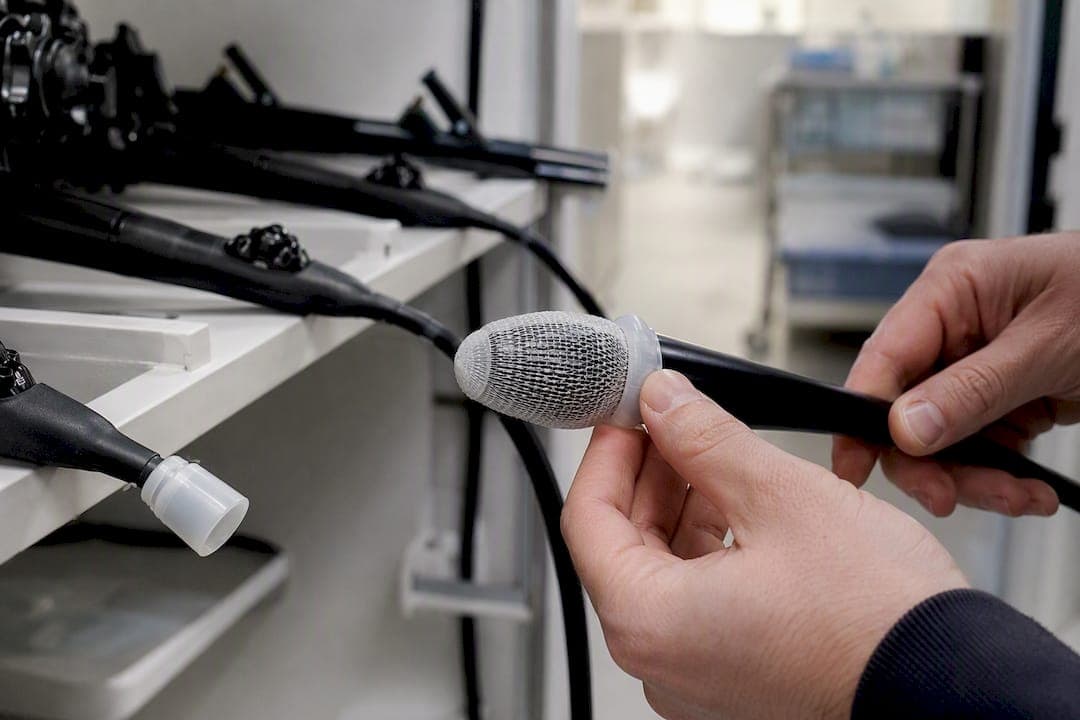
A distal tip protector is a disposable or reusable cover that shields a flexible endoscope's distal optics during handling, transport, drying, and storage. Choose a size-matched, open or mesh design that supports aeration to reduce moisture retention and repair risk. Follow reprocessing guidance from your device manufacturer and pair the protector with a scope-tracking process, not just the product itself.
TL;DR:
- Open mesh or cage protectors improve drying by allowing airflow, reducing moisture retention and chances of microbiological growth.
- Proper sizing involves measuring the scope's distal OD directly with calipers to avoid fits that are too tight or loose, especially for atypical scopes.
- Sterile single-use protectors prevent cross-contamination, while reusable caps require validated cleaning and drying between patients to avoid trapped moisture.
- When purchasing, confirm fit, material, sterilization method, packaging size, and workflow compatibility to avoid issues like damage or fit failure.
- Protectors mainly incur costs through waste or reprocessing, but proper use can significantly lower repair expenses caused by tip damage in storage and transport.
Table of Contents
- What Types of Distal Tip Protectors Protect Your Endoscope?
- How Do You Match Protector Size to Your Scope?
- Sterility, Single-Use, and Infection-Control Rules You Need to Follow
- How Should Procurement Teams Choose the Right Protector?
- What Are the Best Practices for Placing and Storing Protectors?
- What Should You Expect on Packaging and Cost?
- Why Trust 1800endoscope's Take on Protector Selection
- Do Protectors Fit Differently Across Endoscope Brands?
- What Regulatory Standards Apply to Distal Tip Protectors?
- Are Single-Use or Reusable Protectors Better for the Environment?
- An Editorial Take on Where Protectors Actually Earn Their Cost
- How 1800endoscope Supports Your Protector and Accessory Orders
- Sources
What Types of Distal Tip Protectors Protect Your Endoscope?
Three basic designs dominate the market, and they behave very differently once a wet scope goes into storage. The open mesh or cage protector is essentially a lattice sleeve, often a semirigid expandable mesh, that slides over the distal end and lets air circulate around the lens and channel openings. The boot style is a closed, sponge-lined sleeve that grips tighter but traps moisture against the optics. Cap designs sit somewhere in between, rigid enough to stop crush damage but usually with vent holes cut into the shell.
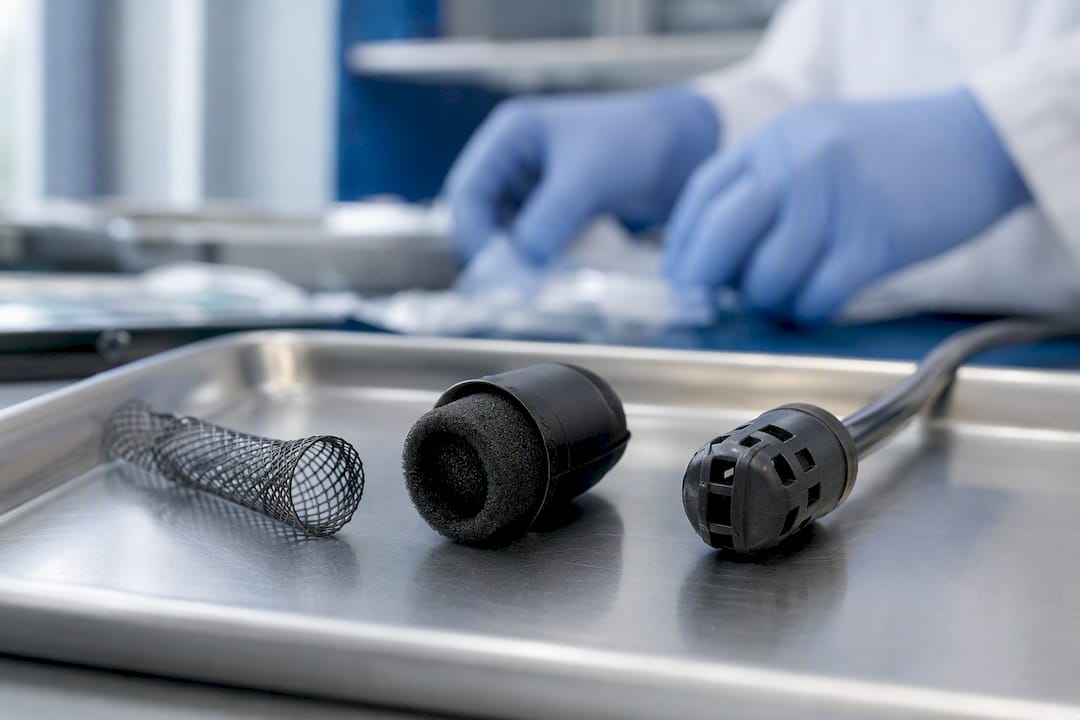
Materials range from soft expandable polymer mesh to firmer molded plastic, depending on whether the goal is impact protection during a bumpy transport cart ride or scratch prevention on a storage shelf.
Infection-control teams increasingly favor open designs because they let the channel and distal optics finish drying instead of sealing residual moisture against the lens, which is exactly the mechanism around which the ScopeValet™ TipGuard is built.
The practical payoff shows up in three places:
- Fewer bent or scratched distal tips from cart edges, drop impacts, and drawer storage
- Lower repair-shop visits for lens and bending-section damage, which keeps more scopes in rotation
- Faster turnaround between procedures because staff aren't waiting on a scope stuck at the repair vendor
How Do You Match Protector Size to Your Scope?
Sizing mistakes are the single most common reason a protector fails in the field, either falling off in transit or fitting so tight it stresses the bending section. Vendors report compatibility as an outer-diameter (OD) range, and most catalogs group products into bands covering a broad range of scopes from small-animal cystoscopes to adult colonoscopes.
- Measure the distal end OD directly with calipers rather than trusting the scope's model spec sheet, since insertion tube diameter and tip OD aren't always identical.
- Check clearance around the angulation section and any elevator mechanism before committing to a SKU, since a protector that fits the shaft can still bind on a duodenoscope's elevator wire.
- Confirm the SKU's stated fit against your actual measurement, not just the "small/medium/large" label, since color-coding conventions vary by manufacturer.
Pediatric and small-animal scopes often fall below the smallest catalog size band, and large therapeutic scopes with side-viewing optics may need a custom or vendor-confirmed fit rather than a standard mesh sleeve.
Sterility, Single-Use, and Infection-Control Rules You Need to Follow
Distal tip protectors come in two forms: sterile, individually wrapped single-use pieces, and reusable caps meant to be cleaned between patients. The sterile disposables arrive ETO-sterilized in sealed pouches, similar to how the PROTECH Flexible Endoscope Tip Protector is packaged, and they get discarded after one use, which removes any cross-contamination question between procedures.

Reusable caps only make sense if your reprocessing workflow can validate cleaning and drying between patients, and most departments find that harder to document than it sounds.
The moisture question matters more than most buyers realize. Closed sponge or boot-style protectors can hold water against the distal lens for hours after a scope leaves the sink, and that trapped moisture is exactly the condition microbiological growth favors.
Statistic Callout: Open-cage designs are built specifically to let the scope aerate during storage and transport, which reduces the likelihood of microbiological growth compared with moisture-sealing legacy covers.
Practical rules for your reprocessing team:
- Default to sterile single-use protectors for any scope going into storage before full high-level disinfection is confirmed complete
- Never re-wrap or reuse a single-use protector, even if it looks clean
- Pair every protector with your facility's standard drying protocol rather than treating the cover as a substitute for aeration
How Should Procurement Teams Choose the Right Protector?
Selection comes down to five practical filters, and skipping any one of them tends to surface as a complaint from reprocessing staff three weeks after the purchase order clears.
- Fit: Confirm OD compatibility against your actual scope fleet, not a generic size chart.
- Material and design: Prioritize open mesh or cage construction over sealed boots unless your workflow has a specific reason to prefer a closed cap.
- Sterility status: Decide upfront whether you need sterile individually wrapped units or whether a non-sterile reusable cap fits your process.
- Packaging quantity: Match case sizes to your procedure volume so you're not storing six months of stock in a closet built for six weeks.
- Workflow compatibility: Verify the protector integrates with your existing clean/dirty tab system and scope-tracking log.
Supply-chain questions belong on the RFP too: ask vendors about lead times on reorders, whether SKUs are traceable by lot for recall purposes, and whether they'll hold pricing across a multi-quarter contract.
Pro Tip: Calculate cost-per-use by dividing the box price by unit count, then compare that number against your average repair invoice for tip damage. A $0.75 protector looks expensive until you set it next to a $1,200 bending-section repair.
What Are the Best Practices for Placing and Storing Protectors?
Getting the mechanics right prevents the two most common failure points: pinching the bending section during installation and leaving a protector on so long it traps moisture instead of shedding it.
- Slide the protector on straight, without twisting, to avoid stressing the angulation wires just behind the distal tip.
- Leave the protector in place only through transport and initial drying, not through extended storage, unless your protocol specifically calls for continuous coverage.
- Hang the scope in its designated storage position with the tip unsupported and free of pressure, rather than resting the distal end against a cabinet wall.
- Apply a clean or dirty tab at the same time you place the protector, so the scope's processing status travels with it rather than living only in a logbook.
- Discard single-use protectors immediately after removal and log the change in your scope-tracking system.
What Should You Expect on Packaging and Cost?
Most vendors package distal tip protectors in boxes of 50 or 100, with sterile individual wrapping adding cost per unit but removing any question about cross-contamination between patients. Datasheets from suppliers like Micro-Tech Endoscopy typically list SKU-to-OD compatibility right alongside the packaging count, which is the fastest way to confirm you're ordering the right size in the right quantity.
Reorder math is straightforward once you know two numbers: monthly procedure volume and fleet size. A clinic running 40 procedures a month across three scopes needs a very different case size than a hospital endoscopy suite running 400.
Cost drivers worth comparing across quotes:
- Single-use sterile units cost more per piece than reusable caps but eliminate reprocessing labor and cross-contamination risk
- Custom labeling or color-coded SKUs for multi-scope fleets can add a modest premium
- Sterilization method (ETO versus gamma) sometimes affects unit price and shelf life
Why Trust 1800endoscope's Take on Protector Selection
1800endoscope catalogs endoscopy accessories across veterinary and industrial fleets, which means the compatibility questions procurement teams ask about protectors come up constantly on the sales floor, not just in theory. That day-to-day exposure to fleet-wide sizing mismatches, elevator-mechanism clearance issues, and reorder timing shapes the guidance here. If you're assembling a full accessory kit rather than a single SKU, the veterinary scoping accessories guide covers what else typically belongs in that order.
Do Protectors Fit Differently Across Endoscope Brands?
Distal geometry varies enough between manufacturers that a protector fitting one scope comfortably can bind or gap on another, even at the same nominal OD. Standard flexible gastroscopes and colonoscopes usually have straightforward round-tip geometry that fits generic mesh sleeves without issue. Duodenoscopes are the exception that causes the most support calls, since the elevator mechanism at the distal tip creates an offset profile that a generic sleeve can snag on.
Veterinary scopes add another layer of variation. Small-animal cystoscopes and bronchoscopes often run smaller than the lowest band in a human-medicine size chart, while equine or large-animal gastroscopes can exceed the largest standard SKU entirely. Industrial borescopes used for inspection work carry their own tip geometry considerations, and the same probe-tip-to-access tradeoff that governs borescope inspection in wind turbine maintenance applies just as directly to matching a protector to a scope's working end: get the geometry wrong and you either lose access or risk the tip.
The safest procurement move is to request brand-specific compatibility confirmation from the vendor rather than assuming a universal size chart covers your exact model. If your fleet mixes brands, a color-coded system tied to your scope-tracking log prevents staff from grabbing the wrong SKU under time pressure. For scopes with atypical distal features, offset lenses, elevator wires, or unusual bending-section profiles, a custom protector request is often cheaper in the long run than repeated repair invoices from a poor-fit generic sleeve.
What Regulatory Standards Apply to Distal Tip Protectors?
There's no single dedicated regulation that governs distal tip protectors as a standalone device category. Instead, they fall under the broader reprocessing and device-handling framework that governs flexible endoscopes generally, which means the standards that matter are the ones covering drying, storage, and infection prevention rather than protector design specifically.
Manufacturer reprocessing instructions remain the primary reference point, since scope makers publish specific drying and storage requirements that any accessory, including a tip protector, has to work within rather than override. Industry groups like AdvaMed publish broader guidance for device manufacturers on handling and regulatory expectations, which is useful background when evaluating whether a vendor's claims about their protector line hold up against general device-handling norms.
For sterile single-use protectors specifically, the sterilization method (commonly ethylene oxide) and packaging integrity fall under standard sterile-barrier requirements that apply to any sterile single-use medical accessory, not a protector-specific rule set. What buyers should actually check on a datasheet is whether the sterility claim is backed by a stated shelf life and a clear expiration date on the individual pouch, not just a general "sterile" label on the box.
The practical compliance takeaway for procurement is this: your infection-control policy, not the protector's marketing copy, sets the bar. If your facility's reprocessing protocol requires aeration and drying before storage, choose a protector design that supports that requirement instead of working against it.
Are Single-Use or Reusable Protectors Better for the Environment?
Single-use protectors generate ongoing waste, one unit per procedure, discarded after a single transport or storage cycle. For a busy endoscopy suite running several hundred procedures a month, that adds up to a steady stream of disposed plastic mesh or boot covers, which is the tradeoff every facility weighs against infection-control benefits.
Reusable caps reduce that waste stream but shift the environmental cost elsewhere: reprocessing labor, water use for cleaning, and the energy involved in whatever disinfection cycle validates the cap for reuse. Neither option is free of environmental cost, and the honest comparison depends on your facility's reprocessing capacity and procedure volume rather than a blanket "reusable is greener" assumption.
For most clinical settings, the deciding factor isn't the environmental math. It's whether your reprocessing workflow can reliably validate a reusable cap between patients without adding risk. If it can't, sterile single-use protectors are the safer choice, and the disposal volume becomes a cost of doing business rather than a factor you can trade away.
Facilities trying to minimize waste without compromising infection control sometimes land on a hybrid approach: sterile single-use protectors for scopes going into extended storage or shared-use rotation, and no protector at all (relying instead on proper hanging and drying protocols) for scopes cycling quickly between back-to-back procedures in a single-provider setting. That approach only works if your storage protocol already has the hanging cabinet space and airflow to support tip-unprotected drying safely.
An Editorial Take on Where Protectors Actually Earn Their Cost
Most tip damage doesn't happen during the procedure. It happens in the ten minutes after, when a wet scope gets set down on a cart edge or jammed into a bin for transport. A properly sized, open-design protector closes that gap cheaply. Skip the sizing step and you've bought a false sense of security instead of protection.
— Endoscope
How 1800endoscope Supports Your Protector and Accessory Orders
Getting protector sizing right only matters if the rest of your scope inventory is built on solid ground, which is where a full accessory and equipment catalog earns its keep. 1800endoscope stocks the veterinary and industrial scopes, light sources, and accessory lines that a properly protected fleet actually depends on, so you're not sourcing protectors from one vendor and replacement scopes from three others.
Browsing the borescope endoscope catalog shows the range of probe diameters and tip geometries that determine which protector band you'll need in the first place, while the general medical and veterinary catalog covers the light sources, valves, and cleaning accessories that round out a reprocessing kit. If a scope in your fleet is due for replacement rather than another repair cycle, the portable airway inspection endoscope system is worth a look for clinics that need SD-card recording without a full-tower price tag. For sizing questions specific to your scope models, reach out through the catalog for a compatibility check before you commit to a protector SKU across your whole fleet.