
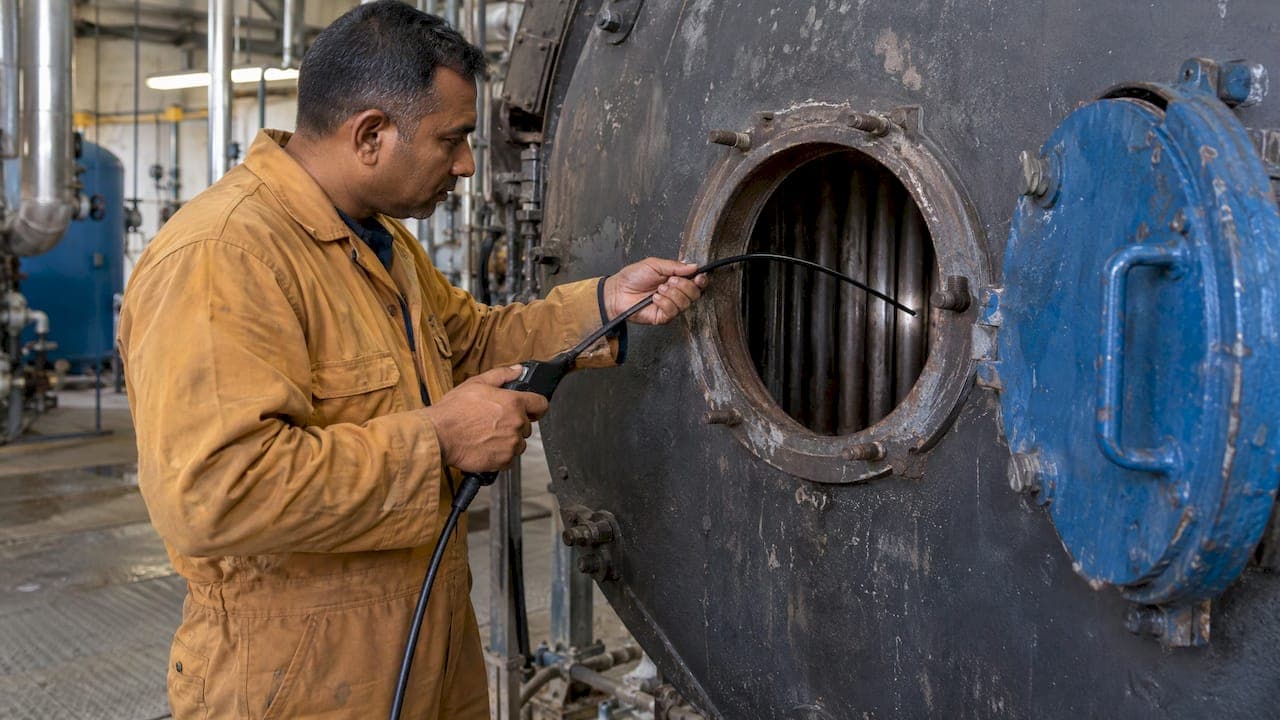
A boiler tube borescope is a small camera on a rigid or flexible probe that lets you see the inside of tubes, headers and drums without cutting anything open. Pick a probe slim enough for the tube or access port, prepare the boiler under lockout and confined-space rules, capture the footage the way an inspector can use it, and treat what you see as the first step in a documented condition assessment. This guide covers each of those steps.
TL;DR
- Match the scope to the access: rigid probes give strong images where you have a straight line, flexible probes reach around bends and elbows.
- Prepare first: the boiler must be locked out, tagged out, cooled and cleaned enough to see, with confined-space permits in place before anyone enters.
- Look for scale, pitting, corrosion, cracking, blisters, erosion and tube-to-tube contact, and record slow pans with location notes and a size reference.
- A borescope shows surfaces. Pair it with ultrasonic thickness testing or other methods when the question is wall loss or subsurface flaws.
- Keep tube maps, video and notes together so the next inspection can compare like with like.
Table of Contents
- What a boiler tube borescope inspection is for
- Choosing the right borescope for boiler tubes
- Preparing the boiler: lockout, cooling and permits
- What you can see inside boiler tubes
- How to run the inspection
- Reading the image with care
- Quick decision guide
- Find a boiler-ready borescope
- Care for the scope between jobs
- FAQ
- Sources
What a boiler tube borescope inspection is for
Boiler tubes fail from the inside as often as from the outside. Waterside scale, deposits and corrosion build up where nobody can see them, and the first sign is often a leak or an overheated tube. A borescope gives you eyes on those surfaces while the unit is down, without disassembly.
The tool is well established in the trade. The National Board of Boiler and Pressure Vessel Inspectors has noted that the borescope's main value is documentation and confirming that unsafe conditions were corrected in areas that would otherwise stay unseen. That framing is useful: a good borescope session produces a record you can compare against next year's.
Typical places a borescope goes on a boiler:
- Inside watertubes and generating tubes through header handholes or cut-outs
- Superheater and reheater tubes
- Economizer elbows and return bends
- Drum interiors, including the drum floor
- Burner throats, refractory and areas behind baffles
- Weld seams where access is tight (see our guide to endoscopic weld inspection)
Choosing the right borescope for boiler tubes
Start with the access, not the spec sheet. Three questions decide most purchases.
How big is the opening, and how long is the run?
Probe diameter has to clear the smallest opening on your route, and the working length has to reach the farthest point you need to see. Tube bores, handholes and inspection ports differ by boiler design, so measure the openings on your units before you shop. A slim probe also leaves room for the cable to move without scraping the surface you are trying to inspect.
Rigid or flexible?
According to the National Board's guidance, rigid borescopes generally give better images at lower cost but need straight-line access, while flexible fiberscopes can go around corners. In practice:
| Situation | Better fit |
|---|---|
| Straight tube runs, drum interiors with a clear sightline | Rigid scope |
| Bends, return bends, economizer elbows | Flexible videoscope |
| Tight header spaces with offset access | Flexible with articulating tip |
| Quick look through a small port | Micro fiber borescope |
| Long pipe-like runs | Portable pipe inspection videoscope |
Most plant crews end up with more than one scope for this reason. If you want a refresher on handling a flexible unit, see how to use flexible borescopes for accurate diagnostics.
What features earn their place?
- Built-in light and a clean, bright image. Dark, sooty interiors swallow light. A strong, adjustable light source matters more than headline resolution.
- Video and still recording to SD card. You want footage you can hand to the inspector or review at your desk. Monitor-type SD-card videoscopes make this simple.
- A tip you can steer. It lets you look at the tube wall rather than only down the bore.
- Durable, wipe-clean insertion tube. Boilers are dirty, and you will clean the probe after every session.
- Portability. A handheld monitor and a case you can carry through a plant beat a cart you have to wheel into a mechanical room.
Our borescopes page lists monitor-type SD-card videoscopes, portable pipe inspection videoscopes and micro fiber borescopes. For a broader view of applications, read industrial borescope uses.
Preparing the boiler: lockout, cooling and permits
The scope is the easy part. The preparation is where people get hurt, so do it in order.
- Take the boiler out of service and lock it out and tag it out. Before an internal inspection, the boiler is locked out/tagged out and cooled, and surfaces may need cleaning or other preparation.
- Understand the isolation requirements. OSHA expects hazardous energy that could injure employees during servicing and maintenance to be controlled. In an OSHA interpretation letter, double block and bleed is described as one isolation option for permit spaces and is encouraged as a lockout best practice.
- Get confined-space permits before entry. If anyone will physically enter a drum or firebox to place the scope, permits come first. The same ACHR News guidance lists a safety watch, PPE and a company safety briefing for inspectors as part of the preparation.
- Gather your paperwork. The inspection package typically includes the boiler's technical manual, inspection forms and the tube map or renewal sheet.
- Clean what you need to see. Heavy soot or wet deposits hide detail, and deposits, oils or condensation on the lens can obscure critical features. VentaVid's glossary makes the same point about surface cleanliness.
If you want a step-by-step tool prep routine, our guide to prepping an endoscope for inspection covers cleaning, checking the light and testing the tip before you go in. We also keep a checklist written for tube technicians: the ASME borescope checklist for boiler tube work.
Safety rules for your plant, your state and your insurer can be stricter than any general guide. Ask your authorized inspector or safety officer which procedures apply to the specific unit before you begin.
What you can see inside boiler tubes
Knowing what normal looks like helps you spot what is not. Here are the findings a borescope session most often turns up.
Scale and waterside deposits
Scale forms when calcium, magnesium and silica in the water react and settle on heat-exchange surfaces. According to the U.S. Department of Energy, scale insulates the tubes and can cause overheating and tube failures. ACHR News adds that oil or scale inside watertubes can insulate the metal and contribute to overheating, fatigue, bulging or rupture.
A borescope makes internal scale visible in superheater, reheater and generating tubes. One HRSG case history described layered iron and copper scale linked to under-deposit corrosion and tube leaks.

What to note: color, thickness you can estimate from the edge, whether it is uniform or patchy, and whether it flakes.
Corrosion, pitting and flow-accelerated corrosion
Power Engineering reports that borescope examination can reveal single-phase flow-accelerated corrosion in evaporator tubes and economizer elbows. The same article says visible black magnetite in drums or evaporator tubes points to ineffective AVT(O) water treatment, and loose deposits on the drum floor can indicate system corrosion or contaminant ingress.
Look for pitting clusters, grooving along flow paths and discoloration at elbows.
Cracks, blisters, warping and tube contact
ACHR News lists the defects inspectors check on boiler tubes: corrosion, deterioration, warping or sagging, cracking, pitting, scaling, weld cracks, blisters, general enlargement and tube-to-tube contact, sometimes called tube marriage.
Tell real cracks from surface features. Casting lines in cast-iron boilers, for example, are straight and regular, while true cracks tend to be irregular with oxidized edges, a distinction Montréal Combustion's field guide stresses to avoid false positives.

Erosion on the fireside
High-velocity flue gas, fuel ash and improperly installed or operated soot blowers can erode tube metal, and leaks can corrode or erode adjacent tubes, according to ACHR News. If you find a thinned, polished or grooved area, look at the neighbors too.
How to run the inspection
A repeatable routine produces better records than an improvised one.
- Check the scope before it goes in. Confirm the light, focus, recording and tip movement. Wipe the lens.
- Start with a reference shot. Record the tube ID, header or drum location and date, by voice or on a placard in frame.
- Insert slowly and steadily. Fast movement blurs video and risks scraping the insertion tube. For handling practice, our guide on flexible borescope use is worth a read.
- Capture slow pans, not just stills. Montréal Combustion recommends slow pans with location annotations and a known-size object for scale.
- Stop at anything unusual. Hold, angle the tip, vary the light, then move on.
- Mark the tube map. Tie each finding to a tube number so the renewal sheet stays accurate.
- Withdraw and clean the probe. Wipe it down before it goes back in the case.
Documenting what you saw
A clip nobody can place is of little use. Name files by unit, tube and date, keep notes with the footage and store everything with the tube map. For a broader look at structuring records, this overview of how to conduct site inspections covers inspection documentation and image capture in a general way that carries over to boiler work.
Reading the image with care
A borescope shows you surfaces in two dimensions, and good inspectors use that knowledge to get more from it.
- Sizing. Borescopes are not measuring instruments. Without stereo measurement, a corrosion pit cannot be sized by eye from a 2D image. Use your reference object, and bring in measurement tools where a number matters.
- Lighting and angle. Visual testing depends on line of sight, lighting, surface preparation and inspector skill, according to ASNT.
- Temperature. Cold appliances may close fine cracks, which can hide them. If symptoms persist after a clear image, Montréal Combustion advises further verification.
- Wall condition under the surface. ASNT describes visual testing as a preliminary step that identifies areas needing more detailed ultrasonic or radiographic inspection, because it cannot detect subsurface flaws.
That is why borescope work sits inside a broader program. One checklist describes boiler tube inspection as visual inspection, ultrasonic thickness testing and advanced NDT such as eddy current, EMAT or radiography. The borescope tells you where to aim the other methods. ASME Boiler and Pressure Vessel Code Section V holds the NDE requirements and methods that other code sections reference, so check which sections govern your unit.
Quick decision guide
| If you need to... | Do this |
|---|---|
| Confirm internal scale or deposit condition | Borescope the tube and record a slow pan |
| Find where to focus a repair | Borescope first, then mark the tube map |
| Verify a corrected unsafe condition | Re-inspect and record before and after video |
| Measure remaining wall thickness | Follow up with ultrasonic thickness testing |
| Check a weld in a tight spot | Use a small-diameter flexible scope |
What we see in the field
Most of the boiler and pipe questions we hear come down to one thing: people buy a scope before they know their access. We start with the opening and the run length, then choose between a rigid scope and a flexible videoscope. That order saves money and avoids a second purchase.
We also think the record matters as much as the image. That is why we favor monitor-type SD-card videoscopes: you capture video on the spot and carry it straight to the tube map. Our focus is portable, high-resolution scopes at more affordable prices than traditional hospital-grade or human-use systems, with 24/7 support and quick shipping behind them.
The same discipline carries across our veterinary and industrial customers. A clean probe, a steady hand and good notes make an inspection useful, whether the tube is in a boiler or the airway is in a horse.
Endoscope
Find a boiler-ready borescope
We sell monitor-type SD-card videoscopes, portable pipe inspection videoscopes and micro fiber borescopes for industrial inspection work, along with endoscope repairs for scopes already in your kit. Browse the full range on our borescopes page and pick the diameter and reach your access calls for.
If you are not sure which probe fits your units, our FAQ and inspection procedures page is a good place to start, and our team is available around the clock.
Care for the scope between jobs
Boiler work is hard on equipment. After each session:
- Wipe the insertion tube and tip with a clean cloth and an appropriate cleaner
- Inspect the tube for kinks, scratches or exposed fibers
- Test the light and monitor, then clear the SD card after backing up footage
- Coil the probe loosely in its case, never tight
If an image goes dim or the tip stops responding, the videoscope troubleshooting guide walks through common fixes, and we handle endoscope repairs when the fix needs a technician.
FAQ
Can a borescope inspect inside a boiler tube without cutting it?
Yes, if the probe is slim enough for the opening and you can reach the area. Rigid scopes suit straight runs, and flexible scopes handle bends. Prepare the boiler under lockout and confined-space rules first.
What can a borescope reveal inside boiler tubes?
It can show scale, deposits, pitting, corrosion, cracking, blisters, erosion and tube contact. It also helps confirm that a corrected condition stays corrected. Record slow pans with a size reference so the footage can be reviewed later.
Does a borescope replace ultrasonic testing?
They do different jobs. A borescope shows surface condition and points to where closer checks are needed. Ultrasonic or radiographic testing evaluates subsurface flaws and wall thickness, so many programs use them together.
What safety steps come before borescope work in a boiler?
Lock out and tag out the boiler, let it cool, obtain confined-space permits, keep a safety watch, wear PPE and attend the safety briefing. Ask your safety officer or authorized inspector which rules apply to your unit.
Sources
- National Board of Boiler and Pressure Vessel Inspectors, Bulletin Fall 2011
- ACHR News: Inspection Requirements for Watertube Power Boilers, Part 1
- ACHR News: Inspection Requirements for Watertube Power Boilers, Part 2
- OSHA standard interpretation, April 18, 2007
- VentaVid: Borescope inspection glossary
- U.S. Department of Energy: Clean Firetube Boiler Waterside Heat Transfer Surfaces
- Combined Cycle Journal: Clean heat-transfer surfaces inside and out
- Power Engineering: Guidelines for effective HRSG inspections
- Montréal Combustion: Borescope inspection for boilers
- ASNT: Visual Testing method
- Oxmaint: Boiler Tube Inspection Checklist
- ASME Boiler and Pressure Vessel Code
- How to Conduct Site Inspections: 2026 Guide