
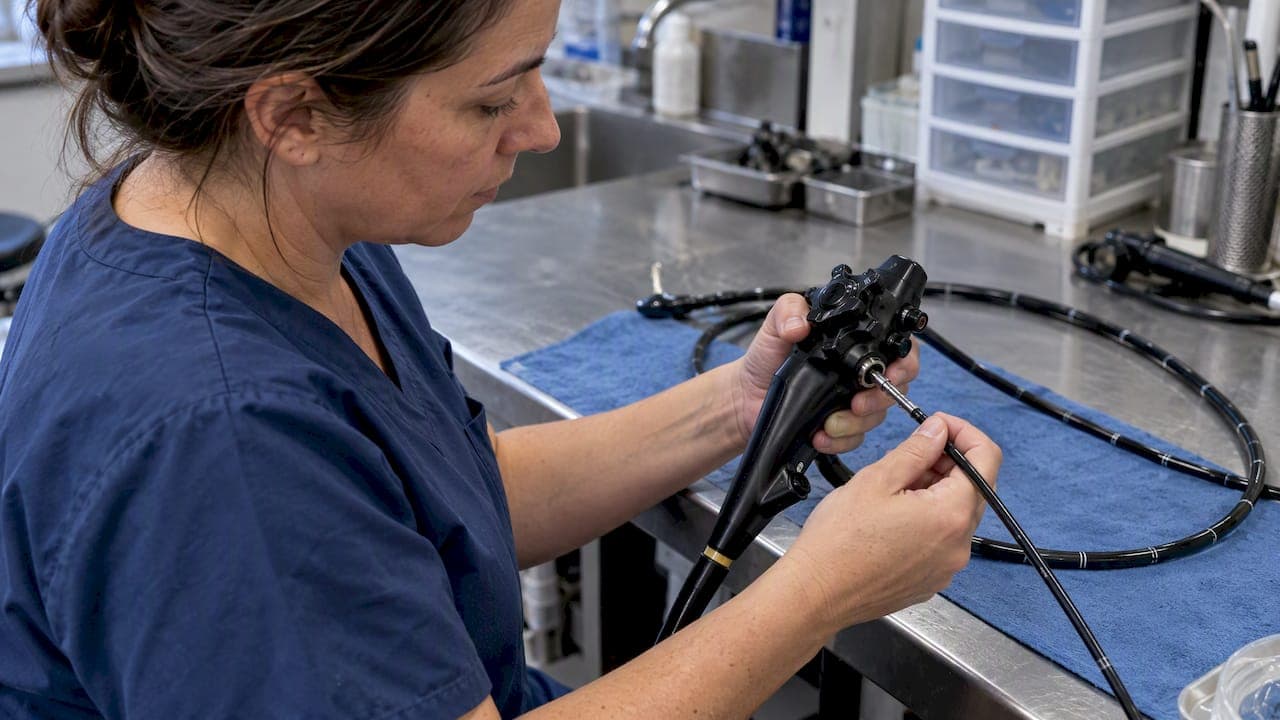
A biopsy channel diameter mismatch happens when the outer diameter of an instrument is larger than, or too close to, the inner diameter of the endoscope's working channel. The result is binding, poor suction, damaged channel lining or a forceps that never reaches the tissue. The fix is simple in principle: confirm the channel's inner diameter, confirm the instrument's outer diameter and working length, and leave a margin. The details below show how to do that for veterinary and industrial scopes, where labels are often less standardized than in human medicine.
TL;DR
- Match the instrument's outer diameter to the scope's inner channel diameter. The insertion tube's outer diameter tells you nothing about the channel.
- Channels range from about 2.0 mm in ultra-slim scopes to 4.2 mm in therapeutic colonoscopes, so "standard" depends entirely on the model.
- Check working length as well as diameter. A forceps that is too short cannot exit the distal tip.
- Verify the channel itself (a pin gauge or the maker's specification) before ordering accessories, especially on repaired or older scopes.
- Smaller forceps in narrow channels work, but they change your sampling technique and sample size.
Table of Contents
- What a mismatch really is
- Typical channel sizes and what they allow
- The mistakes that cause most mismatches
- How to check before you order: a six-step routine
- Why small channels change how you sample
- Industrial borescopes: the same problem in another form
- Don't forget cleaning tools
- Our perspective
- Find the right forceps for your scope
- FAQ
- Sources
What a mismatch really is
Three dimensions have to agree before a forceps, brush, grasper or catheter is safe to pass:
- Channel inner diameter (ID). The bore the instrument travels through.
- Instrument outer diameter (OD). The sheath of the forceps, not the jaw opening.
- Working length. The instrument must be long enough to clear the distal tip and short enough to operate at the handle.
A mismatch on any one of them causes trouble, but diameter is the one that does physical harm. An oversized sheath scrapes the channel wall, restricts suction and can force the tip of the instrument against the bending section. Health regulators treat this seriously: a Canadian recall notice for a core biopsy instrument kit lists device compatibility as the issue, showing that dimensional fit is a recognized safety matter and not just an inconvenience.
There is also a looser kind of mismatch. An instrument that fits but with almost no clearance technically passes, yet it drags, heats the sheath through friction and wears the channel. Repair suppliers report that a difference of even 0.2 mm between the instrument and the channel can cause binding, restricted suction or premature channel wear. Treat that as a practical warning from the repair trade rather than a universal tolerance: always follow the scope maker's compatibility list first.
Typical channel sizes and what they allow
Working channels vary widely. One repair-parts guide gives a range of 2.0 mm in ultra-slim gastroscopes up to 4.2 mm in therapeutic colonoscopes. Transnasal scopes sit at the small end: one comparison of tip and channel size describes TNE scopes at roughly 2 to 2.4 mm against 2.8 mm in a standard endoscope, as the search summary of that comparison is commonly quoted, but verify against your own scope's manual.
Here is a practical way to read the numbers.
| Channel ID | Typical scope type | Forceps OD to look for | What to expect |
|---|---|---|---|
| About 2.0 mm | Ultra-slim or transnasal scopes, small-animal and exotic work | Around 1.8 mm jaws | Limited accessory choice, smaller samples |
| About 2.8 mm | Standard diagnostic gastroscopes and many bronchoscope-class scopes | Around 2.4 mm jaws | Good all-round diagnostic flexibility |
| 3.2 mm and up | Therapeutic scopes | Larger or therapeutic accessories | More tools, but a thicker insertion tube |
The pairing in the second column is not a guess. A manufacturer's guidebook lists pediatric oval-jaw forceps with 1.8 mm jaws sized for a 2.0 mm instrument channel, a pairing that shows how little clearance is normally designed in. Those are catalog figures for one brand's line. Another maker's 2.0 mm channel may allow slightly different instruments.
The mistakes that cause most mismatches
Confusing the insertion tube with the channel
Procurement staff often read a spec sheet that says "6 mm" or "8 mm" and assume it describes the working channel. It describes the scope's body. An engineering reference on endoscope design stresses that quoted diameters of endoscopes and instruments refer to the external diameter, not the bore. A slim insertion tube can still carry a reasonable channel, and a thick one can carry a small one. Ask for the channel ID in writing.

Reading a minimum as a measurement
Many specifications quote the minimum instrument size the channel accepts, not the physical bore. Repair technicians recommend confirming patency with a pin gauge set instead of trusting the label, because a channel can be narrowed internally even when it looks clear. This matters most on older scopes, on scopes that have had a channel replaced, and on units bought second-hand.
Ignoring working length
Diameter gets the attention, but a forceps that is 1,600 mm long in a scope with a 1,800 mm insertion tube will never leave the channel. Equine gastroscopes and long colonoscopes need longer accessories than a 150 mm airway scope. Compare the instrument's working length to the scope's, and leave a few centimeters beyond the tip for the jaws to open fully.
Assuming one brand's accessories fit another's scopes
Channel diameter is the first hurdle. The handle's biopsy port, the valve fitting and the sheath's flexibility are the next. A forceps with the right OD can still hang up in a tight bend because its sheath is stiffer than the scope designer assumed. Our guide on accessory compatibility for endoscopy professionals walks through those secondary checks.
How to check before you order: a six-step routine
- Record the scope's model and serial number. Don't work from memory or from the case label.
- Find the channel ID in the manufacturer's documentation. If you have only the insertion tube size, you don't have the answer yet.
- Measure what you can. On a scope with an unknown or repaired channel, a pin gauge set confirms the usable bore.
- Note the working length and the distance from the handle port to the distal tip.
- Read the accessory's OD and working length on the product page or sterile pack, not just the jaw size.
- Test dry. Before the animal is on the table, pass the accessory through the closed, straightened scope, then through the scope in its working bend. Feel for drag, and look at the tip.
Step 6 is where most surprises appear. A forceps that slides in a straight scope can bind once the tip is deflected. Stop and change instruments rather than pushing, because forcing an instrument through a flexed channel is how a puncture or a kink starts.
Why small channels change how you sample
A mismatch isn't always an error. Sometimes the only scope that gets you where you need to go has a narrow channel, and you have to choose a smaller forceps on purpose. That has consequences for tissue yield.
A feline study compared 1.8 mm and 2.4 mm biopsy forceps for duodenal samples and reported that the larger 2.4 mm forceps gave higher quality specimens. It also describes different sampling techniques with the smaller forceps in a 2.0 mm channel, such as pushing off the tissue rather than avulsing it. If your clinic has a small-diameter scope, plan for more samples per site and practice the technique on a training model.

The tradeoff extends beyond biopsies. Reports of sedation-free transnasal procedures with ultra-slim scopes note that 2.0 mm channels are often too small for items like hemostatic clips. If there is a chance you will need to treat what you find, a scope with a larger channel may serve the case better than the smallest one available.
Patient size drives the same logic. A pediatric review recommends ultra-thin gastroscopes with a 5 to 6 mm outer diameter for infants. That is human medicine, but the lesson carries over to cats, puppies, rabbits and exotics: the smaller the patient, the less room there is for error, and the more carefully you must match the whole system. For veterinary sizing, see our guides to choosing the right small animal endoscope size and small diameter endoscopes.
Industrial borescopes: the same problem in another form
Borescope users hit a version of this mismatch with retrieval tools. A micro fiber borescope may have an accessory port that accepts only fine graspers or magnets. A larger inspection scope may take a different retrieval tool entirely. The rules are the same: confirm the port or channel ID, the tool's OD and the usable length, then test the tool before it goes into a pipe or engine where recovery is difficult. Dropping a tool inside an assembly is a more expensive mistake than a returned accessory.
Don't forget cleaning tools
Cleaning brushes need the same attention as forceps. A brush that is too large will jam in the channel. One that is too small will glide past debris without scrubbing it. Sizing brushes to the channel is part of reprocessing, and our reference on endoscope brush sizing from 1.2 to 2.8 mm covers it. Channel reprocessing guidance from the Public Health Agency of Canada describes the scope's structure, including the biopsy and suction path, which is useful background for anyone training new staff.
Our perspective
We sell veterinary and industrial scopes and accessories, and we also handle endoscope repairs, so we see mismatches from both ends: the order that arrives wrong and the scope that comes back after an instrument was forced through it. Most of those cases trace to one assumption, usually that a scope's outer dimension or its label describes the channel.
Our advice is practical. Give us the scope model, ask for the channel ID before you buy forceps, and don't be shy about asking whether a smaller forceps will give you enough tissue. In small-animal work, the choice between a 1.8 mm and a 2.4 mm forceps is a clinical decision as much as a purchasing one. We would rather help you confirm a fit in advance than take a call after an instrument has bound in the field. Our own guide to stocking 1.8 and 2.4 mm veterinary biopsy forceps explains how clinics can plan a small kit that covers most of their scopes.
— Endoscope
Find the right forceps for your scope
If you are ready to match accessories to your equipment, start with our flexible biopsy forceps. For scopes that need servicing before you add accessories, see our endoscope repairs and veterinary endoscopy equipment. Our endoscope diameter guide is a good first read if you are still deciding on a scope. If you are unsure about a specific model, send us the details and we will help you confirm compatibility before you order.
FAQ
What does the working channel size of an endoscope tell me?
It is the inner diameter of the bore that accessories and suction pass through. It limits the largest forceps, brush or catheter you can use. Never infer it from the insertion tube's outer diameter.
Can I use a smaller forceps in a larger channel?
Usually yes in terms of passing, but check the manufacturer's guidance. A forceps far smaller than the channel may leave a gap that reduces suction control and can feel less precise. Choose the largest instrument the channel is rated for, while leaving the margin the maker recommends.
Does working length matter as much as diameter?
Yes. If the accessory is shorter than the scope's channel path, the jaws never emerge. If it is far longer, the handle end becomes awkward. Compare the accessory's working length to the scope's insertion tube length and allow extra for jaw opening.
How do I confirm a channel after repair or on a used scope?
Ask the repairer for the channel's ID in writing, and use a pin gauge set to check that the bore is clear. Repair suppliers note that labels can state a minimum rather than the physical bore, and that internal constriction can occur even when a channel looks clear.
What should I do if a forceps starts to bind?
Stop pushing. Straighten the scope as far as the procedure allows, withdraw the instrument slowly and inspect both the instrument and the tip. Then check the sizes against the specification before trying again, and have the scope inspected if you suspect channel damage.
Sources
- Bard Mission Disposable Core Biopsy Instrument Kit recall, Health Canada
- What Makes a Quality Endoscope Insertion Tube?
- Complete Guide to Endoscope Biopsy Channel Replacement
- Fujifilm Endoscopy Guidebook
- Endoscope Design and Assembly
- Comparison of 2 differently sized endoscopic biopsy forceps in cats
- Office-based sedation-free transnasal EGD with single-use gastroscopes
- The application of gastrointestinal endoscopy in children
- Flexible endoscopes: structure and function, Canada.ca