
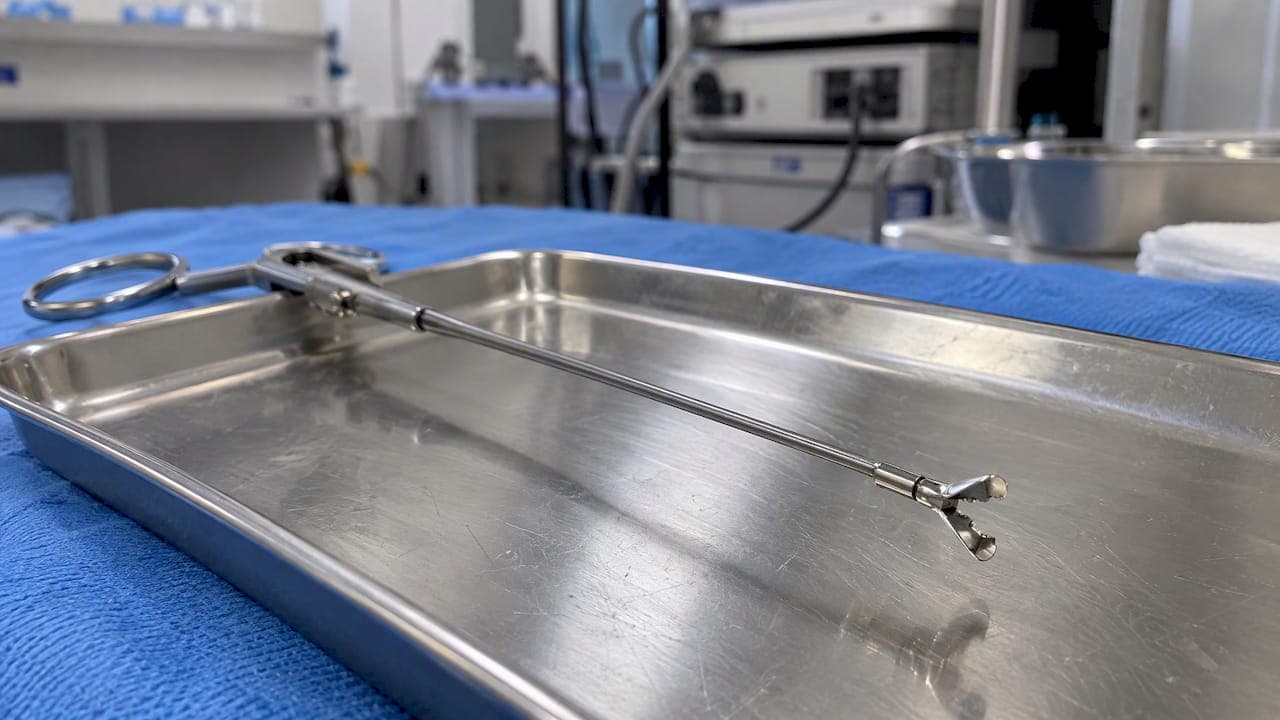
The main biopsy forceps jaw types are static (plain), alligator, oval, serrated, large-capacity, rotatable or swinging, and spiked. Static and oval cups can favor subepithelial depth, serrated and large-capacity cups can favor sample volume, and spikes or swinging jaws may help stabilize and aim at difficult targets. Technique and scope compatibility often move diagnostic yield as much as jaw choice does.
TL;DR:
- Comparative esophageal data found static jaws reached subepithelial tissue in 93–97% of samples, versus 80% for alligator and 55% for large capacity forceps.
- Serrated jaws produced larger samples than oval jaws, while oval cups penetrated more deeply; gentle closure helps limit crush damage, especially with high capacity cups.
- ASGE guidance endorses large capacity forceps for Barrett's surveillance at defined biopsy densities, including four quadrant sampling every 1–2 cm depending on dysplasia risk.
- Before ordering, verify working channel, shaft diameter, working length, and port clearance; in tight or angled sites, prioritize a smaller, steerable jaw over specimen capacity.
- Veterinary recommendations are mechanical guides, not species specific yield findings, because the cited comparisons involved human esophageal and biliary procedures.
Table of Contents
- 1. How jaw design shapes specimen depth and trauma
- 2. What each common jaw type does in practice
- 3. What the evidence and guidelines say
- 4. How to choose the right jaw type
- 5. Maintenance and compatibility checks that protect performance
- 6. How material and build quality affect durability and tissue compatibility
- 7. Choosing jaws by species and veterinary procedure
- 8. Which jaws work best in small or difficult anatomical locations
- 9. A quick guide matching jaw types to veterinary diagnostic needs
- 10. How jaw opening angle and closing force affect effectiveness and safety
- 11. Our view on which jaw types to stock
- 12. Where to find biopsy forceps and sizing support from us
- FAQ
- Sources
1. How jaw design shapes specimen depth and trauma
Every jaw design trades depth, volume and tissue damage against one another. Knowing the mechanics lets you predict what a forceps will bring back before it enters the channel.
- Cup geometry: oval cups tend to penetrate deeper into the epithelium, while round or flat cups capture more surface area.
- Serrations: teeth add cutting surface and may raise sample volume, but aggressive closure on teeth can increase the risk of crush artifact.
- Spike or needle: a center spike may help stabilize the forceps on small or fibrotic lesions, yet it can skate off dense, hard tissue before the cups seat.
- Rotatable and swinging jaws: orienting the cup toward the target in an awkward angle can improve placement without repositioning the whole scope.
- Large-capacity cups: each bite can carry more tissue, which may change how the specimen is handled, oriented and processed afterward.
Pathologists caution that crush artifact, which aggressive use of high-capacity forceps can worsen, compromises histological analysis, so specimen orientation and gentle handling matter as much as the cup you choose. In practice, you pick a jaw to match the depth you need, then close and withdraw it carefully.
2. What each common jaw type does in practice
Here is how the main families behave once you put them to work.
- Static (plain) jaw: the workhorse for diagnostic sampling. Comparative data show it reaches subepithelial tissue more reliably than the alternatives below.
- Alligator jaw: its grasping geometry may suit small targets and tight spots; comparative esophageal data found less subepithelial tissue than with static jaws.
- Oval jaw: deeper epithelial penetration may make it a useful option when the question lies below the surface layer.
- Serrated jaw: consider it when you want a larger specimen, while taking care to avoid hard closure that may cause crush artifact.
- Large-capacity cup: may suit surveillance protocols and larger lesions when volume per bite matters. In comparative esophageal data, it obtained subepithelial tissue less often than static jaws.
- Rotatable or swinging jaw: may be useful in angulated access, where precise placement can help target the lesion.
- Spike or needle design: may help hold a fibrotic or angulated target steady, but can bounce off hard surfaces.
No single profile wins everywhere. Match the jaw to the diagnostic question, then confirm it fits the scope. Our flexible biopsy forceps page can help you compare forceps against these profiles.
3. What the evidence and guidelines say
Comparative data give the clearest picture of how much jaw design matters. In a 2016 esophageal biopsy study, static jaw forceps obtained subepithelial tissue in 93–97% of samples, against 80% for alligator and 55% for large-capacity forceps. The same work found serrated jaws gave larger samples than oval jaws, while oval cups penetrated the epithelium more deeply.

The cross-sectional report in Endoscopy described the same pattern for two static jaw models and noted no esophageal perforations. Static jaws also obtained larger surface areas of subepithelial tissue than the alligator and large-capacity designs.
Guidelines weigh volume differently. The ASGE mucosal tissue sampling guidance endorses large-capacity forceps for Barrett's esophagus surveillance at defined biopsy densities, for example four-quadrant biopsies every 1–2 cm depending on dysplasia risk.
In biliary work, a blinded histological comparison of a newer cholangioscopy forceps against its legacy version noted added teeth and roughly double the tissue capacity. It found no statistically significant difference in crush artifact between groups in that cohort.
Jaw design can shift measurable outcomes, while operator angulation, stabilization and specimen handling also affect what reaches the pathologist.
4. How to choose the right jaw type
Work through this sequence when deciding what to stock or deploy.
- Define the diagnostic aim. Mucosal surveillance, subepithelial biopsy, polyp tissue and biliary sampling each point toward different jaws.
- Confirm scope compatibility. Check shaft diameter, working length and port clearance against the scope's channel before anything else.
- Decide single-use or reusable. Let infection control policy and procedure throughput drive this, not unit price alone.
- Build a core inventory. A static jaw, a serrated jaw and one large-capacity forceps cover most general GI, bronchoscopy and ERCP needs.
- Ask vendors specific questions. Request cup volume, jaw opening in millimeters, whether a spike is present and whether the jaw rotates.
Pro Tip: Size labels can differ between manufacturers, so verify the jaw diameter and capacity rather than relying on the size name.
Our guide to 0.2 mm clearance and forceps sizing walks through the clearance checks, and the GI endoscope specs guide covers matching scope specifications to what you plan to sample.
5. Maintenance and compatibility checks that protect performance
A forceps that is out of alignment or dulled will undersample no matter how well the jaw was chosen.
- Verify compatibility before ordering: confirm the working channel diameter and the forceps shaft diameter match.
- Inspect reusable jaws after reprocessing: look at cup edges and serrations for dulling, nicks or deformation, and follow the manufacturer's instructions for use.
- Run pre-procedure checks: confirm the jaws align, close completely and, on rotatable models, turn smoothly through their range.
- Store with care: keep tips protected from contact that can bend cups or blunt serrations, and avoid sterilization practices outside the manufacturer's guidance.
Small-animal teams can pair these checks with the handling advice in our small animal endoscopy tips.
6. How material and build quality affect durability and tissue compatibility
Jaws may be made from stainless steel, and their material and finishing can affect edge durability and cutting performance. Well-finished cups may close flush, which can support cleaner transection and reduce tearing of the specimen. Burrs or uneven edges may shear tissue instead of cutting it and can contribute to specimen damage.
The shaft matters as much as the jaws. The control wire and coil transmit closing force along the working length; stretching or kinking may weaken the bite and affect how the cups feel. For reusable forceps, corrosion resistance and tolerance of reprocessing can affect instrument durability and edge wear. Single-use forceps sidestep wear but still depend on consistent factory finishing.
We recommend asking for material and finishing details when you request a quote. Use the same questions you would ask about capacity: what the cups are made of, how the edges are finished, and how many reprocessing cycles the maker supports. A forceps that holds its geometry across cycles delivers the specimen quality the jaw design promised on paper.
7. Choosing jaws by species and veterinary procedure
Species and procedure help determine practical instrument choices before jaw type enters the discussion. A cat's duodenum and a horse's airway may call for different instruments, and the scope's channel size can narrow the options.
For small animals such as cats and small dogs, narrow channels favor compact static or alligator jaws in the smaller shaft sizes. Our veterinary biopsy forceps guide covers 1.8 mm and 2.4 mm sizes for these clinics. Static or oval cups may suit gastric and duodenal mucosal sampling when reaching the lamina propria is part of the diagnostic aim. Where the lumen is tight and angulated, a rotatable or swinging jaw helps you place the cup on the target.
For larger dogs and horses, scope and channel compatibility may allow the use of larger cups. Serrated or large-capacity jaws can make sense for larger lesions or when you want more tissue per pass, as long as you close gently. A spiked jaw can help steady a small or fibrotic lesion, but avoid relying on it against hard, dense surfaces.
These are working suggestions drawn from the mechanics above, not species-specific trial results. Confirm channel size first, then choose the jaw that fits the sampling aim.
8. Which jaws work best in small or difficult anatomical locations
Tight lumens and sharp angles can favor jaws that are easy to aim. Rotatable and swinging jaws let you turn the cup toward the wall without moving the scope tip.

Alligator jaws may suit small targets. Their grasping geometry can hold a small lesion or fold, though comparative esophageal data found lower subepithelial yield than with static jaws. Spiked designs may help when a small or fibrotic target keeps slipping, though the spike can bounce off hard tissue.
Large-capacity cups may be difficult to use in confined spaces. Their bulk can restrict jaw opening and make it harder to seat the cup against the wall in a tight bend. Serrated jaws may be manageable, but control closure to reduce the risk of crushing thin tissue.
As a rule of thumb, jaws that are easier to orient and stabilize may be more practical in difficult locations, while a larger cup may be harder to maneuver. When access is the problem, prioritize steerability and a smaller profile over capacity, then accept a modest trade in sample volume.
9. A quick guide matching jaw types to veterinary diagnostic needs
| Diagnostic need | Jaw type to consider | Why |
|---|---|---|
| Subepithelial mucosal biopsy | Static (plain) | Reached subepithelial tissue most reliably in comparative data |
| Deeper epithelial sampling | Oval | Cups penetrated the epithelium more deeply |
| Larger specimen from a bigger lesion | Serrated | Larger samples, with higher crush risk if closed hard |
| Surveillance with many bites | Large-capacity | More tissue per pass, less reliable for deep tissue |
| Small target or tight fold | Alligator | Grasping geometry may suit small targets |
| Angulated or hard-to-reach site | Rotatable or swinging | Cup may be oriented toward the wall |
| Fibrotic or slipping lesion | Spiked | Spike may help stabilize the cups, though it can bounce off hard tissue |
Treat this as a starting point rather than a rule. The evidence cited above comes from human esophageal and biliary studies, so apply it to veterinary patients as a mechanical guide, not as validated species-specific yield figures. If your scopes and channels are in flux, our medical endoscopes and accessories page shows what we carry to pair with these jaws.
10. How jaw opening angle and closing force affect effectiveness and safety
A wider jaw opening may let the cups straddle more tissue and seat against the wall, but it also needs more clearance, which a tight channel or a sharp bend may not allow. A smaller opening may be easier to steer and apply in a confined area, but could grasp less tissue per bite. Check the stated opening in millimeters rather than assuming it from the size label.
Closing force works the other way. A firm, controlled closure may transect tissue cleanly, while an abrupt or excessive squeeze can crush cells at the cut edge and degrade the specimen. Serrated and large-capacity cups may be sensitive to this, because their cutting surface and volume can amplify the effect of a hard close.
Use careful technique: press the cups gently against the wall, open them before contact, and close in one smooth motion rather than repeated squeezes. The esophageal study cited earlier reported no perforations in its cohort. That finding does not establish that a well-seated cup or controlled closure alone protects the wall. Reusable forceps whose linkage has loosened may deliver less closing force than expected, which is one more reason to check closure before each case.
11. Our view on which jaw types to stock
We recommend a baseline of static (plain) forceps, serrated forceps and one large-capacity forceps, then adding rotatable or spiked models as your procedures demand. That mix covers most diagnostic questions without crowding the shelf. Whatever you stock, verify scope compatibility first and invest in staff technique, because both shape yield as much as the jaw does. Our sizing guides and product pages are a practical place to start.
— Endoscope
12. Where to find biopsy forceps and sizing support from us
Browse our flexible biopsy forceps to match the jaw types in this guide to your scopes, with our sizing and compatibility guides to check clearance first. We also handle endoscope repairs and can support your ordering questions. Pick your jaw mix, confirm the channel fit, and place your order with us today.
FAQ
What are biopsy forceps?
Biopsy forceps are flexible instruments passed through an endoscope's working channel to pinch off small pieces of tissue for pathology. They have a pair of cups or jaws at the tip, controlled by a handle at the other end.
What are Tischler forceps?
Tischler forceps are a type of biopsy forceps used in gynecologic and cervical procedures to take tissue samples. They differ from the flexible endoscopic forceps discussed here, which pass through a scope channel.
How does jaw type change the tissue you collect?
Jaw design changes depth and volume. In a 2016 esophageal study, static jaw forceps reached subepithelial tissue in 93–97% of samples, compared with 80% for alligator and 55% for large-capacity forceps.
Are biopsy forceps critical?
Forceps can affect whether the pathologist receives a usable specimen. Jaw choice, closing force and handling all influence specimen quality, and crush artifact can compromise histological analysis.