
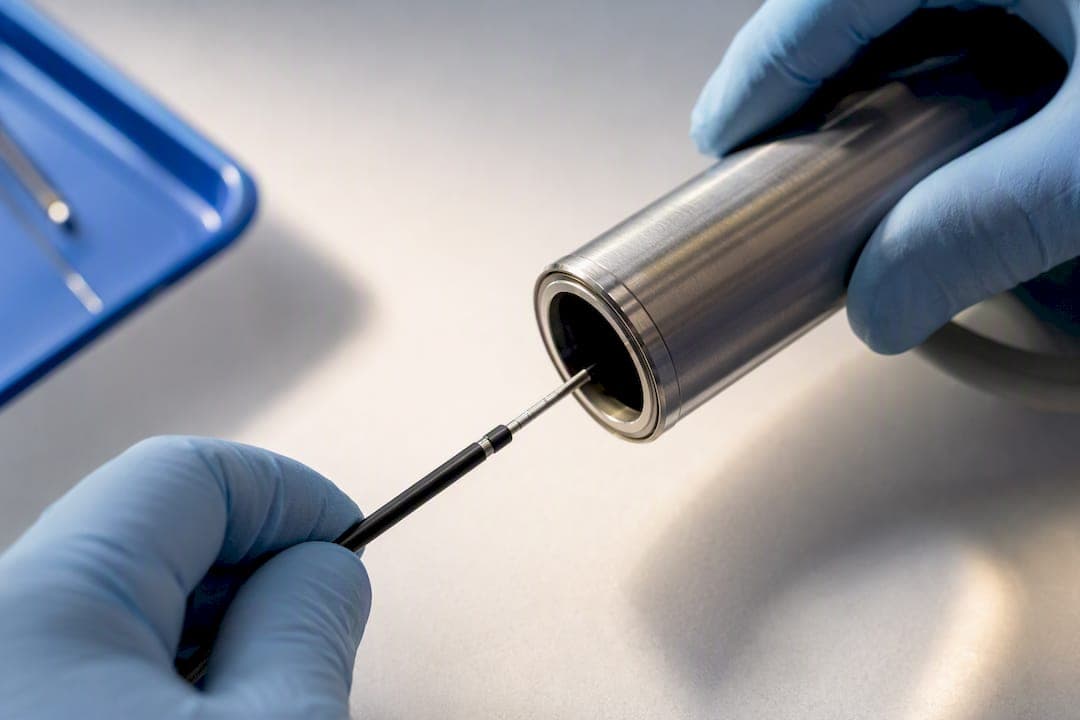
Before ordering forceps, run three checks: catheter outer diameter against scope working channel (leave about 0.2 mm of clearance), jaw diameter against how much tissue the diagnosis actually requires, and working length against the specific scope type. Standard forceps in the approximately 2.2 to 2.4 mm range cover most routine mucosal biopsies. Jumbo forceps, generally starting around 3.0 mm in diameter, are used when deeper or larger samples are needed and the scope channel can accommodate them.
TL;DR:
- Confirm that the catheter outer diameter is at least 0.2 mm less than the scope's inner channel size to ensure safe fit and prevent damage.
- Use standard forceps with a jaw diameter of 2.2 to 2.4 mm for most routine mucosal biopsies, while jumbo forceps of around 3.0 mm are suited for larger or deeper samples.
- Always verify scope-specific working length and channel size from manufacturer specifications before ordering to avoid compatibility issues.
- Choose cup designs based on procedure needs: standard for routine biopsies, fenestrated for larger tissue volume, or spiked for lesions difficult to grip.
- Opt for single-use forceps in high-infection-risk settings or when complex jaw designs with tissue trapping features are involved, to ensure sterility and avoid reprocessing risks.
Table of Contents
- What Sizes Do Biopsy Forceps Come In?
- Which Cup Design Fits Which Biopsy Site?
- How Do I Confirm Forceps Compatibility With My Scope?
- Does Forceps Size Actually Change Diagnostic Accuracy?
- Reprocessing, Sterilization, and Single-Use vs Reusable
- Building a Procurement Checklist That Actually Works
- What Our Order Data Tells Us About Real-World Sizing
- What Clinicians Get Wrong About Forceps Sizing
- Where to Find Compatible Forceps and Endoscopes
- Sources
- FAQ
What Sizes Do Biopsy Forceps Come In?
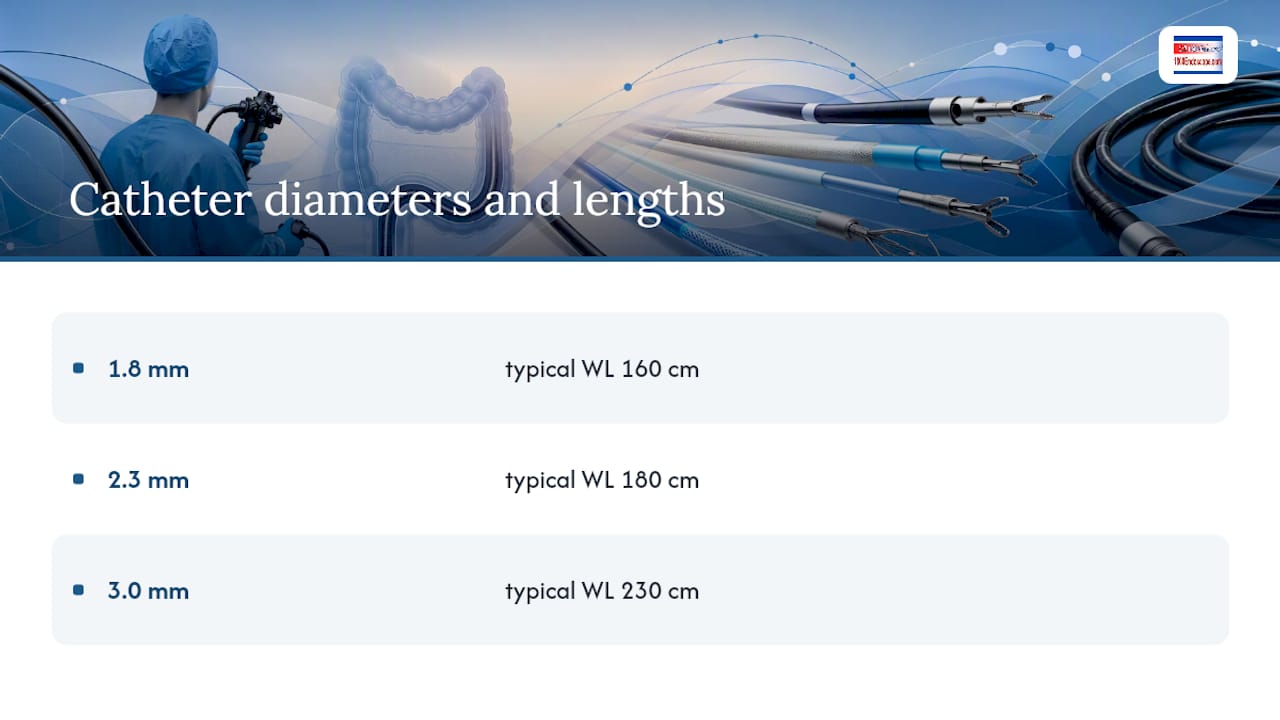
Biopsy forceps sizing isn't one number. It's three: jaw (or bite) diameter, catheter shaft diameter, and working length. Mixing those up is the single most common ordering mistake in endoscopy suites and vet clinics alike, and it's the reason a perfectly good instrument ends up sitting unused in a drawer because nobody double-checked the channel spec before checkout.
Jaw diameter determines how much tissue the cups can physically grab. Catheter diameter is the shaft dimension that has to slide through the endoscope's working channel without binding. Working length is the total insertable length, and it has to reach the target site with room to spare for the scope's own handle and connector hardware.
The table below reflects dimensions drawn from manufacturer datasheets and product catalogs, cross-checked against clinical literature on how bite size affects specimen quality.
*Minimum channel figure assumes approximately 0.2 mm clearance as recommended in manufacturer instructions.
A few things are worth knowing before you trust any chart, including this one. Vendor catalogs use color coding for quick identification, but the colors are not standardized across manufacturers. A surgical technique reference notes that one brand's blue might mean 2.0 mm while another's blue means something else entirely. Always confirm against the specific instructions for use (IFU), never against a color memory from a different product line.
Working length matching follows scope type more than procedure type. Flexible bronchoscopes typically run in the 55–65 cm insertion range, but the forceps working length needs to account for the full length of the scope's biopsy channel plus a margin to keep the handle usable outside the patient, which is why 160 cm forceps dominate bronchoscopy carts even though the actual airway distance is far shorter. Colonoscopy pushes that further. A full colonoscope can require insertion depths past 150 cm, so 180 cm or 230 cm forceps become the practical floor, not the ceiling.
Catheter diameter is where most compatibility failures actually happen, not jaw diameter. A technical manual from ENDO-FLEX is explicit that the working channel diameter must exceed the instrument's outer diameter, and that instruments should never be forced through a channel that's too tight. Forcing a slightly oversized catheter can damage both the scope's channel lining and the forceps cable, and that's an expensive way to learn a size chart wasn't checked closely enough.
Vendor datasheets for single-use lines commonly list diameters clustering around 1.8 mm, 2.3 mm, and 3.0 mm, paired with working lengths of 160 cm, 180 cm, and 230 cm depending on the target anatomy, according to Micro-Tech Endoscopy's product catalog. Those three diameter tiers map closely to the pediatric, standard, and jumbo categories most clinicians already think in, which makes cross-vendor comparison easier once you know to look past the color codes and straight at the millimeter spec.
If your practice runs a mix of scope diameters, our endoscope diameter guide walks through how working channel sizes vary by scope class, which is the number you need in hand before any forceps purchase makes sense.
Which Cup Design Fits Which Biopsy Site?
Jaw diameter tells you how much tissue you can grab. Cup design tells you how well you'll actually hold onto it, and the two decisions aren't the same conversation.
Standard cups are smooth, oval, and closed at the tip. They're the default for routine GI mucosal biopsies because they minimize crush artifact and give pathology a clean specimen edge to work with. If a procedure doesn't have a specific reason to deviate, standard cups are the right starting point.
Fenestrated cups have an opening or window in the jaw that lets tissue partially protrude before the jaws close, increasing the amount captured per bite without needing a larger overall diameter. They're a common choice when you want more tissue volume but the channel won't accept a jumbo catheter.
Spiked or needle-tip cups include a small central spike that anchors the forceps against a slippery or angled surface before the jaws close. That anchoring matters most on rounded or mobile lesions, and in bronchial biopsies where the airway surface can be difficult to grip cleanly on the first attempt.
Alligator or rat-tooth jaws use serrated or toothed edges instead of a smooth cup profile, which helps grip firmer or fibrous tissue that a smooth standard cup tends to slide off. They show up more often in industrial and veterinary rigid-scope work than in routine human GI biopsy, where tissue is generally softer.
Jumbo cups are simply larger versions of the standard or fenestrated design, built to pull the maximum tissue volume the channel allows.
Design choice by procedure type breaks down like this in practice:
- Biliary stricture sampling via ERCP favors large-capacity or jumbo cups, since duodenoscope channels are typically wide enough to accommodate them and specimen size directly affects diagnostic sensitivity.
- Bronchial and transbronchial biopsy often uses standard or spiked cups depending on lesion mobility and airway angle.
- Barrett's esophagus surveillance protocols increasingly specify jumbo forceps where the endoscope channel supports it, given the tissue-volume demands of adequate dysplasia screening.
- Routine GI mucosal surveillance rarely needs more than a standard cup, since the goal is representative sampling, not maximal volume.
Pro Tip: Keep cups fully closed during insertion and withdrawal, even in wide, straight channels. An open cup can catch on channel seams or biopsy port valves, and that single habit prevents more forceps damage than any storage or cleaning practice.
Multi-bite technique, taking two or three passes from slightly different angles on the same lesion, tends to improve diagnostic yield more reliably than switching to a bigger jaw alone. Cup design and bite count work together. A jumbo cup with a single pass can still underperform three well-placed standard bites, particularly on heterogeneous lesions where sampling location matters as much as sampling volume.
How Do I Confirm Forceps Compatibility With My Scope?
Two calculations decide whether a given forceps will work with a given endoscope, and both need to check out before the instrument leaves the tray.
- Confirm catheter clearance. Catheter outer diameter must be less than or equal to the scope's working channel inner diameter minus roughly 0.2 mm. A 2.4 mm catheter needs at least a 2.6 mm channel, not a 2.4 mm channel, because a diameter-matched fit still risks binding at connector points and channel bends.
- Confirm working length reach. Working length must exceed the required insertion depth plus enough margin for the handle and control section to remain usable outside the patient. Undershooting this by even 10 to 15 cm on a colonoscope can leave you unable to reach a proximal lesion at all.
- Cross-check against the scope's actual spec sheet, not its nominal category. "Pediatric bronchoscope" and "adult bronchoscope" don't map to fixed channel sizes across manufacturers. Pull the specific model's channel ID before ordering, every time, even for scopes your clinic has used for years.
- Watch for known mismatch zones. Small-diameter pediatric and neonatal scopes, along with older or refurbished scope models with narrower legacy channels, are where compatibility failures cluster. Long insertion-length scopes, full colonoscopes especially, are where working-length shortfalls cluster.
- Build a fix path before you need one. If a jumbo forceps doesn't fit a given channel, the practical fallback is a fenestrated standard-diameter forceps with a multi-bite technique, not forcing the larger instrument through.
Scope specifications live in the manufacturer's technical manual or the scope's own IFU, not in general size charts, since two scopes with the same external diameter can have different internal channel dimensions depending on how much room the optics and light guide take up.
A simple inventory fix prevents most of these mismatches before they reach the procedure room: label each forceps package with the specific scope models it's confirmed compatible with, and keep a compatibility matrix taped near the procedure cart rather than relying on staff memory. Clinics running mixed fleets, a mix of human GI scopes and veterinary scopes, for instance, benefit the most from this, since channel sizes vary more across that mix than within a single scope family — see our veterinary project work and marketing resources for practice-level procurement and clinic setup guidance. If your clinic handles both small-animal and general procedures, our veterinary endoscope buying guide breaks down channel sizing by scope class in that context specifically.
Does Forceps Size Actually Change Diagnostic Accuracy?
Yes, in several well-documented settings, though the effect size depends heavily on the procedure and the disease being investigated.
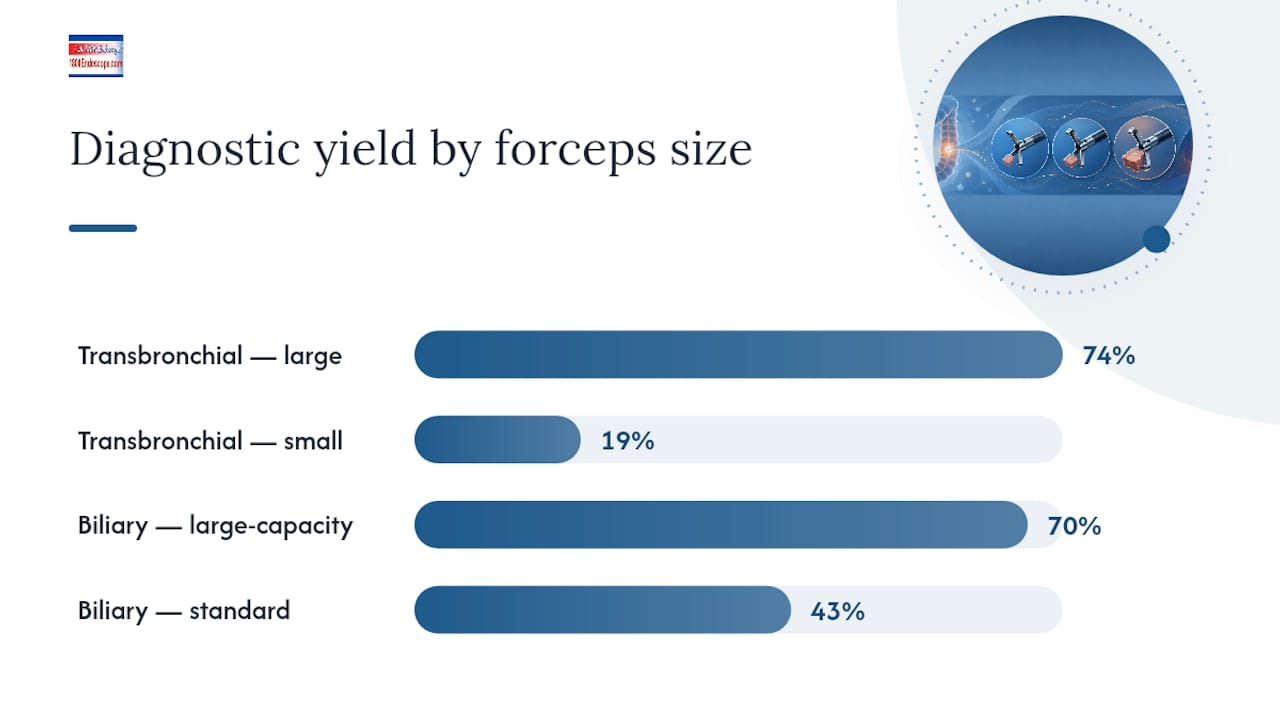
The clearest data comes from transbronchial biopsy. Larger forceps obtained diagnostic tissue in 74% of biopsies compared with 19% for small forceps, a statistically significant gap (p < 0.005), and larger forceps also captured more alveolar tissue without increasing bleeding rates in that series. For diseases like sarcoidosis, where the diagnostic tissue has to include the right lung compartment, that alveolar yield difference is the whole ballgame.
Biliary biopsy shows a similar pattern. A comparative clinical series found large-capacity forceps improved sensitivity to 70% versus 43% for standard forceps, with median sample area nearly triple (1.98 mm² versus 0.68 mm²). That's a meaningful jump for a diagnosis where a false negative on a biliary stricture biopsy has real downstream consequences.
Barrett's esophagus surveillance adds a third data point. Randomized comparisons of different-sized biopsy forceps found that larger forceps improved sampling quality in a setting where dysplasia detection depends on getting enough tissue depth to assess the full mucosal layer, not just surface cells.
The older foundational work on this question, comparing standard 2.4 mm forceps against pediatric 1.8 mm forceps, found the larger instrument produced significantly larger and deeper specimens across comparative in vitro and in vivo testing. Heavier sampling pressure also increased specimen weight and depth. But that same study noted the effect on actual diagnostic adequacy in adult patients wasn't always clear-cut, because lesion characteristics and where exactly the operator sampled mattered just as much as jaw size.
That caveat is worth sitting with. Bite diameter is one lever among several, and it's not always the strongest one:
- Operator pressure and sampling angle influence specimen depth as much as forceps size in several comparative studies.
- Number of bites per lesion (multi-sampling) frequently closes the gap between standard and jumbo forceps on diagnostic yield.
- Specimen handling after retrieval, orientation, fixation timing, can affect what the pathologist actually sees regardless of how good the sample was at retrieval.
The practical rule that falls out of this evidence: reach for jumbo or large-capacity forceps when the clinical question specifically demands submucosal depth or maximal tissue volume, biliary stricture workup and Barrett's surveillance being the clearest examples, provided the scope channel supports it. For routine mucosal surveillance where representative sampling is the goal rather than maximal volume, multiple standard biopsies from different sites usually perform the same diagnostic job.
Reprocessing, Sterilization, and Single-Use vs Reusable
Reprocessing risk, not just cost, should drive the single-use versus reusable decision, and the two variables often point in the same direction.
Reusable forceps carry a hard requirement: sterilization compatibility validated against the manufacturer's own IFU. Skipping that validation step is how instruments end up damaged mid-lifecycle or, worse, how cross-contamination risk creeps into a reprocessing workflow that looked fine on paper. The same 0.2 mm channel clearance warning that governs safe passage through a scope channel also applies every time a reprocessed instrument goes back into service. A forceps that's been through several sterilization cycles can develop dimensional drift at the joint, and that drift is exactly what causes binding on reinsertion.
Facilities lean toward single-use forceps in a few recurring situations:
- Jaw designs with fenestrations, spikes, or serrated teeth, all of which trap tissue debris in crevices that standard cleaning brushes struggle to reach fully.
- High-infection-risk settings where the downside of an imperfect reprocessing cycle outweighs the per-unit savings of reuse.
- Lower-volume clinics where the capital and validation overhead of a reprocessing program doesn't pencil out against a modest case count.
Cost comparison has to include the full reprocessing chain, not just the sticker price. A buying guide comparing single-use and reusable forceps frames the decision as one that has to weigh per-procedure device cost against staff time, sterilization cycle cost, and instrument lifespan, not device price alone.
Pro Tip: Ask any supplier for their sterilization validation documentation before the first order ships, not after a reprocessing failure forces the question. A legitimate manufacturer will have this on hand immediately.
Before adopting a reusable line, confirm three documents exist and are current: the IFU itself, a sterilization compatibility statement naming the exact validated method (steam, ethylene oxide, or otherwise), and a labeling or traceability system that lets staff confirm cycle count per instrument.
Building a Procurement Checklist That Actually Works
Sizing decisions made at the ordering desk are cheaper to get right than sizing decisions discovered mid-procedure. A short, ordered checklist catches most of the failure points already covered above.
- Pull the exact working channel diameter for every scope model in active use. Nominal category names don't substitute for the real spec sheet number.
- Map your procedure mix. Count what percentage of cases are routine mucosal surveillance versus procedures that specifically benefit from jumbo capacity, biliary work, Barrett's protocols, transbronchial sampling.
- Select jaw designs against that mix, not against whatever the previous order happened to include. Standard cups for the surveillance majority, fenestrated or jumbo for the higher-yield indications.
- Decide single-use versus reusable based on reprocessing capacity, case volume, and the jaw designs chosen (complex jaws push toward single-use).
- Confirm sterilization validation and IFU availability before finalizing any reusable order.
- Set stock levels against actual case volume, not round numbers. A high-volume GI unit running a heavy screening colonoscopy schedule might stock 60 to 70% standard-diameter forceps, with the remainder split between jumbo and specialty cup designs. A small veterinary clinic doing occasional GI endoscopy might reasonably stock a single working length and diameter tier plus a small reserve of pediatric-sized forceps for smaller patients.
- Label every stocked unit for scope compatibility at receiving, not at the moment of use.
Request three documents from any supplier before committing to an order: the instrument's IFU, a compatibility chart naming which scope channel sizes the catheter diameter has been validated against, and sterilization validation paperwork if the line is reusable. A supplier unwilling to provide these on request is worth reconsidering, regardless of price.
Small teams and mobile units, common in ambulatory and veterinary field work, benefit from pre-assembled procedure kits: one working length and diameter tier bundled with the matched scope's compatibility sticker, stored together rather than sorted by catalog number. That single habit removes the guesswork that causes most wrong-device picks at the point of care.
What Our Order Data Tells Us About Real-World Sizing
The forceps sizes clinics actually order don't always match what size charts emphasize. Standard 2.2–2.4 mm diameter forceps in the 160–180 cm working length range make up the bulk of repeat orders from small veterinary clinics and general procedure units, largely because that combination fits the widest range of scope channels already in service. Jumbo requests cluster around specific indications rather than general use, consistent with how the clinical evidence frames their benefit.
For mobile and field units, kit assembly matters as much as size selection. Bundling one working length tier with clearly labeled scope compatibility, stored as a single unit rather than loose stock, cuts down on mid-procedure scrambling more than any individual size choice does.
What Clinicians Get Wrong About Forceps Sizing
The instinct to default to "bigger forceps, better sample" doesn't hold up against the evidence. Jumbo capacity earns its keep in specific indications, biliary stricture workup and Barrett's surveillance chief among them, where the data shows a real sensitivity gap. Outside those indications, a well-placed standard biopsy, or three of them, does the job just as well, and it does it without gambling on whether the channel will actually accept the larger catheter.
The bigger blind spot is treating catheter diameter as a formality instead of the actual failure point it is. Clinics rarely get burned by picking the wrong jaw for the wrong lesion. They get burned by ordering a catheter that's technically undersized for the channel spec by a fraction of a millimeter, discovering it mid-procedure, and scrambling for an alternative on the spot. That's a paperwork problem, not a clinical judgment problem, and it's entirely preventable with a five-minute spec check before the order goes in.
Technique deserves more credit than it gets in most purchasing conversations. Sampling angle, bite count, and pressure move the needle on specimen adequacy about as much as jaw diameter does. A facility that trains staff on multi-bite technique often gets more diagnostic value out of its existing standard-diameter stock than one that just upgrades to jumbo across the board.
— Endoscope
Where to Find Compatible Forceps and Endoscopes
Getting the size right on paper only matters if the scope and forceps you actually own can fit together, which is why it is important to select products from a single source or verify compatibility before purchase. Biopsy forceps are available across the standard diameter tiers and working lengths covered in this guide, alongside compact veterinary and field-use endoscopes sized to match, to facilitate sourcing matched equipment.
For clinics running small-diameter scopes in field or mobile settings, our portable airway inspection endoscope system pairs well with standard-diameter forceps sized for narrower channels. If you're stocking or comparing across a broader range of instruments, the full endoscope and accessory catalog breaks down channel sizes by product line, and technical staff can confirm compatibility, IFU availability, and bulk-order pricing before you commit to a purchase. Reach out to request an IFU or a compatibility check on any forceps and scope combination before you place an order.
Sources
The clinical claims in this guide draw on peer-reviewed comparative studies rather than vendor marketing, and it's worth keeping a few of them close if a purchasing committee or infection control review asks for backup. The transbronchial biopsy forceps-size study and the Barrett's esophagus forceps comparison are the two strongest indication-specific data points on size and diagnostic yield. The foundational specimen-depth study remains the reference point for how bite diameter and sampling pressure interact.
On the technical side, ENDO-FLEX's operating instructions and the Micro-Tech Endoscopy catalog lay out real-world diameter and length ranges, and the single-use versus reusable buying guide covers the reprocessing and cost tradeoffs in more depth than this article's summary.
This article is general information, not a substitute for advice from a qualified doctor. Consult a qualified healthcare professional about your own circumstances before acting on anything here.
- Randomized comparison of 3 different-sized biopsy forceps for quality of sampling in Barrett's esophagus
- The Effect of Forceps Size on the Adequacy of Specimens Obtained by Transbronchial Biopsy
- Operating Instructions – Biopsy Forceps SU (ENDO-FLEX)
FAQ
Do Biopsy Forceps Come in Different Sizes?
Yes. Jaw diameters typically range from about 1.8 mm pediatric sizes up to 3.0 mm jumbo variants, and catheter diameters and working lengths vary separately to match different endoscope channels and insertion depths.
What Are the Different Types of Biopsy Forceps?
The main cup designs are standard (smooth oval jaws), fenestrated (windowed jaws for higher tissue capture), spiked or needle-tip (anchoring point for slippery surfaces), alligator or rat-tooth (serrated for firmer tissue), and jumbo versions of these same shapes built for maximum tissue volume.
What Is the Standard Size of an Endoscopy Biopsy Forceps?
Most routine GI mucosal biopsies use standard forceps with a jaw diameter around 2.2 to 2.4 mm and a catheter working length of 160 to 230 cm, depending on the specific endoscope model.
What Is the Diameter of Open Biopsy Forceps?
Open jaw diameter, sometimes called bite diameter, generally runs from 1.8 mm on pediatric-sized forceps to 3.0 mm or larger on jumbo forceps, with the exact figure listed in the manufacturer's IFU rather than assumed from the product category name.