
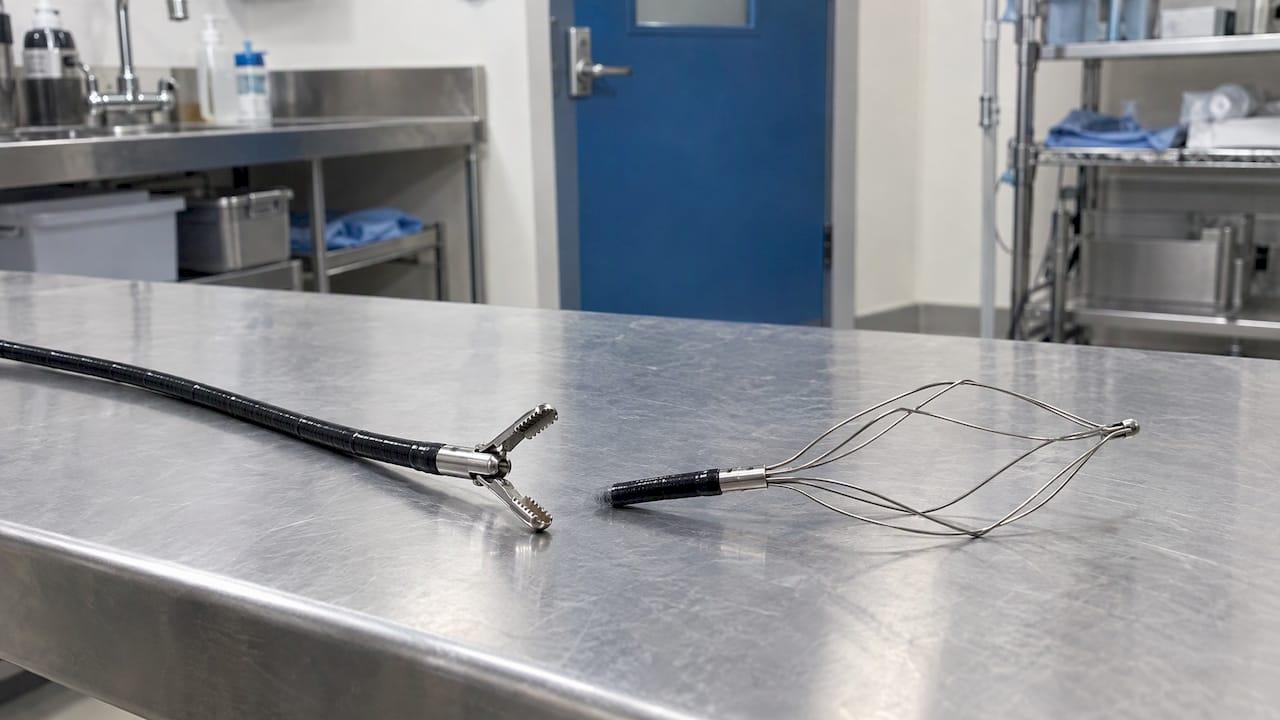
A grasper holds an object by closing jaws or prongs on it. A basket surrounds the object with open wires and captures it by entrapment. Graspers are the workhorse for most gastrointestinal foreign bodies, while baskets earn their place with smooth, rounded targets, stones and multiple small objects. The right choice depends on the target, the scope's working channel and what you can pass without forcing. A clinic that stocks both, matched to its scope channels, can handle the widest range of retrievals.
TL;DR
- Graspers (two-prong, tripod, alligator, rat-tooth) grip and pull. They are the most commonly used retrieval tools for foreign bodies.
- Baskets (retrievers, dislodgers) entrap rather than pinch. They suit smooth, rounded objects, stones and, in cardiac work, adult heartworms.
- Channel size decides first. Many instruments need a 2.8 mm channel, and most also come in versions for 2.0 mm channels.
- Never force an instrument through the channel or pull a foreign object into it. Channel damage is a common cause of fluid invasion and costly repairs.
- A practical starting set is a long-armed two-prong grasper plus a snare, with a basket and rat-tooth forceps added as the caseload demands.
Table of Contents
- What a grasper and a basket actually are
- How graspers work in the field
- Where baskets earn their place
- Side-by-side comparison
- Choosing: a five-question checklist
- Protecting the scope and the patient
- Worked example: one case, two tools
- Equipping your clinic
- Our perspective
- FAQ
- Sources
What a grasper and a basket actually are
Both are flexible accessories passed through the working channel of an endoscope. They differ in how they hold the target.
Graspers have jaws or prongs that open at the tip and close on the object. The common patterns are two-prong, three-prong (tripod), four-prong, alligator-jaw and rat-tooth forceps. Each has a different jaw shape, and that shape decides what it can hold.
Baskets are made of several wires that spring open into a cage. You steer the open cage around the object, then close the wires or draw the object back against the scope. Hall describes how basket wires have a shape memory that makes them spring open, so you can steer the basket over a foreign body by moving the endoscope tip before closing it.
The practical difference is contact. A grasper concentrates force at a few points, which gives grip but also pressure. A basket spreads contact around the object and has no sharp claws.
How graspers work in the field
Graspers are the first instrument most clinics reach for. A veterinary chapter on endoscopic removal of GI foreign bodies states that two-, three- and four-pronged grasping instruments are the ones most commonly used for foreign-body retrieval. The same chapter gives the specifics that help with purchasing:
- Two-prong graspers: a sturdy model has a jaw width of about 1.4 cm and fits a 2 mm channel.
- Tripod (three-prong) graspers: these usually need a 2.8 mm channel.
- Sheathed four-prong graspers: made for small channels, but less durable.
- Alligator-jaw forceps: best on smooth, flat objects.
- Rat-tooth forceps: excellent grip on heavy cloth such as socks and towels, and on trichobezoars (hairballs).
Technique matters as much as the tool. The endoscopist gets the object in view, grips it firmly and removes it with gentle traction. In cats, the Journal of Feline Medicine and Surgery review by Neiger and colleagues advises gripping the object firmly with a foreign-body grasper or forceps, never using force to remove it, and notes that careful rotational torque may help dislodge bony objects.
Where graspers fall short
Grasper jaws have a limited opening. Hall notes that rat-tooth and alligator jaws rarely open wide enough to take hold of a rubber ball. Smooth objects are another problem: the Veterian Key chapter says smooth items can be hard to hold firmly enough to get through the narrow upper and lower esophageal sphincters.
Those are the situations where a basket comes in.
Where baskets earn their place
Baskets are described in the same chapter as less commonly required, but potentially more effective for smooth, rounded objects. Neiger's feline review says stones or rubber objects in cats can be taken with a basket or prong forceps.
Stones in the urinary tract
A 2025 veterinary nursing article on noninvasive removal of bladder stones describes passing a stone retrieval basket through the endoscope channel, collecting the stone and withdrawing the endoscope to remove it. It gives size limits of under 5 mm in female dogs, and under 4 mm in female cats and male dogs.
Heartworms: the clearest head-to-head data
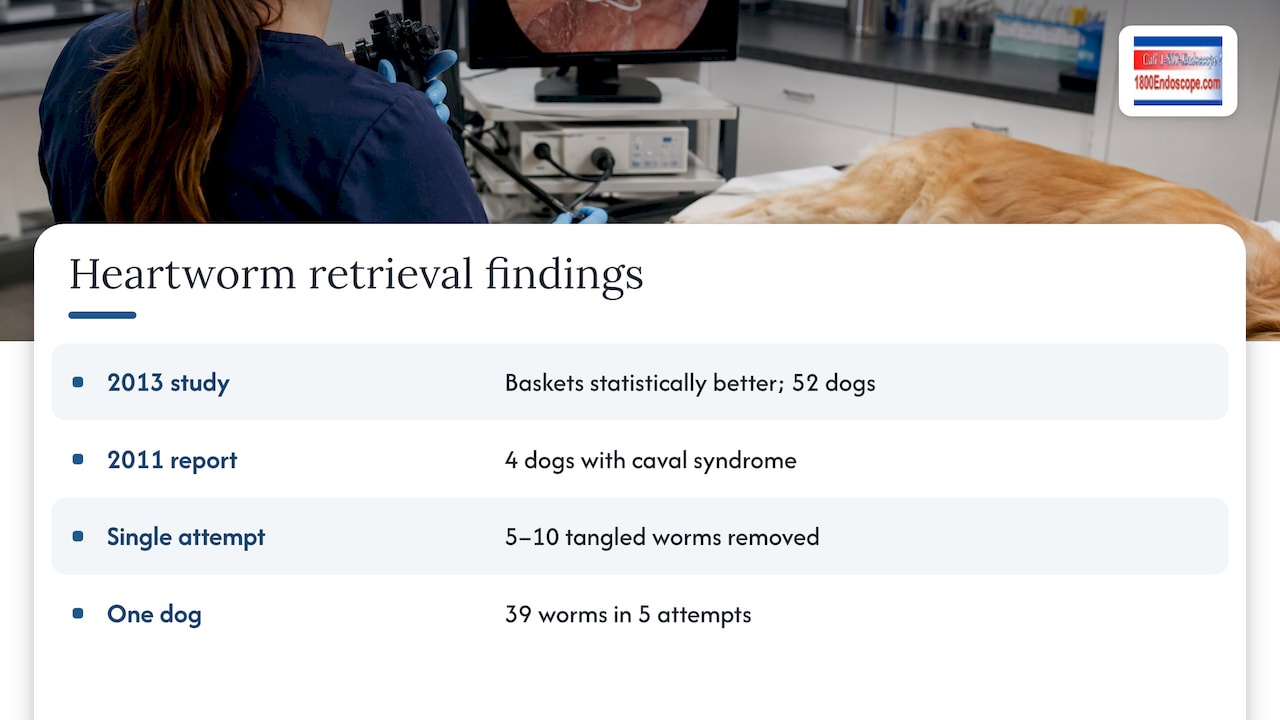
The best direct comparison of the two designs comes from cardiac retrieval rather than the GI tract. In a 2013 study of 52 dogs with heavy heartworm burden, baskets were statistically better than grasping forceps at removing adult worms. The authors attribute this to flexibility, the absence of sharp grasping claws, rare intracardiac or vascular damage, and the ability to capture several worms per pass by entrapping them.
An earlier 2011 report in the Journal of Veterinary Science used a catheter-guided nitinol basket in four dogs with caval syndrome. Tangled worms allowed 5 to 10 to be removed in a single attempt, and one dog had 39 worms removed in five attempts, with minimal intracardiac damage.
This is a fluoroscopic, catheter-guided procedure and not routine endoscopy. It still shows the design logic: when the target is soft, multiple or fragile, entrapment beats pinching.
Large baskets
Size still has limits. The Veterian Key chapter describes a large six-wire foreign-body basket that opens to 14 cm by 10 cm and needs a 2.8 mm channel. Hall cautions that very large baskets made for tennis balls are often too large to pull out of the stomach endoscopically, so check the object's size against the exit route, not only the stomach.
Side-by-side comparison
| Factor | Grasper | Basket |
|---|---|---|
| Holding principle | Jaws or prongs close on the object | Open wires surround and entrap it |
| Best targets | Bones, cloth, sticks, flat or irregular objects with an edge to grip | Smooth rounded objects, stones, multiple small items |
| Typical patterns | Two-prong, tripod, alligator, rat-tooth | Wire basket, retriever or dislodger, large foreign-body basket |
| Channel need | 2 mm for many two-prong models, 2.8 mm for tripod and rat-tooth | Many sizes for 2.0 mm channels, large baskets need 2.8 mm |
| Tissue contact | Concentrated at the jaw points | Spread across wires, no sharp claws |
| Main limit | Jaw opening and grip on slippery objects | Object size against the exit route |
| Frequency of use | The most common retrieval tool | Less commonly required |
Choosing: a five-question checklist
1. What is the target?
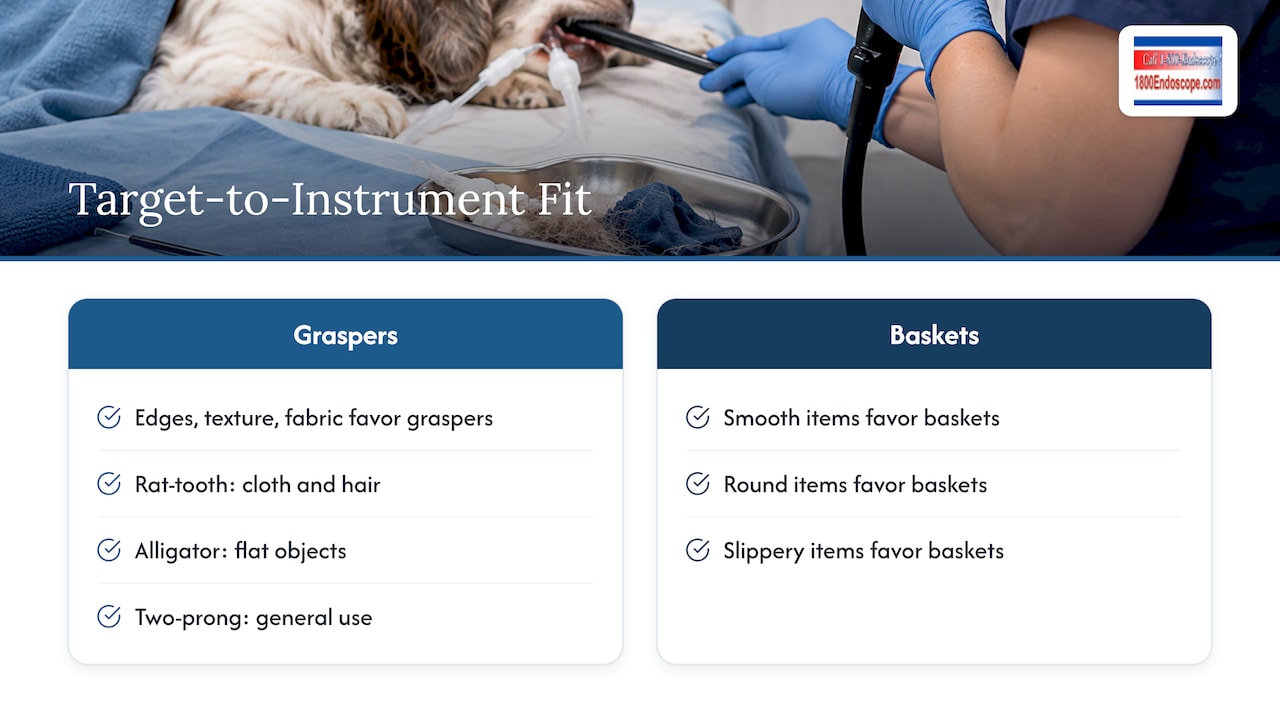
Start with shape and surface. Edges, texture and fabric favor graspers: rat-tooth for cloth and hair, alligator for flat objects, two-prong for general use. Smooth, round and slippery items favor baskets.
2. What channel does your scope have?
This is the real gatekeeper. Neiger and colleagues report that feline retrieval instruments, including rat-tooth, alligator, multi-prong and basket forceps and snares, are available for 2.8 mm working channels, and most also for 2.0 mm channels. Hall points out the trade-off: unless the endoscope has a 2.8 mm channel, many instruments cannot be passed, yet a larger channel increases the tip diameter, which can rule out some attempts in small dogs and cats.
That is why scope diameter and accessory choice should be planned together. Our endoscope diameter guide and our veterinary endoscope buying guide walk through how size relates to patient size.
3. What is the exit route?
A retrieval is not finished when you have the object. The Neiger review says instruments must never pull a foreign object into the working channel. Plan to withdraw object and scope together, and think through the sphincters and the oropharynx before you grip.
4. Which patient and how much holding power?
The Veterian Key chapter notes that alongside-scope rigid forceps have significantly more holding power than through-the-scope instruments and help with large bones. Because they grip so firmly, only gentle traction should be used during removal, to avoid esophageal perforation. Match the grip to the risk of the tissue the object must pass.
5. What should you keep in stock?
A veterinary endoscopy chapter suggests a typical practice should have at least two biopsy forceps, three or more foreign-body graspers and two or three balloon dilators ready for immediate use. It lists two-prong graspers, basket retrievers and snares as the most popular retrieval styles. For a minimum retrieval kit, the Tams chapter recommends a long-armed two-prong grasper plus a snare, completed with rat-tooth, net and basket instruments as the caseload grows.
Protecting the scope and the patient
Most accessory problems are really channel problems. The same endoscopy chapter warns that channel damage from inappropriate instruments is a common cause of fluid invasion and costly repairs. Its guidance is concrete:
- Use only instruments of the right size, style and specification for the scope.
- Never force an instrument through the channel against resistance.
- If you meet resistance with a deflected tip, straighten the tip before passing the instrument.
It also observes that multiuse instruments tend to be more cost-effective over time than single-use ones, which matters when you are building a kit for a busy clinic. Reprocessing needs the right brush for the channel, and our channel brush sizing guide covers the 1.2 to 2.8 mm range.
On the patient side, endoscopic removal in experienced hands is much quicker than surgery, normally under 30 minutes from anesthetic induction, according to the Neiger review. The same authors recommend that owners consent to surgical intervention under the same anesthesia, because complications such as esophageal perforation can occur. Build that consent conversation into your protocol before the procedure. For a clinic-level workflow, see our foreign body retrieval protocol article.
Worked example: one case, two tools
A clinic gets a 30 kg dog that swallowed a sock and a smooth rubber ball in the same week.
- The sock: a rat-tooth grasper through a 2.8 mm channel is the logical first pick, since this pattern is described as excellent on heavy cloth. Grip, gentle traction, withdraw scope and object together.
- The ball: jaws may not open wide enough, so a basket is worth considering. Check first that the object will clear the cardia and esophagus on the way out. If it is too large for the exit route, that points to a different plan with the owner's surgical consent already in hand.
The point is not that one tool wins. The target decides, and the channel decides what you can pass.
Equipping your clinic
We supply veterinary endoscopy equipment and endoscopic accessories, including flexible biopsy forceps, for clinics building out a kit. Browse the veterinary rigid endoscopy catalog, the flexible biopsy forceps page and the medical endoscopes and accessories page. Our site also lists endoscope repairs.
Tell us the scope and channel size you are working with, and we can help you match accessories to it.
If you are choosing a scope at the same time, our GI endoscope specifications guide shows what small-animal clinics need from a GI scope, and our small animal endoscopy tips cover day-to-day technique.
Our perspective
We treat the basket versus grasper question as a kit-planning question, not a contest. A grasper is the everyday retrieval tool, and a basket is the specialist you are glad to have on the day a smooth, round target turns up. Clinics get into trouble when the accessory is chosen before the scope, because the working channel sets what every later purchase can do.
Our focus is veterinary-specific endoscopy at prices that make a full kit realistic for a small-animal or equine practice, not only for a hospital-grade budget. That means thinking about the scope, its channel, the forceps and the cleaning tools as one system, supported 24/7 and shipped quickly.
Our advice is simple: pick the scope for your patients, confirm the channel diameter, then build the instrument set around it, starting with the grasper patterns that cover the most cases and adding baskets as your caseload shows the need.
Endoscope
FAQ
Is a basket or a grasper better for foreign body removal in dogs and cats?
Neither is better across the board. Graspers are the most commonly used tools and cover bones, cloth and irregular objects. Baskets are more effective for smooth, rounded objects that jaws cannot hold. Many clinics keep both for that reason.
What working channel do I need for retrieval instruments?
Many two-prong graspers fit a 2 mm channel, while tripod graspers and large baskets typically need 2.8 mm. Neiger and colleagues report that most feline instruments come in 2.0 mm versions as well. Confirm the channel before ordering any accessory.
Can a basket remove bladder stones?
Yes, within limits. A 2025 veterinary nursing article describes using a stone retrieval basket through the endoscope channel for stones under 5 mm in female dogs and under 4 mm in female cats and male dogs.
What is the minimum set of retrieval instruments for a clinic?
The Veterian Key chapter advises a long-armed two-prong grasper plus a snare as a minimum. Rat-tooth forceps, a net and a basket complete the set. A general endoscopy chapter suggests at least three foreign-body graspers on hand.
How do I avoid damaging the scope with accessories?
Use only accessories sized for the channel, never force an instrument against resistance, and straighten a deflected tip before passing one. Channel damage from inappropriate instruments is a common cause of fluid invasion and costly repairs.
Sources
- Endoscopic Removal of Gastrointestinal Foreign Bodies (Veterian Key)
- Endoscopy (Veterian Key)
- Gastrointestinal endoscopy in the cat, Journal of Feline Medicine and Surgery, 2013
- Endoscopic retrieval of foreign bodies, Edward J. Hall, 2022
- Noninvasive Methods for Removing Cystoliths, Today's Veterinary Nurse, 2025
- Comparison of 2 Retrieval Devices for Heartworm Removal, Journal of Veterinary Internal Medicine, 2013
- Catheter-guided percutaneous heartworm removal, Journal of Veterinary Science, 2011