
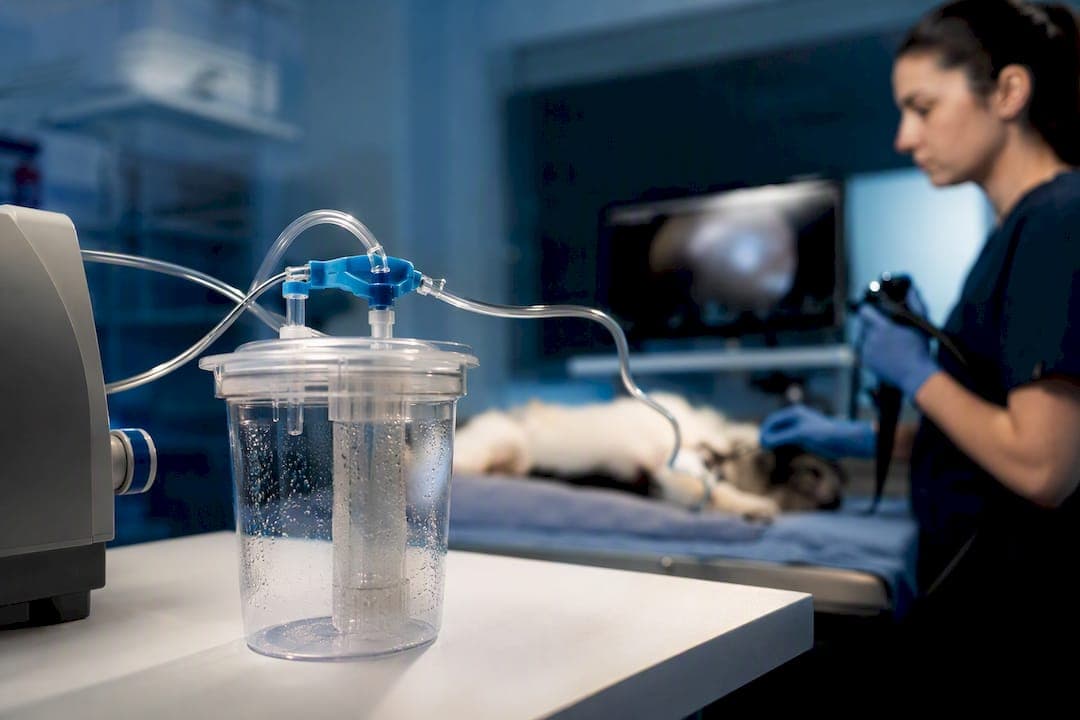
Most veterinary clinics do best with a portable AC/DC aspirator built with overflow protection and a hydrophobic filter. That single combination protects the motor from fluid ingress while giving enough vacuum and flow to keep the endoscopic field clear during routine gastroscopy, bronchoscopy, and otoscopy. Clinics running heavy surgical caseloads or large-animal, long-reach procedures need a step up to a high-vacuum unit. 1800endoscope stocks scope-compatible pump options and can walk you through matching catheter and canister specs to your equipment.
TL;DR:
- Use a portable aspirator with overflow protection and a hydrophobic filter for general practice, but switch to a high-vacuum unit for large animals or long procedures.
- Match vacuum and flow specifications to your caseload, with clinic-class units handling most cases and surgical units needed for high-volume or continuous-duty procedures.
- Confirm catheter bore, tubing length, and accessories are compatible with your scope to prevent aspiration failure during procedures.
- Always verify vendor specs, including overflow safety, kit contents, certifications, and support options, before purchasing equipment.
- Regularly clean and inspect components, replace filters, and schedule pump maintenance to ensure reliability and prevent equipment failure.
Table of Contents
- What Veterinary Teams Actually Need From an Endoscopy Suction Pump
- Which Pump Type Fits Your Procedure?
- Reading the Spec Sheet: Vacuum, Flow, and Canister Size
- Accessories and Compatibility: Where Most Purchase Mistakes Happen
- Buying Checklist: What to Confirm Before You Order
- Keeping Your Suction System Reliable Between Procedures
- How suppliers approach suction compatibility
- Finding the Right Pump and Kit from specialized suppliers
- Sources
What Veterinary Teams Actually Need From an Endoscopy Suction Pump
A suction pump for veterinary endoscopy has one job: keep the visual field clear without starving the procedure of pressure or flooding the collection system. That sounds simple until you factor in what actually happens mid-procedure. A cat with a mucus-heavy airway, a dog with active GI bleeding, or a horse with three meters of scope buried in a guttural pouch all demand different things from the same piece of equipment.
Three clinical goals drive every purchase decision: clear visualization, controlled irrigation and aspiration, and protecting the pump motor from contamination. Miss any of those and you either lose the procedure or lose the equipment.
Operational constraints matter just as much as clinical ones. A five-minute otoscopy generates a trivial fluid volume. A prolonged bronchoalveolar lavage or an equine gastroscopy can produce far more, and species size change both scope reach and expected debris load. Facility setup matters too. A mobile equine practice needs battery operation and portability; a fixed surgical suite can rely on wall power and a larger footprint.
Whatever pump you land on, a few safety features are not optional extras. Insist on:
- Overflow protection that shuts off suction before fluid reaches the motor housing
- A hydrophobic filter positioned between the canister and the pump head
- Sealed collection canisters that prevent aerosolized contamination during handling
- Enough canister capacity for your longest anticipated procedure without a mid-case swap
Clinical reviews of endoscopic equipment consistently point out that a standard pump handles most cases fine, but long-reach or high-volume procedures push past what a basic setup can deliver, which is exactly where the next section comes in.
Which Pump Type Fits Your Procedure?
Pump classes split cleanly along duty cycle and reach. Matching the class to the caseload, not just the price tag, is what keeps clinics from replacing equipment every two years.
- Portable AC/DC aspirators. These run on wall power or battery, weigh little enough to move between exam rooms, and suit general practice diagnostics. Their limit shows up in continuous-duty surgical settings, where sustained high-volume aspiration outpaces their motor design.
- Oil-free diaphragm clinic units. Models like the Gomco 3000 Series run quiet, need no oil changes, and handle the daily rhythm of gastroscopy and bronchoscopy without complaint. They're the workhorse choice for a busy small-animal practice doing several scopes a day.
- High-vacuum surgical units. When a procedure calls for heavy, sustained aspiration, high-vacuum systems built for continuous duty with dual canisters are the safer bet. Swapping a full canister without interrupting the case matters a great deal in a lengthy surgical aspiration.
For day-to-day gastroscopy and otoscopy, a portable or diaphragm unit is plenty. Bronchoscopy with significant secretions leans toward the higher end of clinic-class specs. Long-reach equine procedures, where three meters of scope separate the working tip from the pump, are where the pump class matters least and the catheter matters most, a point worth remembering before you spend money chasing more vacuum.
Reading the Spec Sheet: Vacuum, Flow, and Canister Size
Vacuum and flow numbers on a spec sheet only mean something once you know what range fits your caseload. Clinic-class aspirators like the Gomco 3000 Series typically list vacuum around -559 mm Hg with open-flow near 26 L/min, which covers the vast majority of general practice endoscopy. Surgical-grade high-vacuum units push toward 680 mmHg with flow rates of 32 L/min or higher, built for continuous heavy aspiration rather than occasional use.
Pro Tip: Higher vacuum isn't automatically better for endoscopy. Too much negative pressure at a small-diameter catheter tip can collapse soft tissue against the aperture and actually block flow. Match vacuum to catheter bore, not the other way around.
| Spec category | Clinic-class range | Surgical-class range | Why it matters |
|---|---|---|---|
| Vacuum | Up to about -559 mm Hg | Up to about -680 mmHg | Higher range needed for heavy, continuous aspiration |
| Open flow | Around 26 L/min | 32 L/min or more | Clears large-volume fluid faster during active bleeding or lavage |
| Canister setup | Single canister | Dual canister, swappable | Lets staff change canisters mid-procedure without pausing |
| Power source | AC or AC/DC battery | Typically AC | Battery units suit mobile equine or ambulatory work |
| Noise | Often under 60 dBA | Generally louder | Lower noise reduces stress in awake or lightly sedated patients |
That noise figure is not a footnote. Aspirators running under 60 dBA noticeably reduce patient stress during procedures done under light sedation, which matters more in cats and small exotics than most equipment guides admit.
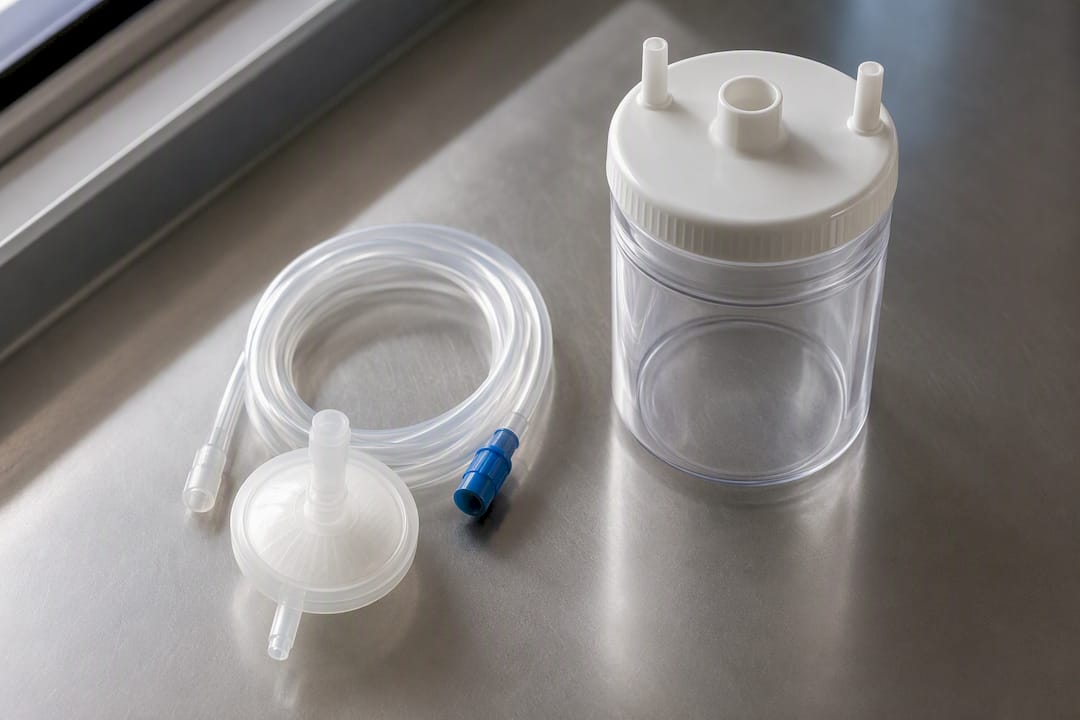
Overflow protection and filter placement round out the spec sheet that actually protects your investment. A Schuco S130A style kit ships with the filter, tubing, and collection bottle already matched to the pump, which removes a common failure point: buying a pump and discovering the filter you need is sold separately.
Accessories and Compatibility: Where Most Purchase Mistakes Happen
The pump is rarely the reason suction fails on an endoscopy case. It's almost always the catheter or tubing that doesn't match the scope. Aspiration catheters come in procedure-specific sizes, such as 1.8 mm by 35 cm for otoscopes and 2.3 mm by 350 cm for full-length flexible endoscopes, and most can be cut to length rather than forcing you to stock a dozen fixed sizes.
Before you buy a pump, confirm these four things against your scope inventory:
- Catheter diameter versus instrument channel. A catheter too wide won't pass through the scope's working channel; too narrow and you lose aspiration efficiency.
- Tubing length and bore for long-reach work. Standard clinic tubing loses effective vacuum at the distal tip once you're running a three-meter equine gastroscope, so dedicated long-reach catheters with a larger bore are worth stocking separately.
- Hydrophobic filter type. Disposable filters simplify infection control; reusable ones cost less over time but need a validated cleaning protocol.
- Canister material. Disposable liners speed turnover between cases; rigid reusable canisters need autoclave or high-level disinfection capacity.
Keep a small reserve stock of spare tubing sets, filters, and replacement canisters on hand. Running out mid-week because a filter clogged during a messy GI case is an avoidable scheduling headache, and it's the single most common inventory gap clinics report after switching pump brands.
Buying Checklist: What to Confirm Before You Order
Cut through vendor pitches with one checklist covering specs, kit contents, and supplier reliability.
- Vacuum and flow match your caseload, not just your budget. Confirm clinic-class specs cover routine work and, if you do surgery, that a surgical-class unit is available as a backup or upgrade path.
- Catheter and tubing compatibility is confirmed in writing. Ask the vendor for exact bore and length specs, not just "compatible with most scopes."
- Overflow protection is standard, not an add-on. If a listing doesn't mention it explicitly, ask before ordering.
- Kit contents are itemized. Filter, tubing, and collection bottle should be included or clearly priced separately.
- Battery runtime and noise rating are disclosed for mobile or ambulatory use cases.
- Certifications are listed, including UL, ETL, or IEC marks appropriate for clinical electrical equipment.
- Warranty terms and US-based service are confirmed before purchase, not after a breakdown.
When you call a supplier, ask about replacement-part lead times, whether support reps are US-based, how often the pump needs servicing, and what training resources come with the unit. Walk away from any listing that skips overflow protection, gives vague spec ranges instead of numbers, or can't confirm consumables are stocked domestically. Those three gaps predict most of the equipment complaints that show up a year after purchase.
Keeping Your Suction System Reliable Between Procedures
Clean canisters and tubing immediately after each procedure, not at the end of the day. Disposable liners speed this up considerably and cut cross-contamination risk between patients.
- Rinse and disinfect reusable canisters per your infection-control protocol before the next case.
- Inspect the hydrophobic filter for moisture breakthrough; replace it rather than pushing one extra use.
- Run a monthly leak test on tubing connections and canister seals.
- Schedule pump servicing per manufacturer intervals, generally every six to twelve months for clinic-class units.
Overflow protection and a properly seated hydrophobic filter are what keep fluid out of the motor housing in the first place, and practitioners across the field flag this as the difference between a pump that lasts years and one that fails within months.
Pro Tip: Before your first case each day, run the pump dry for ten seconds and listen. A whine or a drop in suction strength at the catheter tip is often the earliest sign of a worn seal or a tubing crack, and catching it before a procedure beats discovering it mid-case.
How suppliers approach suction compatibility
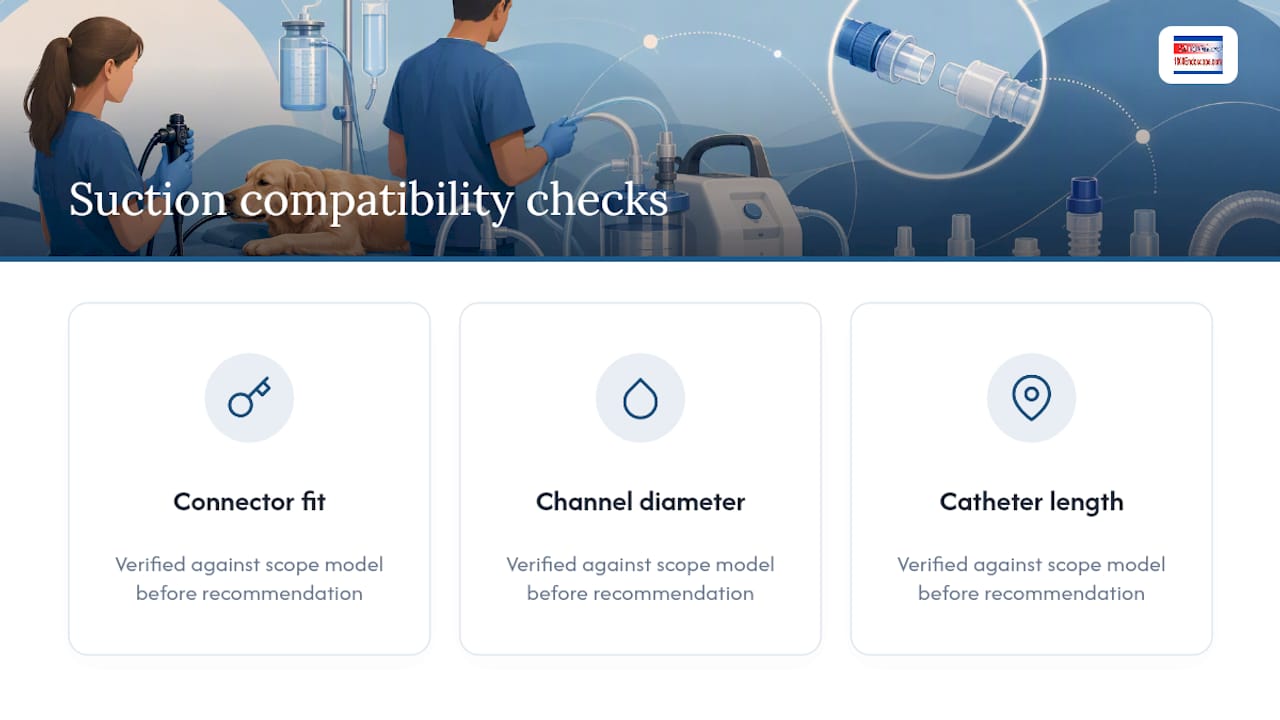
Suction only works when it's matched correctly to the scope, not just to the procedure. This approach helps clinics pair pumps with endoscopic equipment. Connector fit, channel diameter, and catheter length get checked against the scope model before recommendations, because a mismatched catheter can impede suction performance.
For deeper technical background on how suction affects procedure quality, our guides on small animal endoscopy workflow and optimizing endoscope video recording cover the practical side of keeping the visual field clean throughout a case.
— Endoscope
Finding the Right Pump and Kit from specialized suppliers
If the checklist above left you wondering whether your current scope inventory has a matching pump kit, this service gap can be filled by suppliers offering endoscope-compatible aspiration options alongside scopes, plus support to confirm channel and tubing fit before ordering.
Clinics running rigid scope setups can browse the veterinary rigid endoscopy catalog for compatible accessories, and anyone evaluating a portable system built around integrated video and suction access can check the portable airway inspection endoscope as a starting point. Parts, consumables, and documentation questions go through the same support channel as the equipment purchase, so replacement filters and tubing aren't a separate hunt six months later. Reach out through the catalog page to confirm compatibility for your specific scope model before you commit to a kit.
Sources
- Schuco S130A Aspiration Pump | Veterinary Tool | DVM Central
- Gomco 3000 Series General Use Aspirators - Infinium Veterinary
- High Vacuum Veterinary Suction Unit | Professional Electric Suction Apparatus - Ivetwell