
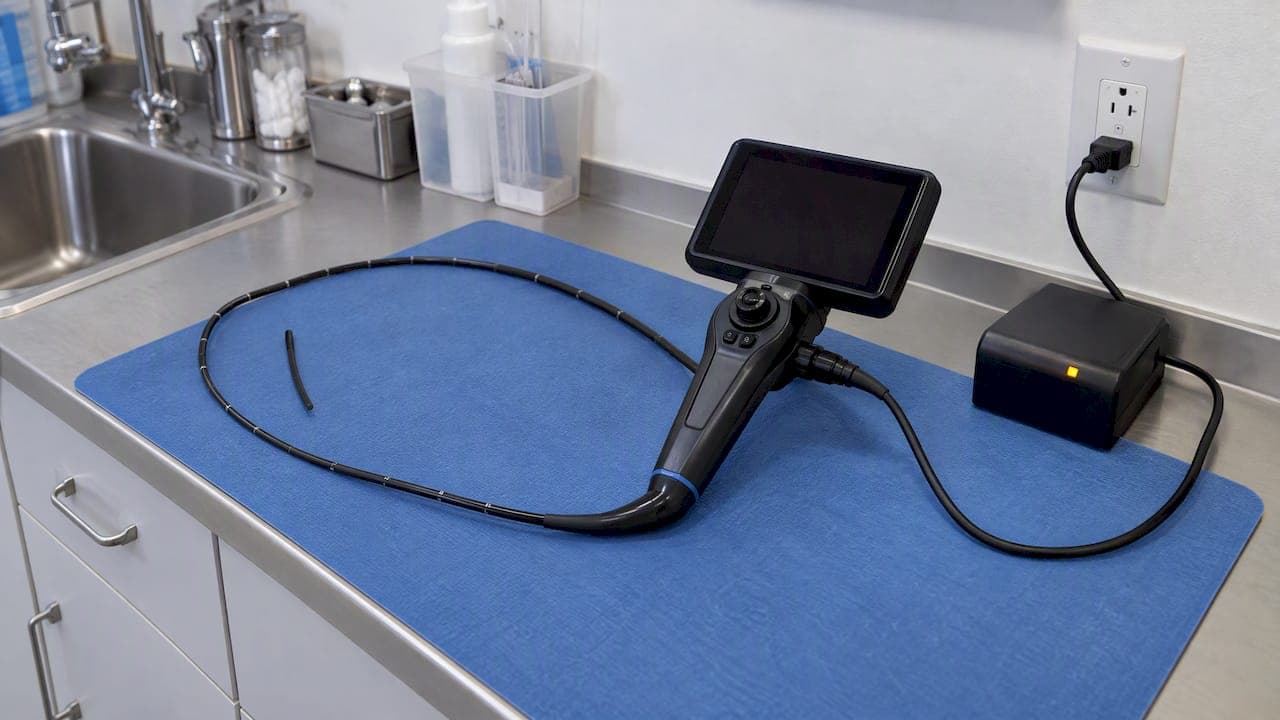
Good videoscope battery maintenance comes down to five habits: use only the charger and cells the manual specifies, charge within safe temperatures, inspect the pack and compartment before every shift, store it cool and dry (removed from the scope if the manual says so), and pull any damaged pack out of service instead of trying to fix it. Do those consistently and your portable scope is ready when a horse is waiting in the stocks or a technician is on a roof.
This guide is written for clinics, inspection firms and procurement managers who run portable scopes, not for hobbyists fixing camera batteries. Where we give a number, it comes from a named safety body. Where a detail depends on your model, the manual wins.
TL;DR
- Use only the battery and charger named in your scope's manual. No generic cells, no unapproved fast chargers, no rebuilt packs.
- Do not charge a very cold or hot battery. New York State guidance says not to charge below 32°F (0°C) or above 105°F.
- Check charge, housing, contacts, swelling, heat and odor before each shift. Remove any pack that swells, leaks, smells, overheats or is deformed.
- Keep the battery compartment out of the wet reprocessing workflow. Cleaning the scope and caring for the battery are separate jobs.
- Standardize one battery, one charger and one inspection routine across every unit you own.
Table of Contents
- Why battery care matters more on a portable scope
- Know your model before you set a routine
- The before-shift check
- Charging: temperature, charger and supervision
- Storage between jobs
- Cleaning the battery compartment
- Keep battery care separate from reprocessing
- When to pull a battery from service
- Retiring and disposing of a failed battery
- A standard routine for a mixed clinic and field team
- Our perspective
- Need a portable scope or a replacement part?
- FAQ
- Sources
Why battery care matters more on a portable scope
A portable videoscope with a built-in monitor and SD card recording is only as dependable as the pack feeding it. A tired battery shows up as a dim light source, a monitor that cuts out mid-exam, or a scope that fails the moment you leave the shop. In a clinic that means a rescheduled procedure and an anesthetized animal. In industrial work it means a lost inspection window.
There is also a safety side. Lithium-powered devices are common in workplaces, and OSHA's guidance on small lithium battery powered devices stresses using batteries, chargers and accessories that are tested to recognized standards, and following the manufacturer's instructions. The ATF's guidance on damaged cells adds a point many teams miss: temperature and physical damage matter as much as charge percentage. Charging a cold pack can cause irreversible lithium buildup inside the cell, and heat can push a charging battery toward failure.
That is why the advice from video tutorials on gluing a battery back together or swapping in whatever cell fits does not belong in a professional setting.
Know your model before you set a routine
Videoscope batteries are not interchangeable. Some units use a built-in rechargeable pack. Others use removable cells, and some models require protected button-top cells at an exact voltage. A generic 18650 that physically fits may not be electrically correct.
Before you write a routine, gather this for each unit:
- The manual, kept as a printed or saved copy.
- The exact battery type, voltage and approved charger.
- The model and serial number, which you will need if there is ever an incident or a repair.
- The manufacturer's storage guidance, including whether to remove batteries for long periods.
One videoscope manual we reviewed says to remove batteries when the unit will be stored for more than 30 days. Your model may differ, which is exactly the point: the number comes from the manual, not from a general rule of thumb. For a wider look at how field conditions change runtime, see our guides to battery life in field inspections and borescope battery life comparison factors.
The before-shift check
The check takes about two minutes per scope and catches nearly every problem early. Before each shift, look at:
- Charge level. Is it enough for the longest procedure or inspection you expect, plus margin?
- Housing. Cracks, gaps, or a case that no longer sits flush.
- Contacts. Dull, green or white residue, or bent terminals.
- Swelling. A pack that bulges or a battery door that will not close properly.
- Heat and odor. A warm pack at rest or a sweet, chemical smell.
- Cable and charger condition. Frayed cords, loose plugs, discolored connectors.
If you want a model for building a daily habit, general pet-care routines follow the same logic: short, repeatable checks beat occasional deep dives. This pet health maintenance process shows how a simple daily checklist and storage routine keep small problems from piling up, and the same discipline applies to your equipment cart.
Put the check on a sheet, initial it, and keep it with the scope. When something goes wrong, a record of the last good inspection is valuable.
Charging: temperature, charger and supervision
Three rules cover most charging mistakes.
Use the approved charger. The OSHA lithium-ion guidance ties safe operation to the charger and battery being a matched, tested system. The charge-control circuitry in the pack and the charger work together. Do not bypass it, modify it or overcharge it.
Mind the temperature. A scope that rode in a truck overnight in winter should come to room temperature before you plug it in. The ATF warns against charging hot or cold batteries, and the New York guidance puts the limits at 32°F (0°C) and 105°F. A pack that is hot after a long procedure should rest and cool before it goes on the charger.
Do not leave it unattended, and do not leave it on forever. OSHA advises removing lithium-powered devices from the charger once they are fully charged. Charge in an open, uncluttered spot away from flammable materials, not in a drawer or on a soft surface.
As for the common question of whether topping up to 100% harms the battery: the safety guidance in our sources does not ask you to ration charge percentage. It asks you to use the correct charger, charge at safe temperatures and take the pack off when it is done. The ATF also cautions against letting a fully discharged battery sit for a prolonged period, so do not park a dead scope in a cabinet for months.

Storage between jobs
Storage is where most batteries lose their life quietly. The practical rules:
- Keep batteries in a cool, dry location, away from direct sunlight, exits and heat sources. The New Jersey fire safety guidance on lithium devices says to store batteries away from extreme temperatures and direct sunlight.
- Follow your model manual on removal. Taking batteries out before storage also prevents leakage damage inside the compartment.
- Do not store a depleted pack for long stretches.
- Keep spare packs in a nonconductive case so terminals cannot touch metal tools or each other.
- Do not store the scope in a vehicle that sits in summer sun or winter cold.
For the rest of the kit, our guide on how to store endoscopic equipment covers cases, hanging and humidity for both veterinary and industrial scopes.
Cleaning the battery compartment
The compartment is the one place on a videoscope where liquid is never welcome. The safe sequence:
- Power the scope down and unplug it.
- Remove the battery if the design allows it.
- Inspect for corrosion, leakage, cracked plastic or moisture.
- Clean only by the method in the manual.
- Let everything dry fully before reinserting the pack.
Never flood the compartment, and never spray disinfectant into the electronics. If you see leakage or corrosion, do not just wipe it and carry on. Treat it as a sign the pack, the seal or the storage conditions failed, and find out which.
Keep battery care separate from reprocessing
In a veterinary setting, the wet workflow and the battery workflow should never blur. The FDA explains that reusable devices must be reprocessed: cleaned, then disinfected or sterilized, following the device labeling. It also notes that long narrow lumens, valves, O-rings, hinges and hard-to-reach surfaces can hold debris, which is why a scope that looks clean may not be.
Battery care cannot substitute for that, and the reverse is true as well. Consoles, chargers and battery compartments stay out of the wet process unless the manufacturer explicitly permits otherwise. Wipe the exterior of a hot pack once it has cooled, without wetting electronics, then recharge with the approved equipment.

For the patient-contact side, we cover the full process in our step by step endoscope sterilization guide and the 2026 guide to sterilization in veterinary endoscopy.
When to pull a battery from service
Some conditions end a battery's working life immediately. Remove it from service if it shows any of these:
| Sign | What to do |
|---|---|
| Swelling or deformation | Stop using, do not charge, quarantine |
| Leakage or corrosion | Stop using, avoid skin contact, quarantine |
| Hissing, smoke or rising temperature | Move away, follow your emergency plan |
| Cracked or damaged casing | Stop using, quarantine |
| Unusual heat during normal use or charging | Unplug, let it cool, take it out of service |
OSHA's guidance is that a battery with these signs should not be returned to service. Do not test it, rebuild it or squeeze one more week out of it because a replacement is out of stock. That last one is the field mistake we see most often, and it is why we suggest keeping a spare pack per scope.
Retiring and disposing of a failed battery
A failed lithium pack is a hazardous waste item, not office trash. OSHA's lithium-ion safety publication calls for designated recycling facilities and appropriate emergency planning. In practice:
- Quarantine the pack away from flammable materials, ideally in a non-combustible container.
- Do not put it in municipal trash or ordinary recycling.
- Get disposal instructions from an approved battery recycling or hazardous waste channel.
- Record the incident, and keep the model and serial information.
- Check applicable shipping rules before you transport lithium batteries.
A standard routine for a mixed clinic and field team
If you run both veterinary and industrial scopes, a single written policy is easier to enforce than a collection of habits. The OSHA guidance supports a model-controlled procedure rather than a generic rule. A workable version:
| When | Task |
|---|---|
| Before each shift | Check charge, housing, contacts, swelling, heat, odor, cable and charger |
| After each use | Let the pack cool, wipe the exterior without wetting electronics, recharge with approved equipment |
| Monthly | Review the log, confirm spares are charged and labeled, audit storage temperature |
| Before long storage | Follow the manual on removing batteries, store cool and dry |
| On any fault | Remove, quarantine, document, dispose through an approved channel |
Assign one person to own the log and the quarantine container. Train every user on what to do if a pack swells or smokes. Retain each manual.
Our perspective
Most battery trouble we hear about in veterinary and industrial scopes is not exotic. It is a pack left in a hot truck, a charger that is not the original, or a questionable battery kept in use because the replacement was not on the shelf. Portable scopes are built to go to the barn, the pasture or the job site, so the habits around them have to travel too.
Our advice to buyers is to standardize before you scale. Pick scopes whose battery and charger you can stock in quantity, keep a spare per unit, and write the routine above into your clinic or shop procedures. If a unit starts to misbehave, our videoscope troubleshooting guide and technician's maintenance guide help you separate a battery issue from a cable, light or monitor fault.
And please do not rebuild packs. Send a scope that needs more than a battery swap to qualified repair.
— Endoscope
Need a portable scope or a replacement part?
If your current scope is tied to a battery you cannot source, or you are standardizing a fleet, look at our portable SD-card monitor videoscopes and borescopes for industrial work, or browse the full catalog for veterinary systems, light sources and accessories. Scopes that need service can go through our endoscope repairs page. For clinics comparing options, our veterinary endoscope cost guide is a good starting point.
FAQ
How do I clean a dirty battery compartment?
Power the scope down, unplug it and remove the battery if the design allows. Inspect for corrosion, leakage, cracks or moisture, then clean only by the method in your manual. Never flood the compartment or spray disinfectant into the electronics, and let it dry completely before reinstalling the pack.
Does charging to 100% damage a videoscope battery?
The safety guidance we reviewed focuses on using the correct charger, charging at safe temperatures and removing the device once it is fully charged, rather than limiting charge percentage. Do not bypass the charge controls or use an unapproved fast charger. Check your manual for any model-specific advice.
Can I revive a dead or swollen battery?
Not safely. A pack that is swollen, leaking, hot, smelly or deformed should be removed from service, quarantined and disposed of through an approved recycling or hazardous waste channel. A pack that is merely flat should be recharged with the approved charger, at a safe temperature, as the manual describes.
Should I remove the battery when the scope is not in use?
Follow your model's manual. One videoscope manual we reviewed says to remove batteries for storage beyond 30 days, and removal also protects the compartment from leakage damage. Store removed packs cool and dry in a nonconductive case.
Sources
- OSHA: Preventing Fire and/or Explosion Injury from Small and Wearable Lithium Battery Powered Devices
- OSHA: Lithium-ion Battery Safety
- ATF: safe handling of damaged cells and batteries
- New York DHSES: Tips When Using, Charging, Maintaining & Storing
- New Jersey Division of Fire Safety: Lithium-ion battery fact sheet
- FDA: Reprocessing of Reusable Medical Devices
- Loved by Loyal Saints: Pet Health Maintenance Process