
A new veterinary endoscope system runs anywhere from $1,000 for a basic rigid scope to $80,000+ for a full flexible tower system with HD imaging, processor, and accessories. For most small-to-medium U.S. clinics, a portable video endoscope or a refurbished midrange flexible system in the $3,000–$15,000 range delivers the best balance of capability and return on investment. Here is what you need to know before you write the purchase order.
Quick price orientation by system type:
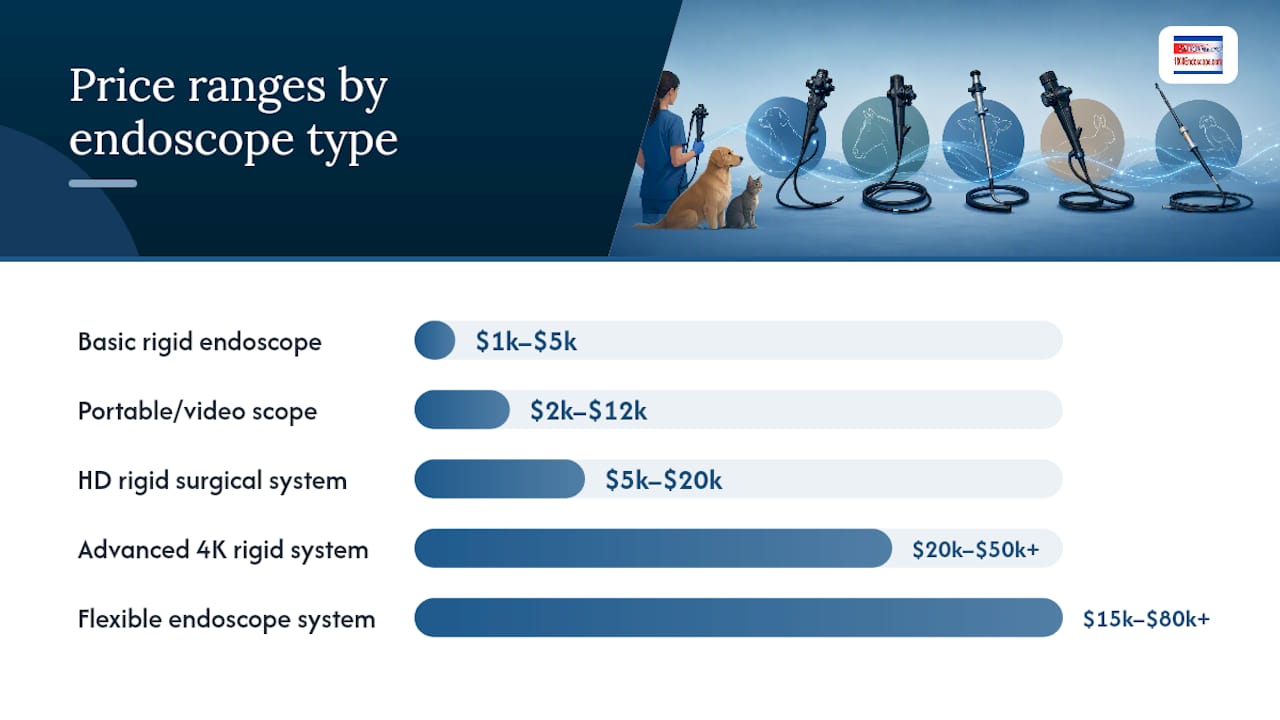
- Basic rigid endoscope (new): $1,000–$5,000
- HD surgical rigid system (new): $5,000–$20,000
- Advanced 4K rigid system (new): $20,000–$50,000+
- Flexible endoscope system (new): $15,000–$80,000+
- Portable/video scope (new or refurbished): $2,000–$12,000
- Pre-owned or refurbished flexible system: $5,000–$30,000 (varies widely by age and condition)
Veterinary endoscopy procedures typically cost patients $800–$3,000 depending on complexity and region, according to PetMD. That fee structure is what makes the ROI math work — even a modest procedure volume can recover equipment costs within one to two years.
Key Takeaways
Veterinary endoscope costs range from under $5,000 for a basic rigid or portable system to over $80,000 for a full flexible tower, and the right choice depends on procedure volume, accessory strategy, and how rigorously you evaluate warranty terms before buying.
| Point | Details |
|---|---|
| New system price ranges | Rigid scopes start at $1,000–$5,000; flexible tower systems run $15,000–$80,000+; portable video scopes fall in the $2,000–$12,000 range. |
| Reusable accessories save money | Break-even vs. single-use typically occurs at 10–20 uses; reusables are the better choice for clinics running 5+ procedures per week. |
| Refurbished requires written protection | Require a multi-year parts-and-labor warranty and a written refurbishment test report — repair costs for flexible scopes can erase upfront savings quickly. |
| ROI timeline is short | A mid-size practice at 12 procedures/week can recover a $18,000 system investment in roughly two weeks of full operation at a $1,200 average fee. |
| 1800endoscope entry point | The PVSM6150 portable system and the full catalog at 1800endoscope.com cover basic through midrange configurations with published specifications. |
Table of Contents
- What does a veterinary endoscope cost by type?
- What are all the cost components you need to budget for?
- New, refurbished, or used: which option actually saves money?
- How do single-use vs. reusable accessories affect your per-procedure cost?
- What questions should you ask vendors before buying?
- Sample clinic configurations with estimated costs and per-procedure math
- What financing and warranty options are available for U.S. clinics?
- How long until the investment pays off?
- The case for not over-buying your first system
- Affordable veterinary endoscopes from 1800endoscope
- Sources
What does a veterinary endoscope cost by type?
The category you buy into determines your price ceiling more than any single feature. Published price data shows a wide spread across system types, driven by imaging technology, working length, channel count, and whether you need a full tower or just the scope.
Rigid endoscopes are the entry point. A basic rigid scope for otoscopy, rhinoscopy, or cystoscopy in small animals costs $1,000–$5,000 new. Step up to an HD surgical rigid system and you are in the $5,000–$20,000 range. 4K rigid systems with advanced optics push past $20,000 and can reach $50,000 for specialty configurations.
Flexible endoscopes are a different budget conversation entirely. A complete flexible system — scope, processor, light source, and monitor — typically starts around $15,000 new and can exceed $80,000 for a multi-channel gastroscope or bronchoscope with 4K imaging. The working length, insertion tube diameter, and number of instrument channels are the main price levers.
Portable and video scopes occupy a practical middle ground. These self-contained units with built-in monitors or wireless output run $2,000–$12,000 new, and refurbished units often appear well below that. For lower-cost video options suited to general practice, portable systems are worth a serious look before committing to a full tower.
| System Type | Typical New Price Range | Best Clinical Use |
|---|---|---|
| Basic rigid endoscope | $1,000–$5,000 | Otoscopy, rhinoscopy, cystoscopy |
| HD rigid surgical system | $5,000–$20,000 | ENT, orthopedic, laparoscopy |
| Advanced 4K rigid system | $20,000–$50,000+ | Specialty/referral centers |
| Flexible endoscope system | $15,000–$80,000+ | GI, bronchoscopy, urology |
| Portable/video scope | $2,000–$12,000 | General practice, field use |
| Refurbished flexible system | $5,000–$30,000 | Budget-conscious mid-volume clinics |
What are all the cost components you need to budget for?
The scope price on a vendor quote is rarely the full story. Total cost of ownership for a veterinary endoscopy setup includes several line items that often get missed until the invoice arrives.
One-time capital costs:
- Endoscope (scope tube itself): often 40–60% of total system cost
- Video processor or control unit: $2,000–$8,000 for mid-tier systems
- Light source (LED or xenon): $1,500–$5,000
- Monitor (HD or 4K): $500–$2,500
- Camera head (if not integrated): $1,000–$3,000
- Digital recorder or documentation system: $500–$2,000
- Equipment cart or tower: $500–$2,000
- Reprocessing equipment (automated endoscope reprocessor or high-level disinfection basin): $2,000–$15,000
- Shipping and installation: $200–$1,500 depending on vendor and system complexity
- Initial training (sometimes bundled, sometimes billed separately): $0–$2,000
Recurring annual costs:
- Reprocessing supplies (enzymatic detergents, disinfectants, test strips): $500–$3,000/year depending on volume
- Reprocessing labor (technician time): often the largest hidden cost at high volume
- Disposable accessories (biopsy forceps, snares, cytology brushes): $10–$60 per single-use item
- Preventive maintenance and calibration: $500–$2,000/year
- Repair reserve (flexible scopes especially): budget 5–10% of scope value annually
For accessory selection and compatibility, the choices you make at purchase time lock in your recurring costs for years.
Pro Tip: When reviewing a vendor quote, check for four items that are frequently omitted: the reprocessing kit (basin or AER), the initial accessory set (at least one biopsy forceps), training fees, and whether the stated warranty covers parts and labor or parts only. A quote missing any of these is not a complete system price.
New, refurbished, or used: which option actually saves money?
Expert guidance from the World Gastroenterology Organisation is direct on this: flexible-scope repair costs can quickly erase the initial savings from buying used if the vendor does not provide rigorous refurbishment testing and a multi-year parts-and-labor warranty.
The risk profile differs by system type. Rigid scopes are mechanically simpler and hold up better in the used market. Flexible scopes have delicate insertion tubes, bending sections, and optical systems that degrade with use and are expensive to repair — often $1,500–$5,000 per repair event, sometimes more.
What to require from any refurbished or used seller:
- Written refurbishment test report (leak test, image quality, channel function, angulation range)
- Multi-year parts-and-labor warranty (two years minimum; three is better for flexible scopes)
- Documented repair history and previous use intensity
- Clear return window (30 days minimum for functional issues)
- Stated repair SLA — how many business days to return a repaired scope
- Confirmed replacement parts availability for that specific model
Red flags that should stop a purchase:
- "Sold as-is" with no warranty
- Refurbishment described only as "cleaned and tested" with no written report
- No in-market service network or factory-certified repair option
- Seller cannot confirm parts are still manufactured for the model
Pro Tip: Ask specifically whether the warranty covers the insertion tube and bending section — the two most expensive failure points on a flexible scope. Some warranties exclude them as "wear items."
How do single-use vs. reusable accessories affect your per-procedure cost?
Accessories are where the per-procedure economics get interesting. A systematic review published in PMC analyzed seven economic studies across the U.S., Europe, and Korea and found that most reported higher per-procedure costs for single-use accessories compared to reusable ones. In some studies, reusable biopsy forceps cost as little as $3.27 per use versus $10 or more for single-use equivalents. The break-even point — where reusables become cheaper than single-use — typically falls around 10–20 uses, depending on reprocessing costs and local labor rates.
Here is a worked example for a mid-volume clinic running 8 GI scoping procedures per week:
- Single-use biopsy forceps at $15 each: 8 procedures × $15 = $120/week, or roughly $6,240/year
- Reusable forceps at $120 purchase price, 100-use lifespan: $1.20 per use in acquisition cost alone
- Add reprocessing: 10 minutes of technician time at $25/hour = $4.17 per cycle, plus $0.50 in supplies = $4.67 reprocessing cost per use
- Total reusable cost per use: $1.20 + $4.67 = $5.87 per procedure
- Annual reusable cost at 8/week: roughly $2,440 — a saving of about $3,800/year versus single-use
The break-even in this example is around 13 uses, consistent with the literature's 10–20 use range. At that volume, reusables pay for themselves in under two months.
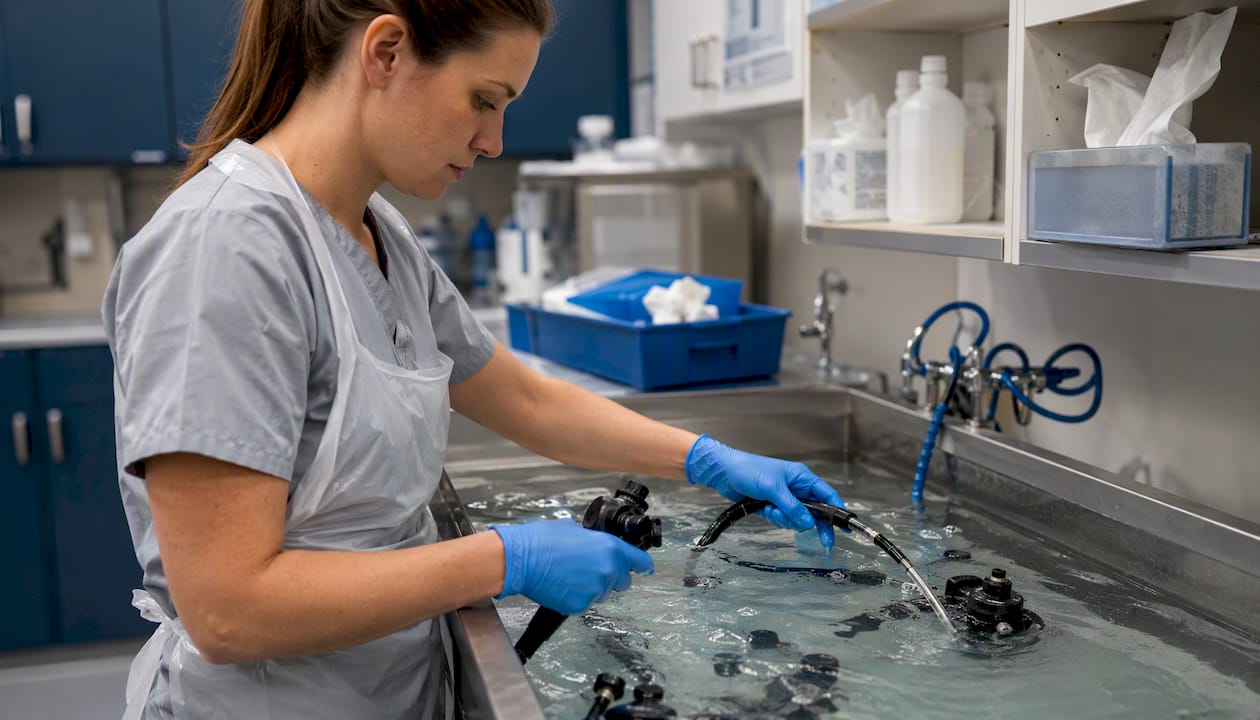
The sterilization and reprocessing costs are the variable that most clinics underestimate. Labor is the dominant driver, not supplies.
Pro Tip: Single-use accessories make financial sense for very low-volume clinics (fewer than 5 procedures per week) or when infection-control protocols require it. For example, when scoping immunocompromised animals or in outbreak situations, below the break-even threshold, the reprocessing overhead exceeds the accessory savings.
What questions should you ask vendors before buying?
Price is the starting point, not the finish line. The questions below separate vendors who can support a working clinical program from those who can only ship a box.
Essential vendor questions:
- What does the warranty cover exactly — parts, labor, or both? For how many years?
- What is your repair turnaround SLA, and do you have a loaner program while my scope is being serviced?
- Are replacement parts for this model still manufactured, and for how long?
- Is training included, and is it on-site or remote?
- What is the price of consumables (biopsy forceps, cleaning brushes, valves) for this specific scope?
- Do you have a U.S.-based service network or factory-certified repair center?
Red flags during vendor evaluation:
- Warranty excludes the insertion tube or bending section
- No written SLA for repair turnaround
- Consumables are proprietary and priced at a significant premium
- Vendor cannot name a U.S. repair facility
- Total system price excludes reprocessing equipment and accessories
Prioritization by clinic size:
- Low-volume solo practice (under 5 procedures/week): Prioritize low upfront cost, single-use accessory compatibility, and a simple reprocessing workflow. A portable video scope is usually the right call.
- Mid-volume general practice (5–20 procedures/week): Balance imaging quality with reusable accessory economics. A refurbished flexible system with a two-year warranty and a reusable accessory kit is the sweet spot.
- High-throughput specialty or referral center (20+ procedures/week): Prioritize image quality (HD or 4K), multi-channel capability, repair SLA with a loaner program, and a full service contract. New equipment with a comprehensive service plan is worth the premium at this volume.
For accessory compatibility guidance specific to your scope model, verify compatibility before ordering any accessory kit.
Sample clinic configurations with estimated costs and per-procedure math
Three realistic setups, from lean to full-featured, with example numbers you can adapt.
Configuration 1: Solo GP or low-volume clinic
- Portable video endoscope (6mm, SD/HD, built-in monitor): $2,500–$5,000
- Basic accessory kit (forceps, cleaning brush, valves): $300–$600
- High-level disinfection basin and supplies: $400–$800
- Total setup: $3,200–$6,400
- Assumed procedure volume: 4/week, 200/year
- Annual accessory cost (single-use strategy): ~$3,000
- Amortized equipment cost over 5 years: ~$800/year
- Estimated cost per procedure: $19–$25 (equipment + accessories)
Configuration 2: Mid-size general practice
- Refurbished flexible endoscope system (gastroscope + processor + light source + monitor): $8,000–$15,000
- Reusable accessory kit: $800–$1,500
- Automated reprocessing basin or AER: $2,500–$5,000
- Cart and documentation system: $1,000–$2,000
- Total setup: $12,300–$23,500
- Assumed procedure volume: 12/week, 600/year
- Annual accessory + reprocessing cost: ~$4,500
- Amortized equipment cost over 5 years: ~$3,600/year
- Estimated cost per procedure: $13–$18
Configuration 3: Specialty or high-throughput center
- New HD/4K flexible endoscope system (multi-channel, full tower): $35,000–$65,000
- Full reusable accessory suite: $3,000–$6,000
- Automated endoscope reprocessor: $8,000–$15,000
- Service contract (annual): $3,000–$6,000
- Total setup: $49,000–$92,000
- Assumed procedure volume: 30/week, 1,500/year
- Annual accessory + reprocessing + service: ~$12,000
- Amortized equipment cost over 7 years: ~$9,000/year
- Estimated cost per procedure: $14–$21
| Configuration | Total Setup Cost | Annual Procedures | Est. Cost per Procedure |
|---|---|---|---|
| Solo/low-volume | $3,200–$6,400 | 200 | $19–$25 |
| Mid-size practice | $12,300–$23,500 | 600 | $13–$18 |
| Specialty/high-throughput | $49,000–$92,000 | 1,500 | $14–$21 |
The per-procedure cost converges across configurations at scale because higher-volume clinics spread capital costs over more procedures while also benefiting from reusable accessory economics.
What financing and warranty options are available for U.S. clinics?
Upfront capital is the most common barrier to adding endoscopy capability. Several financing structures can reduce that barrier significantly.
Common equipment financing models:
- Equipment loans: Traditional bank or credit union loans secured against the equipment; terms of 36–60 months are typical for veterinary equipment in this price range
- Vendor financing: Some manufacturers and distributors offer 0% or low-interest financing for 12–24 months; worth asking for on orders above $10,000
- Equipment leasing: Operating leases keep the asset off the balance sheet and often include a service component; useful for high-cost tower systems where technology refresh matters
- Third-party medical equipment lenders: Specialty lenders familiar with veterinary practice cash flows; often faster approval than traditional banks
On the patient side, CareCredit offers veterinary financing that clinics use to increase case acceptance for higher-cost procedures — which directly affects the procedure volume assumptions in your ROI model.
What a solid warranty should cover:
- Parts and labor (not parts only)
- Minimum two-year term for refurbished systems; one year is the floor for new
- Insertion tube and bending section included (not excluded as wear items)
- Stated repair turnaround in business days
- Loaner scope provision for extended repairs
Recommended maintenance schedule and annual budget:
- Leak test before and after every procedure (no additional cost beyond technician time)
- Monthly inspection of insertion tube, angulation, and channel patency
- Annual factory or certified-technician inspection: $500–$1,500
- Reprocessing equipment service (AER): $300–$800/year
- Budget a repair reserve of 5–10% of scope replacement value annually
Vet practice management considerations, including how equipment uptime affects scheduling and revenue, are worth reviewing as part of your practice operations planning.
How long until the investment pays off?
The procurement-to-first-case timeline for a veterinary endoscopy system typically runs 6–14 weeks from initial quote to first scheduled procedure. Here is a realistic sequence:
- Weeks 1–2: Vendor evaluation, quote requests, and internal budget approval
- Weeks 3–4: Purchase order, financing approval (if applicable), and order confirmation
- Weeks 5–7: Manufacturing or refurbishment completion and shipping
- Week 8: Delivery, installation, and initial setup
- Weeks 9–10: Staff training (on-site or remote; typically 1–2 days for basic systems)
- Week 11+: First scheduled cases
ROI example for a mid-size practice (Configuration 2):
- Total system investment: $18,000 (midpoint of range)
- Average procedure fee charged to clients: $1,200 (within the $800–$3,000 range typical for veterinary endoscopy)
- Gross margin per procedure after direct costs: ~$1,000
- Procedures needed to recover equipment cost: 18 procedures
- At 12 procedures/week: break-even in roughly 2 weeks of full operation
That math assumes the clinic is adding net-new endoscopy revenue rather than replacing a referral stream. In practice, break-even on the full annual operating cost (equipment amortization + accessories + reprocessing) at 600 procedures/year and $13–$18 cost per procedure leaves substantial margin against a $1,200 fee.
Depreciation and replacement planning:
- Video processors and tower systems: amortize over 5–7 years
- Flexible scopes: 3–5 years depending on use intensity and repair history
- Rigid scopes: 7–10 years with proper care
- Portable video units: 3–5 years
Budget replacement reserves from year one. A scope that costs $12,000 today and has a 5-year useful life needs a $2,400/year replacement reserve built into your operating budget.
The case for not over-buying your first system
There is a version of this purchase that clinics get wrong consistently: they buy a full tower system for a procedure volume that a portable scope could handle, then spend years paying for capability they rarely use.
The per-procedure cost math in the sample configurations shows something worth sitting with. At 200 procedures per year, a $5,000 portable setup and a $50,000 tower system produce wildly different capital burdens — but the imaging quality gap between them has narrowed considerably as portable video technology has improved. For rhinoscopy, otoscopy, and upper GI work in small animals, a well-chosen portable video scope handles the clinical workload without the tower overhead.
The smarter move for most general practices is to start with a capable portable or refurbished midrange system, build procedure volume and staff competency, and then upgrade when the numbers justify it. A two-year-old practice that bought a $6,000 portable scope and ran 300 procedures in year one has a much cleaner upgrade argument than one that financed $45,000 upfront and is still trying to hit break-even.
Warranty and service terms matter more than most buyers realize at the time of purchase. The World Gastroenterology Organisation's guidance on refurbished equipment is worth reading before any used-scope purchase. A scope with no written refurbishment report and a 90-day parts-only warranty is not a bargain at any price.
Affordable veterinary endoscopes from 1800endoscope
For clinics that want to skip the guesswork on configuration, 1800endoscope offers a direct path to equipment that fits the solo-practice and mid-volume budgets described in this guide. The PVSM6150 portable video endoscope is a fully portable 6mm airway inspection system with a direct monitor and SD card video recording — a practical, low-overhead entry point for clinics adding endoscopy without committing to a full tower.
For clinics ready to step up, the full product catalog covers rigid systems, flexible scopes, light sources, and the accessory kits that make a system clinically complete from day one. Every product listing includes specification detail so you can match scope diameter, working length, and channel configuration to your actual procedure mix before ordering. Browse the catalog, compare specifications against your vendor quotes, and contact 1800endoscope directly to confirm warranty terms and accessory compatibility for your setup.
Sources
- Single-use versus multiple-use accessories in gastrointestinal endoscopy: a systematic review of economic evaluations - PMC
- Endoscopy Accessory Reuse: Balancing Cost-Effectiveness with Patient Safety | World Gastroenterology Organisation
- How Much Does an Endoscope Cost? Complete Medical Endoscope Price Guide 2026
- Veterinary Endoscopy: What Is It, and Why Do Pets Need It?
- Carecredit