
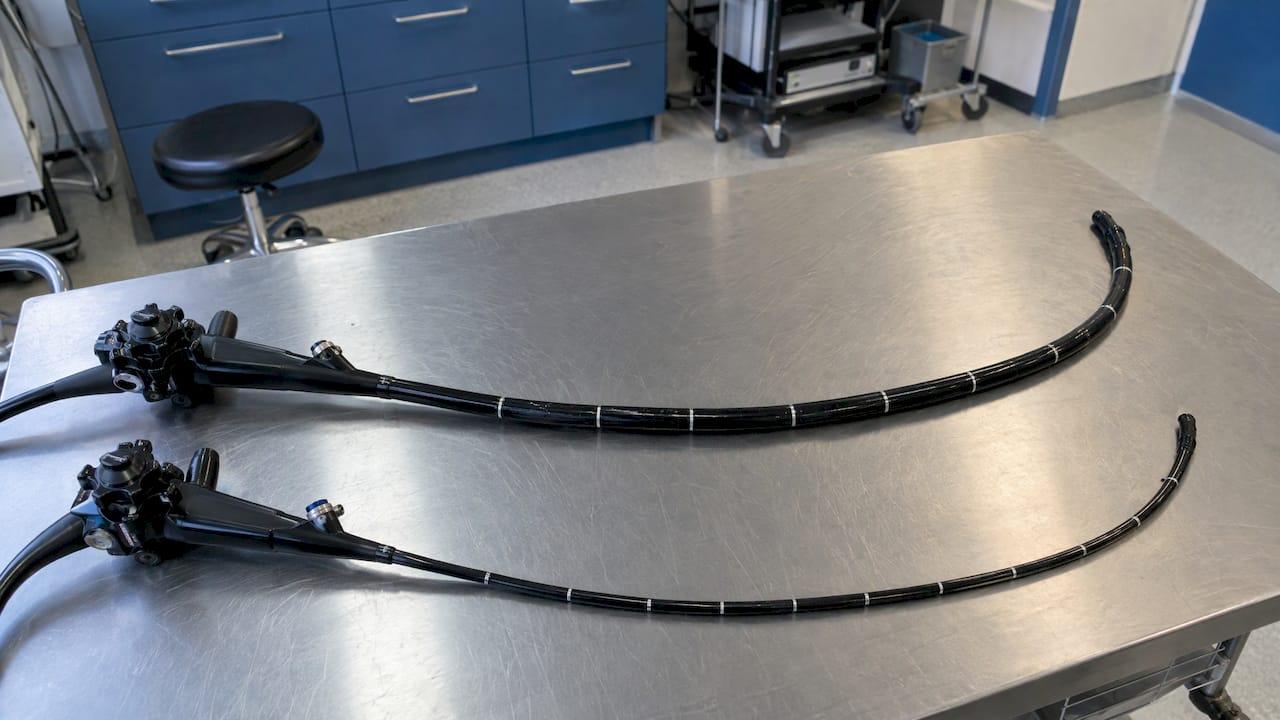
For a small-animal general practice, the workable gastroscope has an insertion tube under 9 mm, a length of at least 100 to 125 cm and a biopsy channel of about 2.8 mm. Equine work is a different instrument class, with a much longer tube. Diameter is the first number on a spec sheet, but it only makes sense next to length and channel size. This guide explains what the number measures, which sizes fit which patients, and how to buy once instead of twice. Our veterinary endoscopy equipment page lists the scopes we sell.
TL;DR
- Gastroscope diameter normally means the outer diameter of the insertion tube. Working channel size is a separate figure, and it decides which biopsy forceps fit.
- For dogs and cats, a gastroscope under 9 mm and 100 to 125 cm long covers common procedures in most patients.
- A tube under 8 mm passes the pylorus of cats and small dogs most easily. A 2.8 mm channel is preferred for biopsy and foreign-body retrieval.
- A gastroscope wider than 7.8 mm is too large for bronchoscopy, rhinoscopy or urethrocystoscopy in cats and small dogs. Those procedures call for a 5.4 to 6 mm scope.
- Large animals use a different design: a long, semi-portable or portable gastroscope built for horses.
Table of Contents
- What "diameter" means on a gastroscope spec sheet
- The sizes that exist, and the range that matters
- Why the pylorus sets the lower limit for cats and small dogs
- Matching diameter to the patient and the procedure
- Channel size: the number that decides your biopsy quality
- Large animals: a different class of gastroscope
- Optical quality: why the spec sheet is only half the decision
- A buying checklist for procurement managers
- Worked example: a three-vet mixed practice
- Perspective
- Find the right scope and accessories
- FAQ
- Sources
What "diameter" means on a gastroscope spec sheet
A flexible endoscope has three dimensions that matter: working length, outer diameter and channel size. The Veterian Key endoscopy chapter names exactly these three as the key dimensions.
Outer diameter is the width of the insertion tube, the part that goes into the patient. It sets which animals and which organs the scope can enter. When someone says "a 7.8 mm gastroscope" they mean this.
Working length is the usable length of the insertion tube. It sets how far into the gut you can get.
Channel size is the inner diameter of the accessory channel running through the tube. It carries biopsy forceps, grasping instruments and the suction and flushing path. The channel is always narrower than the tube, and a thicker tube does not automatically mean a bigger channel. Always read the channel figure on its own line.
The tube also has to hold the light bundle, the image path or video chip, and the four-way deflection cables. That is why diameter, channel and image quality pull against each other. A smaller tube enters smaller patients. A larger tube leaves room for a bigger channel and more light.
The sizes that exist, and the range that matters
Flexible endoscope insertion tubes run from under 1 mm to 14 mm in diameter and from 55 cm to 170 cm in length. Most scopes over 2 mm have an accessory channel and a deflectable tip. Only a narrow slice of that range is used for gastroscopy.
The veterinary literature gives a consistent picture:
| Source | Recommended outer diameter | Length | Channel |
|---|---|---|---|
| Today's Veterinary Practice, 2012 | Under 9 mm | 100 to 125 cm | Not specified |
| WSAVA 2003 overview | 7.8 to 9.0 mm for general practice | At least 100 cm | At least 2 mm |
| WSAVA 2008, Cornell (Simpson) | 5.9 to 9.8 mm | At least 1 m, at least 130 cm for big dogs | 2.0 to 2.8 mm |
| Veterian Key | 9 mm or less, ideally under 8 mm for cats and small dogs | At least 125 cm | At least 2.2 mm, 2.8 mm preferred |
The sources agree on a band of roughly 7.8 to 9.8 mm for gastroscopy. They agree that 100 to 125 cm is the floor for length. They also agree that a channel of at least 2 mm is needed for diagnostic biopsies. The Veterian Key chapter gives a worked example of the most versatile small-animal GI scope: 140 cm long, 7.8 mm in diameter, with a 2.8 mm channel.
Why the pylorus sets the lower limit for cats and small dogs
The pylorus is the muscular outlet between the stomach and the duodenum. If the tube cannot pass it, you cannot examine or biopsy the duodenum, and the duodenum is often where chronic vomiting and diarrhea cases need answers.
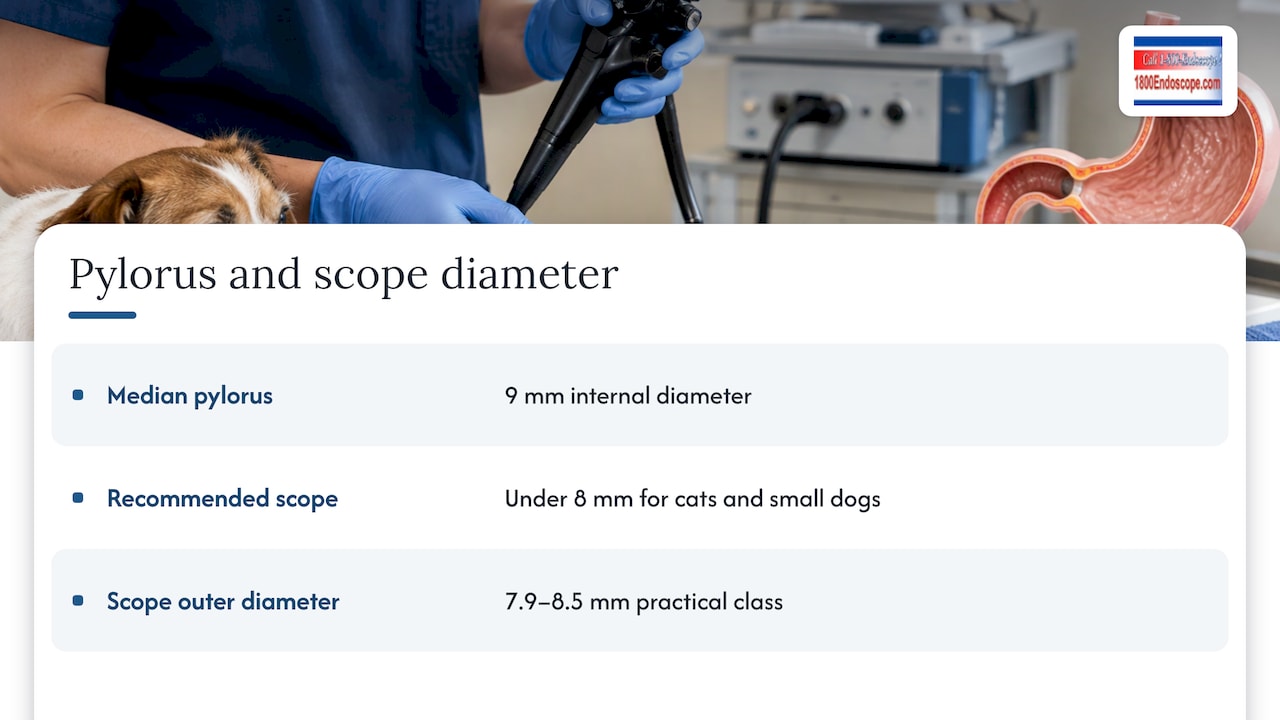
A study of 24 healthy adult cats found a median internal pyloric diameter of 9 mm, with 23 of 24 within 1 mm of that value. Age, sex, breed and weight had no apparent effect. A tube sitting right at the pyloric diameter leaves no margin for a sedated, tense or inflamed animal. That is why the veterinary chapter recommends under 8 mm for cats and small dogs.
The WSAVA 2003 overview adds a practical note. Newer scopes of 140 to 150 cm and 7.9 to 8.5 mm can reach the small intestine of the largest dogs and still pass the pylorus in most cats. One instrument covers a wide range of patients, so the 7.8 to 8.5 mm class is the practical starting point for a first purchase.
For a deeper look at cat-specific specs, see our guide to pediatric endoscopes for cats.
Matching diameter to the patient and the procedure
Julie Callahan Clark, an ACVIM diplomate, advises writing in Today's Veterinary Practice that you select the largest-diameter, longest-length gastroscope the patient can accommodate. Her guidance:
- Most dogs: 100 to 140 cm long, 9.8 mm in diameter.
- Small dogs and cats: 100 to 140 cm long, 7.8 mm in diameter.
- Instrument channel of 2.8 mm or larger, so larger biopsy forceps fit.
The logic runs in both directions. A larger tube gives a larger channel, more light and better suction. A smaller tube passes through tighter anatomy. The goal is the biggest scope that still enters comfortably.
Esophagus and stomach
For esophageal examination, a scope with at least 100 cm of working length, under 10 mm outer diameter and a 2.8 mm biopsy channel suits most dogs and cats.
Duodenum and large-breed dogs
Length becomes the limit here. A working length of 140 cm or more may be needed to reach the duodenum of some giant-breed dogs. For the lower tract, large and giant breeds may need at least 140 cm to evaluate the ascending colon, cecum or ileum. That article also recommends an operating channel of at least 2.8 mm for adequate biopsy samples.
Airway and urinary work
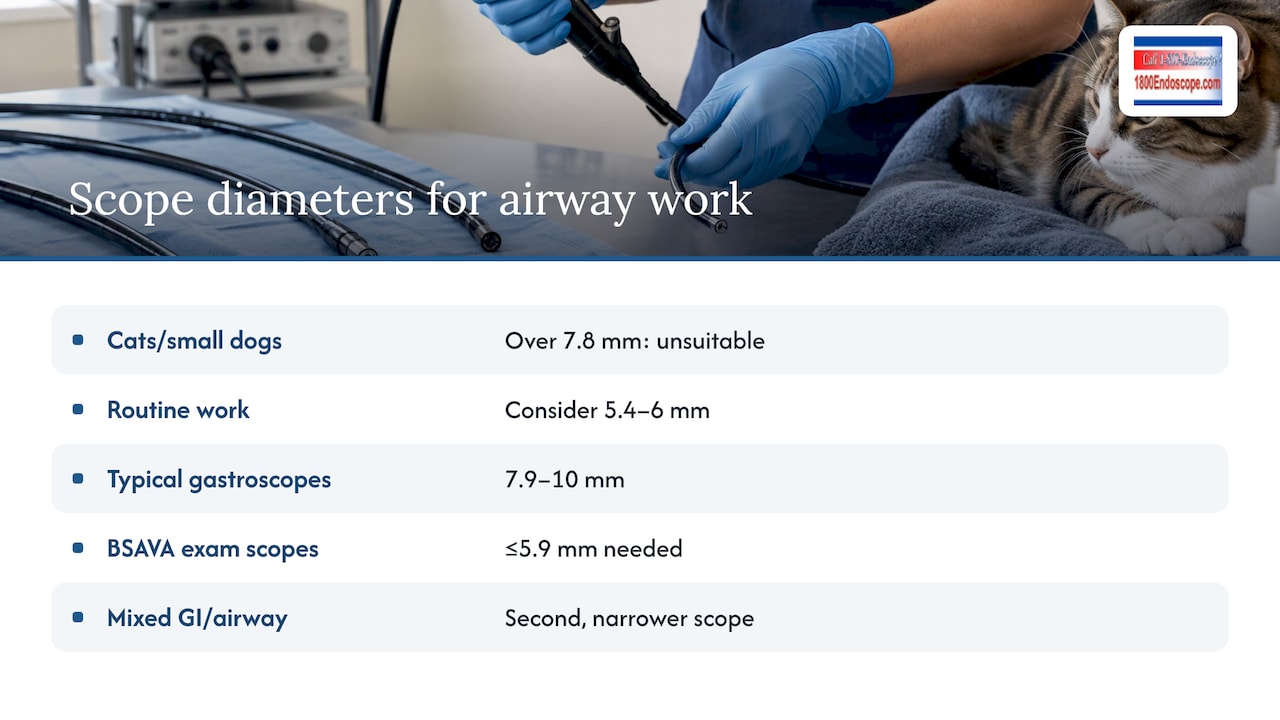
A gastroscope wider than 7.8 mm cannot be used for bronchoscopy, rhinoscopy or urethrocystoscopy in cats or small dogs. Practices that do these routinely should consider a 5.4 to 6 mm scope. The BSAVA manual makes the same point: most gastroscopes are 7.9 to 10 mm, so smaller flexible scopes of 5.9 mm or less are needed for respiratory and urinary examinations in dogs and cats.
If your caseload mixes GI and airway work, a second, narrower scope is the normal answer, and it widens what you can offer. Our 6 mm x 150 airway inspection videoscope sits in that class. Our guide to small diameter endoscopes covers the uses in more detail.
Channel size: the number that decides your biopsy quality
Diameter gets the attention, but the channel is where purchases go wrong. The sources give a clear ladder:
- 2.0 mm: the minimum for diagnostic biopsy in the WSAVA and BSAVA recommendations.
- 2.2 mm: the minimum in the Veterian Key description of the most versatile small-animal scope.
- 2.8 mm: preferred for biopsy and foreign-body retrieval, and recommended for adequate samples.
A larger channel takes larger forceps and gives larger samples. Larger samples mean fewer nondiagnostic results and fewer repeat procedures. Check that your biopsy forceps match the channel before you order. We stock flexible biopsy forceps, and you can match them to the channel of the scope you are buying. Our article on GI endoscope specs that help you avoid repeat biopsies goes through this in more detail.
Large animals: a different class of gastroscope
Equine gastroscopy changes the problem. A horse's stomach is far deeper than a dog's, so you need a tube of about 3 meters instead of 100 to 150 cm. Diameter then becomes about passing through the nasal passage and esophagus of an adult horse, not a pylorus.
Our equine-oriented range reflects this. The 12.9 mm x 3.5 meter gastroscope is a fully portable direct-monitor SD card system. The PVS3M 3 meter semi-portable equine scope is built for horse endoscopy. For airway work in horses, we offer an 8 mm equine airway field scope and a 9.5 mm x 150 airway system, both monitor-type SD card videoscopes.
Optical quality: why the spec sheet is only half the decision
Two scopes of the same diameter can look very different inside a stomach. The BSAVA Manual of Canine and Feline Endoscopy notes that image brightness is inversely proportional to the size of the organ being examined. A scope that images a hand beautifully may be unacceptably dark in a dog's stomach. So the light source matters as much as the tube. Our guide to choosing the best light source for veterinary endoscopy explains what to look for.
A buying checklist for procurement managers
Work through these in order before requesting quotes.
- List your procedures by frequency. If 80 percent of cases are small-animal GI work, choose in the 7.8 to 9.0 mm band. If you also do airway or urinary work, plan on a second scope of 5.4 to 6 mm.
- Set a minimum length. 100 cm is the floor. Take 125 to 140 cm if you see large dogs. Take 3 meters or more for horses.
- Set a minimum channel. Aim for 2.8 mm if your budget allows. Treat 2.0 mm as the floor.
- Confirm four-way tip deflection. The sources list it as a basic requirement for GI scopes.
- Match accessories. Forceps, valves, pumps and cleaning tools all depend on the channel and the connector. Order them with the scope.
- Plan the light source and recording. Decide whether you need an integrated monitor with SD card recording or a separate processor.
- Plan for service. A repair route keeps the scope in use for years. We offer endoscope repairs alongside new equipment.
Our guides on choosing the right small animal endoscope size, the endoscope diameter guide and which endoscope a clinic should buy first take the same decision further.
Worked example: a three-vet mixed practice
A mixed practice sees cats, dogs from 5 kg to 45 kg, and the occasional foreign-body case. It wants to do upper GI biopsies and look into the nose.
- Gastroscope: 7.8 to 8.5 mm outer diameter, 125 to 140 cm long, 2.8 mm channel. This passes the pylorus of most cats and reaches the duodenum of most dogs.
- Second scope: 5.4 to 6 mm for rhinoscopy and bronchoscopy in cats and small dogs.
- Accessories: 2.8 mm-compatible biopsy forceps, retrieval forceps, valves and cleaning tools.
That pair covers the great majority of the small-animal procedures in the sources above. The practice can add a larger 9.8 mm scope later if it starts seeing more large and giant breeds.
Perspective
Most buyers ask us for a single diameter. We steer them to a pair of numbers instead: the tube they need for their smallest patient, and the channel they need for their best biopsy.
Our approach is to build around the smaller patient. A scope that passes a cat's pylorus will also work in most dogs, and the veterinary literature supports sizes in the 7.8 to 8.5 mm range for general practice. Clinics that also do airway work add a narrower scope of about 6 mm, which is why we offer both portable airway systems and longer gastroscopes.
Hospital-grade human systems are one way to get these sizes. We aim to give veterinary and industrial buyers the same kinds of dimensions in portable, affordable systems with SD card recording, supported by repair service and accessories under one roof.
Endoscope
Find the right scope and accessories
Once you have your diameter, length and channel figures, the next step is matching them to a scope and its accessories. Browse our veterinary endoscopes, our medical endoscopes and accessories and our rigid scopes, arthroscopes and otoscopes for your caseload.
If you do industrial inspection instead, our borescopes and pipe inspection videoscopes use the same logic: match tube diameter and length to the smallest opening you need to pass.
FAQ
What is the typical diameter of a veterinary gastroscope?
Most small-animal gastroscopes fall between about 7.8 and 9.8 mm in outer diameter. The BSAVA manual puts most gastroscopes at 7.9 to 10 mm. For general practice, the WSAVA overview names 7.8 to 9.0 mm as ideal.
Does the diameter include the working channel?
No. Diameter is the outer width of the insertion tube. The channel is a separate, smaller inner measurement, typically 2.0 to 2.8 mm on small-animal GI scopes. Check both figures before you order.
Can one scope handle both GI and airway work in cats?
Usually not. A gastroscope wider than 7.8 mm is too large for bronchoscopy, rhinoscopy or urethrocystoscopy in cats and small dogs. Practices that do those procedures routinely should consider a 5.4 to 6 mm scope in addition.
How long should a gastroscope be for large dogs?
At least 100 cm for most patients, and 125 to 140 cm for large breeds. Some giant-breed dogs need 140 cm or more to reach the duodenum.
Sources
- Endoscopy, Veterian Key
- Endoscopic Equipment for the Veterinary Practitioner, Today's Veterinary Practice
- Diagnostic Gastrointestinal Endoscopy, WSAVA 2008, VIN
- Overview of Flexible and Rigid Endoscopy in Small Animal Practice, WSAVA 2003, VIN
- Feline pyloric diameter study, University of Liverpool repository
- Endoscopy Techniques, Today's Veterinary Practice, March/April 2015
- Lower Gastrointestinal Endoscopy Series, Part 2, Today's Veterinary Practice