
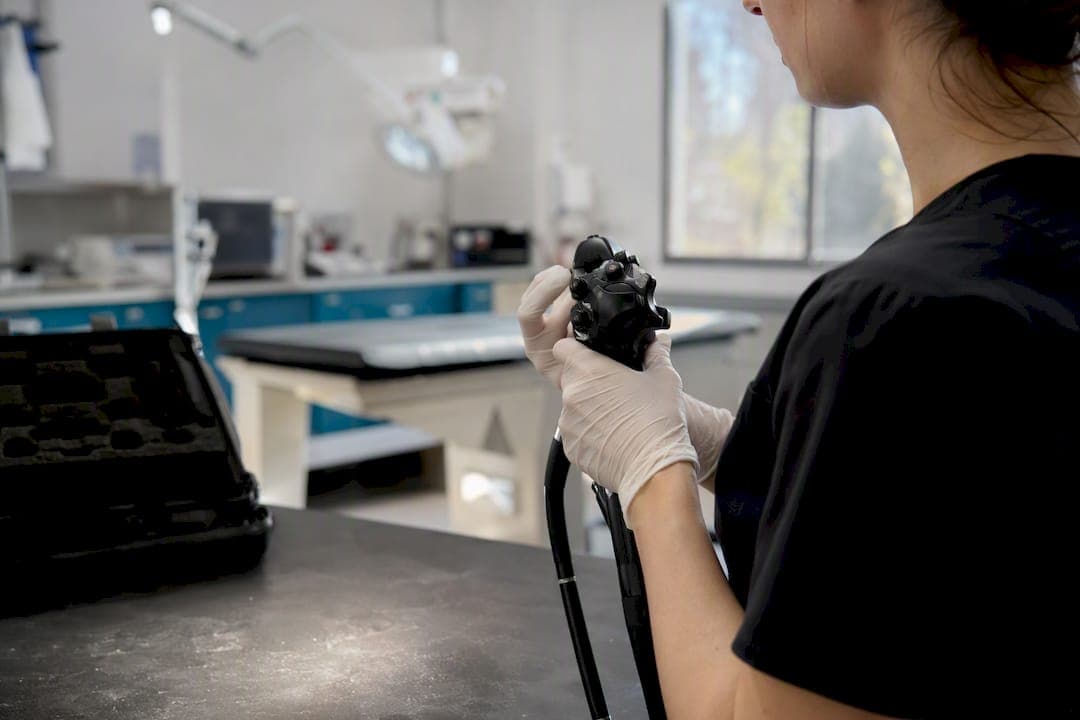
Most general practices should start with a flexible videoscope in the 5.8 to 9.2 mm outer diameter range with a working channel of at least 2.4 mm, then add a rigid telescope set once caseload justifies it. That single choice covers gastroscopy, bronchoscopy, and most foreign-body retrieval work in dogs and cats. Before you sign a purchase order, confirm three things:
- The working channel's inner diameter actually matches the biopsy forceps and retrieval baskets you plan to buy, not just the scope's marketing sheet.
- The vendor can show ISO 13485 quality certification and a pre-shipment test report.
- 1800endoscope, or a comparable supplier, offers a documented warranty and loaner policy, so a repair doesn't shut down your endoscopy schedule for weeks.
Skip this compatibility check and you'll own a scope that can't pass the instruments your surgeons actually need.
Key Takeaways
Matching working channel diameter to your actual instrument set determines whether an endoscope purchase succeeds or sits unused in a supply closet.
| Point | Details |
|---|---|
| Start with a versatile flexible scope | A gastroscope with a 2.4 mm or larger channel covers most small-animal GI and retrieval work before adding rigid systems. |
| Verify channel-to-instrument fit | Confirm working channel inner diameter matches biopsy forceps and retrieval devices before ordering. |
| Budget beyond the unit price | Set aside 10% of purchase cost for spares, consumables, and staff training in year one. |
| Require certification and test documents | Ask vendors for ISO 13485 declarations and pre-shipment test reports as part of any contract. |
| 1800endoscope supports the full checklist | Portable HD systems like the PVSM6150 and rigid endoscopy catalogs give buyers spec sheets, warranty terms, and accessory compatibility in one place. |
Table of Contents
- Endoscopic Procedures in Veterinary Medicine: Core Specs That Matter
- Flexible or Rigid: Which Scope Family Fits Your Case Mix?
- What Accessories Does Every Endoscopy RFQ Need?
- Building a Procurement Checklist and Estimating Total Cost of Ownership
- Keeping Scopes Running: Sterilization and Maintenance Basics
- Common Endoscopic Procedures by Species
- What Training Does Veterinary Endoscopy Actually Require?
- Patient Prep and Anesthesia for Veterinary Endoscopy
- Common Complications During Endoscopic Procedures in Animals
- Emerging Technology in Veterinary Endoscopy
- Frequently Asked Questions
- Sources
Endoscopic Procedures in Veterinary Medicine: Core Specs That Matter
Endoscopic procedures in veterinary medicine live or die on four numbers: outer diameter, working length, working channel size, and tip deflection. Get any one wrong for your case mix and the scope sits in a drawer.
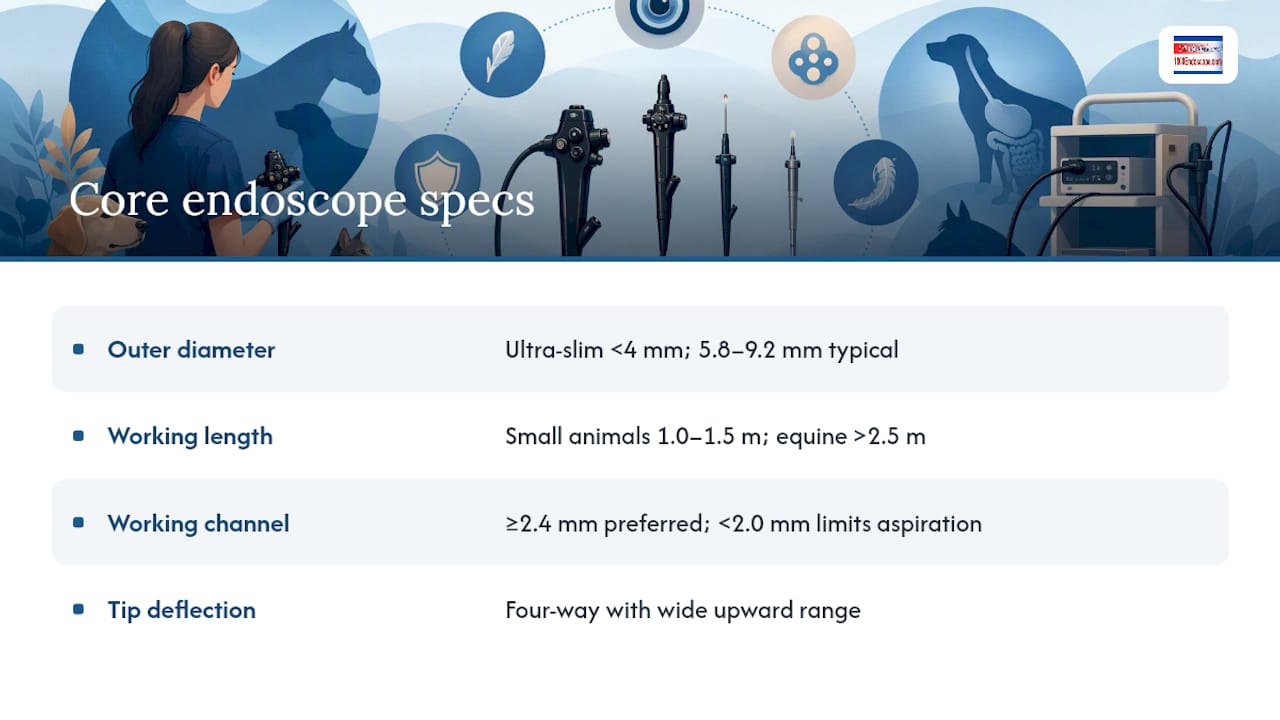
Outer diameter (OD) determines what patient sizes and body cavities a scope can enter. Ultra-slim scopes under 4 mm suit rhinoscopy, small-airway work, and exotic patients. Standard small-animal gastroscopes run 5.8 to 9.2 mm OD, which procurement guidance from SioMedical identifies as the practical range for dogs and cats. Equine and bovine work typically demands longer, sturdier scopes built for large-bore anatomy.
Working length needs to match the patient population, not just the procedure name. A feline upper GI exam needs far less reach than an equine gastroscopy, where scopes commonly run past 2.5 meters. SioMedical's guidance puts small-animal gastroscope length in the 1.0 to 1.5 meter band, which covers most canine and feline upper GI work but falls short for large-breed colonoscopy or equine procedures.
Working channel size decides which instruments actually pass through the scope. A channel under 2.0 mm limits you to basic aspiration. SioMedical's guidance flags 2.4 mm and above as the preferred threshold for standard biopsy sampling, retrieval baskets, and therapeutic tool passage.
Tip deflection matters more than most buyers expect going in. Four-way deflection with a wide upward range gives you the maneuverability to navigate the pylorus or negotiate tight colonic turns without repositioning the patient repeatedly.
On imaging: expect HD or 1080p resolution as the baseline in 2026, not a premium feature. Confirm video capture and connectivity options, whether that's USB export, Wi-Fi transfer to a tablet, or direct HDMI output to a clinic monitor, since that affects how you document findings and consult with specialists.
Flexible or Rigid: Which Scope Family Fits Your Case Mix?
The honest answer is both, eventually, but the order depends on what you're already seeing walk through the door.
- Flexible scopes handle GI, respiratory, and urinary tract work where the endoscope needs to follow a curved path. Gastroscopy, bronchoscopy, rhinoscopy, and colonoscopy all require the flex and steerability a rigid tube can't provide.
- Rigid scopes dominate laparoscopy, arthroscopy, cystoscopy, and thoracoscopy, procedures where the target cavity is accessed through a fixed port and the surgeon benefits from superior optical clarity. VIN's proceedings on rigid endoscopy note that rigid systems generally deliver sharper image quality than comparable flexible scopes, at the cost of needing ancillary gear like insufflators and dedicated light sources.
- Rigid telescopes in 2.7 mm and 5 mm sizes cover most minimally invasive surgical work, and a single camera head and light source can often serve multiple rigid procedures, which spreads the capital cost across more use cases.
- A general practice usually starts with one versatile flexible gastroscope and adds rigid arthroscopy or laparoscopy equipment only after referral volume or surgical caseload justifies the second capital purchase.
The trade-off is training time. Flexible scope handling has a real learning curve around torque and tip control; rigid scope work demands a different skill set around port placement and triangulation. Budget for both when you plan staff training, not just equipment.
What Accessories Does Every Endoscopy RFQ Need?
An endoscope without the right accessories is an expensive paperweight. Your request for quote should specify:
- Biopsy forceps and retrieval devices sized to the exact inner diameter of your working channel, not a nominal "compatible" claim.
- Suction and irrigation pumps rated for the fluid volumes your procedure mix requires.
- A light source matched to the scope's connector type, plus a spare bulb or LED module.
- Camera adapters if you're pairing a rigid telescope with a shared camera head across multiple procedures.
- Cleaning brushes, leak testers, and enzymatic detergent rated for your scope's specific channel design.
Pro Tip: Ask the vendor for a written compatibility matrix listing exact part numbers for every accessory that fits your working channel, and request proof the forceps have actually passed through the scope during pre-shipment testing.
Confirm sterilization compatibility before you order. Some flexible scopes tolerate only high-level chemical disinfection, while certain rigid telescopes and rigid accessories can go through autoclave cycles. Mixing this up shortens the life of expensive optics fast.
Building a Procurement Checklist and Estimating Total Cost of Ownership
A scope's sticker price is the smallest number in the purchase decision. Before you request quotes, walk through this sequence:
- Audit your last 12 months of case volume by procedure type and patient species.
- Map each procedure to a required OD, working length, and channel size.
- Build a spec matrix comparing at least two vendor options against that mapping.
- List every accessory the scope needs to be clinically useful on day one.
- Assess which staff members need training and how much time that requires.
Total cost of ownership runs well beyond the unit price. Factor in spare parts, consumables like biopsy forceps and cleaning supplies, shipping and taxes, staff training time, and expected repair costs over the equipment's working life.
Your RFQ and contract should require:
- A signed certification declaration confirming ISO 13485 compliance.
- A pre-shipment test report showing the scope was checked before it left the factory.
- A written warranty term and a defined repair turnaround (a service-level agreement, not a verbal promise).
- Stated lead time, return policy, and a documented parts list for future ordering.
Ask for the full spec sheet, sterilization instructions, a compatibility matrix, training materials, and a user manual before you sign anything. A vendor who hesitates to hand these over is telling you something about after-sale support.
Keeping Scopes Running: Sterilization and Maintenance Basics
Endoscopes fail from neglect more often than from manufacturing defects. Build these habits into your clinic's standard operating procedure, not just your annual budget.
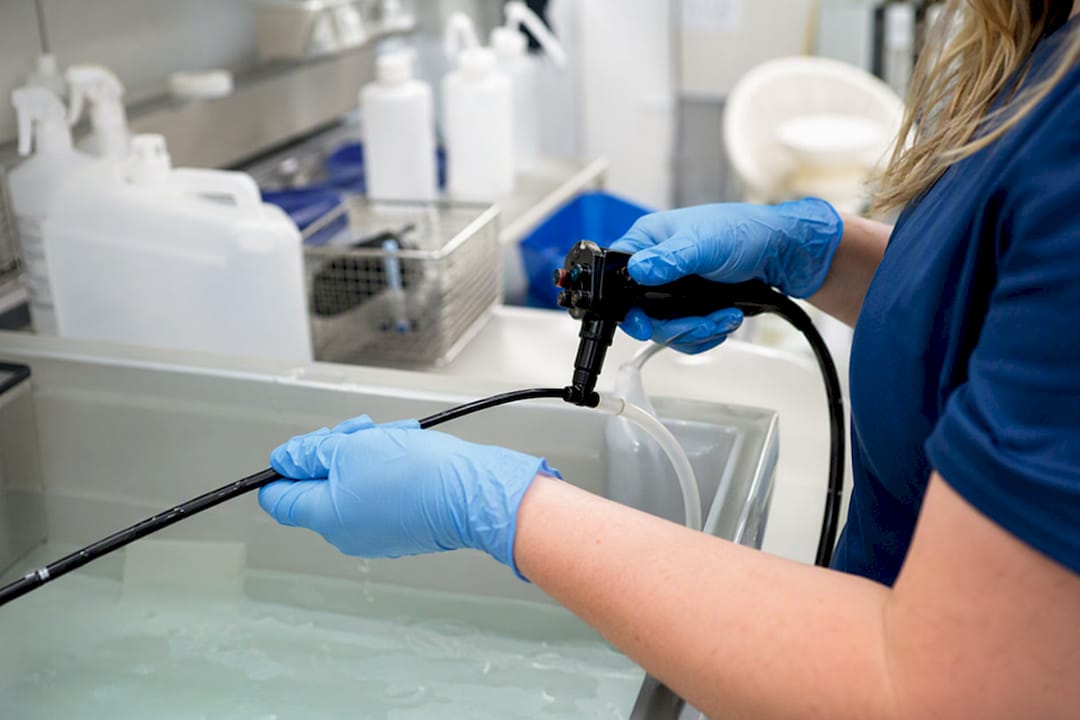
- Run a visual inspection and leak test before and after every procedure day, checking insertion tubes for nicks or kinks.
- Flush and brush the working channel immediately after each use; dried organic material is far harder to remove once it sets.
- Confirm which components tolerate autoclaving and which require high-level chemical disinfection only. Camera heads and light sources often can't handle the heat that a rigid telescope tolerates.
- Stock spare valves, seals, and light bulbs so a minor failure doesn't become a canceled surgery day.
- Log every use, repair, and sterilization cycle. That record matters for both compliance and warranty claims.
Vendors who offer a loaner program during repairs are worth prioritizing over marginally cheaper competitors without one. Portable systems reduce upfront capital outlay, but buyer guidance on certification and specs points out that smaller working channels and lower fluid-handling capacity on compact units can limit therapeutic use compared to cart-based towers, so weigh that trade-off against your surgical caseload before committing to the lightest option on the shelf.
Common Endoscopic Procedures by Species
Canine and feline gastroscopy accounts for the bulk of small-animal endoscopy caseload: biopsy of the stomach and duodenum, foreign-body retrieval, and evaluation of chronic vomiting or weight loss. Colonoscopy follows a similar flexible-scope path for chronic diarrhea workups and colonic mass evaluation.
Bronchoscopy and rhinoscopy in dogs and cats typically call for a slimmer scope diameter, since airway and nasal passages tolerate far less bulk than the GI tract. Cystoscopy, most often performed with rigid telescopes in female dogs and cats, supports both diagnostic bladder evaluation and minimally invasive stone retrieval.
Equine practice leans heavily on gastroscopy for ulcer evaluation, given how common gastric ulceration is in performance and stressed horses, along with upper airway endoscopy for lameness and respiratory workups. Equine procedures demand the longer working lengths and larger ODs discussed earlier, since patient anatomy simply requires more scope.
Exotic and avian patients push clinics toward the ultra-slim end of the OD spectrum, often under 4 mm, for both respiratory and coelomic examination. Veterinary Endoscopy for the Small Animal Practitioner catalogs an extensive range of these procedures, including otoscopy and both diagnostic and operative laparoscopy, and remains a solid reference when you're deciding which procedures your clinic wants to add before finalizing an equipment order.
What Training Does Veterinary Endoscopy Actually Require?
Owning the right scope solves only half the problem. Endoscopy skill develops through hands-on repetition, not a single afternoon reading a manual.
Veterinarians typically build competency through a combination of wet labs, continuing-education courses, and mentored cases before operating independently. Flexible endoscopy demands comfort with torque, tip deflection, and air insufflation control; rigid endoscopy demands spatial awareness for port triangulation and instrument handling under magnified optics.
Practices that add a second scope family, say moving from flexible-only to adding rigid laparoscopy, should budget real time for the learning curve. A veterinarian skilled with a flexible gastroscope isn't automatically fluent with a rigid arthroscopy setup; the hand skills don't transfer directly. Technicians also need training specific to their role: proper scope handling during cleaning, correct channel flushing technique, and recognizing early signs of optical or mechanical damage before a small issue becomes an expensive repair.
Ask vendors what training resources ship with the equipment. Documented procedural guides, instructional video content, and access to a support line for troubleshooting during early cases all reduce the real-world learning curve and protect your equipment investment.
Patient Prep and Anesthesia for Veterinary Endoscopy
Most veterinary endoscopic procedures require general anesthesia, since patient movement during scope passage risks both diagnostic accuracy and tissue injury. Fasting protocols before GI endoscopy typically run 12 hours or more for food, with water restriction handled more conservatively depending on patient age and health status.
Airway management deserves particular attention during bronchoscopy and rhinoscopy, where the endoscope itself occupies airway space the anesthetist needs to monitor closely. Capnography and pulse oximetry become essential monitoring tools when a scope is sharing real estate with the patient's airway.
Positioning matters too. Left lateral recumbency is standard for upper GI gastroscopy, while cystoscopy and certain laparoscopic procedures require different patient positioning to optimize scope access and gravity-assisted visualization. Older patients or those with comorbidities may need adjusted anesthetic protocols, and clinics running higher-risk endoscopy caseloads should have a documented pre-anesthetic workup standard rather than deciding case by case.
Common Complications During Endoscopic Procedures in Animals
Most complications trace back to two sources: patient physiology and equipment limitations, and procurement decisions influence the second category directly.
Perforation risk exists with any endoscopic procedure, particularly during aggressive biopsy sampling or foreign-body retrieval in a friable GI tract. Careful technique and appropriately sized instruments reduce this risk, which is another reason working-channel-to-instrument compatibility isn't a minor detail.
Insufflation-related complications, including abdominal distension affecting ventilation during laparoscopy, require an anesthetist watching more than just heart rate and blood pressure. Equipment-side troubleshooting comes up constantly too: a scope that won't hold image focus, a light source that dims mid-procedure, or a working channel that won't pass forceps smoothly all point back to maintenance gaps or channel wear.
Fogging and image degradation during longer procedures often trace to antifog solution application or camera-head condensation, both fixable with routine pre-procedure steps rather than equipment replacement. Keep a documented troubleshooting checklist near your endoscopy suite. A five-minute pre-procedure equipment check catches most of these issues before the patient is under anesthesia, which is a far better time to discover a problem than mid-procedure.
Emerging Technology in Veterinary Endoscopy
The clearest shift in the last several years is the move toward portable HD systems with wireless connectivity, replacing bulkier cart-based towers for many general-practice applications. These systems record directly to SD card or transmit via Wi-Fi to a tablet, which simplifies case documentation and specialist consultation without a dedicated video cart taking up suite space.
Higher-resolution imaging, including narrower-band lighting options that improve mucosal detail visualization, is becoming more accessible outside referral-only settings. Battery-backed recording and documented operating-temperature ranges matter more as mobile and ambulatory practice grows, particularly for equine practitioners doing fieldwork away from a fixed clinic.
Connectivity improvements also support better case records: video files exported directly to a patient's digital chart, rather than a separate storage system, tighten up documentation for both clinical and legal purposes. None of this replaces sound technique or proper training, but it does lower the barrier for general practices to bring procedures in-house that once required referral.
Author Perspective and 1800endoscope's Role in Procurement
Most procurement mistakes happen because clinics buy specs, not workflows. A scope with an impressive resolution number is worthless if its working channel can't pass the forceps you already own. 1800endoscope's portable HD systems and accessory catalogs are built around that mapping problem, matching working channel size, OD, and connectivity to the procedures clinics actually perform. Request a spec sheet, ask about warranty terms, and confirm training materials before you commit.
Get Specs and Quotes for Your Next Endoscopy Purchase
Compared to the multi-week quoting cycles typical of larger medical-equipment resellers, 1800endoscope lets a clinic buyer go from spec question to purchase decision without waiting on a sales cycle built for hospital systems, not single-location practices. The PVSM6150 portable endoscopy system is a practical example: a 6 mm by 150 cm airway inspection unit with direct SD card recording, built for clinics that want HD documentation without a full video tower.
If your case mix leans toward minimally invasive surgery, the veterinary rigid endoscopy catalog covers telescopes and accessories for laparoscopy, arthroscopy, and cystoscopy work. Clinics evaluating smaller diagnostic tools for inspection or exotic patient work can browse the borescope and endoscope catalog for compact options. Whatever your procedure mix, request a written spec sheet and confirm warranty and loaner terms before you finalize an RFQ. Reach out to 1800endoscope directly to get product specifications matched to your working channel and accessory needs, and get a quote started today.
Frequently Asked Questions
What is the minimum working channel size for standard biopsy sampling? Most procurement guidance points to 2.4 mm or larger as the practical threshold for passing biopsy forceps and retrieval instruments reliably during standard veterinary endoscopic procedures.
Do general practices need both flexible and rigid endoscopes? Not immediately. Most general practices start with one versatile flexible scope and add a rigid telescope set once laparoscopy, arthroscopy, or cystoscopy caseload justifies the second purchase.
How often should endoscopy equipment be serviced? Daily visual and leak checks, combined with immediate post-procedure channel cleaning, catch most issues early. Formal service contracts and annual professional maintenance help prevent costly downtime.
Can portable endoscope systems handle surgical procedures? Many portable HD systems handle diagnostic work well, but smaller working channels and lower fluid-handling capacity can limit therapeutic use compared to cart-based systems, so match the unit to your actual caseload.
What certifications should a veterinary endoscope vendor provide? Look for ISO 13485 quality management certification and a documented pre-shipment test report confirming the scope and accessories passed functional testing before delivery.
Sources
- Guidelines for Selecting Veterinary Endoscopes - SioMedical
- VIN proceedings: Rigid endoscopy and applications
- Veterinary Endoscopy for the Small Animal Practitioner (Wiley)