
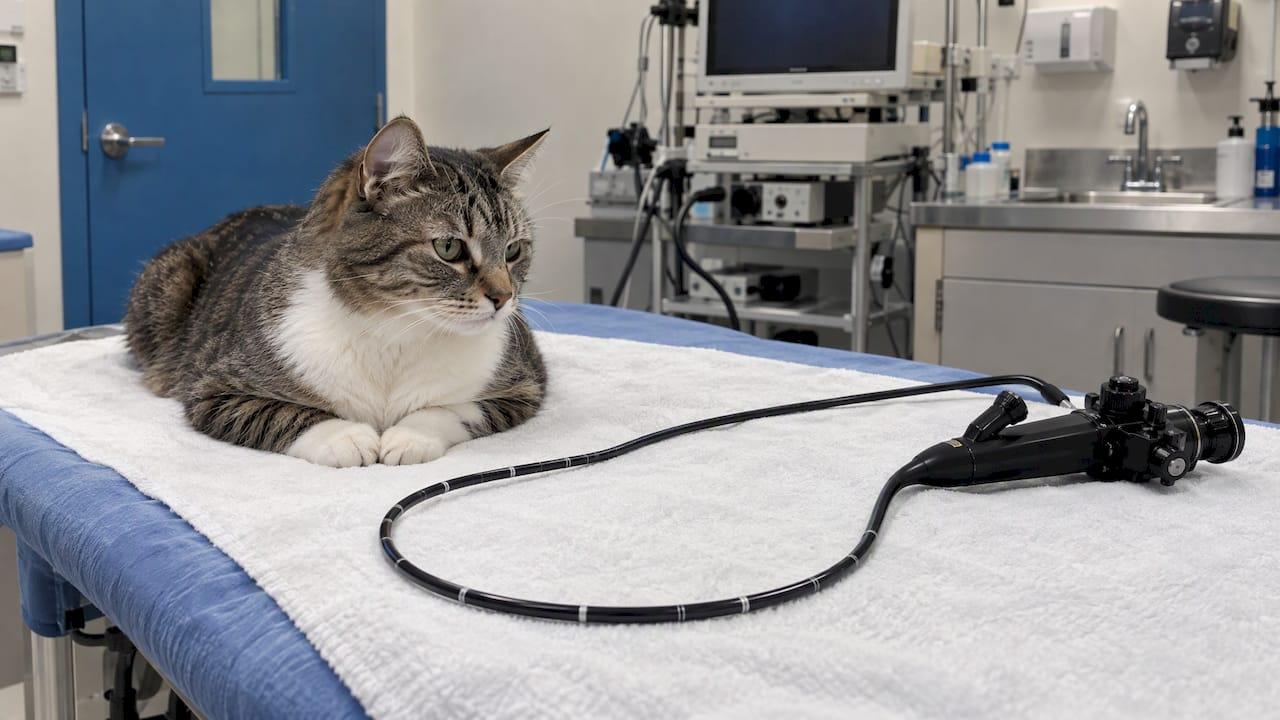
A cat needs a pediatric-class flexible endoscope: about 5.9 to 9.8 mm outside diameter, at least one meter of working length, four-way tip deflection and a 2.0 to 2.8 mm instrument channel for GI work. Airway work needs a much thinner scope, 2.5 to 3.8 mm. If your clinic scopes cats, those numbers decide what you buy. We sell veterinary endoscopy equipment built around these small-animal needs, including portable video systems in the 6 mm and 9.5 mm classes.
TL;DR
- For feline GI work, WSAVA guidance calls for a shaft of at least 1 m, a 5.9 to 9.8 mm outside diameter, four-way deflection and a 2.0 to 2.8 mm biopsy channel.
- For feline bronchoscopy, a 2.5 to 3.8 mm scope is considered best, and a working channel limits instrument size.
- GI endoscopy in cats is done under general anesthesia, and biopsies are its main purpose.
- Match scope diameter, channel and forceps size before you order, because the three decide what you can sample and retrieve.
Table of Contents
- What "pediatric" means in feline practice
- Feline GI scope specifications at a glance
- Flexible or rigid: what each does in a cat
- Airway work needs a thinner scope
- What endoscopy can diagnose and treat in cats
- When to scope a cat
- The procedure: anesthesia, preparation and recovery
- How to choose a scope for a feline caseload
- Our view: a feline scope should not cost hospital money
- Equipment for your feline caseload
- FAQ
- Sources
What "pediatric" means in feline practice
A pediatric endoscope is a human pediatric-class instrument with a thin insertion tube. Veterinary specialists adopted the class because a cat's esophagus, pylorus and duodenum are narrow. An adult human gastroscope is too thick to pass comfortably.
The WSAVA diagnostic GI endoscopy lecture states that modern pediatric endoscopes generally meet the requirements for dog and cat GI examination. Those requirements are:
- a working shaft of at least one meter (at least 130 cm in big dogs)
- an outside diameter of 5.9 to 9.8 mm
- a flexible tip with four-way deflection
- a field of view wider than 100°
- channels for insufflation (air), suction and biopsy instruments of 2.0 to 2.8 mm
In the feline GI chapters of the Journal of Feline Medicine and Surgery, the authors describe a feline-specific video endoscope 110 cm long with a 5.9 mm insertion tube. They also describe a 7.9 mm scope, 140 cm long, with a 2.8 mm instrument channel.
An older WSAVA proceeding calls a 9 mm forward-viewing pediatric gastroscope of 120 to 140 cm with a 2.8 mm biopsy channel perhaps the best instrument for general small animal practice. It reaches the esophagus, stomach, proximal small intestine and colon in all but the largest patients, and it can double as a bronchoscope.
Feline GI scope specifications at a glance
| Feature | Published range for cats and dogs | Why it matters |
|---|---|---|
| Outside diameter | 5.9 to 9.8 mm | Passes the cranial esophageal sphincter and pylorus in small patients |
| Working length | At least 100 cm (110 to 140 cm described for cats) | Reaches the duodenum, and the colon from below |
| Tip deflection | Four-way | Lets you retroflex in the stomach and enter the pylorus |
| Field of view | Greater than 100° | Keeps landmarks visible in a small lumen |
| Instrument channel | 2.0 to 2.8 mm | Sets which biopsy forceps and retrieval tools fit |
Source for the table: WSAVA 2008 and Stengel, Robertson and Neiger, 2013.
The 5.9 mm tube is attractive for a small cat. The 2.0 to 2.8 mm channel is what most clinics overlook. A narrow channel limits you to smaller forceps, and small forceps take smaller bites. Read the channel size on the spec sheet before the outside diameter.
Two of our video systems fit these published ranges on diameter and length. The 6 mm x 150 airway inspection monitor system and the 9.5 x 150 monitor-type SD card video endoscope both have a diameter inside 5.9 to 9.8 mm and a length above one meter. Check channel size, deflection and your own caseload with us before ordering.
Flexible or rigid: what each does in a cat
The feline GI authors put it plainly. Flexible scopes are preferred for complete stomach visualization and for intubating the small intestine and proximal large intestine. Rigid scopes examine the oral cavity, esophagus, rectum and descending colon.
Rigid endoscopes for esophagoscopy and proctoscopy are about 25 cm long. They come in pediatric (9 to 12 mm) and adult (18 to 25 mm) diameters, and the pediatric size suits cats best.
In practice this means:
- Flexible pediatric scope: your main GI instrument, for gastroduodenoscopy, ileocolonoscopy, foreign-body retrieval and feeding-tube placement.
- Rigid scope: a complement for oral, ear, nasal and short-reach work. See our rigid scopes, arthroscopes and otoscopes.
Airway work needs a thinner scope
A GI-size scope is too large for most feline bronchoscopy. WSAVA respiratory guidance says a bronchoscope of 2.5 to 3.8 mm outside diameter is best for cats. At least bidirectional tip flexion is required, and four-way flexion helps with foreign-body retrieval. Most of these scopes have a channel of about 2 mm that accepts instruments of 1.8 mm or less.
A feline airway review adds a rule of thumb. Instruments must be 0.2 mm smaller than the channel to pass the full length safely. It also notes 1.0 mm instruments for the smallest scopes, which have a 1.2 mm channel.

Cats are not small dogs here. The same WSAVA notes say cats tend to bronchoconstrict and desaturate during lavage. A 2018 WSAVA review rates feline lower airway endoscopy as medium to high risk because the airways are small and highly responsive. Plan oxygen supplementation and monitoring before you pass the scope.
What endoscopy can diagnose and treat in cats
The diagnostic list is broad. Small-diameter flexible endoscopes are used to investigate regurgitation, chronic vomiting, hematemesis, melena, and small- and large-bowel diarrhea. They also obtain mucosal biopsies, according to WSAVA 2008.
The therapeutic list is just as practical:
- foreign-body removal
- stricture dilation
- polyp removal
- percutaneous gastrostomy (PEG) tube placement
A JFMS review reports that experienced clinicians normally remove an endoscopic foreign body in under 30 minutes from anesthesia induction, much quicker than surgery. A 2024 study reports that endoscopic removal avoids many gastrotomy complications (hemorrhage, spillage, peritonitis, dehiscence) and shortens anesthesia time. Our foreign body retrieval protocols article covers the clinic workflow.
When to scope a cat
The feline GI authors advise endoscopy only after less invasive steps have not given a diagnosis. Those steps are laboratory tests, diagnostic imaging and trial therapy (diet, anthelmintics, antibiotics).
Two rules follow from that source and from the WSAVA GI Standardization Group:
- Biopsy every cat. Biopsies should be taken regardless of how the mucosa looks, because macroscopic appearance does not predict histology.
- Pick the lesion location. Per a clinical summary of the group's guidance, cats with ultrasound abnormalities confined to the stomach and duodenum are ideal endoscopy candidates. Cats with mainly jejunal changes may benefit more from surgical biopsies.
Because biopsy is the point, the sampling kit matters as much as the scope. Our flexible biopsy forceps page lists the forceps we carry. Match their diameter to your channel using the 0.2 mm clearance rule above. Our guide on GI endoscope specs that avoid repeat biopsies goes deeper on sample quality.
Samples only help if they are read well. Clinics that also build in-house cytology or slide review can use a veterinary microscope buying guide when planning the bench.
The procedure: anesthesia, preparation and recovery
Anesthesia
GI endoscopy in cats can only be done safely under general anesthesia. An assistant who can maintain and supervise anesthesia must be present throughout, because the endoscopist is focused on the task. That assistant should also understand endoscopy, so they can anticipate stomach over-inflation or colon stretching.
For bronchoscopy, the WSAVA 2018 review says the feline larynx is sensitive and needs topical 1% lidocaine spray first. It also says there is no single protocol for every cat. Most tolerate low-dose acepromazine, an opioid and a bronchodilator, with TIVA using incremental propofol or alfaxalone. Your anesthesia plan belongs to your veterinarian and the case.
Fasting and colon preparation
Per Stengel, Robertson and Neiger, withhold food for 12 to 18 hours before upper GI endoscopy, with water allowed until 2 hours before. For lower GI endoscopy, withhold food for at least 24 hours. Warm water enemas every 1 to 2 hours until the effluent is clear clean the colon. The last enema should be no later than 2 hours before the procedure. Do not overdistend the colon, because it can cause vomiting in cats.
Complications and consent
The 2024 intra-operative endoscopy paper lists retching as the most common complication of foreign-body removal. It comes from pyloric irritation and air insufflation. Perforation is rarer but more serious. It results from excessive pressure on firm, narrow or diseased wall. Over-inflation of the stomach can cause hypotension.
Owner consent should cover an unsuccessful procedure, esophageal perforation and surgery under the same anesthesia, per the JFMS foreign-body review. The same authors suggest discussing a temporary gastrostomy feeding tube in advance for cats with severe esophagitis after foreign-body removal.
After lower airway endoscopy, the main post-procedure danger is upper airway obstruction from laryngeal edema, inflammation, mucus or bronchoconstriction. The cat should stay on 100% oxygen and under close monitoring until recovered, per the WSAVA 2018 review.

How to choose a scope for a feline caseload
For a procurement manager or lead veterinarian, work through this order:
- Define the cases. GI, airway, or both? GI cases point to a 5.9 to 9.8 mm flexible scope. Airway cases need a 2.5 to 3.8 mm scope for cats.
- Check the channel first. A 2.0 to 2.8 mm channel decides which forceps and retrieval tools fit.
- Confirm length. One meter is the floor, and more reach helps in larger patients and for ileocolonoscopy.
- Confirm four-way deflection if you want to retroflex or retrieve foreign bodies.
- Plan for mixed species. A clinic seeing cats, dogs and horses may want more than one scope. Our guides on choosing a small animal endoscope size and endoscope diameter compare the options, and the veterinary endoscope buying guide covers the 5.8 to 7.0 mm class.
- Plan for upkeep. Pumps, valves, light sources and cleaning tools are part of the system, and so are repairs. We list them under endoscopic accessories.
A wider tip of advice: ask the supplier for the exact channel diameter and deflection in writing for any model you consider, since listings sometimes show only outside diameter.
Our view: a feline scope should not cost hospital money
Most small clinics do not need a hospital-grade human GI tower to scope a cat. They need the right diameter, a working channel that takes real biopsy forceps, enough length, and a system that moves between the exam room and the surgery suite.
That is why we build our offer around portable video endoscopes, flexible biopsy forceps and accessories at affordable prices for veterinary use. Our claim is simple: high-resolution portable scopes should not be out of reach for a clinic that sees cats every week.
We also back the equipment. We offer endoscope repairs, 24/7 support and rapid shipping, so a scope does not sit idle while a case waits.
Choose by channel and diameter first, then by price. That order serves the patient and the budget.
Endoscope
Equipment for your feline caseload
We stock veterinary video endoscopes, rigid scopes, biopsy forceps, light sources, pumps, valves and cleaning tools for small and large animals. Start with the 6 mm x 150 portable monitor system, or browse the full veterinary endoscopy catalog to build a complete set.
If you want help matching a scope to your cases, our endoscopy FAQ and inspection procedures page is a good first stop. Support is available 24/7.
FAQ
What size endoscope do you use for a cat?
For GI work, published guidance gives an outside diameter of 5.9 to 9.8 mm with a length of at least one meter. A 5.9 mm, 110 cm scope has been described specifically for cats. For bronchoscopy, 2.5 to 3.8 mm is best for cats. Match the channel to your forceps.
Does a cat need anesthesia for an endoscopy?
Yes. GI endoscopy in cats can only be done safely and adequately under general anesthesia, with a trained assistant monitoring throughout. Airway endoscopy also requires general anesthesia, with topical lidocaine on the larynx. Your veterinarian sets the protocol.
What can endoscopy treat in cats besides diagnosing disease?
It can retrieve foreign bodies, remove polyps, dilate esophageal strictures and place PEG or jejunostomy feeding tubes. Foreign-body removal normally takes under 30 minutes from induction in experienced hands. Owners should consent to possible surgery under the same anesthesia.
When should a veterinarian choose endoscopy over surgery for biopsies?
WSAVA GI guidance favors endoscopic biopsy in most feline cases, especially when ultrasound changes are in the stomach and duodenum. Jejunal disease may be better served by surgical biopsy. Endoscopy is usually considered after labs, imaging and trial therapy have not given an answer.
Sources
- Diagnostic Gastrointestinal Endoscopy, WSAVA 2008
- Gastrointestinal Endoscopy in Dogs and Cats, WSAVA 2004
- Gastrointestinal Endoscopy in the Cat, JFMS 2013 (PMC)
- Gastrointestinal Endoscopy in the Cat, Stengel et al., JFMS 2013
- Gastrointestinal Endoscopy in the Cat, Neiger et al., JFMS 2013
- Lower respiratory tract endoscopy in the cat (PMC)
- Lessons Learned in Respiratory Endoscopy, WSAVA 2013
- Feline Tracheobronchoscopy, WSAVA 2018
- The Use of Intra-Operative Endoscopy in Dogs and Cats, 2024 (PMC)
- Chronic Gastrointestinal Disease in Cats, MSPCA-Angell