
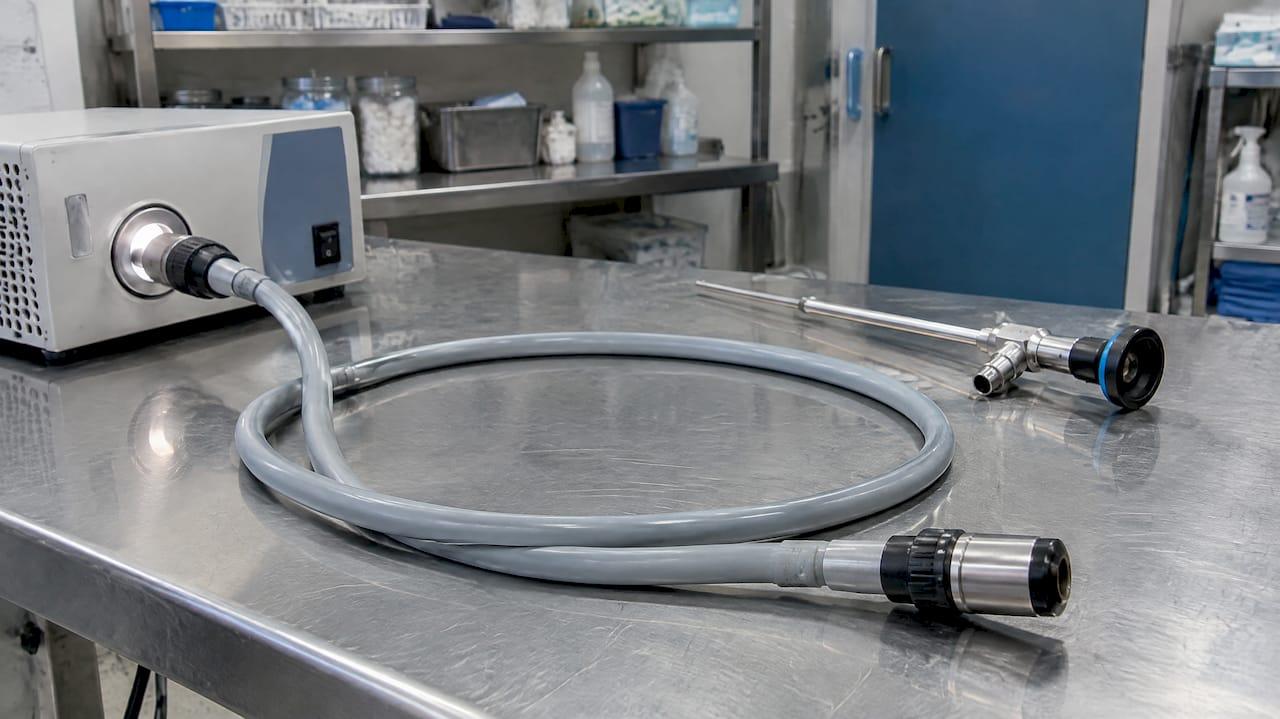
A light cable (also called a light guide cable or light cord) carries light from the light source to the scope, so the right one comes down to three things: how it is built, which connectors it has at each end, and how much light it still passes after months of use. Get those three right and your scope images stay bright and consistent, whether you examine a dog's airway or a weld inside a pipe. This guide walks through the types, the compatibility questions that cause most buying mistakes, and a care routine that keeps a cable working.
TL;DR
- Most endoscope light cables are glass fiber bundles in a protective sheath with a metal connector at each end. Differences come from diameter, length, sheathing and connector style.
- Compatibility has two sides: the plug at the light source and the plug at the scope. Both must match, or an adapter must bridge them.
- Broken fibers, dark spots and stiff or damaged sheathing are the usual signs a cable is losing light.
- Reprocess a cable only as its manufacturer's instructions for use (IFU) say, and keep it coiled loosely and dry between jobs.
- If you are unsure which cable fits your scope and light source, send us the make and model and we will help you match it.
Table of Contents
- What a light cable does
- The main light cable types
- Matching a cable to your scope and light source
- How the lamp type relates to the cable
- Inspecting a cable: is it still good?
- Caring for a light cable
- Choosing a cable: a short checklist
- Our perspective
- Where to get what you need
- FAQ
- Sources
What a light cable does
An endoscope does not make its own light in most designs. The light source (a lamp in a box) makes it, and the cable carries it to the scope's light post, where fibers inside the scope take it to the tip. Video endoscopes with LEDs at the tip are different, but any fiber-optic scope, rigid or flexible, depends on a cable.
That makes the cable a consumable part of the imaging chain. A great camera and a strong lamp still give you a dim picture through a tired cable, and a dim picture is a common reason clinics think a scope is failing when the real culprit is a few inches of worn fiber.
The main light cable types
Fiber-optic (glass fiber bundle) cables
This is the standard type. The U.S. Food and Drug Administration describes a typical light guide cable in a premarket notification record: glass fibers are glued or fused into ferrules (metal sleeves) at both ends, polished so light passes through, fitted with standard endoscope connectors and covered with silicone sheathing. The same record lists its purpose as carrying illumination from an illuminator to headlights, microscopes and endoscopes during examinations or surgery.
Two features matter when you compare these cables:
- Fiber count and quality. More fibers, and cleaner ones, mean more light delivered. Two cables with the same model number can still differ slightly, because fiber count and production factors vary.
- Diameter. A wider bundle collects and carries more light from the source than a narrower one. Match the bundle to the light post on the scope, because a bundle much larger than the post wastes light at the junction.
Liquid-filled light guides
Some cables use a liquid-filled core instead of glass fibers. They are common in certain surgical and industrial settings where high transmission matters and the cable stays in one place. They tend to be less forgiving of tight bends and rough handling, so for portable field work in a vet truck or a plant floor, fiber bundles are the usual pick.
Reusable versus single-use
Most clinical and industrial cables are reusable. A reusable cable has to survive repeated cleaning and sterilization, so the sheath, ferrules and connectors are made for that. Always check which methods your cable's IFU allows: steam, ethylene oxide, hydrogen peroxide plasma, or only cleaning and disinfection.
Short, standard and long cords
Length is a practical choice. A short cord keeps a bench setup tidy. A long cord lets you work around a large animal or a long piece of equipment without moving the light source. Fiber loss over a few meters is small compared with loss from damage or a poor connection, so pick length for how you work, not to save light.
Matching a cable to your scope and light source
This is where most orders go wrong. A cable has two ends, and each end has its own fitting.
Step 1: Identify the source end
Light sources have a port, and the cable's source-end plug has to seat in it. Some ports take a cable directly. Others use a turret or adapter that accepts several plug sizes. Write down the light source make and model, and look at whether the port is a simple round socket or a stepped turret.
Step 2: Identify the scope end
The scope's light post is the other half. Scopes from different manufacturers use different post shapes and diameters. Many rigid scopes, arthroscopes and otoscopes use a small post, while flexible scopes may take the cable at an umbilical or a universal connector.
Step 3: Choose a cable with the right ends, or a cable with an adapter
There are two routes:
- A cable with the correct plug at each end, which is the cleanest solution.
- A cable with one common end plus a small adapter at the other. Adapters are practical when you use several scopes on one light source.
When is an adapter fine?
An adapter works when it seats fully and the light path stays aligned. It is a poor choice when it sits loose, leaves a gap, or forces a small bundle against a larger post. Any gap lets light escape and gives you a dimmer, uneven image. If the adapter wobbles in the port, do not trust it.
A useful habit: after you connect everything, run the light source at a normal setting and look at the scope tip or the light post end. Strong, even light means a good fit. A dim or uneven tip points to a fitting problem or a tired cable.
For a deeper look at the other half of the system, see our guide to choosing the best light source for veterinary endoscopy and our piece on how to select light sources for endoscopic inspections.

How the lamp type relates to the cable
Common light sources use halogen, xenon or LED lamps. The cable does not care much which one you use, as long as the bundle can handle the heat and brightness at its source end. A strong lamp pushes more light into the cable, but it also pushes more heat into the first few millimeters of fiber. Over time, that end can discolor or lose fibers. Running a source at its highest setting for every job speeds that wear, so use the lowest setting that gives a clear image.
If you work with industrial borescopes, our guide to LED illumination in borescopes shows how tip-mounted LEDs change the picture, and how light sources drive accuracy in endoscopic NDT covers why lighting quality affects what you can see in a defect.
Inspecting a cable: is it still good?
A quick inspection before each use takes a minute and prevents a lot of frustration.
| Check | What to look for | What it usually means |
|---|---|---|
| Sheath | Cracks, kinks, flattened spots, sticky or swollen areas | Damage to the fibers underneath, or heat and chemical wear |
| Ferrules and connectors | Dents, corrosion, loose fit | Poor seating, light loss at the joint |
| Fiber faces | Dark or black dots when you hold one end to a light and look through the other | Broken fibers |
| Brightness | Dimmer image than before at the same source setting | Gradual loss from aging or damage |
| Source end | Brown or burnt look on the polished face | Heat damage |
The dark-dot check is simple. Hold one end toward a bright room light and look into the other end. A healthy cable shows a field of bright points. Black spots are broken fibers. A few are normal with age, but a growing number means the cable is losing light, and it is time to replace it.
Transmission also differs from cable to cable. Two cables of the same model number will not be identical, so judge a cable against its own earlier performance on your own light source, not against a number from a brochure.
If your picture is dim and you are unsure whether the cable, the scope or the light source is at fault, our videoscope troubleshooting guide for vet professionals helps you work through the chain in order.
Caring for a light cable
Clean and disinfect or sterilize according to the IFU
The U.S. Centers for Disease Control and Prevention's HICPAC reprocessing elements set out seven steps for reprocessing flexible endoscopes: pre-cleaning right after use, leak testing, manual cleaning, visual inspection, high-level disinfection or sterilization, storage that prevents recontamination and promotes drying, and documentation. A light cable is not a flexible scope with channels, and it has no leak test, but the principles carry over: clean right away, inspect, process by the manufacturer's instructions, dry, store and record.

The FDA record for a light guide cable notes that the cable is intended to be sterilized by the user with ethylene oxide. Other cables are cleared for different methods, so the only reliable rule is: use the method in the IFU that came with your cable.
The CDC's guideline for disinfection and sterilization in healthcare facilities adds that steam is the preferred method for critical items that can withstand it, that ethylene oxide can be too slow for routine use between patients, and that newer technologies such as hydrogen peroxide gas plasma give faster cycles. Your cable's IFU tells you which of these it tolerates.
For sterilization routines in animal and industrial settings, see our 2026 guide to sterilization in veterinary endoscopy and the step by step endoscope sterilization guide for vets and industry.
Handle it like fiber, not like a power cord
- Coil it in wide loops. Tight bends break fibers.
- Never pull a cable by the sheath. Hold the connector.
- Do not crush it under a case lid or a wheel.
- Wipe both ends clean and dry before connecting. Residue on a polished face burns in under a hot lamp.
- Cap the ends when stored, if caps came with the cable.
Store it dry and loosely
The CDC reprocessing elements call for storage that prevents recontamination and promotes drying. For a cable, that means hanging or laying it loosely in a clean, dry case, away from sharp edges and heat sources.
Keep a simple log
Note the date you put a cable into service and how many times you reprocess it. A log makes replacement a scheduled decision rather than a surprise on the day of a procedure. Documenting each reprocessing step is also part of the CDC elements.
Know what changed in the standards
The FDA revised its guidance on sterility information in premarket submissions on January 8, 2024, updating the lists of established sterilization methods. That guidance is aimed at device makers, but it explains why newer cables may list methods that older IFUs do not. Always read the IFU for the exact cable you hold.
Choosing a cable: a short checklist
- Write down your light source model and port type.
- Write down your scope model and light post type.
- Choose a bundle diameter that suits the scope's post.
- Pick a length for your workspace, not to chase brightness.
- Confirm the sterilization or disinfection method you can use with the cable.
- For multi-scope setups, ask about a cable with interchangeable end adapters.
- Keep a spare, because a cable fails at the worst moment.
Procurement managers buying for several rooms or several inspection teams can use the same list to standardize on one or two cable styles, which cuts the number of spares to hold.
Our perspective
Most light problems we hear about are not scope problems. They are cable and connection problems, and they are easy to prevent.
Veterinary and industrial users work in places where a hospital-style setup is not practical: a barn, a field, a crawl space, a pipe run. In those places a cable gets dragged, bent and wiped in a hurry. We think a cable should be treated as a working part, checked often and replaced before it lets the image go flat.
That is why we pay attention to the whole chain: the scope, the light source, the cable and the fittings between them. Our focus is high-resolution, portable veterinary and industrial endoscopes and accessories at more affordable prices than traditional hospital-grade or human-use systems, with support available around the clock and quick shipping.
If you tell us what scope and light source you run, we can help you work out what connects to what.
Endoscope
Where to get what you need
Our catalog covers veterinary endoscopes, rigid scopes, borescopes, light sources and accessories for animal and industrial work. If your cable is part of a bigger refresh, the medical endoscopes and endoscopic accessories page is the place to start, and our rigid scopes, arthroscopes and otoscopes page shows the small-post scopes that depend most on a good cable fit.
If a scope has worn fittings or a dim image after you have replaced the cable, we also offer endoscope repairs, listed on our main site. For the full range, browse the complete catalog.
FAQ
What are the main types of endoscope light cables?
The most common is the glass fiber bundle cable, with fibers fused into metal ferrules and covered in silicone sheathing. Liquid-filled guides also exist for specific uses. Cables differ mainly in bundle diameter, length, sheathing, connector style and the sterilization methods they allow.
Can I use an adapter to connect a cable to a different light source?
Yes, if the adapter seats fully and keeps the light path aligned. A loose adapter or a gap at the joint lets light escape and gives a dim, uneven image. Match both the source port and the scope's light post, and use the cable's IFU to confirm the connection.
How do I know my light cable is wearing out?
Look for a dimmer image at the same source setting, dark dots when you look through the cable toward a bright light, a burnt or brown polished face, and cracks or kinks in the sheath. Compare against how the cable performed when it was new on your own light source.
How should I clean and store a light cable?
Clean it soon after use, then process it by the manufacturer's IFU, which names the allowed disinfection or sterilization methods. Dry it, coil it loosely in wide loops and store it in a clean, dry place. Record each reprocessing cycle.
Sources
- FDA 510(k) record K111342, light guide cable description
- CDC HICPAC, Essential Elements of a Reprocessing Program for Flexible Endoscopes
- CDC, Guideline for Disinfection and Sterilization in Healthcare Facilities
- FDA, Submission and Review of Sterility Information in Premarket Notification (510(k)) Submissions