
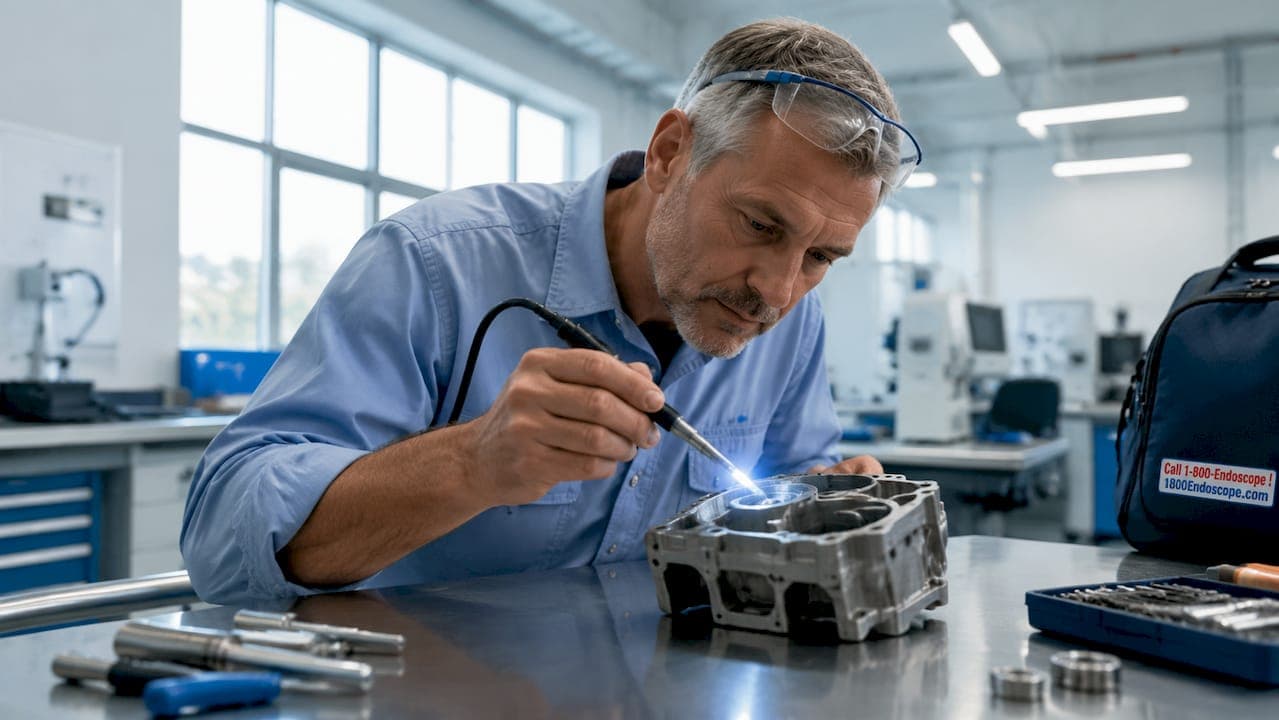
LED illumination is the core enabling feature in borescopes that delivers controlled, high-intensity light directly at the inspection site. Without it, confined spaces like engine cavities, animal airways, or corroded pipelines remain effectively invisible to the camera sensor. The role of LED illumination in borescopes goes beyond simply lighting a dark space. It determines contrast, color accuracy, and defect visibility in ways that directly affect inspection outcomes for both veterinary and industrial professionals. Getting the lighting right is what separates a usable image from a missed diagnosis.
How does LED illumination work in borescopes?
LED lighting in borescopes works by mounting small, high-output diodes at or near the distal tip of the probe, delivering light exactly where the camera looks. This placement eliminates the light loss that occurs in traditional fiber-optic systems, where illumination travels through a bundle of glass fibers and degrades over distance. LEDs provide stable, flicker-free, and instant-on light with no warm-up time, which matters when you are working in a time-sensitive inspection environment.
The performance gap between LEDs and older halogen or fluorescent sources is significant. Halogen bulbs generate excess heat, require warm-up time, and produce a yellow-shifted spectrum that distorts color rendering on tissue or metal surfaces. LEDs run cooler, last longer, and produce a consistent white light that renders surface detail accurately.
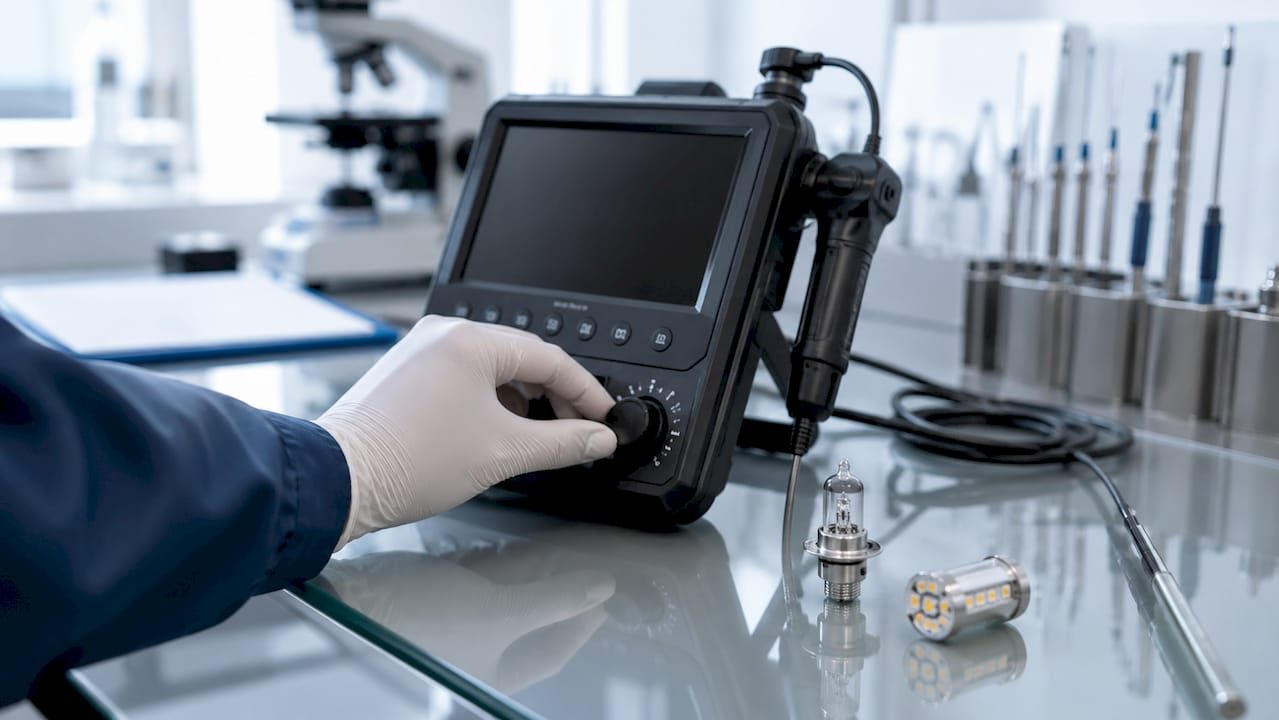
Advanced LED systems extend well beyond visible light. LED illumination systems support a spectral range from 340 nm to 1,900 nm with up to 10 independently controlled channels. That range covers ultraviolet through near-infrared, enabling multispectral imaging for material characterization and specialized defect detection.
Key advantages of LED lighting in borescopes over legacy illumination methods include:
- No warm-up time. LEDs reach full brightness instantly, unlike halogen sources that need several minutes to stabilize.
- Compact size. Miniaturized LED packages fit inside probes as small as 4 mm in diameter.
- Efficient power use. LEDs convert more electrical energy into light and less into heat than halogen or fluorescent alternatives.
- Long service life. LED diodes outlast halogen bulbs by a wide margin, reducing maintenance costs over time.
- Spectral flexibility. Modern designs support UV, visible, and near-infrared wavelengths within a single probe.
LED count also matters for matching the tool to the task. Short-range close-up inspections work well with 4–7 LEDs, mixed-use drain or duct work suits 6–10 LEDs, and long-run sewer or pipe inspections require 12 or more LEDs. Choosing the right count for the job prevents both underlit images and unnecessary glare.
Why does adjustable LED intensity matter for accurate inspection?
Poor contrast, not just insufficient light, is the biggest obstacle in borescope inspections. A fixed maximum brightness setting creates glare on reflective surfaces, washes out texture, and hides the very defect edges you need to see. Adjustable LED intensity solves this by letting you tune the light output to the specific material and environment.
Consider a cast iron pipe with standing water at the bottom. At full LED brightness, the water surface reflects light back into the camera, creating a blown-out white zone that obscures corrosion or cracks beneath. Reducing the LED output by 30–50% restores contrast and reveals the pipe wall clearly. The same principle applies in veterinary airway inspections, where wet mucosal tissue reflects light aggressively and a dimmed LED preserves the color gradients that indicate inflammation or lesions.
Brightness control via dimming is more important than raw LED count. Excessive brightness causes blinding glare and washes out images rather than improving detail. This is a counterintuitive finding that most technicians learn the hard way after their first inspection on a polished metal surface.
Pro Tip: Before any field inspection, run a quick brightness test on a sample of the target material at your intended working distance. Adjust the LED output until surface texture is visible without glare. This single step prevents most image quality failures.
Dimmable LEDs also protect sensor health. High-quality borescope LEDs use pulse-width modulation to regulate intensity and manage heat, protecting sensor longevity and providing stable illumination. PWM cycling reduces the thermal load on the sensor, which extends the working life of the probe in high-frequency inspection environments.
How do veterinary and industrial borescopes differ in LED design?
The lighting requirements for veterinary endoscopy and industrial borescope inspection pull in opposite directions. Understanding those differences helps you select the right tool and use it correctly.
| Design factor | Veterinary endoscopes | Industrial borescopes |
|---|---|---|
| Light intensity | Softer, lower output for tissue safety | Bright, direct floodlighting for defect detection |
| Spectral priority | Accurate color rendering for tissue assessment | High contrast for metal, pipe, and composite surfaces |
| Heat management | Critical. Heat can damage biological tissue | Important for sensor life, less critical for the target |
| Probe diameter | Often 4–8 mm for airway and GI access | Ranges from 4 mm to 12+ mm depending on application |
| Illumination delivery | Fiber-optic or tip-mounted LED with diffused output | Tip-mounted LED array with focused or flood output |
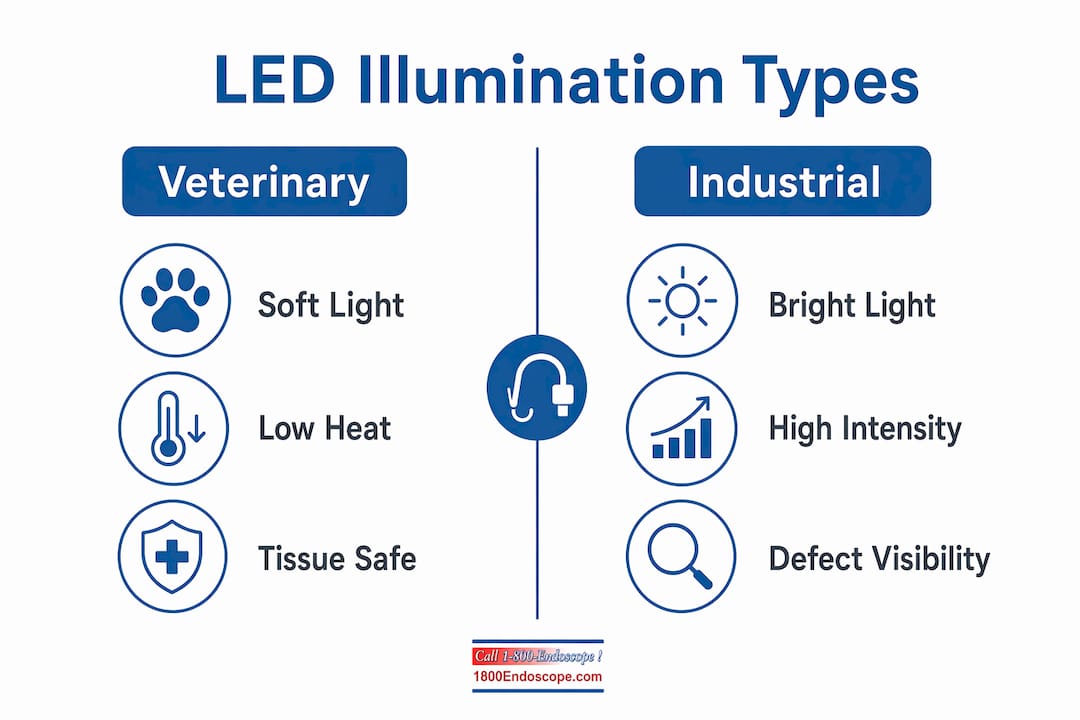
Industrial borescopes prioritize bright, direct LED floodlighting for defect visibility, whereas veterinary endoscopes use softer illumination for tissue safety. This is not just a preference. Excessive heat from an industrial-grade LED array placed against mucosal tissue can cause burns during a prolonged veterinary procedure.
Thermal dissipation, optical uniformity, and miniaturization present stiff engineering challenges in borescope LED design, influencing light placement and heat management. Designers must balance LED power output against the thermal capacity of a sealed probe that cannot vent heat passively. In veterinary scopes, this often means using lower-power LEDs with wider beam angles to spread light without concentrating heat at the tip. In industrial scopes, heat sinking materials and PWM regulation allow higher output LEDs to run safely inside metal probe housings.
Optical uniformity is the other key variable. Dark spots or hot spots in the illumination field create false shadows that mimic defects or hide real ones. Quality LED arrays use diffuser optics or carefully spaced diode placement to produce an even light field across the full field of view. For veterinary professionals selecting a scope, checking for uniform illumination across the image frame is as important as checking resolution specs. You can learn more about selecting light sources for veterinary endoscopy to match LED output to clinical needs.
What advanced LED technologies are improving borescopes in 2026?
LED illumination technology in borescopes has moved well beyond a simple white light at the tip. The most capable systems now treat illumination as a programmable variable rather than a fixed hardware parameter.
-
Multispectral LED arrays. Systems supporting a spectral range from 340 nm to 1,900 nm with up to 10 independently controlled channels allow wavelength-specific inspection. A technician can switch from visible white light to near-infrared to reveal subsurface features invisible to the naked eye, all within the same inspection pass.
-
RGB switchable illuminators. Adaptive illumination with runtime-switchable wavelengths like RGB or infrared optimizes contrast across diverse materials without hardware changes. An inspection line handling aluminum castings in the morning and carbon fiber composites in the afternoon can use the same probe with different wavelength settings for each material.
-
Pulse-width modulation brightness control. PWM regulation allows fine-grained intensity adjustment without changing the LED's color temperature. This keeps white balance consistent across the full brightness range, which matters when comparing images taken at different settings during a single inspection.
-
Integrated adaptive vision systems. Industry trends point toward borescopes that couple tunable LED illumination with onboard image processing. The system analyzes the live image and adjusts LED output automatically to maintain target contrast levels, reducing operator error in variable environments.
-
Miniaturized high-output packages. Advances in LED chip packaging now deliver significantly higher lumens per millimeter than designs from five years ago. This allows brighter illumination in probes under 6 mm in diameter, opening new applications in small-animal veterinary work and micro-bore industrial inspection. Understanding how light sources drive accuracy in NDT helps industrial technicians apply these advances to non-destructive testing workflows.
Key Takeaways
LED illumination is the single most important variable in borescope image quality, and brightness control matters more than LED count for accurate defect detection.
| Point | Details |
|---|---|
| LED count matches the task | Use 4–7 LEDs for close-up work, 6–10 for mixed use, and 12+ for long-run pipe inspections. |
| Adjustable brightness beats raw output | Dimmable LEDs prevent glare on reflective surfaces and preserve defect edges better than fixed high-output designs. |
| Veterinary vs. industrial design differs | Veterinary scopes use softer, lower-heat LEDs for tissue safety; industrial scopes use bright floodlighting for defect detection. |
| Multispectral LEDs expand capability | Systems with 340–1,900 nm range and up to 10 channels enable material characterization beyond visible light inspection. |
| PWM protects sensors and tissue | Pulse-width modulation controls heat and brightness simultaneously, extending probe life in both clinical and field use. |
What I've learned about LED lighting and inspection accuracy
After working with veterinary and industrial inspection tools across a wide range of environments, one pattern stands out clearly. Technicians consistently overestimate the value of more LEDs and underestimate the value of control. A 12-LED probe running at full power inside a 4-inch steel pipe produces a washed-out image that misses hairline cracks. The same probe dimmed to 40% output reveals them clearly.
The real skill in borescope inspection is learning to read the image and adjust the light to match the surface. Wet tissue in a horse's airway needs a completely different LED setting than a dry cast iron valve seat. Testing borescope lighting on specific materials and distances is critical for validating glare control and detail visibility in real inspections. I recommend every technician build a small reference kit: a few material samples representing their most common inspection targets, used to calibrate LED settings before any critical job.
Thermal management is the other underappreciated factor. In sealed probes, heat has nowhere to go. Running LEDs at maximum output for extended periods degrades the sensor faster than any other single factor. For veterinary professionals, the stakes are higher because heat at the probe tip affects tissue. Choosing a scope with PWM-regulated LEDs and a well-engineered heat path is not a luxury. It is a requirement for safe, repeatable use.
The best LED-illuminated borescopes are not the ones with the most LEDs or the highest lumen rating. They are the ones that give you precise control over the light and manage heat effectively. That combination produces usable images in the widest range of conditions.
— Endoscope
LED-illuminated borescopes from 1800endoscope
1800endoscope carries a full range of LED-illuminated inspection tools built for both veterinary clinics and industrial inspection teams.
The portable 6mm airway inspection endoscope features adjustable LED illumination, direct monitor output, and SD card video recording in a compact, field-ready package. For broader clinical needs, the veterinary rigid endoscopy catalog covers a range of scopes with integrated LED lighting designed for safe, accurate tissue visualization. Industrial professionals can browse the full borescope and NDT catalog for options ranging from compact 4 mm probes to long-run pipe inspection systems. Every product category includes detailed specs and operation videos to help you match the right LED configuration to your inspection environment.
FAQ
What is the role of LED illumination in borescopes?
LED illumination delivers controlled, high-intensity light directly at the inspection site inside confined spaces where external light cannot reach. It determines image contrast, color accuracy, and defect visibility, making it the most critical variable in borescope image quality.
How many LEDs does a borescope need?
The right LED count depends on the application. Short-range close-up inspections work well with 4–7 LEDs, mixed-use duct or drain work suits 6–10 LEDs, and long-run pipe inspections require 12 or more LEDs.
Why is adjustable LED brightness better than fixed high output?
Fixed maximum brightness creates glare on reflective and wet surfaces, hiding defect edges rather than revealing them. Adjustable LEDs let technicians tune light output to the material, preserving contrast and texture for accurate inspection.
How do LED lights differ in veterinary vs. industrial borescopes?
Veterinary endoscopes use softer, lower-heat LED output to protect biological tissue, while industrial borescopes use bright, direct floodlighting for defect detection on metals and pipes. Heat management requirements differ significantly between the two applications.
What is multispectral LED illumination in borescopes?
Multispectral LED systems support wavelengths from ultraviolet to near-infrared, with up to 10 independently controlled channels. This allows wavelength-specific inspection and material characterization beyond what standard white light can reveal.