
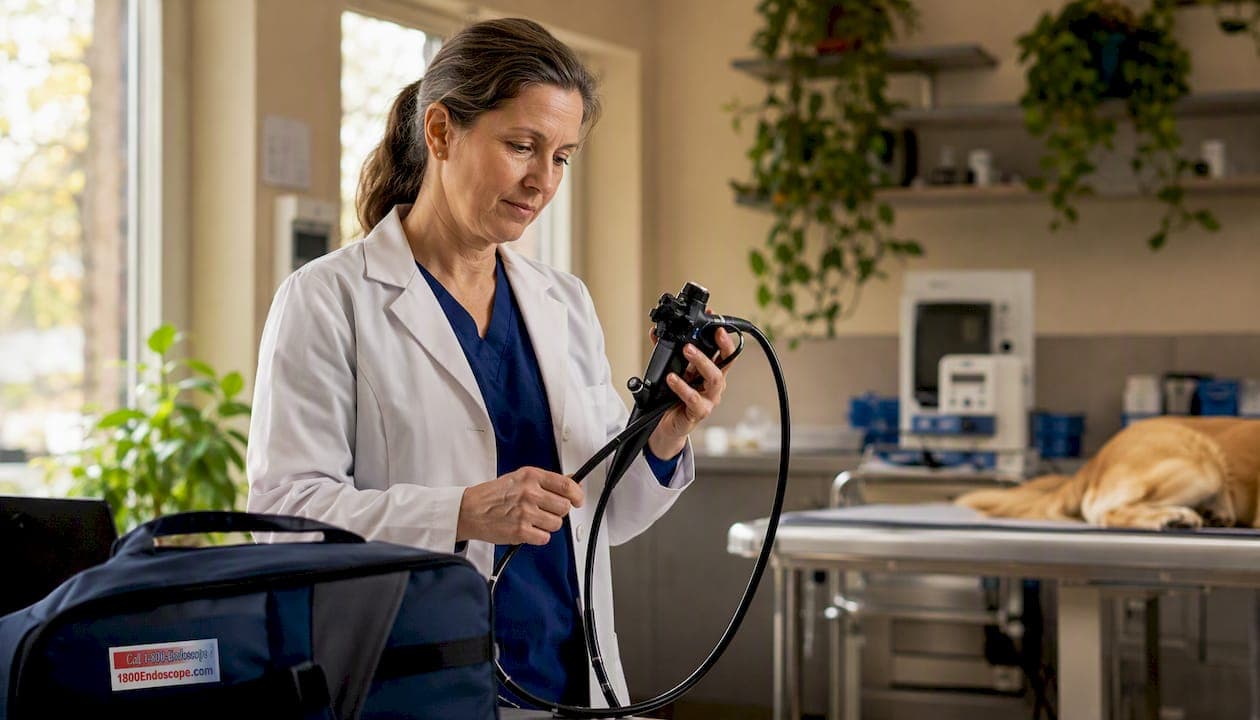
For most U.S. small-animal practices, the VET-FHD35 Veterinary Video Endoscope from 1800endoscope is the strongest starting point: HD imaging, a working channel suited to GI and airway diagnostics, and a form factor that fits general mixed-animal workflows without requiring a dedicated cart. Rounding out the shortlist:
- VET-FHD35 — best for small and mixed-animal clinics needing clear HD imaging across GI and airway cases
- VET-6028R — best for cats, small dogs, and bronchoscopy where a 6 mm slim profile is the deciding factor
- VET-2812R — best for feline patients, tight-lumen exams, and mobile or field clinics
- MVE 6010 — best for mid-volume practices that need both diagnostic and modest therapeutic capability in one system
- VET-OR1335 — best for arthroscopy, otoscopy, and rigid-cavity work where a telescope-style instrument is preferred
TL;DR: If your practice handles a general small-animal caseload, start with the VET-FHD35. If portability or field deployment is the priority, the VET-2812R is the pick. Working channel size and sterilization compatibility are the two criteria that most often drive the final decision.
The global pet diagnostics market is large and growing, reflecting how central diagnostic technology has become to modern veterinary practice. Endoscopy sits at the core of that shift: it is the minimally invasive standard that lets clinicians visualize, sample, and treat without opening the patient.
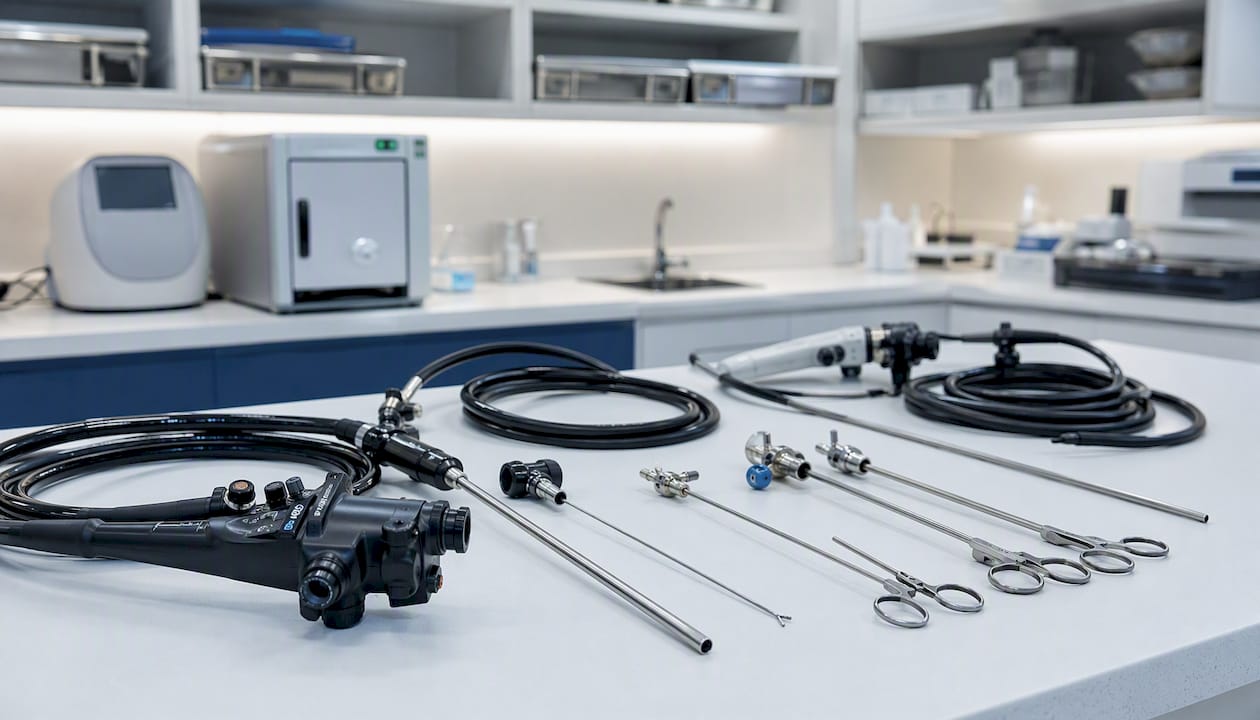
Table of Contents
- Which veterinary endoscopes compare best on specs?
- Model-by-model quick reviews: strengths, limits, and accessories
- How do you choose the right endoscope for your practice?
- Which scope type fits which procedure and species?
- What does a veterinary endoscope system actually cost?
- Cleaning, sterilization, and maintenance: what your team needs to know
- Why endoscopy is the minimally invasive diagnostic standard
- Key Takeaways
- What clinics actually experience when they adopt endoscopy
- Ready to order or request a demo from 1800endoscope?
- Useful sources and product references
Which veterinary endoscopes compare best on specs?
| Model | Best for | Outer diameter / length | Image quality | Working channel | Portability | Accessories | Sterilization |
|---|---|---|---|---|---|---|---|
| VET-FHD35 | Small/mixed-animal GI & airway | Standard flexible | HD video | Diagnostic channel | Portable | Forceps, light source, valves | High-level disinfection |
| VET-6028R | Cats, small dogs, bronchoscopy | 6 mm slim | Video | ~2.0 mm | Portable | Slim forceps, light source | High-level disinfection |
| VET-2812R | Feline, tight lumens, mobile clinics | Ultra-compact flexible | Video | Narrow | Highly portable / field | Compact forceps | High-level disinfection |
| MVE 6010 | Mid-volume diagnostic + therapeutic | Mid-range flexible | HD video | 2.8 mm+ | Clinical portable | Full accessory set | High-level disinfection |
| VET-OR1335 | Arthroscopy, otoscopy, rigid-cavity | Rigid telescope | Optical/video | N/A (rigid) | Compact rigid | Sheaths, light source | Autoclavable |
A note on the table: sterilization compatibility and working channel size are the two columns that most often change a purchase decision. The VET-OR1335 is the only model here that is autoclavable as a rigid instrument; the flexible scopes require high-level disinfection with a compatible chemical agent. Working channels below 2.0 mm limit instrument passage to small biopsy forceps; the MVE 6010's 2.8 mm+ channel opens the door to retrieval forceps and larger therapeutic tools.
Video imaging in animal diagnosis is a useful reference if your team is evaluating recording and image-sharing workflows alongside hardware selection.
Model-by-model quick reviews: strengths, limits, and accessories
VET-FHD35 Veterinary Video Endoscope
The VET-FHD35 is the general-purpose workhorse of this lineup. HD video output means images hold up on a clinic monitor without the grain that plagues older fiber systems, and the flexible insertion tube handles both upper GI and airway passes in a single session. The main practical limit: it is not the slimmest option, so very small cats or neonatal patients may need the VET-6028R instead.
Recommended accessories: standard biopsy forceps, a compatible LED light source (see the light source selection guide), irrigation valve, and an external video recorder or SD card capture unit.
Buying note: budget for a compatible monitor if your clinic does not already have a video-in display. The scope itself is the core cost; the monitor and recorder are the most common overlooked line items.
VET-6028R Veterinary 6mm Video Endoscope
At 6 mm outer diameter, this scope fits airways and bronchi where a standard flexible scope simply will not pass. It is the right call for bronchoscopy in cats and small-breed dogs, and for any nasal or tracheal inspection where a slimmer profile reduces trauma risk. The trade-off is working channel size: at approximately 2.0 mm, instrument passage is limited to smaller biopsy forceps, and therapeutic retrievals requiring larger tools are not realistic through this channel.
Recommended accessories: slim-profile biopsy forceps, cytology brush, compatible light source.
Buying note: pairs well with the VET-FHD35 as a second scope for clinics that want one general-purpose unit and one airway-specific unit.
VET-2812R Ultra-Compact Flexible Veterinary Endoscope
The VET-2812R is built for situations where size and weight matter more than channel capacity. Mobile clinics, farm calls, and shelter medicine settings benefit most. Its ultra-compact form factor makes it the easiest scope on this list to transport and set up in a non-clinic environment. Field-deployable scopes like this one should be specified for battery life and wireless streaming if remote consultation is part of the workflow.
Recommended accessories: compact biopsy forceps, portable LED light source, protective carry case.
Buying note: confirm wireless connectivity specs before ordering if real-time image sharing with a remote specialist is a clinical requirement.
MVE 6010
The MVE 6010 occupies the mid-range tier where diagnostic imaging and modest therapeutic work coexist. Its 2.8 mm+ working channel accepts retrieval forceps and cytology tools that the slimmer scopes cannot accommodate, making it the right choice for practices that regularly perform foreign-body retrievals or need to pass larger biopsy instruments. Imaging quality is HD, so it does not sacrifice diagnostic clarity for the added channel capacity.
Recommended accessories: retrieval forceps, standard and jumbo biopsy forceps, irrigation pump, light source.
Buying note: this is the model to consider if your caseload includes medium-to-large breed dogs with GI foreign bodies or chronic GI disease requiring repeated sampling.
VET-OR1335
Rigid scopes operate on a different logic than flexible ones. The VET-OR1335 is a telescope-style instrument: it does not articulate, but it delivers optical clarity and durability that flexible scopes cannot match for joint and cavity work. Arthroscopy, otoscopy, and cystoscopy are its natural territory. Because it is autoclavable, reprocessing is faster and simpler than chemical high-level disinfection.
Recommended accessories: rigid sheaths in appropriate diameters, light source with rigid-scope adapter, camera coupler if video documentation is needed.
Buying note: rigid scopes require a compatible camera head and light cable. Factor those into the total system cost. For clinics adding arthroscopy capability, the veterinary rigid endoscopy catalog lists compatible components.
Pro Tip: If your clinic is buying its first endoscope, start with the VET-FHD35 for general diagnostics and add the VET-6028R or VET-OR1335 as a second unit once your team has established a reprocessing workflow and case volume justifies the investment.
How do you choose the right endoscope for your practice?
The decision comes down to five variables: case mix, species, procedure types, working channel requirements, and reprocessing capacity. Work through them in order.
Checklist for scope selection
- Define your case mix. What percentage of your endoscopy cases are GI vs. airway vs. joint vs. ear? A practice doing 80% upper GI in medium-to-large dogs needs a different scope than one doing 60% feline bronchoscopy.
- Identify your species range. Outer diameter is the hard constraint for small patients. Cats and small dogs generally require scopes at or below 6 mm for airway work; small-diameter scopes under 9 mm cover most canine and feline GI procedures.
- Determine therapeutic vs. diagnostic-only needs. If you retrieve foreign bodies, place feeding tubes, or perform polypectomies, you need a working channel of 2.8 mm or larger. Diagnostic-only practices can work with 2.0 mm channels.
- Assess portability requirements. Does the scope stay in one procedure room, or does it travel between exam rooms, buildings, or field sites? Portable and wireless units trade some channel capacity for mobility.
- Confirm reprocessing capacity. How many procedure rooms do you have? How long can a scope be out of rotation for cleaning? Autoclavable rigid scopes turn around faster; flexible scopes require a dedicated reprocessing station and chemical agents.
Questions to ask any vendor
- What is the service SLA for repairs, and is a loaner scope available during service?
- Are spare parts (insertion tubes, bending sections, light guides) stocked domestically?
- What training is included, and is onsite or virtual training available?
- What is the upgrade path if we need a larger working channel or a different diameter later?
Red flags to watch for
- Channel size listed without instrument compatibility specs
- No sterilization guidance in the product documentation
- Warranty terms that exclude "user damage" without defining it
- No domestic service contact or repair depot listed
Quick decision flow
Portable units in field care covers the deployment logistics for mobile practices in more detail.
Which scope type fits which procedure and species?
Veterinary endoscopes fall into four categories, and each maps to a distinct set of clinical situations.
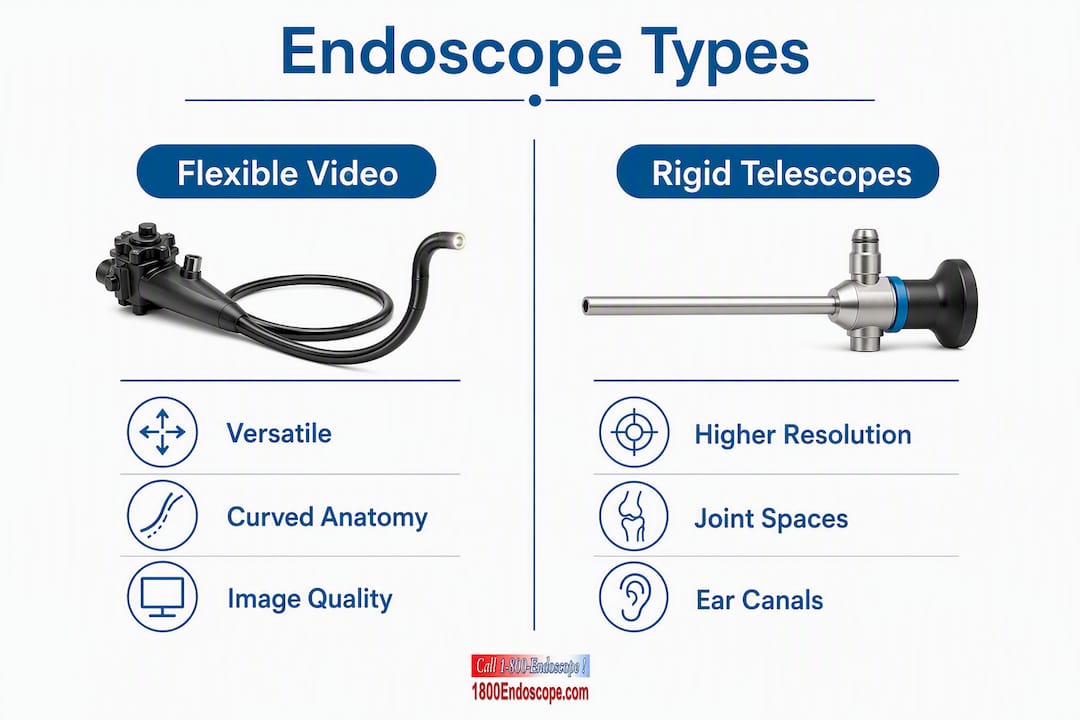
Flexible video endoscopes are the most versatile. They articulate at the tip, pass through curved anatomy, and transmit live video to a monitor. GI endoscopy (gastroscopy, colonoscopy), bronchoscopy, rhinoscopy, and cystoscopy all fall within their range. The VET-FHD35, VET-6028R, and VET-2812R are all flexible video scopes.
Rigid telescopes do not bend, but they deliver superior optical resolution for joint spaces, ear canals, and body cavities where a straight line of sight is achievable. The VET-OR1335 is the rigid option in this lineup. Arthroscopy, otoscopy, and laparoscopy are its primary applications.
Fiber optic scopes transmit light and image through glass fibers rather than a digital sensor. Image quality is lower than video scopes, but cost is also lower, and they are useful for basic visualization where HD is not required.
Video laryngoscopes are a specialized subset of flexible video scopes optimized for airway visualization. The veterinary professional's guide to video laryngoscopy covers the clinical workflow in detail.
Species and diameter guidance
| Species / size | Recommended outer diameter | Typical working length | Common procedures |
|---|---|---|---|
| Cat / small dog (<5 kg) | 5–6 mm | 60 cm | Bronchoscopy, rhinoscopy, upper GI |
| Medium dog (5–15 kg) | 6–9 mm | 100 cm | Upper GI, colonoscopy, airway |
| Large dog (>15 kg) | 9–11 mm | — | GI, foreign-body retrieval |
| Equine (airway/dental) | 9–14 mm | — | Airway, guttural pouch, dental |
| Joint / cavity (any species) | Rigid 2.7–4 mm | 10–30 cm | Arthroscopy, otoscopy, laparoscopy |
Portable 5.8 mm outer-diameter scopes with approximately 2.0 mm working channels cover most small-animal GI and airway procedures, but larger therapeutic needs require 2.8 mm+ channels. A single scope cannot cover every clinical scenario: diameter and working channel size are the practical limits, and a clinic doing both feline bronchoscopy and large-dog foreign-body retrievals will eventually need two instruments.
Procedure-to-scope mapping:
- Upper GI (gastroscopy, duodenoscopy): flexible video, 6–11 mm depending on patient size
- Lower GI (colonoscopy): flexible video, longer insertion tube, 9–11 mm for large dogs
- Bronchoscopy / rhinoscopy: flexible video, 5–6 mm slim profile
- Otoscopy: rigid telescope, 2.7–4 mm
- Arthroscopy: rigid telescope, 2.7–4 mm with irrigation sheath
- Foreign-body retrieval: flexible video with 2.8 mm+ working channel and retrieval forceps
- Equine dental / airway: specialized long flexible video or rigid scope, 9–14 mm
What does a veterinary endoscope system actually cost?
Upfront hardware is only part of the budget. The total cost of ownership includes accessories, reprocessing supplies, service contracts, and staff training.
Typical price bands:
- Entry-level portable units (USB/WiFi, basic video): generally the most accessible tier for clinics adding endoscopy for the first time
- Mid-range clinical systems (HD video, 2.0–2.8 mm working channel, portable): the segment where most of the 1800endoscope lineup sits
- Cart/tower platforms (large working channel, full accessory ecosystem, high-volume throughput): the highest upfront cost, justified by volume and therapeutic case mix
Accessory costs add up quickly. Biopsy forceps, retrieval forceps, irrigation valves, light sources, and video recorders are separate line items. A complete first-time setup typically requires at minimum: the scope, a light source, one set of forceps, an irrigation valve, and a monitor or recording device.
On the patient-billing side, endoscopy procedures on dogs typically run between $800 and $2,000 depending on procedure complexity and facility. This is the typical range for endoscopic procedures in dogs, as cited in clinical resources.
Total cost of ownership considerations:
- Reprocessing supplies (enzymatic cleaners, high-level disinfectants, leak-test equipment): ongoing monthly cost
- Repair and spare parts: insertion tube damage is the most common failure mode in flexible scopes; budget for at least one repair per year in active-use units
- Service contracts: some vendors offer annual service agreements that cover preventive maintenance and priority repair turnaround
- Training: onsite or virtual training sessions, typically a one-time cost at purchase
Pro Tip: When comparing quotes, ask vendors to itemize the scope, light source, forceps, and monitor separately. Bundled pricing can obscure whether you are getting a complete system or just the insertion tube.
Financing and leasing options exist through veterinary equipment distributors and third-party medical equipment lenders. For clinics adding endoscopy for the first time, a lease structure spreads the upfront cost across 24–36 months and preserves capital for other equipment.
Cleaning, sterilization, and maintenance: what your team needs to know
Reprocessing is where endoscope longevity is won or lost. A scope that is cleaned inconsistently will fail sooner and carry infection risk between patients.
Step-by-step reprocessing checklist
- Point-of-care flush: immediately after withdrawal, flush the working channel with water and air to remove gross debris before biofilm sets.
- Leak test: submerge the scope and pressurize the insertion tube to confirm no breach in the outer sheath. A failed leak test means the scope goes to repair, not reprocessing.
- Manual cleaning: use an enzymatic detergent and a channel brush sized to the working channel diameter. Scrub all external surfaces, ports, and the distal tip.
- High-level disinfection (HLD): immerse in a compatible HLD agent (glutaraldehyde, OPA, or peracetic acid) for the contact time specified by the manufacturer. Rigid autoclavable scopes skip this step and go directly to steam sterilization.
- Rinse and dry: rinse all channels with sterile water, then purge with filtered air. Moisture left in channels promotes bacterial growth.
- Storage: hang flexible scopes vertically in a ventilated cabinet; do not coil tightly or store in a case immediately after reprocessing.
Turnaround time for a flexible scope through full HLD is typically 45–90 minutes depending on the agent and soak time. Autoclavable rigid scopes like the VET-OR1335 cycle through a standard steam sterilizer in 30–45 minutes. If your schedule runs back-to-back procedures, either stagger cases or budget for a second scope.
Maintenance schedule
- Daily: visual inspection of insertion tube for kinks or abrasions; check angulation controls for smooth movement; verify light guide connection.
- Weekly: inspect all valves and caps for wear; clean the light guide connector; check the working channel for debris with a channel scope.
- Monthly: full leak test even if no damage is suspected; inspect bending section for fatigue; review reprocessing log for any anomalies.
Common failure modes in flexible scopes: bending-section damage from over-angulation, insertion tube perforation from biting patients, and light guide degradation from repeated sterilization cycles. Keeping one spare biopsy valve and one spare irrigation cap in stock prevents a minor consumable failure from canceling a procedure day.
Pro Tip: Assign reprocessing to a dedicated trained staff member rather than rotating the task. Inconsistent technique is the leading cause of scope damage and reprocessing failures in general practice.
Why endoscopy is the minimally invasive diagnostic standard
The clinical case for endoscopy in veterinary practice is well established. Endoscopy enables diagnostic visualization and tissue sampling while reducing anesthesia and recovery time compared with exploratory surgery. For a patient with chronic vomiting, weight loss, or a suspected airway foreign body, the alternative is an open surgical approach that carries significantly higher anesthetic risk and a longer recovery.
The therapeutic dimension is what separates endoscopy from other imaging modalities. Radiographs and ultrasound show you what is there; an endoscope lets you act on it in the same session. VCA Lakeside Animal Hospital and similar referral centers describe endoscopy as reducing the need for open surgery and improving diagnostic access to the GI tract, ear, and airway, with staff training and monitoring as operational prerequisites.
Clinical benefits that drive adoption:
- Targeted mucosal biopsies from specific GI segments, not random surgical samples
- Foreign-body retrieval without abdominal incision in many cases
- Airway visualization and bronchial lavage for respiratory disease workup
- Otoscopic examination and ear canal flushing under direct visualization
- Arthroscopic joint inspection with minimal soft-tissue disruption
AI-assisted image analysis is an emerging complement to endoscopic visualization. A Frontiers review of deep learning in veterinary diagnostics shows that AI integration with imaging platforms is a growing trend, particularly for image-based tasks like cytology and radiograph interpretation. Endoscopic video feeds are a natural next application as the technology matures.
Endoscopy is indicated after noninvasive tests are inconclusive. If bloodwork, radiographs, and ultrasound have not identified the cause of chronic GI signs, endoscopy is the logical next step. Device choice affects diagnostic yield: a scope with a working channel too small to pass a standard biopsy forceps will limit the tissue samples you can obtain, which directly affects whether the procedure answers the clinical question.
Complementary diagnostics like skin cytology and ultrasound remain part of the workup alongside endoscopy, particularly when the differential list includes dermatologic or reproductive conditions that scopes cannot address.
Key Takeaways
The VET-FHD35 from 1800endoscope is the strongest general-purpose starting point for U.S. small-animal practices, with the MVE 6010 the upgrade path when therapeutic channel capacity becomes a clinical requirement.
| Point | Details |
|---|---|
| Match scope to case mix | Working channel size (2.0 mm vs. 2.8 mm+) determines whether you can perform therapeutic retrievals, not just diagnostics. |
| Slim diameter for small patients | Cats and small dogs require 5–6 mm outer diameter for airway work; the VET-6028R is the right tool for that subset. |
| Sterilization drives scheduling | Autoclavable rigid scopes (VET-OR1335) turn around in 30–45 minutes; flexible scopes need 45–90 minutes for high-level disinfection. |
| Total cost exceeds hardware | Budget for light source, forceps, monitor, reprocessing supplies, and at least one annual repair on active-use flexible scopes. |
| 1800endoscope lineup | The VET-FHD35 leads for general diagnostics; the VET-2812R is the pick for mobile and field deployment. |
What clinics actually experience when they adopt endoscopy
Most practices underestimate how quickly endoscopy becomes a core workflow rather than a specialty add-on. The first few cases are the learning curve: getting the reprocessing station set up, training staff on the leak-test protocol, and building the procedure schedule around turnaround time. After that, the scope tends to be in use more days than not.
The 1800endoscope product line is designed with that adoption curve in mind. The scopes ship with documentation, and the team can support demo requests and clinical questions for practices that want to see image samples or talk through a specific case type before committing to a model. What clinics typically ask about first: working channel compatibility with their existing forceps, and whether the scope will work with their current monitor setup. Both are answerable before purchase.
Ready to order or request a demo from 1800endoscope?
1800endoscope offers the full lineup reviewed here, available for direct order through the online catalog. If your team wants to see image samples or confirm compatibility with existing clinic equipment before purchasing, demo requests are handled virtually or through image sample review.
The portable airway inspection system is a strong entry point for clinics adding airway capability without a full cart investment. For rigid endoscopy needs, the veterinary rigid endoscopy catalog lists compatible telescopes, sheaths, and camera couplers. Warranty and service terms are available on each product page. To browse the full range or place an order, visit 1800endoscope.com.
Useful sources and product references
Clinical guidance and peer-reviewed references:
- Endoscopic Equipment for the Veterinary Practitioner — Today's Veterinary Practice: the primary clinical reference for endoscope selection, indications, and procedural scope.
- Veterinary Endoscope Selection by Scenario: A Practical Guide — HTNXT: diameter and working-channel guidance by species and procedure type.
- Review of Deep Learning Applications in Veterinary Diagnostics — Frontiers in Veterinary Science: AI and imaging trends relevant to future scope platform integration.
1800endoscope product and catalog pages:
| Resource | Link |
|---|---|
| Portable airway inspection system | PVSM6150 |
| Veterinary rigid endoscopy catalog | vet_rigid_endoscopy |
| Full borescope and endoscope catalog | borescopes.htm |
| Endoscope FAQ and reprocessing guidance | faq.htm |
| Equine dental videoscope | PVSUDC |