

Cost-effective endoscope selection is defined as choosing equipment that balances purchase price with total cost of ownership (TCO), including maintenance, reprocessing, repair frequency, and operational downtime. For veterinary clinic managers and industrial inspection technicians, getting this balance right determines whether a scope pays for itself or quietly drains your budget. The difference between a smart purchase and an expensive mistake often comes down to one thing: whether you evaluated TCO or just compared price tags. This guide gives you the frameworks, thresholds, and specifications to make a defensible buying decision in 2026.
What are the key cost factors in choosing an endoscope?
TCO should guide endoscope selection more than initial purchase price. A scope priced at $8,000 that requires $3,000 in annual repairs and 40 hours of reprocessing labor is more expensive over three years than a $12,000 unit with a service contract and automated cleaning compatibility. The purchase price is just the entry fee.
Here are the cost components you need to quantify before any purchase decision:
- Purchase price: The baseline, but rarely the largest cost over a three-year horizon.
- Reprocessing labor and materials: Manual reprocessing can cost $18.50 per cycle in labor alone. Automated reprocessing cuts that to $7.20 per cycle and reduces cycle time from roughly 60 minutes to 17 minutes. That 61% labor reduction compounds fast at high procedure volumes.
- Repair frequency and cost: Flexible scopes carry higher wear and tear on insertion tubes and optical assemblies than rigid scopes. Budget for this explicitly, not as a surprise line item.
- Downtime costs: Every day a scope is in the repair shop is a day you cannot perform procedures. For a busy veterinary clinic or an industrial inspection firm on contract deadlines, that lost revenue is a real cost.
- Accessory compatibility: Scopes that require proprietary biopsy forceps, valves, or light sources lock you into one vendor's pricing. Confirm accessory compatibility before signing any purchase order.
- Repair vs. replacement threshold: Repair an endoscope only if the cost stays below 30 to 40% of a new unit's value. Above that threshold, replacement is typically more economical when you factor in downtime and safety.
Pro Tip: Build a simple spreadsheet before you buy. List purchase price, estimated annual reprocessing cost, average repair cost per year, and projected downtime days. Multiply by three years. The number that comes out is your real cost.
How to decide between reusable and single-use endoscopes
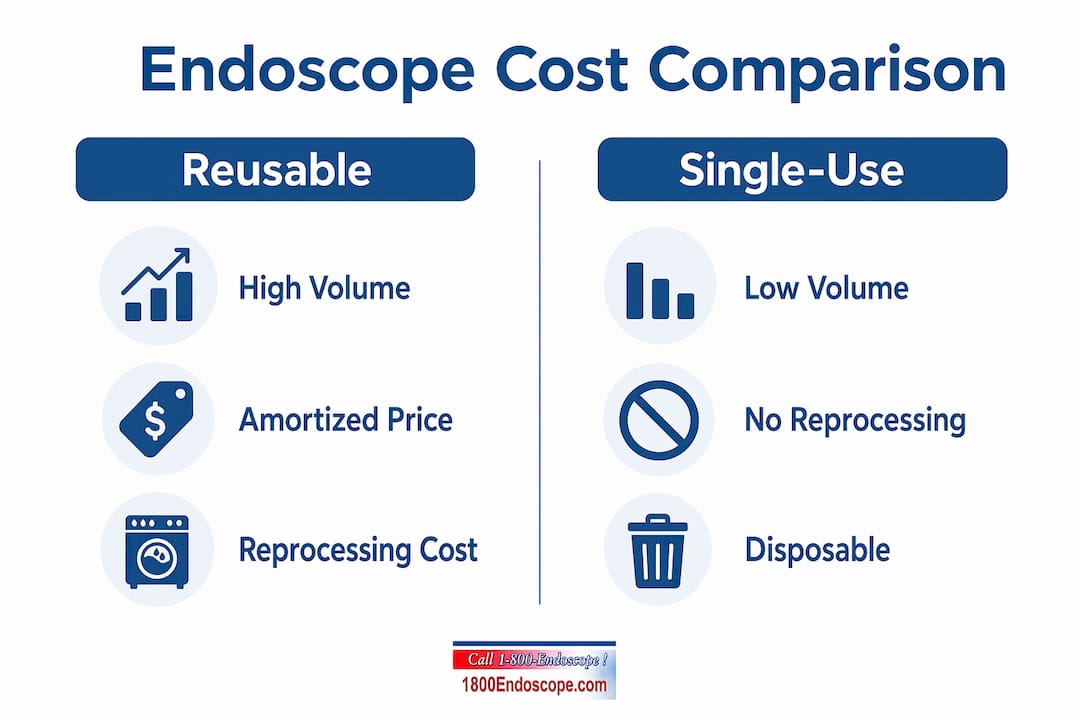
The choice between reusable and single-use models is not primarily a clinical one. Studies confirm that reusable and single-use bronchoscopes deliver clinically equivalent diagnostic performance, which means the decision should be driven by volume, infection control capacity, and operational workflow.
The volume threshold is the most important number here. Reusable flexible bronchoscopes become cost-effective only when a facility performs at least 913 procedures annually versus single-use models. Below that threshold, the per-procedure cost of reusable scopes (approximately €196 to €231) exceeds the median single-use cost of €245 only when reprocessing, maintenance, and fleet management are fully accounted for. That means a small veterinary clinic doing 200 scoping procedures per year may actually spend less with single-use models.
| Factor | Reusable scopes | Single-use scopes |
|---|---|---|
| Best for | High-volume facilities (900+ procedures/year) | Low-volume or variable caseloads |
| Upfront cost | Higher | Lower per unit |
| Per-procedure cost | Lower at scale | Higher at scale |
| Infection control complexity | Requires reliable reprocessing | Eliminated |
| Downtime risk | Moderate to high | None |
| Accessory investment | Ongoing | Minimal |
Fleet turnaround time is a hidden variable that most buyers ignore. Slow reprocessing turnaround forces facilities to purchase backup scopes or rent units, which raises TCO significantly. If your reprocessing workflow cannot turn a scope around within the same business day, your effective fleet size is smaller than you think, and your per-procedure cost rises accordingly.
A hybrid approach combining reusable and disposable scopes works well for facilities with variable caseloads. An equine veterinary practice, for example, might use reusable flexible scopes for routine upper airway exams on horses while keeping single-use scopes available for emergency procedures or high-infection-risk cases.
Pro Tip: If your annual procedure volume is close to the 913 threshold, model both scenarios in your TCO worksheet. A 10% drop in caseload can flip the math entirely.
What specifications and features should you prioritize?
Specifications drive both diagnostic performance and long-term cost. Cutting corners on the wrong components creates indirect costs that dwarf the initial savings.
Image quality and component integration directly affect diagnostic yield. A scope with a substandard camera or incompatible light source forces repeat procedures, which adds labor cost, patient stress in veterinary settings, and project delays in industrial inspections. Integrated systems where the camera, light source, and monitor are designed to work together consistently outperform mismatched assemblies. For industrial NDT borescope applications, this is especially true in confined-space inspections where lighting consistency determines whether a defect is visible at all.
Here is what to prioritize when evaluating specifications:
- Working channel diameter: For veterinary use, a 2.0 to 2.8mm working channel accommodates biopsy forceps and cytology brushes. For industrial borescopes, channel diameter is less relevant, but outer diameter determines access to tight spaces.
- Insertion tube length and flexibility: Match the length to your most common procedure. Oversized scopes in small-animal veterinary practice increase patient risk and handling difficulty. For industrial inspections, longer insertion tubes add weight and reduce maneuverability.
- Light source compatibility: The right light source determines image clarity at depth. LED systems cost more upfront but last significantly longer than halogen alternatives and consume less power.
- Durability of the insertion tube: Veterinary flexible endoscopy budgets must account separately for insertion tube wear, bending mechanisms, and optics since these components drive repair frequency. Specify minimum bend radius and insertion tube material before purchasing.
- Video recording capability: HD video recording reduces the need for repeat procedures by creating a permanent diagnostic record. For industrial inspections, video documentation supports compliance reporting and client deliverables.
- Accessory compatibility: Confirm that biopsy forceps, valves, and cleaning tools from multiple vendors are compatible. Proprietary accessory lock-in is one of the most common hidden costs in endoscopy procurement.
Small veterinary clinics are advised to avoid top-tier systems with features they will rarely use. A small diameter videoscope designed for airway or gastrointestinal work in small animals often delivers better value than a full-featured system built for a large referral hospital.
How to build a TCO worksheet for endoscope procurement
A TCO worksheet converts guesswork into a defensible procurement decision. Effective worksheets separate unit price, reprocessing labor and materials, failure and repair frequency, downtime costs, and logistics fees into distinct line items. Running scenario ranges rather than relying on a single price quote is what separates a sound buying decision from an expensive assumption.
Follow these steps to build yours:
- List all candidate units with their purchase prices and warranty terms. Note whether the warranty covers parts, labor, or both.
- Estimate annual reprocessing cost. Multiply the number of procedures per year by your cost per reprocessing cycle. Include chemical costs, labor time, and any equipment depreciation for automated reprocessors.
- Estimate annual repair cost. Use vendor data or industry averages. For flexible scopes, budget for insertion tube repairs and optical assembly servicing. For rigid scopes, budget is typically lower but not zero.
- Calculate downtime cost. Estimate how many days per year the scope will be unavailable for repairs. Multiply by your average daily revenue from endoscopy procedures or the daily cost of renting a backup unit.
- Add logistics and accessory costs. Include shipping for repairs, consumable accessories, and any software or service subscription fees.
- Build three scenarios: a baseline (average utilization), a high-volume scenario (20% above baseline), and a low-volume scenario (20% below baseline). This range reveals whether your choice holds up under realistic variation.
| TCO component | Estimated annual cost (example) |
|---|---|
| Purchase price (amortized over 5 years) | $2,400 |
| Reprocessing labor and materials | $3,800 |
| Repair and parts | $1,200 |
| Downtime opportunity cost | $900 |
| Accessories and consumables | $600 |
| Total estimated annual TCO | $8,900 |
Pro Tip: When comparing two units with similar purchase prices, the reprocessing and repair rows almost always determine which one is cheaper over five years. Weight those rows heavily in your analysis.
Key takeaways
Cost-effective endoscope selection requires evaluating total cost of ownership across reprocessing, repair, downtime, and accessory costs rather than comparing purchase prices alone.
| Point | Details |
|---|---|
| TCO beats purchase price | Reprocessing labor, repair frequency, and downtime costs routinely exceed the initial unit price over three to five years. |
| Volume determines reusable viability | Reusable scopes become cost-effective only above approximately 913 procedures per year; below that, single-use models often win on total cost. |
| Repair threshold is 30 to 40% | If repair cost exceeds 30 to 40% of a new unit's value, replacement is typically the more economical choice. |
| Hybrid strategies reduce risk | Combining reusable and single-use scopes manages variable caseloads without overcommitting to either model's cost structure. |
| Specifications drive indirect costs | Poor camera integration or incompatible accessories force repeat procedures and vendor lock-in, both of which raise long-term costs. |
What I've learned about buying endoscopes on a real budget
Most purchasing mistakes I've seen come from one place: the buyer evaluated the scope, not the system. They compared camera resolution and insertion tube diameter, then signed a purchase order without asking a single question about reprocessing workflow, parts availability, or repair turnaround time. Six months later, the scope is sitting in a repair depot for three weeks, and the clinic is renting a backup unit at $400 per day.
The 913-procedure threshold for reusable scope viability is one of the most useful numbers in this space, and almost nobody uses it. Veterinary clinic managers in particular tend to default to reusable scopes because they feel like the responsible long-term investment. Sometimes they are. But a mixed-species practice doing 300 scoping procedures per year is almost certainly better served by a single-use model for high-risk cases and a mid-range reusable scope for routine work.
I also think the industry underestimates how much supplier support matters. A scope from a vendor with a 48-hour repair turnaround and a loaner program is worth more than a marginally better scope from a vendor whose service team takes three weeks. That difference does not show up in a spec sheet, but it shows up in your annual revenue. Ask vendors directly: what is your average repair turnaround time, and do you offer loaners? The answer tells you more about long-term cost than any feature comparison.
The videoscope troubleshooting resources available to vet professionals today are genuinely useful for extending scope life before a repair call is even necessary. Train your staff to use them. Every avoided repair call is money back in your budget.
— Endoscope
Find cost-effective endoscope solutions at 1800endoscope
1800endoscope carries veterinary, industrial, and portable endoscope systems built for buyers who need reliable performance without overpaying for features they will never use. The portable 6mm airway inspection system is a strong example: HD video recording, direct monitor display, and SD card storage in a fully portable package at a price point that makes sense for small clinics and field inspection teams. For industrial NDT applications, the borescope and endoscope catalog covers flexible and rigid options across a range of diameters and working lengths. Every product listing includes compatibility details and accessory information so you can build your TCO estimate before you buy. Browse the full selection or contact the team directly for a recommendation matched to your procedure volume and budget.
FAQ
What is cost-effective endoscopy?
Cost-effective endoscopy means selecting and operating endoscopic equipment so that the total cost per procedure, including purchase, reprocessing, repair, and downtime, is minimized without compromising diagnostic or inspection performance.
How do I choose between reusable and single-use endoscopes?
Base the decision on annual procedure volume. Reusable scopes become cost-effective above approximately 913 procedures per year; below that threshold, single-use models typically deliver a lower total cost per procedure.
What is the repair vs. replacement threshold for endoscopes?
Repair an endoscope only if the repair cost stays below 30 to 40% of the price of a new unit. Above that threshold, replacement is usually more economical when downtime and recurrent repair risk are factored in.
How do I choose a veterinary endoscope on a limited budget?
Match the scope's specifications to your most common procedure type and patient size, confirm accessory compatibility with multiple vendors, and avoid top-tier systems with features your caseload does not justify. A mid-range flexible or rigid scope with reliable service support typically delivers better value than a premium unit with high idle time.
Why does reprocessing cost matter so much in endoscope selection?
Reprocessing labor and materials often exceed the amortized purchase price over a three-to-five-year period. Automated reprocessing can cut labor cost per cycle by 61%, which makes workflow capacity a financial decision, not just an operational one.