
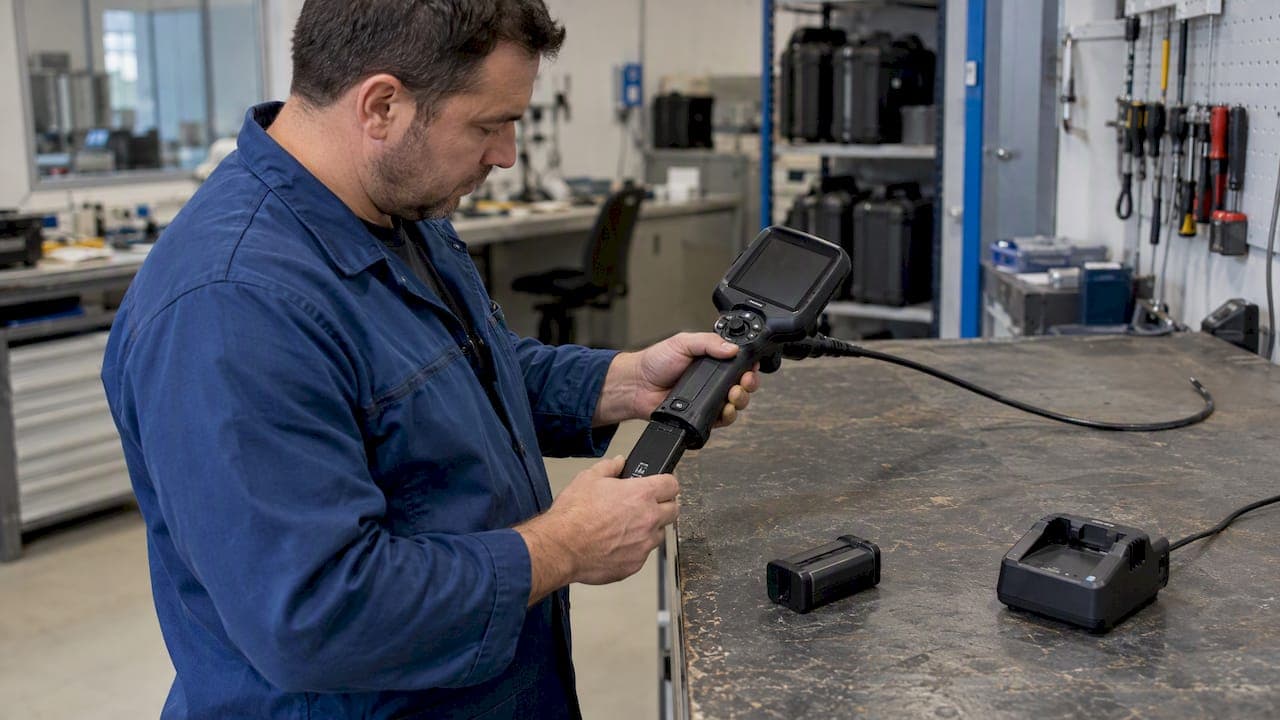
Choose a videoscope with warm or hot-swap battery capability and a multi-battery fast-charge workflow to keep inspections running without interruption. A hot swappable battery videoscope lets you change power mid-job, so recordings continue and schedules hold. Before the shift, stage charged spare batteries and a fast charger within reach of the inspection point.
TL;DR:
- A removable battery does not guarantee warm swap; confirm explicit support and operating conditions in the manual, then test the change before a live inspection.
- The Mentor Visual iQ lists 10.8 volts nominal and about 74.5 watt hours; at an illustrative 15 watt draw, that capacity suggests roughly five hours.
- Set recording to auto save, practice with footage running, and use AC, inline DC, or a UPS when a critical capture cannot risk interruption.
- Size spare inventory from watt hours and average draw, then add runtime margin for cold, bright lighting, and aging batteries; keep a separate fast charger.
- A larger battery can extend runtime but adds hand fatigue, so compare weight and durability alongside voltage, watt hours, spare availability, and charging costs.
Table of Contents
- What does hot-swappable mean for a videoscope?
- How do you swap a battery without stopping the inspection?
- How many batteries and chargers does a team need?
- What should you require when specifying a hot-swappable videoscope?
- Why do teams adopt hot-swap workflows?
- Where can you find hot-swap capable systems and spares?
- FAQ
- Sources
What does hot-swappable mean for a videoscope?
Hot swap, or "warm swap," means you can replace the battery while the device stays operational. The unit holds its state during the change, so you do not reboot, reload a session or lose your place in a long inspection. Terminology varies by maker, which is why you should read the spec sheet for the exact phrase rather than assume.
The practical payoff is predictable work. Industry guidance for remote visual inspection recommends systems with hot-swappable power to avoid the operational costs and logistical delays tied to emergency turnarounds. For a gas turbine crew or a veterinary team with an anesthetized patient, an unplanned stop is expensive in very different ways.
- No emergency turnarounds: a depleted pack becomes a quick task, not a trip back to the truck.
- Continuous recording: the session keeps capturing while power changes over.
- Predictable schedules: you plan around spare inventory instead of guessing at runtime.
A useful reference point for reading datasheets comes from a high-end unit:
The Waygate Technologies Mentor Visual iQ brochure lists warm swap capability and a 10.8V nominal battery of about 74.5 Wh (6.9 Ah). Use it as a benchmark when comparing voltage and capacity claims on other systems.
Hot-swap capability also touches build quality. RVI experts advise balancing power reliability against system weight and durability, and they point to MIL-STD environmental testing as a relevant durability signal. Heavier units tire technicians during long manual inspections, so a bigger battery is not automatically better.
How do you swap a battery without stopping the inspection?
Treat the swap as a short, rehearsed procedure. The sequence below assumes your unit explicitly supports warm or hot swap; if it does not, use the fallback power options after the list.
- Confirm in the manual that the model supports warm or hot swap, and test it once on the bench before any live job.
- Stage fully charged spares at the inspection point, labeled by rotation order.
- Set recording to auto-save and check that the buffer is healthy before the scope goes into the asset.
- When the low-battery indicator appears, bring the spare to hand and place the unit in a stable position, with the insertion tube secured.
- Release the depleted battery and seat the spare while watching the screen for any power or buffer warning.
- Confirm the display, the recording indicator and the power state before you resume probing.
- Mark the depleted pack, move it to the charger and log the swap time.
If the buffering risk is unacceptable for a critical capture, run the scope from AC or an inline DC supply, or a UPS, during the swap instead. In tight spaces, assign roles: one person operates the scope, a second handles the spare and the charger. That division keeps hands steady and the insertion tube where it belongs.
Pro Tip: Run one practice swap with the camera pointed at a test target and the recording running, then play back the file to see exactly what the swap does to your footage.
If power or recording behaves oddly after a swap, our videoscope troubleshooting guide walks through the usual causes.
How many batteries and chargers does a team need?

Brochure-level practitioner guidance recommends an external fast-charge station with multi-battery rotation to reach virtually unlimited operational life for continuous, high-stakes inspections. We recommend that rotation plus a dedicated charger as a practical workflow.
To size your spare count, start from the datasheet. Divide the battery's watt-hours by the scope's average draw to estimate runtime, then compare it to your longest uninterrupted shift. For example, say a scope draws an illustrative 15 W: a 74.5 Wh pack would run roughly five hours, which is a worked example, not a measured claim. Then add a margin, because cold temperatures, bright LED settings and an aging pack all shorten real runtime. Our borescope battery life guide covers those factors in more depth.
- Charging station: keep it separate from the scope so a spare is always topping up while another is in use.
- Pre-shift checklist: every pack at full charge, contacts clean, labels legible, charger powered and tested.
- Storage: keep packs in a moderate, dry environment, away from heat sources and direct sun.
- Inspection: check each pack for swelling, dents or damaged contacts and retire anything suspect.
- Tracking: log cycle counts per pack so the oldest cells leave rotation before they fail on the job.
Keep the rotation order written on the case lid. When everyone follows the same sequence, nobody grabs a half-charged pack by accident.
What should you require when specifying a hot-swappable videoscope?
Write the requirement into the spec. A removable battery is not the same as hot swap, so ask vendors to state explicitly that the unit supports warm or hot swap and under what conditions.
- Voltage and watt-hours: verify both, then compare runtime claims to your real shift length. As one reference point, IPLEX GX/GT product material cites about 186 minutes of battery operation for the supplied battery and lists AC and battery power options.
- Weight and ergonomics: a heavier pack extends runtime but adds fatigue across a full day. Check durability claims against named standards.
- Recording and archive workflow: practitioners stress that inspection success depends as much on capturing and archiving findings as on battery life, so confirm how files are saved and exported.
- Optics and processing: modern units with wide field-of-view optics and better image processing reduce lens changes, which pairs well with an uninterrupted power strategy.
- Service and spares: confirm spare battery availability, repair options and warranty terms.
- Total cost: budget for the spare packs and charging station, not just the scope itself.
If you are still mapping the device itself, start with our overview of what a videoscope is and its key features, and see the types of videoscope applications to match features to your use case.
Why do teams adopt hot-swap workflows?
From the operator's chair, hot swap is about removing a variable. When power changes no longer threaten the session, shift planning becomes reliable and nobody schedules around the fear of a dead pack mid-inspection. The tradeoff is real: more capacity means more weight in the technician's hands, so the best choice is usually a balanced pack plus disciplined rotation rather than one oversized battery. Our specialization in veterinary and industrial scopes, and the support resources behind it, give buyers a practical advantage when they need accessories, spares and answers from people who handle these systems daily.
— Endoscope
Where can you find hot-swap capable systems and spares?
We offer portable and industrial videoscopes and accessories suited to battery-rotation workflows.
- Browse our borescopes and portable videoscopes, including monitor-type SD-card models.
- See our medical endoscopes and accessories for batteries and related equipment.
- Contact us through 1800endoscope to confirm hot-swap support on a specific model before you order.
FAQ
What does warm swap mean on a videoscope?
It means the battery can be replaced while the unit stays powered and running. Check the manufacturer's wording, because "removable battery" alone does not guarantee it.
How many spare batteries should I carry?
Estimate runtime from the battery's watt-hours and the scope's draw, then cover your longest shift with a margin. Pair the spares with a separate fast charger so one pack is always charging.
Does swapping a battery interrupt recording?
On a unit that supports warm swap, the device maintains operation during the change. Set auto-save, test the swap on the bench first, and use AC or inline DC power if the recording is critical.
What battery specs should I look for?
Look at nominal voltage, watt-hours and amp-hours, then compare runtime claims to your real shift. A high-performance reference is 10.8V and about 74.5 Wh (6.9 Ah), per the Mentor Visual iQ brochure.
Sources
- BHCS39504-EN MViQ+ Brochure_8.25x11in_CMYK_R16
- The Role of Videoscopes in Gas Turbine Inspections: Insights from the Field
- Remote Visual Inspection | RVI Resources | Evident
- IPLEX GX/GT Video Borescope | Evident