
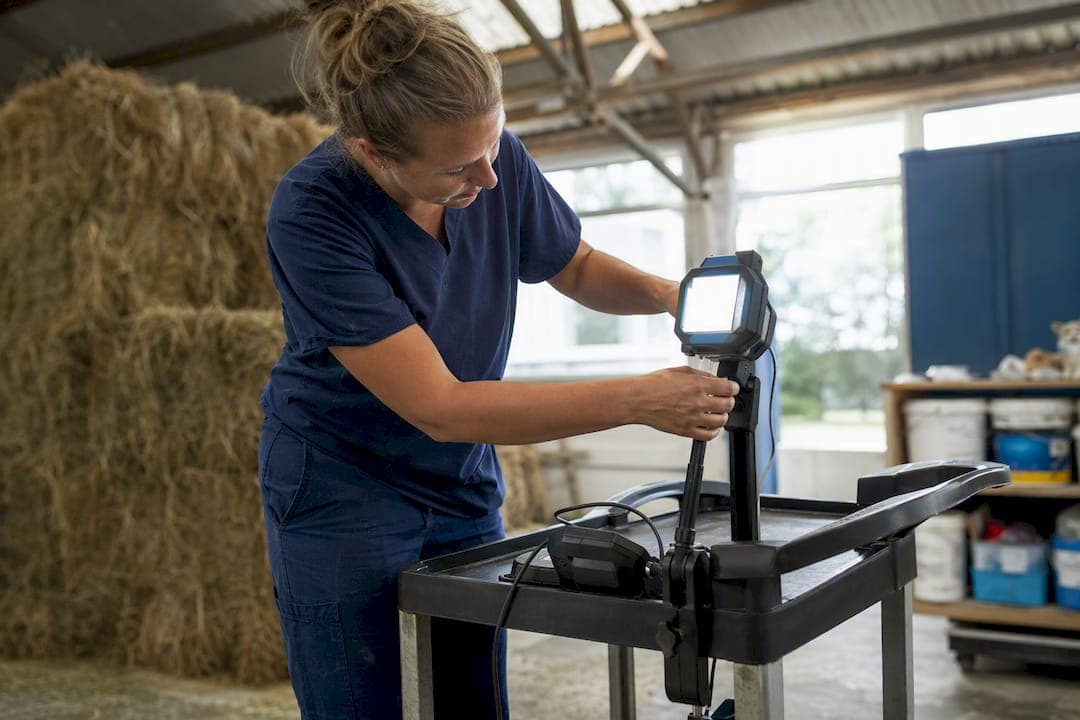
A battery powered light source for endoscopy is a portable LED unit that couples directly to a videoscope, fiberscope, or borescope without a mains-powered console. Pick one by ranking connector compatibility and CRI (color rendering index) first, then runtime and weight. A unit that fits your scope and renders tissue color accurately beats a brighter one that doesn't, and 1800endoscope's catalog is a reasonable place to start comparing compatible units and adapters.
TL;DR:
- The most important specifications are lux at the probe tip, CRI, and connector compatibility, as these directly impact image quality and fit.
- Battery runtime should be based on actual working conditions, with 90 to 180 minutes suitable for small animals and longer for large-animal or industrial use.
- Proper connector matching and routine maintenance of fiber end faces, batteries, and seals prevent performance issues and mid-procedure failures.
- LED has largely replaced halogen due to lower heat output, longer lifespan, and improved color rendering, making it the default choice for portable units.
- Environmental factors like cold, heat, and moisture significantly affect battery capacity and device reliability, especially in field and industrial environments.
Table of Contents
- When Does a Battery Powered Light Source Make Sense?
- What Specs Actually Matter When You're Comparing Units?
- Matching Specs to Your Actual Procedures
- Battery Handling, Heat, and Sterilization Protocols
- Getting the Adapter and Connection Right
- LED vs. Halogen: What's Actually Different
- Keeping a Portable Unit Reliable Over Time
- How Temperature and Moisture Affect Performance
- Where Portable Illumination Technology Is Heading
- Why We Push Compatibility and CRI Over Raw Specs
- Ready to Upgrade Your Portable Lighting Setup?
- Sources
When Does a Battery Powered Light Source Make Sense?
Mains-tethered light towers still dominate fixed operating suites, and for good reason. But plenty of real work happens outside that setting, and that's where a battery powered light source earns its keep.
Ambulatory equine practice is the clearest case. You can't wheel a light tower into a barn aisle, and a generator adds noise, weight, and one more thing to break down before an airway scope. Industrial inspectors face the same math on a pipeline right-of-way or inside a ship's ballast tank, where the nearest outlet might be three decks and a hundred feet away.
Portable units also function as insurance inside a fully equipped clinic. Bulbs blow. Breakers trip. A battery backup that clips onto the scope in seconds keeps a procedure moving instead of stalling it while someone hunts down a spare xenon lamp. A published prototype called Retilight demonstrated exactly this role, showing that a portable LED source can reliably stand in as emergency or supplemental illumination when a primary xenon-based system fails mid-procedure.
Cord management matters more than it gets credit for. A trailing fiber-optic cable running to a console across the room is a contamination risk in a sterile field and a tripping hazard in a cramped industrial vessel. Common scenarios where portable illumination wins outright:
- Farm and field calls where there's no reliable power source nearby
- Backup lighting during equipment failure in a clinic or OR
- Tight-access industrial inspections where a cable run isn't practical
- Short diagnostic scopes where setting up a full console wastes time
- Multi-site mobile practices moving between locations in a single day
What Specs Actually Matter When You're Comparing Units?
Vendor spec sheets throw a lot of numbers at you. Most of them matter less than you'd think, and a couple that don't get listed prominently matter a great deal.
Here's the ranked order that actually predicts whether a light source will work for your procedures:
- Lux at the probe tip, not lumens at the source. Lumens describe total light output from the LED itself; lux measures how much of that light actually lands on the tissue or surface you're inspecting after it travels through the fiber bundle. Two units with identical lumen ratings can deliver very different image brightness once losses in the light guide are factored in.
- CRI and spectral quality. A high lumen count with poor color rendering gives you a bright but muddy image where subtle tissue discoloration, a key diagnostic signal, gets washed out. High-quality LED systems increasingly treat spectral output as a first-class spec, not an afterthought behind raw brightness.
- Color temperature in Kelvin. Most clinical and industrial cameras are calibrated for a daylight-neutral range (roughly 5,000K to 6,500K). A unit that runs warmer or cooler than your camera's white balance expects will need correction in post, or worse, during live viewing.
- Connector compatibility. Olympus-style bayonet mounts, Storz, Wolf, and various universal adapters are not interchangeable without verification. Confirm fit before you buy, not after the unit arrives.
- Battery runtime at your actual working intensity, not the marketing claim measured at minimum brightness.
- Swappable batteries and charging method (USB, magnetic dock, or removable lithium-ion cells).
- Weight and heat management, since a probe running hot near mucosal tissue is a safety issue, not just a comfort one.
Pro Tip: Ask any vendor for lux measured at the probe tip at your typical working distance, not lumens at the LED. If they can't give you that number, ask for their CRI rating instead. Both tell you more than a lumen figure ever will.
Matching Specs to Your Actual Procedures
A general practice cat spay and a stallion's guttural pouch exam have almost nothing in common as procedures, and their lighting requirements shouldn't be treated as identical either.
Small-animal diagnostic work rewards CRI and consistency over raw output. You're usually working at short focal distances inside a body cavity where even modest brightness renders well, but a busy clinic running back-to-back scopes needs a battery that lasts. A runtime target of 90 to 180 minutes covers most daily caseloads without a mid-morning battery swap.
Equine and large-animal field work flips the priority. Airway and guttural pouch exams often run longer, working distances are greater, and you're frequently doing several horses in one barn visit. Higher output and a genuinely swappable battery system, not just a "long-lasting" single cell, matter more here than in a small-animal exam room. 1800endoscope's equine dental inspection videoscope is built around that kind of extended field use.
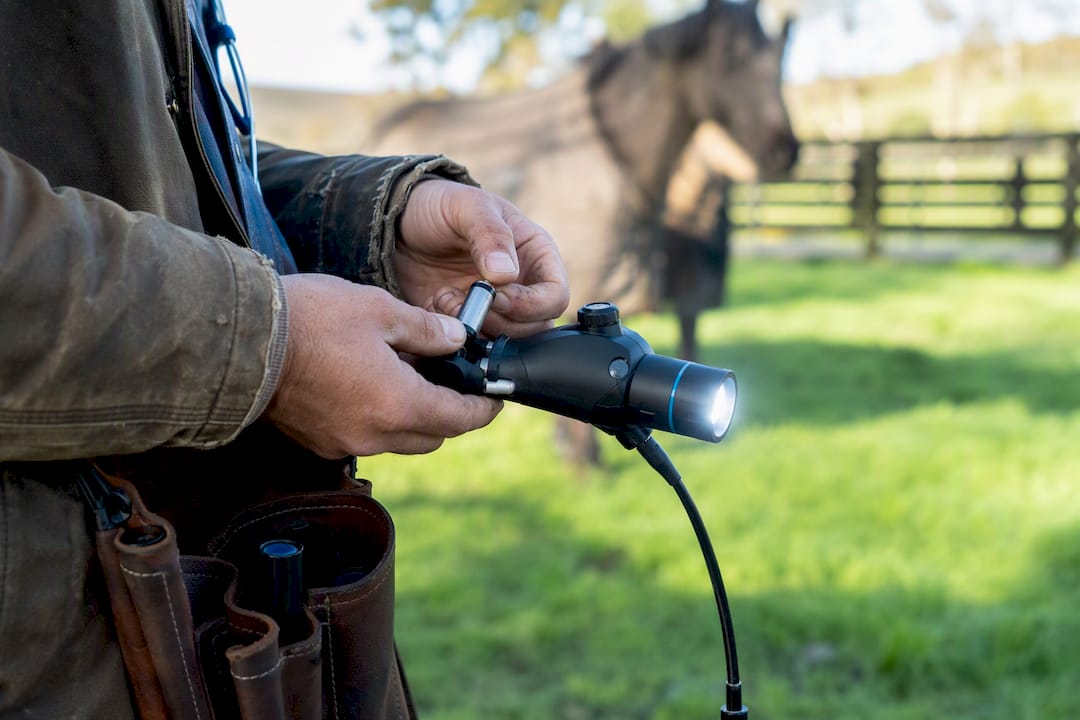
Industrial NDT brings its own list: waterproof or IP-rated housings for wet or contaminated environments, neutral white color temperature for accurate surface and corrosion assessment, and durable construction that survives being dropped on a factory floor. Borescope connector standards vary by manufacturer, so adapter compatibility deserves the same scrutiny here as in veterinary work.
Practical target ranges, not vendor rankings, should guide your comparison:
- Small animal: moderate lux, high CRI, 90 to 180 minute runtime, light enough for one-handed use
- Equine/large animal: higher lux, swappable batteries, rugged housing for barn conditions
- Industrial NDT: neutral color temperature, IP-rated housing, adapter compatibility with your specific borescope brand
Battery Handling, Heat, and Sterilization Protocols
A portable light source is only as reliable as the routine around it. Loose habits here are how a unit fails mid-procedure, not usually a manufacturing defect.
Keep one charged spare battery on hand for every scheduled procedure, not just every day. Batteries degrade with charge cycles, and a unit that ran fine yesterday can drop off faster than expected today, especially after a year or more of daily clinic use. A simple charge log, even a whiteboard tally, catches that decline before it becomes a mid-procedure surprise.
A short operational checklist keeps this from depending on memory:
- Confirm battery charge level before the patient or workpiece is in position.
- Verify adapter fit against the scope you're using that day, not just "the usual one."
- Stage a fully charged spare within reach, not in a drawer across the room.
- Watch for brightness drop during extended procedures and build in a cooling break if the housing feels warm.
- Clean and inspect the connector face and housing per the manufacturer's instructions after every use, and document it as part of your SOP.
Heat matters most in procedures where the probe tip sits close to mucosal tissue for extended periods. Most modern LED units run cooler than the xenon bulbs they replace, one of the documented advantages in the Retilight study, but "cooler than xenon" isn't the same as "cool." If a procedure runs long, monitor for both brightness drop and housing temperature, and pause rather than push through.
Getting the Adapter and Connection Right
Most "dim image" complaints trace back to a connection problem, not a failing light source. Before you assume the unit is underperforming, check the physical interface.
Portable units typically couple one of three ways: a fiber-optic cable running to a separate scope head, a direct screw-on Olympus-style mount, or a clamp-style universal adapter. Each has a different failure mode. Fiber cables lose transmission efficiency if the end face gets scratched or dirty. Screw mounts can seat slightly off-axis if cross-threaded. Universal clamps depend on consistent pressure, and a worn clamp spring quietly degrades light transfer over months without any obvious sign.
Quick troubleshooting sequence before you call it a hardware failure:
- Inspect the fiber end face for scratches, dust, or residue under magnification if possible.
- Reseat the connector fully and confirm it clicks or locks rather than just resting in place.
- Check the battery's actual charge level, not just whether the unit powers on.
- Swap to a spare cable or adapter if you have one, to isolate the cable from the light source itself.
If the image stays dim after all four checks, the problem is likely internal to the LED module or driver electronics, and that's the point to contact the scope manufacturer or a qualified technician rather than attempting a repair yourself. 1800endoscope's guide on selecting light sources for endoscopic inspections walks through adapter verification in more depth.
LED vs. Halogen: What's Actually Different
Halogen and early xenon-style bulbs still show up in older portable units, and understanding why LED has largely replaced them helps explain the spec sheet differences you'll see today.
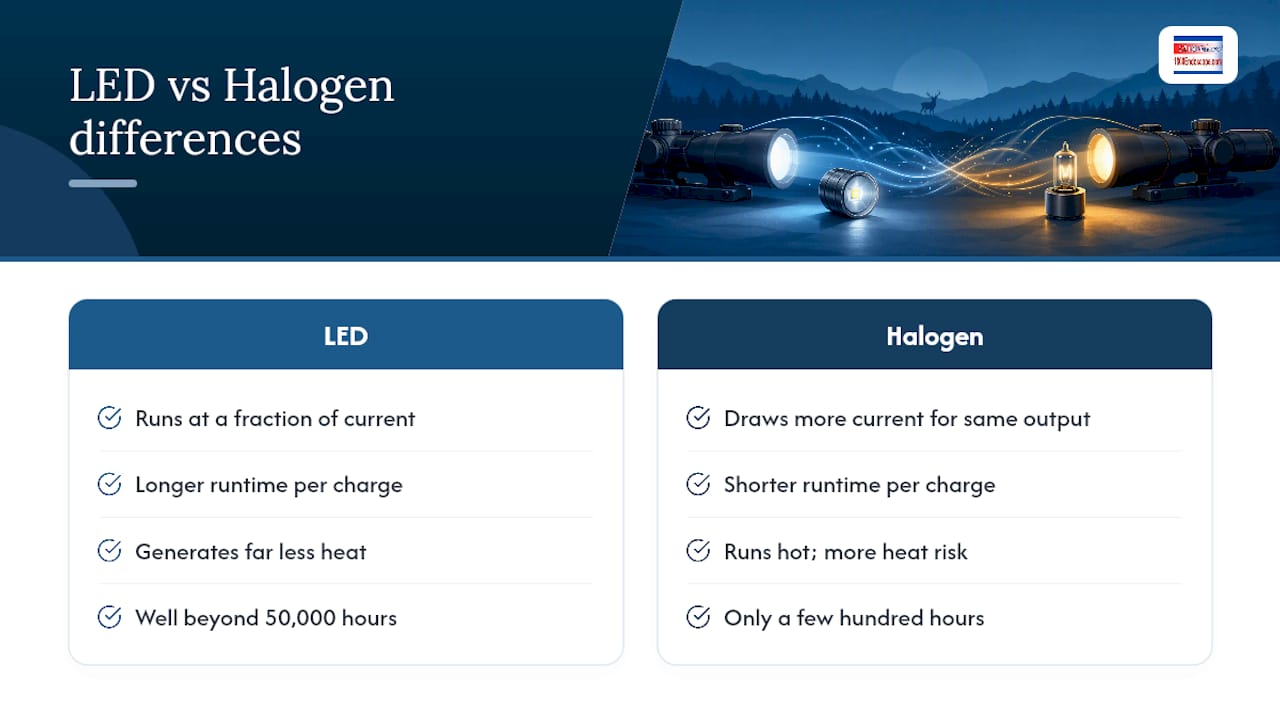
Halogen bulbs run hot, draw more current for equivalent output, and have a shorter working life, often a few hundred hours before noticeable dimming or failure. That combination is a poor fit for a battery-powered device: more current draw means shorter runtime per charge, and more heat means more risk near tissue. LED modules, by contrast, commonly reach lifespans well beyond 50,000 hours in vendor and prototype specifications, run at a fraction of the current draw, and generate far less heat at the source.
The tradeoff historically cited against LED was color rendering, early diodes struggled to reproduce a full, accurate spectrum. That gap has narrowed considerably as high-CRI LED modules have become standard in clinical-grade units, which is why CRI now gets called out explicitly on better spec sheets rather than assumed. Xenon still holds a narrow edge in raw color fidelity in some fixed operating-room consoles, but for a portable, battery-powered unit, LED is the practical default across veterinary and industrial applications alike. If you're evaluating a unit that still specs a halogen or xenon bulb for a battery-powered application, treat that as a flag worth questioning rather than a neutral choice.
Keeping a Portable Unit Reliable Over Time
Most failures in portable illumination units are predictable and preventable, which is good news if you build the right habits early.
Battery capacity is the first thing to degrade, typically showing up as shorter runtime rather than sudden failure. Track this by timing how long a fully charged battery lasts at your standard working brightness every few months; a noticeable drop from baseline is your signal to rotate that battery out of active use rather than wait for it to fail during a procedure.
Connector and fiber-end wear is the second common issue, and it's often mistaken for a battery or LED problem. A scratched or dirty fiber face reduces light transmission gradually, so the dimming can be easy to miss day to day until you compare against a known-good cable. Wipe connector faces with a lint-free cloth per the manufacturer's cleaning instructions, and inspect under light periodically rather than only when a problem appears.
Housing seals matter more than most users realize, particularly for industrial units used in wet or dusty environments. A compromised seal doesn't always cause immediate failure. It often shows up months later as internal condensation or debris that degrades the LED driver electronics. 1800endoscope's guide to borescope battery life factors covers runtime degradation patterns worth building into a fleet maintenance schedule if you're managing multiple units across a team.
How Temperature and Moisture Affect Performance
Portable light sources don't perform identically in a climate-controlled clinic and a humid barn or an outdoor pipeline inspection, and that gap catches people off guard.
Cold weather reduces lithium-ion battery capacity measurably, sometimes cutting usable runtime well below the rated figure in near-freezing conditions common on winter farm calls. Keeping a spare battery in an inside jacket pocket rather than a cold truck cab preserves capacity better than any charging strategy. On the other end, high heat during summer field work can trigger thermal throttling in some LED drivers, which dims output to protect the electronics before a battery even shows low charge.
Moisture is the bigger risk for industrial applications specifically. A unit without an adequate IP rating in a wet inspection environment, ballast tanks, sewer lines, damp mechanical spaces, risks both immediate malfunction and long-term corrosion inside the housing. For veterinary field work, splashing during large-animal procedures poses a similar if smaller-scale risk. Confirm the IP rating actually matches your working environment rather than assuming "water-resistant" language on a spec sheet covers submersion or heavy spray, since those are meaningfully different standards.
Where Portable Illumination Technology Is Heading
The most meaningful recent shift in this category isn't brighter LEDs, output has plateaued for most practical purposes, it's smarter power management and modular design.
The Retilight prototype pointed toward one clear direction: designing portable LED sources that attach to existing endo-illuminator heads and draw power from common USB battery banks, rather than requiring a proprietary battery format. That approach means a clinic or inspection team can standardize on off-the-shelf power banks instead of stocking manufacturer-specific cells, a genuine convenience for fleet management.
Expect continued movement toward higher CRI at lower power draw as LED chip efficiency improves, along with tighter integration between light source and camera white balance, reducing the manual correction that's currently a minor annoyance in mixed-lighting setups. Modular adapter systems that swap between connector standards without a separate purchase for each are also gaining traction, which would meaningfully simplify procurement for teams running mixed scope inventories from different manufacturers.
Why We Push Compatibility and CRI Over Raw Specs
Most buying guides for portable illumination lead with lumens and runtime because those numbers are easy to compare on a spec sheet. We think that's backwards, and the evidence backs that view. A unit that's blindingly bright but renders tissue color inaccurately, or physically doesn't fit your scope's connector, is worse than useless. It's a unit you paid for and can't rely on.
The industry's own literature supports weighting spectral quality this heavily. CRI and spectral irradiance get flagged repeatedly in photonics research on LED endoscopy as factors that directly affect diagnostic accuracy, not cosmetic image quality. Yet most procurement conversations still start and end with brightness and battery life. We'd argue that's a habit carried over from consumer flashlight shopping, where color accuracy genuinely doesn't matter, applied to a clinical and industrial context where it does.
Connector compatibility gets similarly underrated until it's the reason a $400 light source sits in a drawer because it doesn't fit anything in the practice. 1800endoscope's technical guides consistently push readers to verify adapter fit before comparing brightness specs, and that ordering isn't arbitrary. It reflects which mistakes actually get made in the field.
— Endoscope
Ready to Upgrade Your Portable Lighting Setup?
If you've been running on a fixed console and want the flexibility a battery powered light source gives you without gambling on a mismatched adapter, start with a unit built for portability from the ground up rather than retrofitting a console-based system. 1800endoscope's fully portable airway inspection system pairs a compatible light source with the scope itself, which sidesteps the adapter-fit guesswork entirely.
A practical first step: order one starter unit with a spare battery and confirm adapter fit against your current scope inventory before committing to a full fleet purchase. If you manage a mixed inventory of veterinary and industrial scopes, browse the full endoscope and light source catalog to compare compatible options side by side, or reach out through the FAQ and inspection procedures page with specific connector questions before you order.