
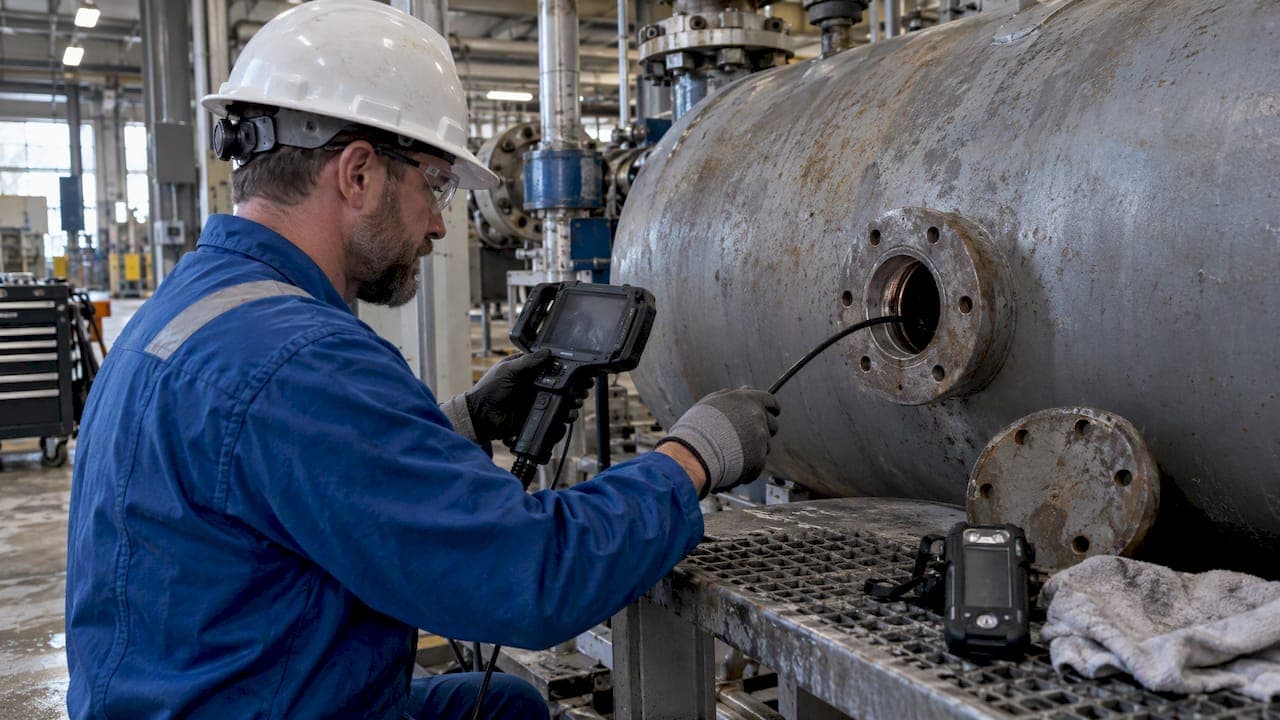
Borescopes and other remote visual inspection tools are the right choice when you need to see inside a turbine, boiler tube, tank, or pipe run without sending a person through the access port. The payoff is a fast condition check, recorded images or video, and a go/no-go decision that often avoids man-entry altogether. One caveat matters before you start: inserting a probe can still trigger confined-space rules under OSHA 29 CFR 1910.146, so plan the inspection as if entry controls might apply.
TL;DR:
- Rigid borescopes offer the highest image quality but are limited to straight-line inspection, suitable for small ports and short distances.
- Flexible fiberscopes are better for inspecting bends but generally provide lower resolution compared to digital videoscopes with articulated tips.
- When the inspection requires sizing defects or traversing complex geometries, a digital videoscope or crawler becomes necessary, especially for longer or more intricate access routes.
- Confined-space rules still apply if inserting a probe into a space, with atmospheric testing performed in a strict order and rescue procedures in place.
- Documenting inspections with high-resolution images and reference measurements is crucial for accurate defect assessment and follow-up repairs.
Table of Contents
- Types of borescopes and RVI tools and when to use each
- Confined-space safety and regulatory requirements that affect borescope inspections
- Step-by-step confined-space borescope inspection workflow
- Selecting hardware and probe specs for confined-space inspections
- Capturing images, measurements, and defect records that hold up
- Practical lessons from the field on safe borescope practice
- When borescope inspections belong in your RVI program
- How Endoscope (1800endoscope.com) can help with equipment and repairs
- FAQ
- Sources
Types of borescopes and RVI tools and when to use each
Picking the right tool class starts with the geometry you are inspecting and what you need to walk away with: a quick visual pass, a measurement, or a 3D model.
Rigid borescopes work well for straight-line access, like inspecting a valve bore or a short casting cavity, and they deliver the sharpest optics of any class because there's no fiber bundle or articulation mechanism degrading the image. Flexible fiberscopes trade some image quality for the ability to snake through bends, useful for tracing a pipe run with multiple elbows. Digital videoscopes with an articulating tip sit in the middle: they combine bend-following flexibility with a camera chip at the tip instead of a fiber bundle, so image quality holds up over longer insertion lengths. Remote crawlers and pan-tilt-zoom (PTZ) camera systems are a different category entirely, built for long-distance travel inside large-diameter pipe or vessel runs where a handheld probe can't reach.
Match the tool to three constraints: the minimum port diameter available, the bend radius the probe has to clear, and the total insertion length needed to reach the inspection zone. A 6mm probe clears tighter ports than a 10mm one but usually costs you resolution and lighting output.
- Rigid scopes: best image quality, straight-line access only, no articulation.
- Flexible fiberscopes: good for bends, lower resolution than digital videoscopes.
- Digital videoscopes: articulated tip, strong image quality over long runs, ideal for general industrial use.
- Crawlers/PTZ systems: justified when insertion length exceeds handheld probe range or when the asset requires 3D point-cloud capture for sizing anomalies.
Escalate to a crawler or 3D-capable system when a flat visual pass isn't enough to size a defect accurately, or when the access geometry simply exceeds what a handheld probe can travel.
Confined-space safety and regulatory requirements that affect borescope inspections
A borescope lets you look inside a space without climbing in, but that doesn't automatically take the inspection outside confined-space rules. OSHA's permit-required confined space standard defines a permit space as one with limited entry and exit, not designed for continuous occupancy, and containing or capable of containing a hazard like a bad atmosphere, engulfment risk, or an internal configuration that could trap someone. The standard requires employers to evaluate the space, and if it qualifies as permit-required, to implement written permits, isolation, atmospheric testing, ventilation, attendants, and rescue procedures before anyone or anything enters.
The gray area technicians run into is "breaking the plane." Sliding a probe through an access port can still count as entry into the space under the standard, which means the atmospheric and procedural requirements may apply even though no part of a person's body goes inside. Whether an alternate procedure is available instead of a full permit entry depends on documented evidence, such as photos of the port and sign-off from a qualified supervisor, showing the insertion method doesn't change the space's hazard profile.
One sequence governs atmospheric testing under the standard: oxygen first, then combustible gases, then toxic contaminants. OSHA requires this exact order because testing for combustibles in an oxygen-deficient atmosphere can give a false reading, and that order protects against missing a hazard that a different sequence would catch.
Before any probe goes near a permit space, have these controls ready:
- Calibrated gas-monitoring instruments tested the day of use, not just the week of use.
- A documented atmospheric test following the oxygen, combustible, toxic sequence.
- Forced-air ventilation running and verified before and during the inspection.
- An attendant stationed outside with rescue equipment and a communication plan, plus a signed entry permit on file.
A detailed pamphlet from OSHA on permit-required confined spaces walks through the full employer program requirements in plain language, worth keeping on hand for crews that don't inspect permit spaces daily.
Step-by-step confined-space borescope inspection workflow
A borescope inspection in a confined space runs in four phases: plan, set up, search, and document. Skipping the first phase is where most avoidable problems start.
Planning:
- Identify every access point and confirm isolation or lockout/tagout status on the equipment before touching it.
- Pull the entry permit if the space qualifies as permit-required, and confirm a rescue plan and attendant are in place.
- Gather PPE and calibrated gas-monitoring instruments, and schedule the atmospheric test sequence.
Setup and verification: 4. Run through a probe checklist: battery charge, optic clarity, LED function, and a quick white-balance check using the LOLER Thorough Examination Checklist — Free Template by Curcle. 5. Clean the probe tip and confirm any tethering or cable-reel setup you plan to use for extraction. 6. Stage cable management so the insertion cable doesn't kink or snag on the way in.
Insertion and search: 7. Feed the probe slowly, using articulation and variable lighting to sweep methodically rather than randomly. 8. Watch for snag points as you advance, and back off rather than forcing the probe past resistance. 9. When you spot a defect, hold position and use a reference scale or laser module to estimate size before moving on.
Verification and documentation: 10. Capture still images at full resolution for anything questionable, with video reserved for context and motion-dependent findings. 11. Note the defect location relative to a fixed reference point, since "about halfway down" doesn't help the next inspector. 12. Draft a short report: asset ID, access point used, atmospheric readings, findings with images, and a recommendation.
Pro Tip: Plan your extraction method before insertion, a tether or cable reel prevents a lost probe from turning a routine inspection into a rescue scenario.
Our guide on using flexible borescopes for accurate diagnostics covers probe handling technique in more depth if you're new to sweep patterns in tight geometries.
Selecting hardware and probe specs for confined-space inspections
Probe diameter is the first tradeoff you'll hit: a smaller diameter clears tighter access ports, but it usually means a smaller image sensor, less light output, and lower resolution. Bend radius and total insertion length narrow the field further, since a probe rated for a 2-inch bend radius won't survive the tight turns inside some piping runs.

Articulation matters most in complex geometries where a fixed-view probe can't be rotated to see around a corner; without it, you end up moving the whole probe body to compensate, which risks snagging. Field of view interacts with articulation, since a wider FOV covers more area per frame but can distort measurements near the edges.
Resolution and low-light performance go together: a sensor that performs well in bright light can still produce a grainy, useless image inside a dark tank, so check the LED output and sensor sensitivity together, not separately.
- Diameter: smaller clears tighter access but trades off image quality and light output.
- Bend radius and length: set the hard limit on which assets a given probe can reach.
- Articulation and FOV: essential for complex geometries, less critical for straight bores.
- IP rating and chemical resistance: matter when the inspection involves moisture, residue, or washdown after use.
Measurement or 3D-capable scopes are justified when a routine visual pass can't size a defect accurately enough to support a repair decision, our videoscope features and uses guide breaks down which specs matter for which applications. A model like the 6mm x 150 portable airway inspection videoscope illustrates the diameter-versus-length tradeoff in a real product spec.
Capturing images, measurements, and defect records that hold up
A still image shot straight-on with even lighting beats a dozen rushed video frames when you need to document a defect for a maintenance decision. Pause on anything questionable and capture a high-resolution still before moving the probe, video is better reserved for showing motion or context, like how a deposit shifts under flow.
For measurement, a reference scale or laser module gives you a repeatable estimate without extra equipment. Photogrammetry or point-cloud capture is worth the setup time only when a routine estimate won't support the repair decision, since it requires stationary capture planned in advance rather than a quick handheld pass.
- Shoot an overview frame, a context frame showing the defect's location, a close-up, and a measurement frame for every finding.
- Name files by asset ID, date, and access point, not by a generic sequence number.
| Element | Minimum for the report |
|---|---|
| Overview image | Shows the general area inspected |
| Context image | Shows defect location relative to a landmark |
| Close-up image | Shows defect detail at usable resolution |
| Measurement image | Shows scale or laser reference against the defect |
Our industrial borescope field guide has more examples of application-specific image sets across different asset types.
Practical lessons from the field on safe borescope practice
We sell industrial borescopes, videoscopes, and the accessories that go with them, including probes built for tight-access inspections and repair services for equipment that's taken wear in the field. Our blog's borescope safety procedures guide walks through probe care and pre-inspection checklists in more detail, and a routine maintenance habit worth adopting is checking optics, articulation, and LED function before every critical inspection, not just when something looks off.
When borescope inspections belong in your RVI program
Borescope inspections earn a place in a planned maintenance program once asset criticality and downtime cost justify the time: a turbine or boiler tube that fails unexpectedly costs far more than a scheduled RVI pass during an outage window. RVI complements other NDT methods rather than replacing them, catching internal wear that ultrasonic or radiographic methods might miss from the outside. The operating constraint never changes: safety and the confined-space rules set the boundary for what's possible, and no schedule pressure should push a crew past that line.
— Endoscope
How Endoscope (1800endoscope.com) can help with equipment and repairs
We carry borescopes, monitor-type SD-card videoscopes, and portable pipe inspection videoscopes built for the diameter, length, and articulation tradeoffs covered above, along with the biopsy forceps and accessories some inspection tasks call for. When a probe takes damage in the field, our repair services can get it back in service rather than forcing a full replacement.
- Browse our borescopes and videoscopes for industrial inspection work.
- Check our medical and industrial accessories page for light sources and related parts.
- Reach out to our support team if you need help matching a probe diameter or length to your access constraints.
FAQ
What is a borescope inspection?
A borescope inspection uses a rigid or flexible probe with a camera or optical system to visually examine the inside of equipment or infrastructure without disassembling it or requiring a person to enter the space. It's commonly used on turbines, boiler tubes, piping, and tanks to check for wear, corrosion, or damage, as described in Tetra Engineering's overview of borescope inspection use cases.
How much does a borescope inspection cost?
Cost depends on the equipment used and whether the inspection is done in-house or contracted out, and we don't publish a flat inspection fee since it varies by scope and scenario. For equipment pricing, our borescope and videoscope product pages list specifications, and pricing is available on request for specific models.
What's the difference between an endoscope and a borescope?
An endoscope is the broader term for any scope used to see inside an enclosed space, and it's most often associated with medical or veterinary use inside a body. A borescope is the industrial version of the same concept, built for inspecting equipment, pipes, and structures rather than living tissue, with rigid, flexible, and digital videoscope variants as described in ASNT's RVI guidance.
What is a borescope cavity wall inspection?
A cavity wall inspection uses a borescope inserted through a small drilled hole to check the condition of insulation, moisture, or debris inside a wall cavity without removing brick or siding. It's a construction and building-inspection application rather than an industrial NDT one, though it relies on the same rigid or flexible scope technology covered throughout this guide.
Sources
- 1910.146 - Permit-required confined spaces | Occupational Safety and Health Administration
- Materials Evaluation article on robotic crawlers and RVI benefits (ASNT author Ron Kessler)
- Borescope inspection | Tetra Engineering