
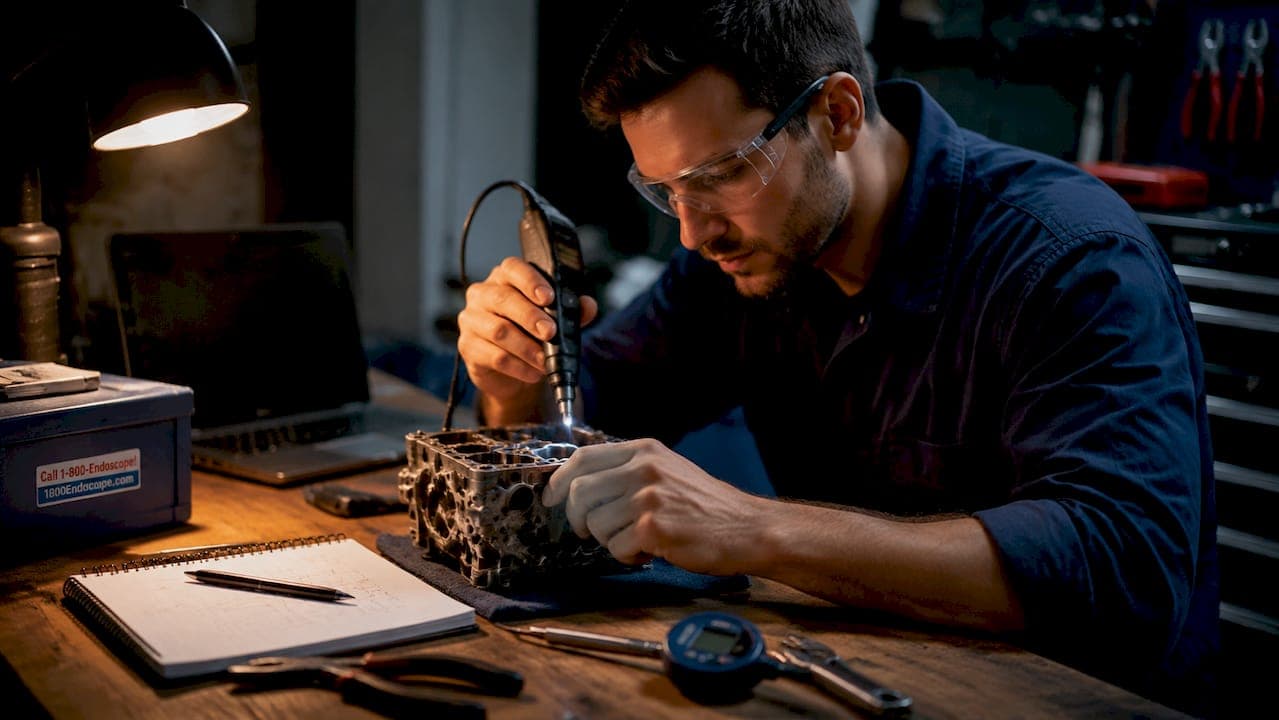
Borescope illumination type is the single most decisive factor in whether an inspection yields clear, actionable images or ambiguous, washed-out footage. The four primary borescope lighting options are LED, fiber optic, halogen, and xenon, each with distinct performance profiles that directly affect visibility, color accuracy, and durability. LED technology now dominates general industrial and veterinary applications, while fiber optic illumination holds a firm niche in high-performance rigid borescopes inspecting polished metal surfaces. Understanding how these different borescope lights perform under real inspection conditions is what separates a productive inspection from a repeat visit.
1. Borescope lighting types compared: the four core technologies
Every borescope illumination system falls into one of four categories. Knowing what each technology actually does at the tip of the probe determines which tool belongs in your kit.
LED lighting is the current standard for most industrial NDT borescopes and veterinary videoscopes. LEDs mount directly at the probe tip, deliver consistent output across thousands of hours of use, and require no external light source. LED technology has largely displaced traditional fiber optic bundles for general aviation inspections due to superior durability and brightness. That shift reflects a real-world performance gap, not just a marketing preference.
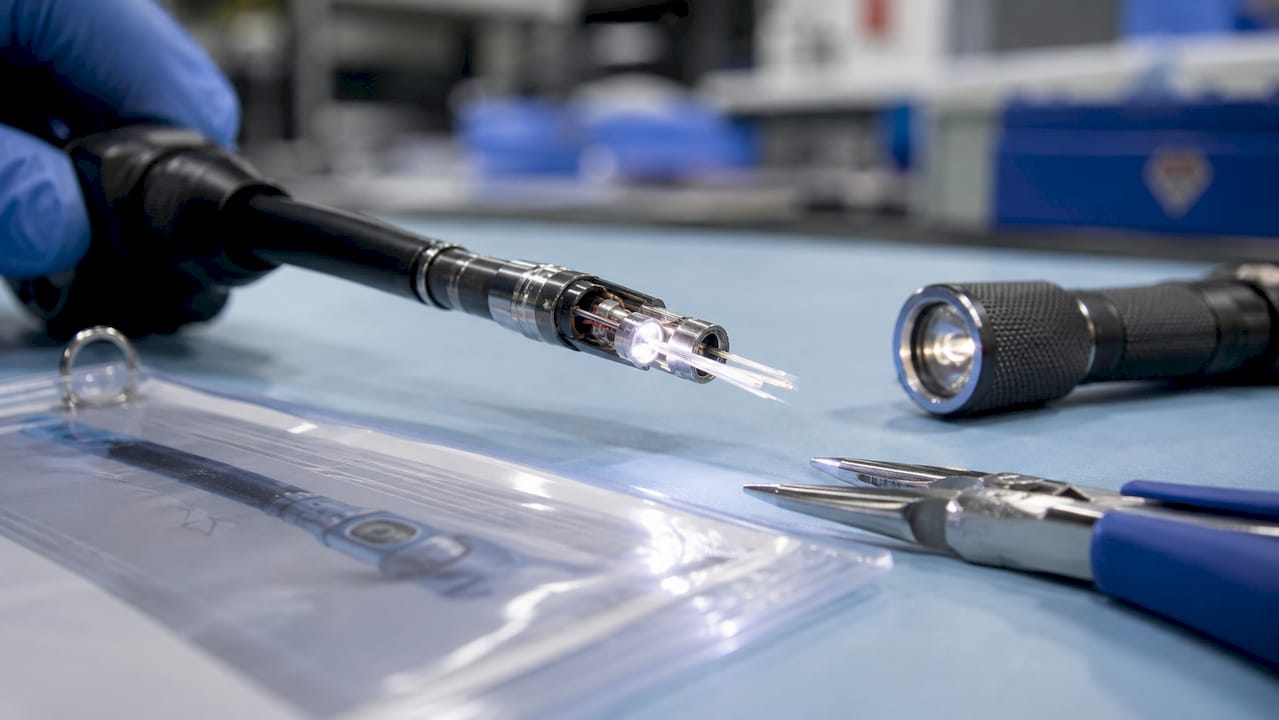
Fiber optic lighting routes light from an external source through glass or plastic fiber bundles to the inspection site. Fiber optic illumination delivers highly directional light that reduces glare and enhances depth perception, which is critical when inspecting polished turbine blades or stainless steel pipe interiors. The trade-off is fragility: fiber bundles break over time, creating dark spots that degrade image quality.
Halogen lighting produces a warm, broad-spectrum output that renders color naturally. Halogen remains used where warm, natural light is required for color-critical tasks, but it is increasingly superseded by LEDs due to shorter lifespan and lower energy efficiency. In veterinary diagnostics, color fidelity still gives halogen a foothold in some legacy systems.
Xenon lighting delivers the highest raw lumen output of any borescope light source. It is favored in surgical-grade medical endoscopes where maximum brightness is non-negotiable. For industrial borescopes, xenon's cost, heat output, and short bulb lifespan make it a poor fit outside specialized laboratory or surgical settings.
Pro Tip: Never select a lighting type based on maximum lumen rating alone. Usable light at your specific working distance and on your specific surface material is the only metric that matters in the field.
2. How LED and fiber optic lighting compare head to head
These two technologies dominate the borescope market, and the choice between them shapes inspection outcomes in measurable ways.
| Feature | LED | Fiber Optic |
|---|---|---|
| Brightness | High, consistent at tip | Dependent on external source |
| Glare on reflective surfaces | Higher risk without design controls | Lower glare, directional control |
| Durability | Excellent, 50,000+ hour lifespan | Moderate; bundles degrade over time |
| Depth perception | Good with separate LED designs | Superior in rigid borescopes |
| Best application | Industrial NDT, veterinary videoscopes | Polished metal, precision rigid scopes |
| Cost | Lower total cost of ownership | Higher due to external light source |
LED lighting provides more brightness, better contrast, and higher durability than fiber optics, which makes it the practical default for field technicians inspecting engine bores, HVAC systems, or animal airways. That durability advantage compounds over time because there are no bundles to fracture and no external light source to maintain.
Fiber optic illumination earns its place in rigid borescope applications where glare control is more important than raw brightness. Fiber optic bundles in rigid borescopes provide uniform, flicker-free light and directional illumination that enhance texture detail and reduce reflections on polished or complex surfaces. When you are reading surface defects on a turbine blade, that texture detail is the difference between a pass and a costly misdiagnosis.
Pro Tip: If your inspection targets include both matte and polished surfaces, consider a borescope with adjustable LED brightness rather than fixed output. Controlling intensity at the source is faster and more reliable than repositioning the probe to manage glare.
3. How light source placement affects image quality
Where the light sits relative to the lens is as important as which technology powers it. This is one of the most underappreciated design variables in borescope selection.
The placement of the light source relative to the lens is a crucial design factor affecting depth perception and texture interpretation. When LEDs are integrated directly beside the lens at the tip, light hits the surface at a near-zero angle, flattening shadows and reducing the visual cues that reveal surface texture and depth. This is why two borescopes with identical LED counts can produce dramatically different images.
Separate LED designs solve this problem by decoupling the light source from the lens. Separate LED units can be 5 to 8 times brighter with flexible angles, improving inspection on reflective surfaces. That angular flexibility creates side-lighting effects that reveal cracks, pitting, and surface irregularities that front-lit integrated LEDs would wash out entirely.
Key design factors to evaluate when comparing borescope lighting placement:
- Integrated tip LEDs: Compact and reliable, but prone to glare on reflective surfaces and limited in angular adjustment
- Separate LED modules: Higher brightness ceiling, better anti-reflection control, and improved depth perception in ultra-fine probes
- Fiber optic routing: Allows the light exit point to be positioned away from the lens axis, mimicking oblique illumination for superior texture rendering
- Adjustable brightness controls: Critical for managing exposure across different surface materials without repositioning the probe
Engineering constraints in sub-4mm diameter probes make separate LED designs technically challenging, but manufacturers producing inspection-grade videoscopes for light sources in endoscopic NDT have made significant progress in miniaturizing these configurations.
4. Matching lighting type to your inspection environment
Selecting the right borescope illumination type requires matching the technology to the specific demands of your inspection scenario. A one-size-fits-all approach produces mediocre results across the board.
-
Polished metal surfaces (turbine blades, engine cylinders): Fiber optic illumination in a rigid borescope is the correct tool. The directional, glare-minimizing output reveals surface defects that LED front-lighting obscures. Aviation MRO technicians have relied on this combination for decades for exactly this reason.
-
Matte or painted industrial surfaces (welds, castings, pipe interiors): LED illumination excels here. High contrast and shadow definition make structural abnormalities easy to identify without the glare penalty that polished surfaces impose.
-
Veterinary airway and GI inspections: LED videoscopes with adjustable brightness are the standard. Color accuracy matters for tissue assessment, and halogen's natural color spectrum still suits some color-critical veterinary applications where legacy systems remain in service. For new purchases, LED systems with color-balanced output now match halogen's clinical color rendering while outlasting it by years.
-
Wet or fluid-filled cavities (veterinary GI, hydraulic systems): Glare from fluid surfaces is a real problem. Fiber optic illumination or LED systems with brightness control reduce the washout effect that fixed-output LEDs create in reflective liquid environments.
-
Field inspections in variable conditions: LED wins on durability and portability. There is no external light source to carry, no fiber bundles to protect, and no warm-up time. For technicians moving between job sites, this operational simplicity has direct productivity value.
-
Budget-constrained purchases: LED borescopes offer the lowest total cost of ownership across all lighting types. Lower power consumption, no bulb replacements, and longer operational life make LED the financially sound default for most inspection programs. Fiber optic systems require external light sources that add both cost and a potential failure point.
5. Practical tips for evaluating borescope lighting before you buy
Usable lighting at the specific working distance and surface conditions encountered defines the best borescope lighting, not sheer brightness. This principle should drive every purchase evaluation.
- Test in a dark room on representative surfaces. Testing borescope lighting in dark rooms on reflective and wet surface mockups reveals true usable lighting at working distance, preventing poor purchases. Bring a sample of the actual material you inspect most often.
- Evaluate glare behavior, not LED count. A borescope with four well-positioned LEDs and brightness control will outperform one with eight fixed LEDs on any reflective surface. LED count is a marketing number, not a performance guarantee.
- Check working distance range. Excessive brightness can cause reflections and overexposure that obscure details during inspection. A borescope that looks impressive at 10mm may be completely overexposed at 3mm in a tight bore.
- Assess brightness control granularity. Step-less dimming gives you more flexibility than a two or three-position switch. This matters most in veterinary procedures where tissue sensitivity and color accuracy are both at stake.
- Factor in maintenance and replacement costs. LED systems have no consumable light source. Fiber optic systems require periodic bundle inspection and external lamp replacement. Xenon and halogen systems carry the highest ongoing maintenance burden.
Pro Tip: When evaluating a borescope for veterinary endoscopy light sources, request a live demo on wet tissue or a tissue analog. Glare behavior in fluid environments is the single most predictive test for clinical performance.
Key takeaways
The best borescope lighting type is defined by usable illumination at your working distance and surface conditions, not by maximum lumen output or LED count.
| Point | Details |
|---|---|
| LED dominates general use | LED borescopes offer superior durability, brightness, and low total cost for most industrial and veterinary inspections. |
| Fiber optic excels on polished surfaces | Directional, glare-free fiber optic light outperforms LED on reflective metal surfaces in rigid borescope applications. |
| Light placement matters as much as type | Separate LED designs produce 5 to 8 times more usable brightness with better glare control than integrated tip LEDs. |
| Test before you buy | Dark-room testing on representative surfaces predicts real-world performance better than any specification sheet. |
| Match lighting to application | Halogen suits color-critical veterinary legacy systems; LED suits field inspections; fiber optic suits precision rigid scope work. |
What I've learned from years of watching lighting choices make or break inspections
The conversation about borescope lighting almost always starts with brightness and almost never starts with placement. That is backwards. I have seen technicians struggle with expensive, high-lumen LED borescopes on turbine inspections because the light source sat flush against the lens, flattening every surface feature they needed to read. Meanwhile, a well-designed fiber optic rigid scope with half the lumen output gave them the shadow definition to catch a fatigue crack that the brighter tool missed entirely.
The separate LED design trend is the most practically significant development in borescope illumination in the past decade. Decoupling the light from the lens axis changes what you can see, not just how brightly you can see it. That distinction matters enormously in tight bores where repositioning the probe is not an option.
I also think the industry underestimates how much brightness control matters in veterinary applications. A fixed-output LED that works well in a steel pipe will wash out delicate mucosal tissue in an equine airway. Adjustable illumination is not a luxury feature for veterinary professionals. It is a clinical requirement.
The future of borescope lighting is in intelligent adaptive systems that adjust output based on working distance and surface reflectivity in real time. We are not there yet for most field-grade tools, but the trajectory is clear. Until then, the technicians who get the best results are the ones who understand their lighting type, know its limits, and test it against their actual inspection conditions before committing to a purchase.
— Endoscope
Find the right borescope lighting for your application at 1800endoscope
1800endoscope stocks a full range of LED and fiber optic illuminated borescopes built for both industrial NDT and veterinary diagnostics. Whether you need a portable videoscope with adjustable LED brightness for field engine inspections or a veterinary-grade rigid scope with precision fiber optic illumination, the catalog covers both ends of the spectrum. The portable 6mm airway inspection system is a strong starting point for professionals who need reliable, adjustable illumination in a compact form factor. Browse the full borescope and endoscope catalog or contact the 1800endoscope team directly for guidance on matching lighting type to your specific inspection requirements.
FAQ
What is the best lighting type for industrial borescope inspections?
LED lighting is the best choice for most industrial borescope inspections due to its durability, consistent brightness, and low maintenance. Fiber optic illumination is preferred for polished metal surfaces where glare control and depth perception are priorities.
Why does light source placement matter in a borescope?
Light placement determines shadow definition and glare behavior at the inspection surface. Separate LED designs positioned away from the lens axis produce significantly better texture detail and anti-reflection performance than integrated tip LEDs.
Can I use an LED borescope for veterinary procedures?
Yes. LED borescopes with adjustable brightness and color-balanced output are the current standard for veterinary videoscopy. Halogen systems still appear in legacy veterinary setups where natural color rendering is critical, but modern LED systems now match that color performance.
How do I test borescope lighting before purchasing?
Test the borescope in a dark room on samples of the actual surfaces you inspect, including reflective and wet materials. Evaluate glare behavior and brightness at your typical working distance rather than relying on LED count or maximum lumen specifications.
Is fiber optic lighting better than LED for all borescope applications?
No. Fiber optic illumination excels in rigid borescopes inspecting polished or complex surfaces where glare reduction and directional light improve defect detection. For flexible borescopes, field inspections, and veterinary procedures, LED lighting offers better durability and practical performance.