
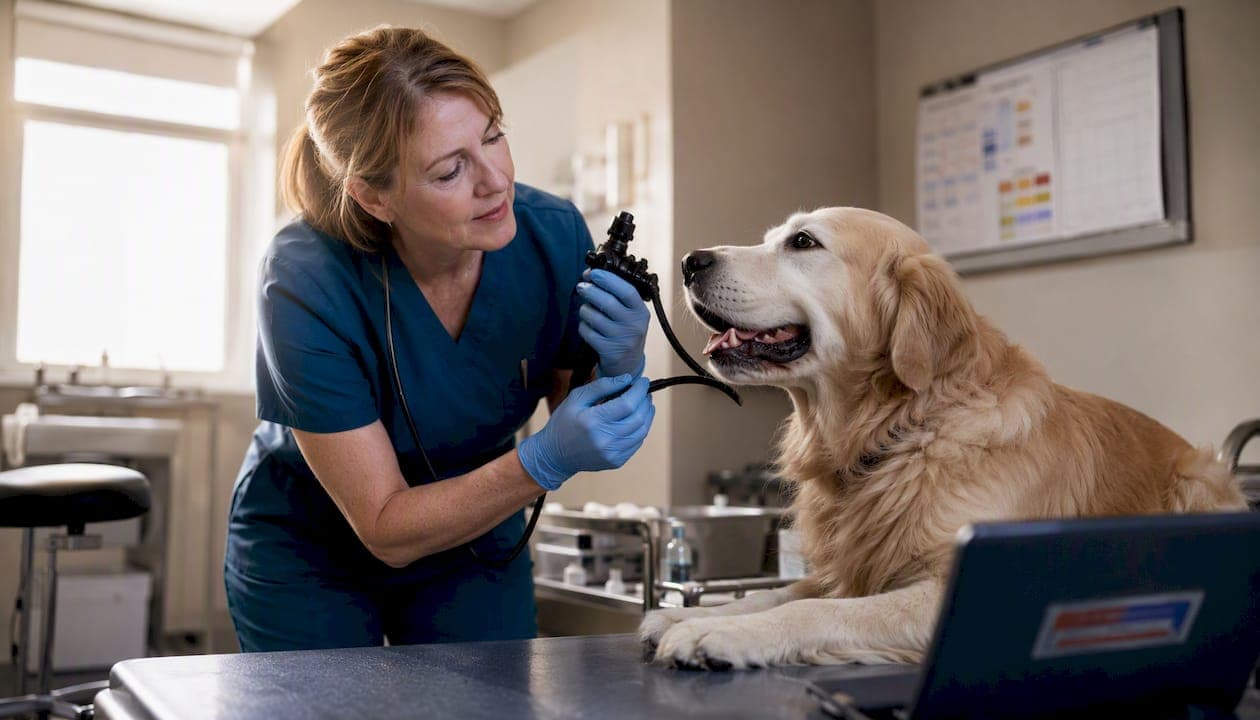
For most veterinary clinics, the 1800endoscope 6mm×150 portable airway videoscope is the strongest all-round starting point: compact enough for mobile use, with onboard SD recording and a monitor built in. Here is the shortlist by clinical role:
- Best for small-animal airway and mobile use: 1800endoscope Fully Portable 6mm×150 Airway Inspection Direct Monitor SD Card Video Endoscope — onboard monitor, SD recording, field-ready.
- Best for long-reach GI work (large dogs, equine, bovine): 1800endoscope Economy 3M Monitor Gastroscope 10mm×3 Meters — 3-meter insertion length, appropriate channel size for therapeutic instruments.
- Best for equine dentistry and oral exams: 1800endoscope Equine Dental Inspection Videoscope — field-rugged optics optimized for the equine oral cavity.
- Best budget portable option (non-sterile screening only): Midrange wireless dual-lens inspection camera category — wireless convenience, no true working channel.
- Best for limited therapeutic small-animal work: Portable video endoscope with 2.0 mm working channel — biopsy forceps compatible, balanced portability.
All three 1800endoscope models ship to U.S. addresses with vendor support available. Verify warranty terms and sterilization compatibility directly with 1800endoscope before ordering.
Table of Contents
- What are the best borescopes for vets? At-a-glance comparison
- Why the 1800endoscope 6mm×150 airway scope is the top pick for small-animal work
- Is the 1800endoscope 3M gastroscope right for your large-animal GI cases?
- What makes the equine dental videoscope worth the investment?
- How to choose the right borescope for your veterinary practice
- Which diameters and insertion lengths match which patients and procedures?
- Cleaning and disinfection: what veterinary endoscopes actually require
- Accessories and consumables you need to budget for
- How these picks were chosen
- Key Takeaways
- The case for keeping it simple — and portable
- Order from 1800endoscope: U.S. shipping and support
- Useful sources and manufacturer references
What are the best borescopes for vets? At-a-glance comparison
| Scope | Best for | OD | Insertion length | Working channel | Steerability | Image / recording | Sterilization | Portability / monitor | Price tier |
|---|---|---|---|---|---|---|---|---|---|
| 1800endoscope 6mm×150 Airway Videoscope | Small-animal airway, mobile clinics | 6 mm | 150 cm | Confirm with vendor | 4-way (confirm range) | SD card, onboard monitor | Per manufacturer IFU | Fully portable, battery | Mid |
| 1800endoscope Economy 3M Gastroscope | Large dogs, equine/bovine GI | 10 mm | 3 m | Yes (confirm diameter) | 4-way (confirm range) | Monitor included | Per manufacturer IFU | Portable monitor | Mid |
| 1800endoscope Equine Dental Videoscope | Equine dentistry, oral exams | Confirm with vendor | Confirm with vendor | — | Confirm with vendor | Video output | Per manufacturer IFU | Field-portable | Mid |
| Portable video endoscope, 2.0 mm channel (category) | Small-animal diagnostic/limited therapeutic | 2.8–5.8 mm | ~1,000–1,500 mm | ~2.0 mm | 4-way | HD, USB/Wi-Fi | High-level disinfection | Portable, USB/tablet | Low–Mid |
| Midrange wireless dual-lens camera (category) | Non-sterile screening, demos | 10 mm | ~1–5 m | None | Fixed or limited | HD, Wi-Fi app | Wipe-down only | Wireless, smartphone | Low |
| Entry-level consumer/industrial camera (category) | Non-clinical inspection only | Varies | Varies | None | None | SD/USB | Not rated for clinical | Handheld | Low |
| Teslong NTS300 Pro Inspection Camera | Industrial/non-clinical inspection | — | 1 m | None | Semi-rigid | 1080P, SD card | Not rated for clinical | Handheld | Low |
| Ridgid Micro CA-25 Digital Inspection Camera | Trades inspection, non-clinical | — | — | None | None | SD card | Not rated for clinical | Handheld | Low–Mid |
| Depstech Dual Lens Wireless Endoscope | Non-clinical wireless inspection | — | 5 m | None | None | 1080P, Wi-Fi | Not rated for clinical | Wireless, smartphone | Low |
| Milwaukee M12 M-SPECTOR Inspection Camera Kit | Trades, non-clinical | — | — | None | None | SD card | Not rated for clinical | Handheld, battery | Mid |
| Klein Tools Wi-Fi ET20 Borescope | Non-clinical wireless inspection | — | — | None | None | — | Not rated for clinical | Wireless, smartphone | Low |
| Depstech 1080P HD Dual Lens Waterproof Camera | Non-clinical, wet environments | — | 5 m | None | None | 1080P, Wi-Fi | Not rated for clinical | Wireless, smartphone | Low |
| Bosch Universal Inspect Inspection Camera | Trades inspection | — | 1 m | None | None | HD, display | Not rated for clinical | Handheld | Low–Mid |
| Depstech DS500 | Non-clinical inspection | — | 5 m | None | None | 1080P, Wi-Fi | Not rated for clinical | Wireless | Low |
| Depstech 86T | Non-clinical inspection | — | 1 m | None | None | 1080P, Wi-Fi | Not rated for clinical | Wireless | Low |
| Depstech DS300 | Non-clinical inspection | — | 3 m | None | None | 1080P, Wi-Fi | Not rated for clinical | Wireless | Low |
| Depstech WF028-5M | Non-clinical inspection | — | 5 m | None | None | 1080P, Wi-Fi | Not rated for clinical | Wireless | Low |
A critical note on consumer/industrial inspection cameras: The Teslong NTS300 Pro, Ridgid Micro CA-25, Milwaukee M12 M-SPECTOR, Klein Tools Wi-Fi ET20, Bosch Universal Inspect, and the full Depstech lineup (DS500, 86T, DS300, WF028-5M, Dual Lens, 1080P HD) are built for trades and industrial inspection. None carry veterinary instructions for use (IFUs), working channels, or clinical-grade sterilization ratings. They can serve as demonstration or non-sterile screening tools in a pinch, but they are not substitutes for a purpose-built veterinary endoscope. Confirm any spec marked "confirm with vendor" directly with 1800endoscope before purchase.
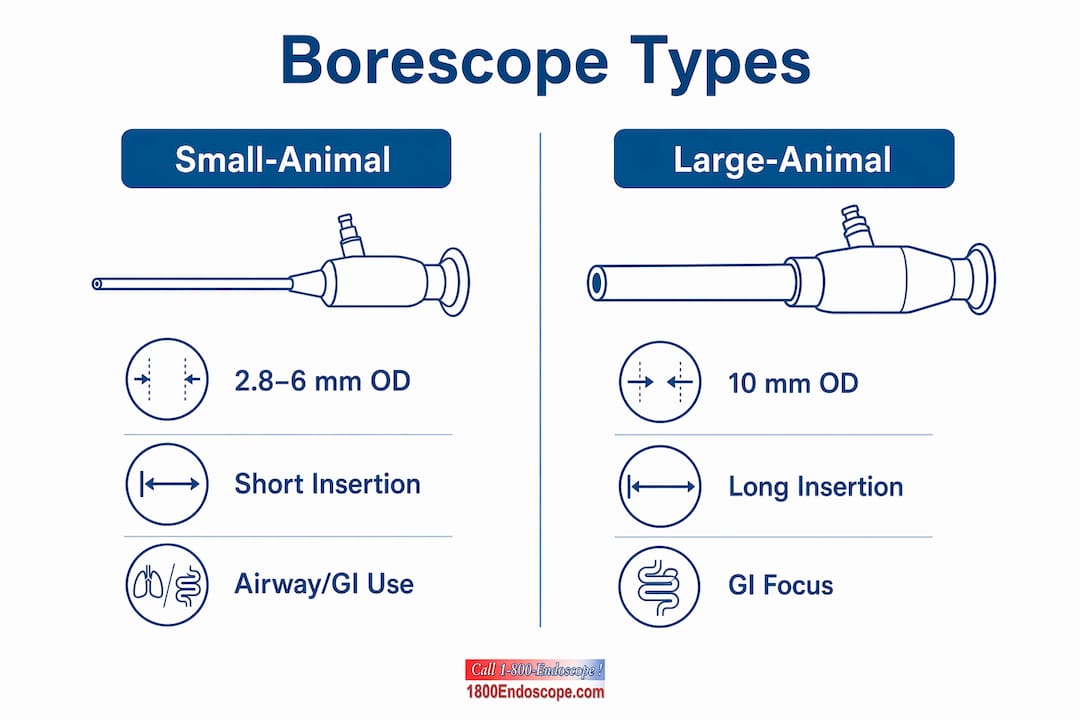
Why the 1800endoscope 6mm×150 airway scope is the top pick for small-animal work
The portable 6mm airway videoscope earns its place at the top of most small-animal shortlists because it solves the single biggest logistical problem in mobile veterinary practice: you need a working monitor and recording capability without dragging a cart into a farm call or a house visit.
Core specs at a glance:
- Outer diameter: 6 mm
- Insertion length: 150 cm (1,500 mm)
- Onboard monitor: yes, direct display
- Recording: SD card
- Power: battery-operated, fully portable
- Working channel: confirm diameter with 1800endoscope before ordering
- Sterilization: follow manufacturer IFU
Clinical use cases where this scope fits well:
- Tracheal and bronchial inspection in dogs and cats
- Foreign body checks in the upper airway
- Otoscopy in small animals (confirm OD suitability)
- Quick airway assessment in emergency or field settings
The 150 cm insertion length is the detail most buyers overlook. Small-animal models commonly feature working lengths around 1,000 mm; at 1,500 mm this scope reaches further, which is more typical for large-dog and some equine applications. The onboard SD recording means you capture the procedure without a laptop tethered to the scope, which is genuinely useful when you are working alone.
The trade-off is OD. At 6 mm, this scope is too large for nasal passages in cats and toy breeds, and the working channel diameter needs vendor confirmation before you plan biopsy or suction work. For straightforward airway visualization and foreign body checks in medium-to-large dogs, it is a practical, cost-effective choice for a mixed or mobile practice.
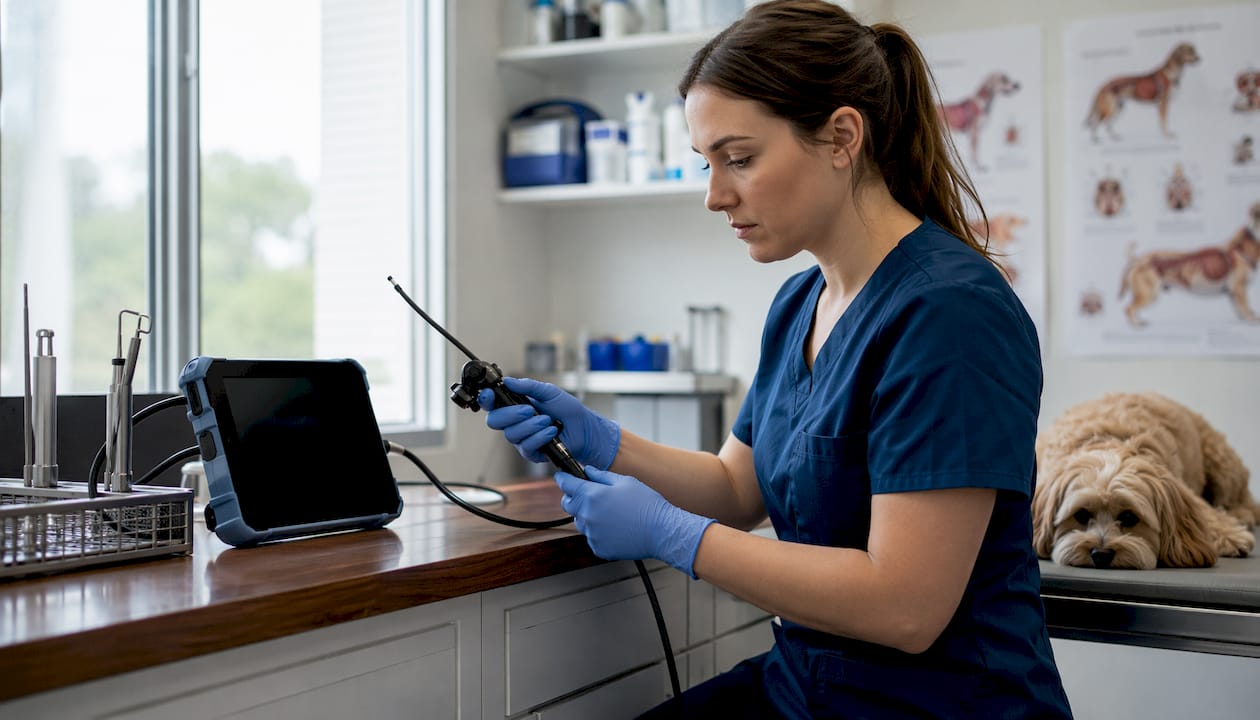
Who should buy this: Solo mobile vets, mixed-practice clinics adding endoscopy for the first time, and emergency practices that need a grab-and-go airway scope.
Is the 1800endoscope 3M gastroscope right for your large-animal GI cases?
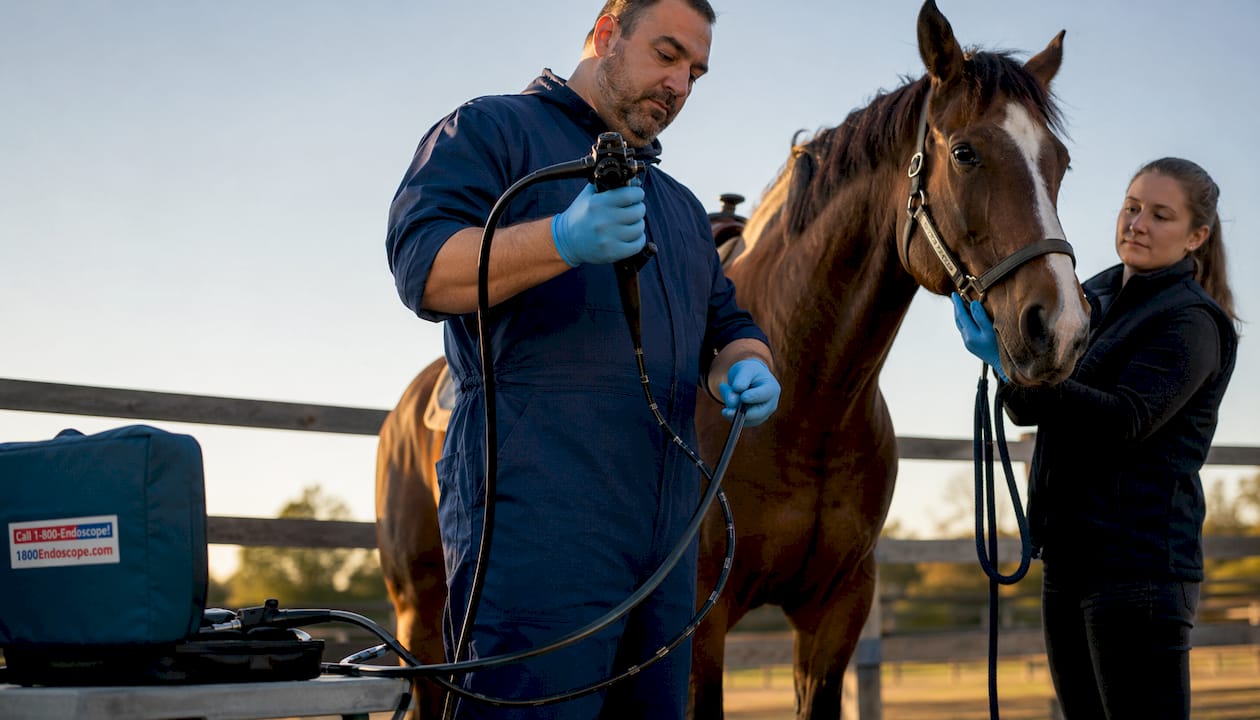
Long-reach GI work has one non-negotiable requirement: enough insertion length to actually reach the stomach. In horses, that means some large-animal gastroscopes reach approximately 3.3 meters. The 1800endoscope Economy 3M Monitor Gastroscope hits that mark.
| Spec | Detail |
|---|---|
| Outer diameter | 10 mm |
| Insertion length | 3 meters |
| Working channel | Yes — confirm exact diameter with 1800endoscope |
| Monitor | Included |
| Sterilization | Per manufacturer IFU |
| Primary use | Large dogs, equine, bovine gastroscopy |
The 10 mm OD is the key constraint. That diameter rules out airway use in any small patient and limits passage in medium dogs, but it is appropriate for equine and bovine gastroscopy where you need a robust scope that can handle the physical demands of large-animal work. The included monitor removes the need for a separate display, which matters for ambulatory equine practices operating out of a truck.
Cart-based towers remain important for therapeutic endoscopy and high case-volume centers; the 3M gastroscope sits between a full tower and a handheld portable, giving referral hospitals and ambulatory equine practices a capable middle option. Confirm the working channel diameter before assuming compatibility with your biopsy forceps or suction adapters.
Buyer profile: Referral hospitals seeing equine or bovine GI cases, ambulatory equine practices, and large-animal clinics adding in-house gastroscopy.
What makes the equine dental videoscope worth the investment?
Equine oral exams are physically awkward. The oral cavity is deep, the lighting is poor, and a standard handheld light source gives you a narrow, poorly documented view. The 1800endoscope Equine Dental Inspection Videoscope is configured specifically for this environment.
What it does well:
- Optics optimized for the equine oral cavity, not repurposed from a GI scope
- Video output for real-time visualization and client communication
- Field-rugged design suited to barn and ambulatory conditions
- Compact enough for a standard equine kit bag
Practical considerations:
- Requires a mouth speculum and appropriate halter setup before insertion
- Cleaning in field conditions needs a dedicated protocol; confirm sterilization method with the manufacturer IFU
- Working channel availability: confirm with 1800endoscope if you plan instrument passage
- Service and warranty: verify terms before purchase, particularly for ambulatory practices far from a service center
When to invest: If your practice sees more than occasional equine dental cases, a dedicated oral videoscope pays for itself quickly in avoided referrals and improved documentation. Practices doing routine tooth floats alongside diagnostic dental work will get the most use from it. For a clinic that sees equine dentistry once a month, a shared flexible scope with appropriate adapters may be sufficient.
How to choose the right borescope for your veterinary practice
Portable endoscopes lack standardized performance benchmarks, which means the buying decision falls entirely on the clinician's ability to ask the right questions. Work through this checklist before any vendor call.
Prioritized selection criteria:
- Patient mix and species: Small-animal airway/GI work needs 2.8–6 mm OD; equine and bovine GI needs 3 meters or more of insertion length and 10 mm+ OD.
- Procedure types: Diagnostic-only practices can work with a 2.0 mm working channel; therapeutic procedures like foreign body removal or biopsy collection often require 2.8 mm or larger channels.
- Sterilization workflow: Confirm the scope is compatible with your clinic's disinfection method before purchase. High-level disinfection (glutaraldehyde, OPA) is standard; autoclaving damages most flexible scopes.
- Recording capability: Saving MP4/AVI files and linking images to patient management software is now a baseline expectation, not a premium feature.
- Portability and power: Mobile and ambulatory vets need battery operation and a built-in monitor. Fixed-clinic use can tolerate a tower or tethered monitor.
- Service and warranty: Ask specifically about U.S.-based repair options, loaner scope availability, and turnaround time.
Questions to ask every vendor:
- What is the exact working channel diameter, and which biopsy forceps sizes are compatible?
- What is the maximum deflection angle in all four directions?
- Is the scope compatible with high-level disinfection agents (OPA, glutaraldehyde)?
- Are replacement insertion tubes or repair parts available in the U.S.?
- Does the scope record to USB or SD, and is DICOM export supported?
Red flags to walk away from:
- No published IFU or sterilization guidance
- Unclear or absent working channel specification
- No U.S. service or repair option
- No onboard recording or USB output
- Vendor cannot confirm deflection range in writing
Tower systems expand a clinic's therapeutic service mix and are worth the investment for high-volume referral practices. For most general practices, a portable videoscope with a 2.0 mm or larger working channel covers the majority of diagnostic and minor therapeutic cases. You can always refer complex therapeutic cases to a specialist veterinary clinic while building your in-house capability.
Which diameters and insertion lengths match which patients and procedures?
Small-diameter scopes in the 2.8–5.8 mm OD range suit airway and GI exams in companion animals; large-animal gastroscopy needs both a larger OD and significantly more length. The table below maps the key dimensions to clinical scenarios.
| Procedure | Patient | Recommended OD | Minimum insertion length | Working channel needed |
|---|---|---|---|---|
| Rhinoscopy | Cat, small dog | 2.8 mm | — | 1.2 mm |
| Tracheoscopy / bronchoscopy | Cat, small dog | 2.8 mm | — | 1.2–2.0 mm |
| Tracheoscopy / bronchoscopy | Large dog | 6 mm | 1,000–1,500 mm | 2.0 mm |
| Bronchoscopy | Horse, cattle | 5.8–10 mm | 1,500 mm | 2.0–2.8 mm |
| Gastroscopy | Dog (medium/large) | 6–10 mm | 1,000–1,500 mm | 2.0–2.8 mm |
| Gastroscopy | Horse, cattle | 10 mm+ | 3,300 mm | 2.8 mm+ |
| Dental / oral exam | Horse | 6–10 mm | — | Optional |
| Otoscopy | Cat, small dog | 2.8 mm | — | 1.2 mm |
Working channel diameter directly limits instrument choice. A 1.2 mm channel accepts only the smallest cytology brushes. A 2.0 mm channel opens the door to standard biopsy forceps and small suction catheters. For common endoscopic procedures like foreign body retrieval or bronchial lavage in larger dogs, a 2.0 mm channel is the practical minimum; complex therapeutic work often demands 2.8 mm or more.
Cleaning and disinfection: what veterinary endoscopes actually require
Flexible endoscopes are among the most damage-prone instruments in a clinic, and most scope damage happens during cleaning, not during procedures. The sequence matters.
Standard high-level disinfection steps:
- Bedside pre-clean immediately after withdrawal: wipe the insertion tube, flush the working channel with water
- Leak test before immersion in any liquid
- Manual cleaning with enzymatic detergent and a channel brush
- High-level disinfection with OPA or glutaraldehyde per the manufacturer's contact time
- Rinse thoroughly, dry the channels with forced air, and store hanging or in a ventilated case
Common mistakes that destroy scopes:
- Autoclaving a flexible scope not rated for steam sterilization
- Skipping the leak test and immersing a scope with a damaged insertion tube
- Forcing biopsy forceps through a channel at an angle — biopsy forceps can be as small as 3 mm long by 1 mm wide, and the channel lining tears easily
- Using alcohol wipes on optical surfaces
- Storing a wet scope in a closed case
Pro Tip: For clinics running both a portable field scope and a tower scope, assign each a dedicated cleaning kit (brushes, basins, enzymatic solution) and label them clearly. Cross-contamination between a barn-use scope and a surgical-suite scope is a real infection-control risk, and shared cleaning equipment is the most common vector.
Always follow the manufacturer's IFU for your specific model. Disinfection compatibility varies by scope construction; what works for one unit may void the warranty or damage the optics of another. Disposable single-use scopes in the 2.8–5 mm range exist and can reduce repair costs for high-turnover clinics, though they change documentation workflows and generate more consumable waste.
Accessories and consumables you need to budget for
The scope is only part of the cost. A veterinary clinic in Tampa running a full endoscopy program will typically budget for accessories that can add 20–40% to the initial scope cost.
Essential accessories by category:
- Biopsy forceps: Match channel diameter precisely. A 1.2 mm channel takes only cup forceps in the smallest sizes; a 2.0 mm channel opens more options. Buy at least two sets per scope.
- Suction adapters and valve assemblies: Required for GI work; confirm compatibility with your specific scope model before ordering.
- Sterile sheaths: Useful for scopes used across multiple patients in a single session; reduces full disinfection cycles.
- Cleaning brushes: Channel-specific sizing; replace regularly. A worn brush leaves debris in the channel.
- Transport and storage cases: Rigid cases for field use; hanging storage for clinic-based scopes.
- Light source (if not integrated): Portable scopes with onboard LED eliminate this cost; tower scopes require a separate light source.
Video integration and software:
Recording procedures to USB and linking images to patient management software has moved from optional to expected in most practices. Confirm that your scope outputs to a format your practice management system can ingest. DICOM compatibility is rare in portable veterinary scopes but worth asking about for specialist referral centers.
Budgeting tip: Buying a scope bundled with a light source, monitor, and a basic forceps set almost always costs less than sourcing components separately. Ask 1800endoscope about bundle options when you request a quote.
How these picks were chosen
Selection for this guide prioritized clinical fit over price. The criteria, in order of weight:
- Patient size and procedure match (OD, insertion length)
- Working channel diameter and instrument compatibility
- Steerability and deflection range
- Image quality and recording capability
- Sterilization compatibility with standard veterinary protocols
- Warranty, service availability, and U.S. support
- Portability and power requirements for mobile use
Sources used include manufacturer product specifications, published veterinary practice equipment reviews, and industry analysis on veterinary endoscope selection by scenario. Consumer and industrial inspection cameras (Depstech, Ridgid, Milwaukee, Klein Tools, Teslong, Bosch) were included for completeness and contrast; none are recommended for clinical veterinary use because they lack veterinary IFUs, working channels, and clinical-grade sterilization ratings.
Disclosure: 1800endoscope supplies the three highlighted recommended models in this guide and is presented as a leading, recommended vendor for U.S. veterinary clinics. The selection criteria above were applied consistently across all entries. Consumer and industrial scopes were assessed on the same criteria and ranked accordingly — their lower placement reflects genuine clinical limitations, not editorial preference.
Key Takeaways
For most U.S. veterinary clinics, the right scope is determined by patient size and procedure type first; everything else is secondary.
| Point | Details |
|---|---|
| Match OD to patient size | Small-animal airway and GI work needs 2.8–6 mm OD; equine and bovine GI needs 10 mm+ and 3 m insertion length. |
| Working channel determines capability | A 2.0 mm channel covers most diagnostic work; therapeutic procedures like foreign body removal often need 2.8 mm or larger. |
| Recording is now baseline | Saving MP4/AVI and linking to patient management software is a standard expectation, not a premium feature. |
| Consumer scopes are not clinical substitutes | Depstech, Ridgid, Milwaukee, Klein Tools, and similar industrial cameras lack veterinary IFUs and sterilization ratings. |
| 1800endoscope covers all three core use cases | The 6mm×150 airway scope, 3M gastroscope, and equine dental videoscope address small-animal, large-animal GI, and equine dental needs from one U.S. vendor. |
The case for keeping it simple — and portable
There is a persistent assumption in veterinary procurement that a bigger, more expensive tower system is always the better investment. For a high-volume urban referral center doing 10 endoscopy cases a week, that is probably true. For the majority of general and mixed practices in the U.S., it is not.
The real clinical gap in most practices is not therapeutic capability. It is the absence of any endoscopy at all. A portable videoscope that a vet can grab, use, and clean in 20 minutes closes that gap immediately. It generates revenue on day one, reduces unnecessary referrals, and gives clients visible evidence of diagnostic capability. A tower that sits unused because setup takes 45 minutes and the technician who knows how to clean it is off on Fridays is a worse outcome than a portable scope used confidently every day.
The 1800endoscope portable lineup is built around that reality. If your practice is ready to move to a tower, the 3M gastroscope and equine dental videoscope are logical next steps. The portable 6mm×150 airway scope, with a 1,500 mm insertion length, extends reach beyond the ~1,000 mm common in many small-animal models, providing additional versatility for larger dogs and certain procedures.
For questions about specific models, procedure compatibility, or U.S. delivery timelines, contact 1800endoscope directly through the product pages.
Order from 1800endoscope: U.S. shipping and support
1800endoscope ships all three featured veterinary scopes to U.S. addresses, with product pages that include full specifications, ordering, and contact options for service inquiries.
The ordering process is straightforward: visit the product page for the portable 6mm airway scope, the 3M gastroscope, or the equine dental videoscope, add to cart, and contact the team directly for service plan options, bundle pricing, or a product demonstration before purchase. The full borescope and endoscope catalog is available for clinics that want to compare the complete range before committing. Warranty terms and delivery timelines vary by model; confirm both with 1800endoscope at the time of order to avoid surprises.
Useful sources and manufacturer references
Consult manufacturer IFUs for your specific model before establishing any cleaning or sterilization protocol. Working channel compatibility must be verified against your biopsy forceps and suction adapter specifications before purchase.
| Source | Relevance |
|---|---|
| Veterinary endoscope selection by scenario (HTNXT) | Practical guide to spec selection by patient size and procedure; working channel and steering criteria |
| Ambu Aview 2 Advance review (Vet Practice Magazine) | Clinical review covering recording workflows and documentation expectations |
| — | Tower system context; when therapeutic endoscopy justifies a cart-based investment |
| Karl Storz Tele Pack + Vet (Vet Practice Magazine) | Exotic and avian endoscopy; biopsy forceps fragility and post-procedure handling |
| — | GI and bronchoscopy clinical use cases; recording and client communication benefits |
| 1800endoscope product catalog | Full range of veterinary and industrial scopes, accessories, and ordering information |
| Small-diameter endoscopes: veterinary benefits | Sizing guidance and clinical applications for small-diameter veterinary scopes |