
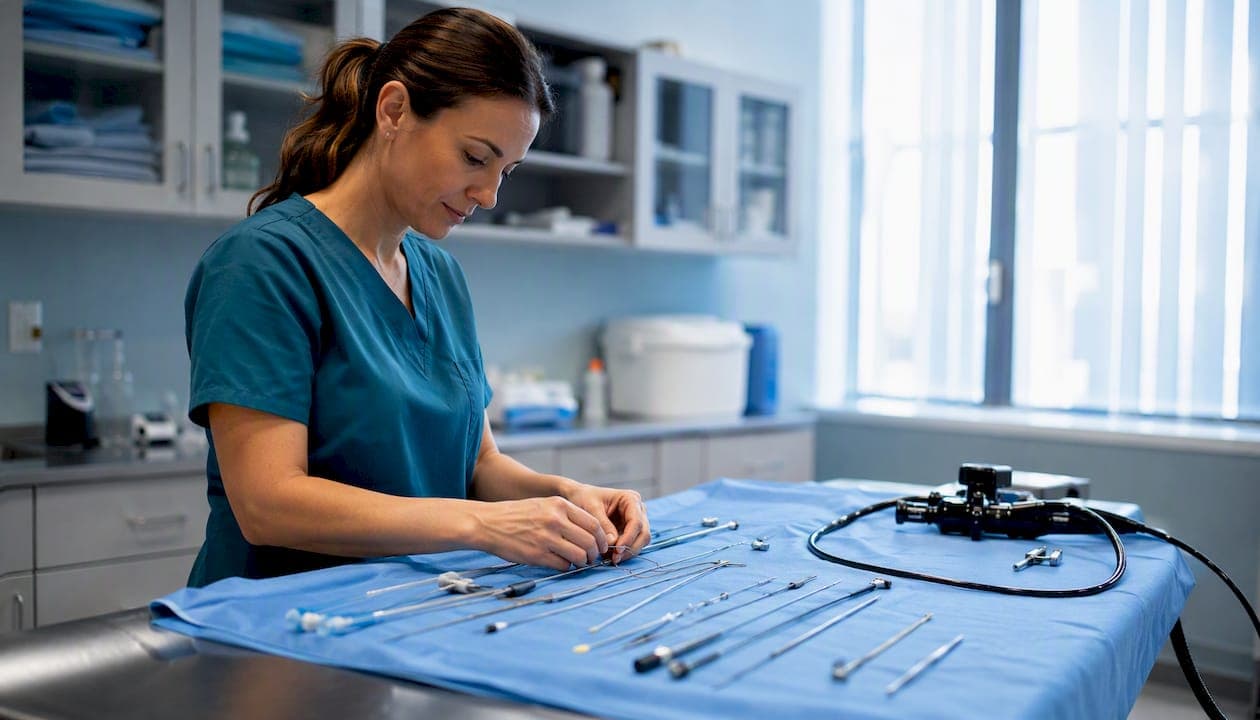
A fully stocked veterinary endoscopy suite needs eight core accessory categories: diagnostic instruments (biopsy forceps, cytology brushes), foreign-body retrieval tools, therapeutic snares and electrosurgical accessories, irrigation and suction valves, the imaging chain (light source, camera/processor, monitor), reprocessing supplies, specialty small-diameter tools for avian and exotic patients, and transport/storage solutions. Get those eight right and you can handle the vast majority of GI, airway, urologic, arthroscopic, and exotic-animal cases without scrambling for missing parts mid-procedure.
Quick-scan category checklist:
- Biopsy forceps and cytology brushes (diagnostic core)
- Foreign-body retrieval tools: alligator, raptor, tripod graspers, baskets, nets
- Snares, hot biopsy forceps, electrosurgical and hemostatic accessories
- Irrigation tubing, suction tubing, air/water valves, insufflation equipment
- Light source, camera/processor, monitor, and documentation accessories
- Reprocessing supplies: channel brushes, enzymatic cleaners, HLD solutions, leak testers
- Specialty small-diameter tools (1.9–2.7 mm) for avian, exotic, and pediatric cases
- Protective carrying cases, scope hangers, padded trays, and transport solutions
Table of Contents
- What to check before you buy any endoscopy accessories
- How the imaging chain determines which accessories actually work
- 1. Biopsy forceps and cytology brushes
- 2. Foreign-body retrieval tools
- 3. Snares, electrosurgical tools, and hemostatic accessories
- 4. Irrigation, suction, valves, and insufflation equipment
- 5. Reprocessing supplies and consumables
- 6. Procedure-specific accessory checklists
- 7. Storage, transport, and maintenance best practices
- 8. Clinic-ready inventory checklist and starter kit
- 9. What to ask suppliers before placing an order
- Stock your clinic with compatible accessories from 1800endoscope
- Key Takeaways
- The case for investing in the imaging chain first
- Useful sources and further reading
What to check before you buy any endoscopy accessories
Buying accessories before confirming compatibility is one of the most common and expensive mistakes in veterinary procurement. A biopsy forceps rated for a 2.8 mm working channel will not pass through a 2.0 mm channel, and no amount of force fixes that on procedure day.
The four compatibility checks that matter most:
- Working channel diameter: Confirm the inner diameter of every scope in your fleet. Accessories must be sized at or below that figure, not just "close."
- Instrument working length: The accessory shaft must reach the distal tip with enough length to deploy. Measure from the instrument entry port to the target anatomy.
- Connector and sterilization limits: Verify that each accessory's connector type matches your scope's instrument port and that the accessory's sterilization tolerance (autoclave, EtO, HLD only) matches your reprocessing workflow.
- Single-use vs. reusable balance: Single-use accessories eliminate reprocessing risk but add per-case cost. Reusable instruments lower cost per use but require validated reprocessing and periodic replacement.
Workflow and throughput shape the decision as much as specs do. A single-room clinic running two to three scoping cases per day can often reprocess reusable accessories between cases. A multi-room practice with back-to-back cases may need two or three sets of critical instruments to maintain safe turnover times. Staff skill matters too: if your team is not yet trained on reprocessing validation, single-use accessories for the highest-risk items reduce exposure.
Budget tradeoffs are real. Reusable cup biopsy forceps cost more upfront but pay off over dozens of cases. Repair turnaround on accessories varies widely by vendor, so ask specifically: what is the average return time, and do they offer loaner instruments? Warranty terms on flexible accessories often exclude damage from improper reprocessing, which is worth reading carefully before signing a purchase order.
Pro Tip: Build your accessory portfolio around your clinic's top three procedure types, not around a generic "complete kit." A practice doing mostly small-animal GI and occasional airway work needs a very different set than one doing avian endoscopy and equine upper-airway exams. Procedure-driven accessory selection saves money and reduces clutter.
How the imaging chain determines which accessories actually work
The imaging chain is not background infrastructure. The quality of your light source, camera, and monitor directly determines how useful your retrieval and therapeutic accessories are in practice. A high-quality grasper is nearly useless if the operator cannot see clearly enough to position it.
A complete endoscopy system includes the endoscope itself, a light source, an air pump, a camera/processor, and a video monitor, with insufflators and irrigation pumps rounding out the support chain for most procedures. Each component creates downstream requirements for accessories.
| System component | Key compatibility questions |
|---|---|
| Endoscope (rigid or flexible) | Working channel diameter, instrument port size, shaft length, sterilization tolerance |
| Light source (LED or xenon) | Light guide connector type (ACMI, Storz, Wolf, Olympus), output wattage for photography/video |
| Camera/processor | Camera head connector, video output format (HD, 4K), recording capability |
| Monitor | Resolution (HD minimum), input ports (HDMI, SDI), screen size for procedure room |
| Irrigation/suction pump | Flow rate (mL/min), pressure range, tubing connector compatibility |
| Insufflator | CO₂ vs. air, flow rate (L/min), pressure limit settings |
Xenon light sources produce the brightest, most color-accurate illumination and are the standard for photography and video documentation. LED sources have improved substantially and are now practical for most diagnostic work, with lower heat output and longer bulb life. For avian and exotic cases where you need a 150 W minimum for observation and a xenon source for endoscopic photography, the light source choice directly affects what you can document and diagnose. See the 1800endoscope guide on choosing a light source for a detailed breakdown.
Documentation and recording accessories to stock:
- HD video capture device or integrated processor with SD card recording
- SD cards (Class 10 or UHS-I minimum) in sufficient quantity for daily case volume
- Thermal or inkjet medical-grade printer for still images and client communication
- HDMI or SDI cables in the lengths your suite requires (measure before ordering)
- USB drives or network storage for case archive export
1. Biopsy forceps and cytology brushes
Biopsy forceps and cytology brushes are the diagnostic core of any veterinary endoscopy setup. Cup biopsy forceps come in standard cup, fenestrated cup, and alligator-jaw configurations. The fenestrated cup retains more tissue per bite and is preferred for GI mucosal sampling. Standard cup forceps work well for airway and urologic biopsies where the target tissue is more accessible.
Spec sizing by working channel:
- 1.2–1.8 mm channel: semi-flexible forceps ~1.8 mm OD (avian/exotic)
- 2.0–2.8 mm channel: standard 2.0–2.4 mm OD cup forceps
- 2.8–3.7 mm channel: larger cup or fenestrated forceps, 2.8–3.2 mm OD
- 5.0 mm and above: full-size cup, alligator, or jumbo forceps
Cytology brushes pass through the same channels and are used for mucosal surface sampling when histopathology is not required or when a brush specimen complements a biopsy. Protected cytology brushes (sheathed) reduce contamination during passage. Stock at least two sizes to match your scope fleet.
2. Foreign-body retrieval tools
Retrieval instruments are where accessory variety pays off most directly. A foreign body that a two-prong grasper cannot grip may come out cleanly with a basket or a retrieval net, and having the wrong tool in the room means either abandoning the procedure or causing mucosal trauma trying to force it.
The core retrieval set for a small-animal GI practice:
- Alligator forceps: serrated jaws for firm grip on dense objects (bones, stones)
- Raptor forceps: rat-tooth jaw pattern for soft or irregular objects
- Tripod graspers: three-prong design for round or smooth objects that slip from two-prong jaws
- Polypoid retrieval nets: mesh basket for soft masses or fragmented material
- Wire baskets (Dormia-style): for uroliths and small rounded foreign bodies in the ureter or urethra
- Magnetic retrievers: for ferrous metallic objects in the esophagus or stomach
Size each retrieval tool to the working channel and the expected foreign-body size. A basket that opens to 15 mm is useless for a 30 mm gastric foreign body. Know your patient population and stock accordingly.
3. Snares, electrosurgical tools, and hemostatic accessories
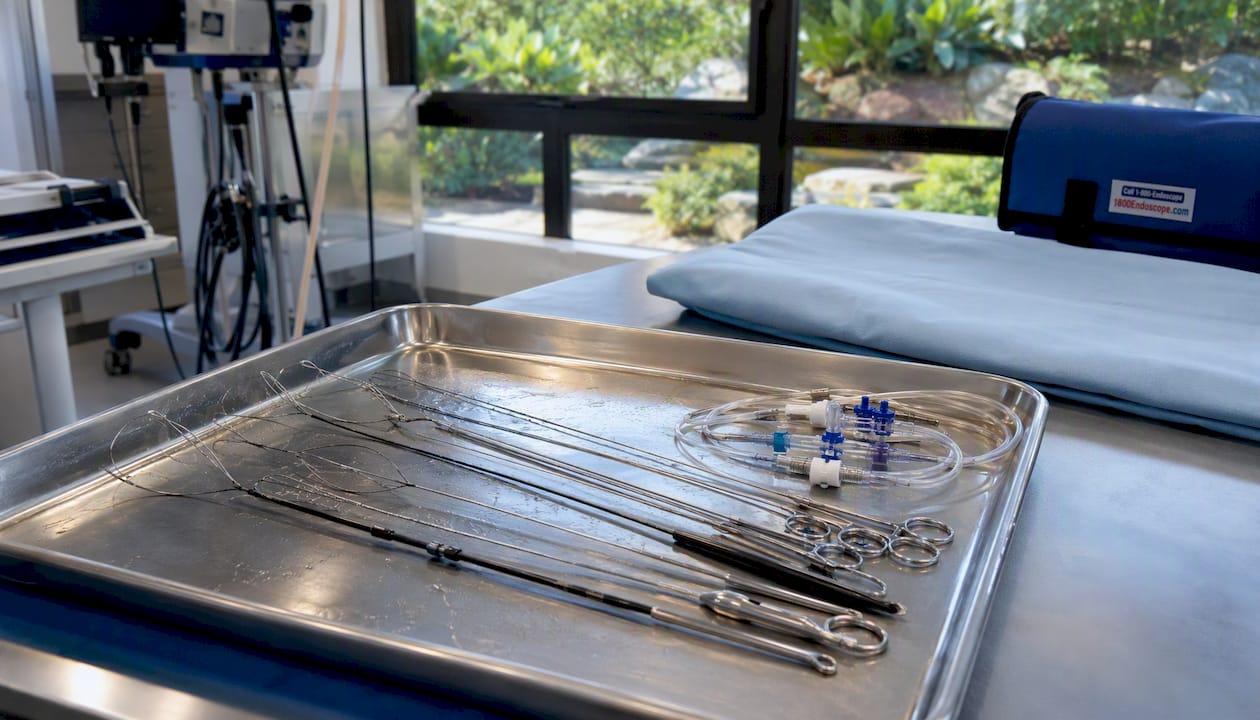
Therapeutic endoscopy expands the scope of what you can accomplish without open surgery, but it requires a broader instrument set and, for electrosurgical tools, compatibility with your generator. Radiosurgical, monopolar, and bipolar instruments are standard in avian and small-laparoscopic toolkits, and the same applies to small-animal GI polypectomy.
Therapeutic accessory checklist:
- Polypectomy snares (hexagonal, oval, crescent configurations) in 10 mm and 15 mm opening sizes
- Hot biopsy forceps (electrosurgical cup forceps for simultaneous sampling and hemostasis)
- Electrosurgical snares with appropriate connector pins for your generator
- Hemostatic clips (through-the-scope, 11 mm and 16 mm clip widths)
- Injection needles (sclerotherapy/submucosal injection, 23-gauge standard)
- Dilation balloons (through-the-scope, sized to stricture diameter)
- Neutral electrode pads for monopolar electrosurgery
- Electrosurgical generator with compatible output settings (verify wattage range with accessory IFU)
Confirm connector pin type and expected wattage range with your generator manufacturer before ordering electrosurgical accessories. A mismatched connector is not just inconvenient; it is a patient safety issue.
4. Irrigation, suction, valves, and insufflation equipment
Mucosal visualization depends on keeping the field clear, and that means having a reliable irrigation and suction setup. Clogged suction channels and failed air/water valves are among the most common reasons a procedure gets interrupted.
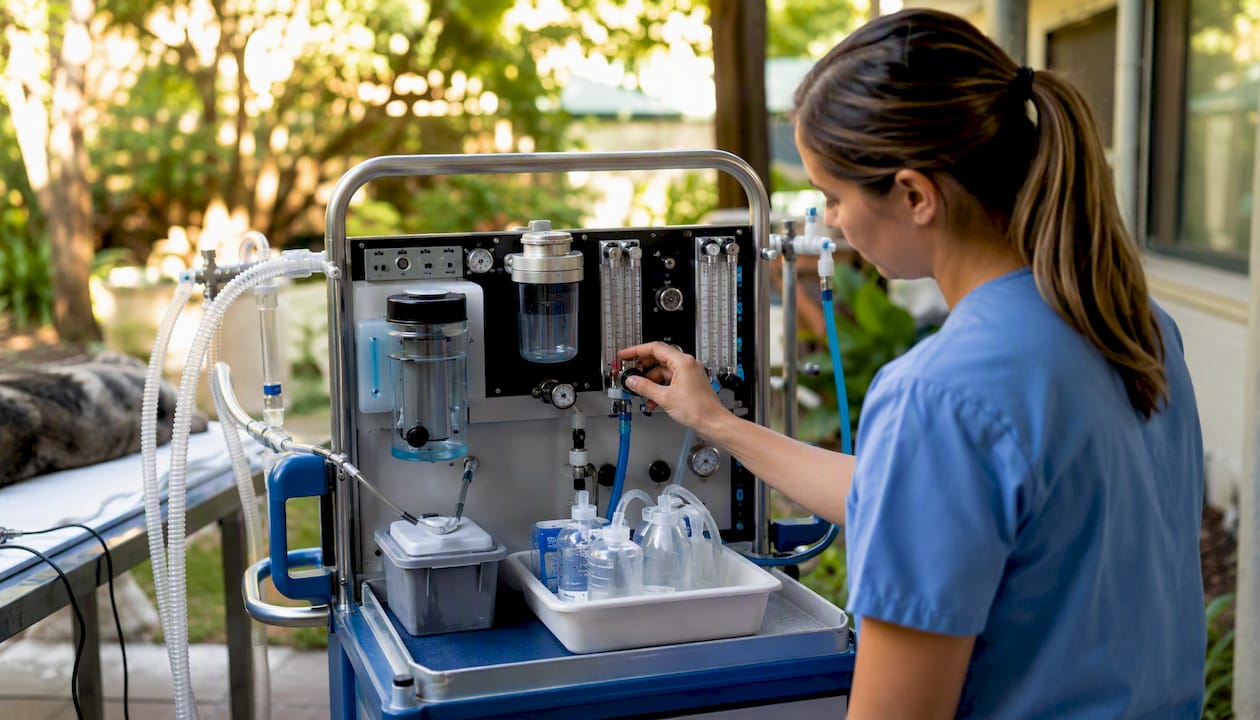
Procedure consumables including air/water buttons, suction tubing, biopsy valves, and single-use valves are critical for case flow and must be stocked in sufficient quantity for daily volume. Running out of single-use valves mid-session is avoidable with a simple par-level system.
Irrigation, suction, and valve inventory:
- Air/water valves (scope-specific; stock two per scope in service)
- Suction valves (scope-specific; same stocking rule)
- Single-use biopsy valves (per-case consumable; stock by daily case count)
- Irrigation tubing sets (compatible with your pump's barb size)
- Suction tubing (standard 3/16" ID for most veterinary suction units)
- Y-connectors and three-way stopcocks for multi-port irrigation setups
- Insufflation tubing (CO₂ or air, matched to insufflator port)
- Lubricating gel (water-soluble, scope-compatible, not petroleum-based)
Valves are the most frequently replaced scope accessories. Keep at least two sets per scope in active use, and replace any valve that shows cracking, stiffness, or failure to seal. A leaking suction valve wastes suction pressure and compromises visualization.
5. Reprocessing supplies and consumables
Reprocessing is not optional and not a secondary concern. Endoscopes are classified as critical or semi-critical devices: critical devices require sterilization, while semi-critical devices require at minimum high-level disinfection. Laparoscopes and arthroscopes that penetrate sterile tissue are critical instruments. Gastroscopes and bronchoscopes that contact mucous membranes are semi-critical. Treating them the same way is a reprocessing failure waiting to happen.
Reprocessing supply checklist:
- Channel cleaning brushes in each diameter used in your scope fleet (replace after each use or per manufacturer guidance)
- Enzymatic detergent solution (low-foaming, scope-compatible formulation)
- High-level disinfectant (glutaraldehyde, OPA, or peracetic acid system per your scope's IFU)
- Enzymatic soak basin or automated endoscope reprocessor (AER)
- Leak tester (manual bulb or automated, matched to scope's leak-test port)
- Sterilization packaging (pouches, wraps) for critical accessories
- Chemical indicators (Class 5 integrators for steam; appropriate indicators for EtO or peracetic acid)
- Biological indicators for periodic sterilization cycle validation
- Drying cabinet or HEPA-filtered air supply for post-HLD drying
- Scope storage cabinet (ventilated, vertical hanging, clean zone)
The drying step is where many clinics cut corners. After high-level disinfection, the interior channels must be dried with instrument air or HEPA-filtered air until no water exits the distal tip, and the manufacturer's IFU specifies the correct air pressure in PSI. Skipping this step allows residual moisture to support microbial growth during storage.
Pro Tip: Schedule reprocessing time as a fixed block in your procedure calendar, not as an afterthought between cases. A flexible scope requires a minimum of 20–45 minutes for proper manual reprocessing. If your case volume does not allow that window, you need either an AER or additional scope sets, not a shorter reprocessing protocol.
6. Procedure-specific accessory checklists
Accessory selection by procedure type is where a generic kit falls short. Curating sets by procedure rather than buying undifferentiated kits saves money and keeps procedure carts organized. Here is what each major procedure type actually requires.
GI endoscopy (gastroscopy, colonoscopy)
Primary priorities: mucosal visualization, biopsy, foreign-body retrieval, and hemostasis.
- Flexible gastroscope or colonoscope (appropriate length and channel diameter)
- Cup biopsy forceps (fenestrated preferred for GI mucosa)
- Cytology brushes
- Foreign-body retrieval set (alligator, raptor, basket)
- Polypectomy snares and hemostatic clips
- Injection needles for submucosal injection
- Single-use biopsy valves and suction valves
- Irrigation tubing and water pump
- Bite block (for esophagogastroscopy)
- Lubricating gel
Bronchoscopy and airway endoscopy
Primary priorities: delicate visualization, gentle sampling, and minimal mucosal trauma.
- Flexible bronchoscope (small-diameter for cats and small dogs)
- Small cup biopsy forceps (2.0 mm OD or smaller)
- Protected cytology brush
- Bronchoalveolar lavage (BAL) catheter or suction trap
- Suction tubing and suction valve
- Saline for lavage (sterile, warmed)
- Single-use biopsy valves
- Oxygen supplementation equipment (procedure support)
Urologic endoscopy (cystoscopy)
Primary priorities: visualization, biopsy, and urolith retrieval.
- Rigid or semi-rigid cystoscope (appropriate diameter for patient size)
- Irrigation pump and tubing (sterile saline)
- Cup biopsy forceps
- Wire basket for urolith retrieval
- Grasping forceps
- Electrosurgical accessories if ablation is planned
- Single-use sheaths (if applicable)
Arthroscopy
Primary priorities: joint visualization, tissue sampling, and surgical access. Arthroscopes are critical devices requiring sterilization, not HLD.
- Rigid arthroscope (2.7 mm or 4.0 mm, procedure-dependent)
- Trocar and cannula set
- Irrigation pump (high-flow, arthroscopy-rated)
- Probes and hooks
- Grasping forceps and scissors
- Shaver system (if available)
- Sterilization pouches and indicators
Avian and exotic endoscopy
Avian endoscopy uses rigid scopes with small diameters, semi-flexible biopsy forceps sized for delicate work, and fine-gauge infusion and aspiration needles suitable for small patients. Radiosurgical electrodes are used for minimal-access procedures. The entire instrument set must be scaled to the patient: the same 2.7 mm scope used in a large parrot is also used in a small mammal, but the approach and accessory selection differ by anatomy.
- Rigid endoscope 1.9–2.7 mm (xenon light source preferred for documentation)
- Fiberoptic light cable (matched to light source connector)
- Simple sheath or operating sheath (for instrument passage)
- Semi-flexible biopsy forceps ~1.8 mm OD
- 22-gauge aspiration/infusion needles
- Radiosurgical electrode (monopolar, fine-tip)
- Sterile saline for irrigation
- Magnification eyepiece or camera adapter for documentation
Equine upper-airway and gastric endoscopy
Primary priorities: long working length, large-diameter visualization, and robust suction.
- Long flexible endoscope (1.0–1.5 m working length for upper airway; 2.5–3.0 m for gastroscopy)
- Large-diameter biopsy forceps
- Suction pump (high-capacity)
- Irrigation pump and tubing
- Grasping forceps for airway foreign bodies
- Bite guard (for gastroscopy)
- Portable video system for field use
Pro Tip: For multi-species clinics, identify which accessories cross-apply between procedures. A 2.4 mm biopsy forceps that works in your small-animal gastroscope may also work in your bronchoscope. Mapping cross-compatibility reduces the total number of SKUs you need to stock and simplifies reordering.
7. Storage, transport, and maintenance best practices
Proper storage and handling prevent most accessory and scope failures before they happen. A scope that is coiled too tightly, stored in a non-ventilated cabinet, or transported without padding will develop problems that no repair turnaround can fix cheaply.
Storage essentials:
- Hang flexible scopes vertically in a ventilated storage cabinet; never coil and store in a case
- Store sterilized accessories in sealed packaging, separated from non-sterilized items
- Use padded instrument trays for rigid telescopes and accessories
- Control humidity in the storage area; excessive moisture promotes corrosion and microbial growth
- Label storage locations by scope model and accessory type for fast retrieval
Handling rules that prevent expensive damage:
- Pick up rigid telescopes by the ocular housing, never by the insertion barrel; gripping the barrel can cause subtle rod-lens misalignment that degrades image quality permanently
- Secure light guide connectors before moving a scope; a dropped connector damages the fiber bundle
- Never force an accessory through a working channel; resistance means a size mismatch or a channel obstruction
Maintenance and troubleshooting checklist:
- Image degradation: clean the distal lens with a soft lens cloth and scope-safe solution; check the light guide for broken fibers (dark spots in the image); inspect the camera head connection.
- Channel blockage: flush with water, then enzymatic solution; if blockage persists, use the appropriate diameter channel brush; do not use metal instruments to clear a channel.
- Leak test failure: remove the scope from service immediately; do not immerse a scope that fails leak testing; send for repair before next use.
- Suction or air/water failure: check and replace the corresponding valve first; if the problem persists after valve replacement, the channel may be damaged.
- Accessory deployment failure: check for kinking in the shaft; inspect the handle mechanism; replace if the jaw or snare does not open and close smoothly.
For a deeper troubleshooting reference, the 1800endoscope animal endoscopy troubleshooting guide covers the most common failure patterns and their fixes.
8. Clinic-ready inventory checklist and starter kit
A single-room small-animal clinic running GI and airway cases can cover most of its caseload with the items in the table below. Scale quantities up for multi-room setups or add specialty columns for avian/exotic and equine work.
| Item | Typical spec | Qty (single room) | Replacement frequency |
|---|---|---|---|
| Cup biopsy forceps (reusable) | 2.0–2.4 mm OD | 2 sets | Every 100 uses or on jaw damage |
| Cytology brushes (single-use) | 2.0 mm OD | 10/box | Per case |
| Alligator retrieval forceps | 2.4 mm OD | 1 set | Annually or on jaw wear |
| Polypectomy snares | 10 mm and 15 mm | 5 each | Per case (single-use) or per protocol |
| Hemostatic clips | 11 mm width | 10/box | Per case |
| Air/water valves | Scope-specific | 2 per scope | On failure or cracking |
| Suction valves | Scope-specific | 2 per scope | On failure |
| Single-use biopsy valves | Universal fit | 20/box | Per case |
| Channel cleaning brushes | Match scope channel diameter | 2 per diameter | Per use (replace per IFU) |
| Enzymatic detergent | Scope-compatible | 1 L concentrate | Per reprocessing session |
| HLD solution | Per scope IFU | Per AER or basin | Per manufacturer cycle limit |
| Leak tester | Scope-specific | 1 | Replace on failure |
| Sterilization pouches | Appropriate size | — | Per sterilization cycle |
| Chemical indicators | Class 5 integrators | 1 box | Per sterilization cycle |
| Irrigation tubing | Pump-compatible | 5 sets | Per case (single-use) |
| Lubricating gel | Water-soluble | 1 tube | Per case |
Add-ons for specialty practices:
- Avian/exotic: 1.9 mm and 2.7 mm rigid scopes, 1.8 mm semi-flexible biopsy forceps, 22-gauge aspiration needles, radiosurgical electrode set, xenon light source
- Equine: long flexible scope (2.5–3.0 m), high-capacity suction pump, large-diameter biopsy forceps, portable video system for field use
SKU planning tips: Set reorder points at 20% of par level for single-use consumables. Keep one spare set of critical reusable instruments (biopsy forceps, retrieval tools) so a repair does not halt your schedule. For accessories with long lead times from specialty suppliers, maintain a 30-day buffer stock.
9. What to ask suppliers before placing an order
Always verify channel diameter, working length, connector type, material (single-use vs. reusable), and sterilization compatibility in writing before purchase. A vendor who cannot provide that information in writing is a vendor worth reconsidering.
Vendor questions for procurement staff:
- What is the exact outer diameter of this accessory, and what minimum working channel diameter does it require?
- What is the working length, and is it compatible with our specific scope model?
- Is this accessory single-use or reusable? If reusable, what reprocessing methods are validated (autoclave, EtO, HLD)?
- What is the warranty period, and what does it exclude (e.g., damage from reprocessing)?
- What is the average repair or replacement turnaround time?
- Are replacement parts (jaws, sheaths, handles) available separately?
- For electrosurgical accessories: what connector pin type, and what wattage range is the accessory rated for?
- Can you provide the Instructions for Use (IFU) and reprocessing instructions before purchase?
- What is the lead time for reorder, and is there a minimum order quantity?
Red flags that should pause any purchase:
- No working channel diameter listed in the product specification
- No reprocessing instructions or IFU available
- Warranty that excludes all reprocessing-related damage without qualification
- Vague compatibility claims ("fits most scopes") with no model-specific confirmation
- No stated working length or shaft diameter
For electrosurgical accessories specifically, request the connector/pin diagram and confirm it matches your generator's input. Wattage compatibility is not a minor detail: an accessory rated for 20 W used on a 100 W setting is a patient safety event.
Stock your clinic with compatible accessories from 1800endoscope
Getting the right accessories on the shelf before a case is scheduled is the difference between a smooth procedure and a last-minute scramble. 1800endoscope stocks veterinary-compatible rigid and flexible endoscopy accessories, including biopsy forceps, valves, light sources, and cleaning tools, alongside complete imaging systems for small-animal, avian/exotic, and equine applications.
For clinics building or upgrading a starter system, the portable HD airway endoscopy system covers airway inspection with direct monitor output and SD card video recording at a price point that works for single-room practices. For rigid-scope applications including avian and exotic work, the veterinary rigid endoscopy catalog covers the small-diameter scopes and accessories that exotic-animal practices depend on. Procurement staff can browse product specs, confirm channel diameters, and contact the team directly for compatibility matching before placing an order.
Key Takeaways
A complete animal endoscopy accessories list covers eight categories: diagnostic instruments, retrieval tools, therapeutic snares, irrigation and suction hardware, the imaging chain, reprocessing supplies, specialty small-diameter tools, and storage solutions.
| Point | Details |
|---|---|
| Verify compatibility first | Confirm working channel diameter, working length, and connector type in writing before any purchase. |
| Classify scopes correctly | Laparoscopes and arthroscopes require sterilization; gastroscopes and bronchoscopes require high-level disinfection at minimum. |
| Build procedure-driven sets | Curate accessory sets by your top procedure types rather than buying a generic complete kit. |
| Reprocessing is non-negotiable | Dry channels with HEPA-filtered air post-HLD; a scope that fails leak testing must be pulled from service immediately. |
| 1800endoscope for sourcing | 1800endoscope stocks veterinary rigid and flexible accessories with spec support for compatibility matching before purchase. |
The case for investing in the imaging chain first
The conventional wisdom in veterinary endoscopy procurement is to buy the scope and then fill in accessories as budget allows. That sequence is backwards. A retrieval forceps guided by a dim, low-resolution image is less effective than the same forceps used under a bright xenon light with a clear HD monitor. The imaging chain is the multiplier on every other accessory in the room.
Clinics that invest in a quality light source and camera/processor first, then build their accessory portfolio around confirmed channel sizes, consistently get more diagnostic value from their instruments than clinics that do the reverse. The accessories are only as useful as the view they are deployed into.
The other underestimated investment is reprocessing infrastructure. A scope that is inadequately dried or stored in a non-ventilated cabinet will develop channel contamination issues that compromise patient safety and accelerate device wear. The cost of a drying cabinet and a validated HLD system is small compared to the cost of a scope repair or, worse, a post-procedure infection investigation.
For clinics at any stage of building their endoscopy program, the 1800endoscope veterinary accessories clinical guide is a practical starting point for matching instruments to procedures and scopes.
Useful sources and further reading
- APIC Endoscope Reprocessing Checklist (2025) — Step-by-step reprocessing checklist including drying protocols and air-flush pressure guidance; the most current U.S. infection control reference for endoscope reprocessing.
- Public Health Ontario: Clinical Office Endoscopy Checklist — Covers critical vs. semi-critical device classification and HLD vs. sterilization requirements; useful for establishing reprocessing policy.
- Clinical Avian Medicine: Endoscopy Chapter (Harrison's Bird Foods) — Detailed equipment tables for avian endoscopy including scope diameters, biopsy forceps sizes, and radiosurgical electrode guidance.
- Avian Endoscopy (VIN/WSAVA) — Equipment requirements for avian rigid endoscopy including light source wattage recommendations and sheath use.
- Therapeutic Endoscopy (AAVAC) — Covers therapeutic instrument categories and training considerations for avian and small-animal laparoscopic procedures.
- 1800endoscope: Veterinary Scoping Accessories Overview — Practical overview of accessory categories and clinical use for veterinary professionals.
- 1800endoscope: Small Animal Endoscopy Tips — Procedure-specific guidance for small-animal cases including accessory selection and handling tips.