
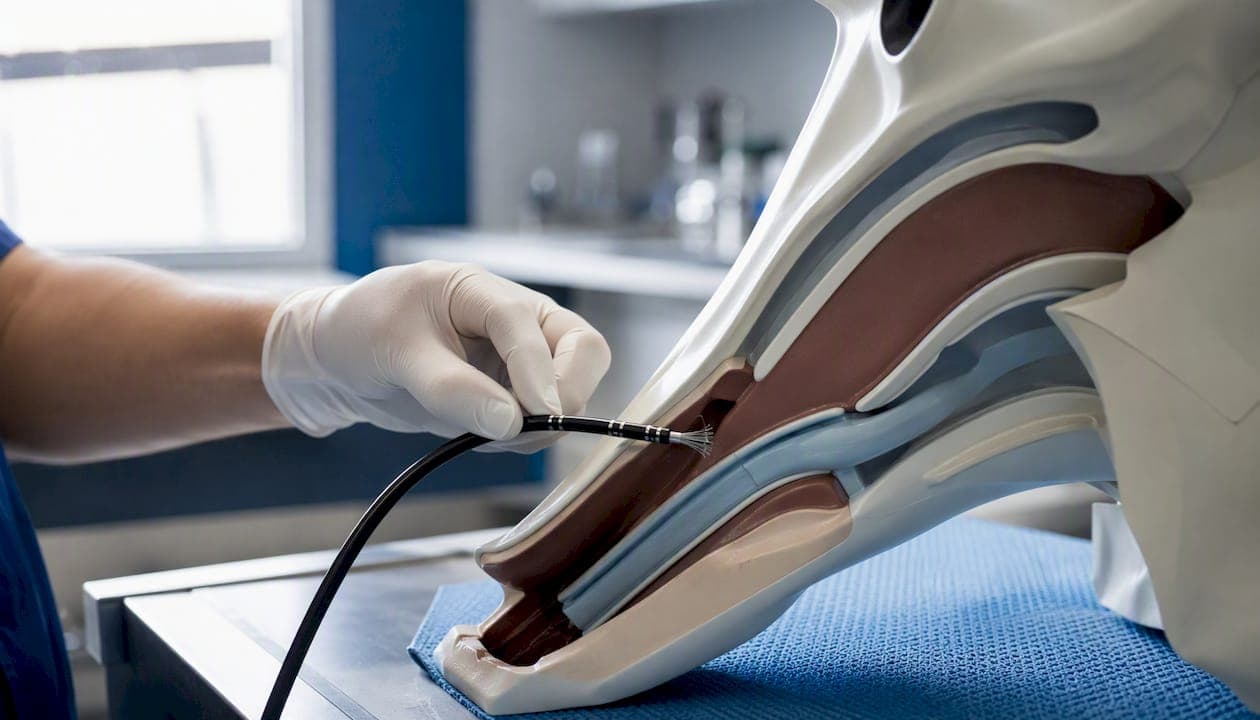
A fiberscope is a flexible optical instrument that carries an image through a coherent bundle of thousands of thin glass or plastic fibers, relaying what a tiny lens sees at one end to an eyepiece or camera at the other. It's the tool a veterinarian reaches for to check a horse's airway around a curve no rigid scope could follow, and it's the same basic technology a turbine inspector threads through a combustion chamber to spot a hairline crack. The physics behind it rests on total internal reflection, the same principle that keeps light trapped inside a fiber-optic cable, and the design itself traces back to endoscopy literature from the mid-20th century. A typical imaging bundle runs about 1 millimeter in diameter and packs roughly 10,000 individual fibers, with working lengths anywhere from a few tens of centimeters to about a meter depending on the job.
That single fact, thousands of hair-thin fibers bundled together and each carrying one tiny piece of the picture, explains almost everything else about how these instruments behave, where they excel, and where they fall short.
Key Takeaways
A fiberscope earns its place in medical, veterinary, and industrial inspection work by trading some image resolution for flexible access that rigid instruments simply cannot match.
| Point | Details |
|---|---|
| Core definition | A fiberscope relays an image through a coherent bundle of thousands of optical fibers, from a distal lens to an eyepiece or camera. |
| Optical principle | Total internal reflection keeps light trapped inside each fiber, letting the bundle bend without losing the image. |
| Main tradeoff | Flexibility and small diameter come at the cost of resolution capped by fiber count and vulnerability to fiber breakage. |
| Care matters | Respecting minimum bend radius and following sterilization or cleaning protocols directly extends usable life. |
| Where to start | 1800endoscope's borescope and endoscope catalog covers fiberscope, videoscope, and rigid options for both veterinary and industrial buyers. |
Table of Contents
- What Is a Fiberscope and How Does It Actually Work?
- What Are the Main Parts of a Fiberscope?
- How Does a Fiberscope Differ From a Borescope or Endoscope?
- Where Are Fiberscopes Actually Used?
- What Are the Advantages and Limitations of Fiberscopes?
- How Should You Clean and Handle a Fiberscope?
- What Do Fiberscope Specifications Actually Mean?
- What Equipment Setups Do Professionals Actually Use?
- A Publisher's Take on Choosing and Supporting Fiberscopes
- Where to Find the Right Fiberscope for Your Work
- Further Reading and Primary Sources
- Frequently Asked Questions
- Sources
What Is a Fiberscope and How Does It Actually Work?
A fiberscope works because a coherent bundle of optical fibers keeps every strand in the exact same relative position from one end of the cable to the other. Light entering fiber number 4,732 at the tip exits from that same fiber's exact position at the eyepiece. Scramble that order and you'd get static instead of an image. Keep it coherent, and thousands of individual points of light reassemble into a picture your eye or a camera sensor can read.
The light itself stays inside each fiber through total internal reflection: a glass or plastic core surrounded by cladding with a lower refractive index, so any light ray hitting the fiber wall at a shallow angle bounces back inward instead of leaking out. That's what lets a fiberscope bend around corners without losing the image; the light just keeps reflecting along the fiber's length no matter how the cable curves.
Every working fiberscope actually contains two separate bundles fused into a single flexible sheath:
- The illumination bundle carries light from an external source down to the distal tip, lighting up whatever the scope is inspecting.
- The imaging bundle carries the reflected light back up to the eyepiece or camera, and this is the bundle whose fiber count determines image resolution.
Length and bend radius both come with tradeoffs. Push a fiberscope past its rated bend radius, or run an unusually long relay, and image brightness and quality drop off. Some fibers in the bundle can crack or snap outright from repeated tight flexing, which shows up as small dark spots or dead zones in specific parts of the picture rather than a uniform loss of clarity.
Modern videoscopes take a different approach entirely. Instead of relaying an optical image through glass fibers, they put a digital sensor right at the distal tip and send an electronic signal back through a cable, similar to how a digital camera works versus a film camera with a long lens. That distinction matters enough that it's worth a closer comparison of videoscopes and fiberscopes before you settle on either one.
What Are the Main Parts of a Fiberscope?
Every fiberscope you'll handle breaks down into six recognizable parts: distal optics, an imaging fiber bundle, an illumination fiber bundle, an eyepiece or camera coupler, an insertion sheath (sometimes with a working channel), and a control section on articulating models.
Distal optics. This is the small objective lens at the working tip, the part that actually forms the initial image before it enters the fiber bundle. Damage here, a scratch, a chip, or debris buildup, degrades every image the scope produces regardless of how good the rest of the unit is.
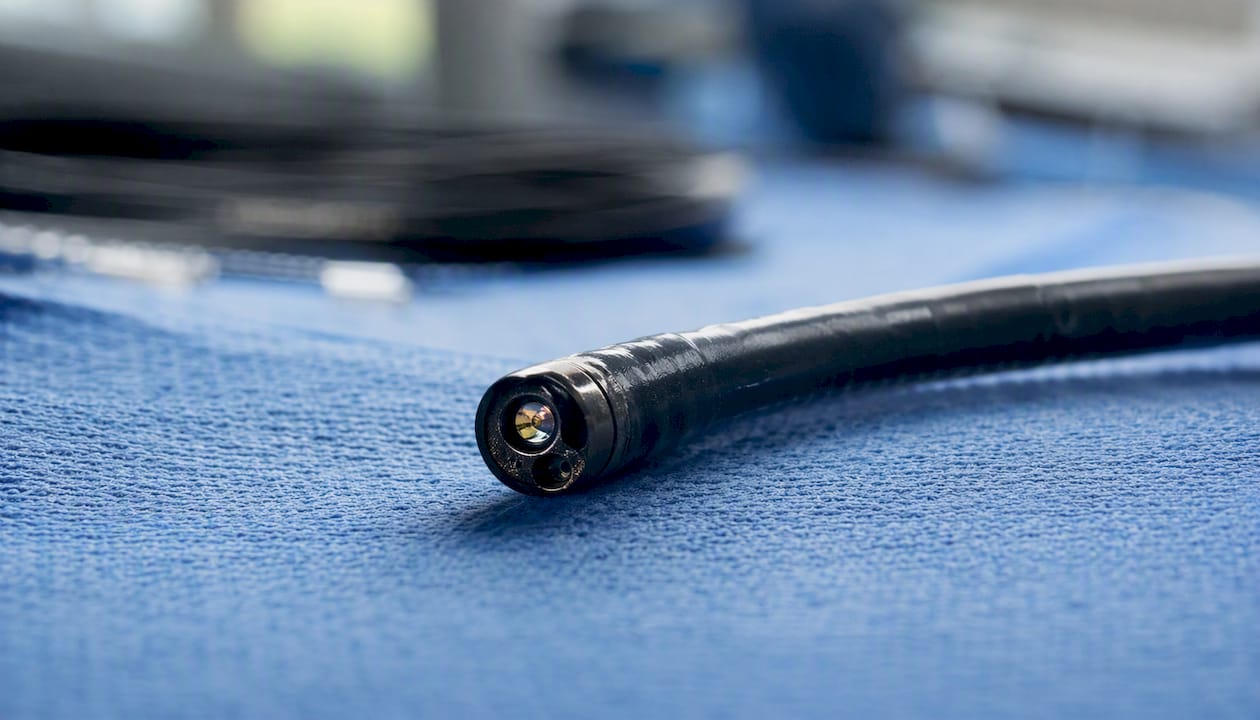
Imaging fiber bundle. The bundle count is the single biggest driver of resolution. More fibers packed into the same diameter mean a sharper, more detailed picture; fewer fibers means a coarser, more pixelated view even with perfect lighting.
Illumination fiber bundle. This carries light down to the tip from an external source. Wear or breakage here doesn't destroy the image outright, but it dims the field of view and can create uneven, patchy lighting.
Eyepiece or camera coupler. On classic optical fiberscopes, you look directly through an eyepiece, or you attach a camera adaptor to capture and display the image on a monitor. Coupling quality affects how much of the fiber bundle's actual resolution makes it onto your screen.
Insertion sheath and working channel. The outer sheath protects the fiber bundles and, on many medical and veterinary models, houses a working channel for suction, irrigation, or passing small instruments like biopsy forceps. Sheath material matters directly for sterilization compatibility.
Control section. Articulating fiberscopes include a handheld control that steers the distal tip up, down, left, or right, letting the operator navigate around bends without twisting the whole insertion tube.
Fiber breakage, distal lens damage, and light-guide wear are the three most common service issues technicians run into, and all three tend to show up gradually as small dark spots, dimming, or soft focus rather than sudden failure.
How Does a Fiberscope Differ From a Borescope or Endoscope?
A fiberscope is a flexible fiber-optic image relay tool. A rigid borescope uses a fixed lens train inside a solid metal tube instead of flexible fibers, and a videoscope replaces the fiber relay entirely with a digital sensor mounted at the tip. "Endoscope" is the broader umbrella term covering all of these; fiberscopes, videoscopes, and rigid scopes are all types of endoscopes distinguished mainly by how they capture and transmit the image.
Here's how the major categories stack up across the dimensions that actually matter when you're specifying equipment:
- Flexibility and insertion: Fiberscopes and videoscopes both bend around curves and tight corners; rigid borescopes only work in straight-line or single-angle access points.
- Image quality and resolution: Videoscopes generally deliver sharper, higher-resolution images because a digital sensor isn't limited by fiber count the way an optical relay is; fiberscope resolution is capped by how many fibers fit in the imaging bundle.
- Diameter and access: Fiberscopes can reach extremely small diameters, with some models as thin as 0.35 millimeters. They often outperform videoscopes for the narrowest access points since a fiber bundle can be drawn thinner than a sensor package.
- Illumination and field of view: Rigid borescopes typically offer the brightest, most consistent illumination since there's no fiber loss over length; fiberscopes lose some brightness over longer runs or tight bends.
- Durability and repairability: Rigid scopes are the toughest and least prone to internal damage; fiberscopes are more fragile due to breakable fibers, though a cracked section can sometimes be repaired rather than replaced outright.
- Cost and maintenance: Fiberscopes generally cost less upfront than comparable videoscopes but need more careful handling to avoid fiber damage over their working life.
In practice, the choice usually comes down to three common scenarios. If you need to navigate a narrow, twisting path, say, a small animal's airway or a tightly coiled pipe run, a flexible fiberscope or thin videoscope wins over anything rigid. If you need the sharpest possible image for documentation or a detailed diagnostic call, a distal-sensor videoscope usually outperforms an optical fiberscope. And if you're doing routine, lower-stakes inspections on a tighter budget, a fiberscope often delivers enough clarity at a fraction of a videoscope's price.
Where Are Fiberscopes Actually Used?
Fiberscopes show up across three broad domains: medical and veterinary endoscopy, industrial nondestructive testing (NDT), and general maintenance or repair work. In every case, the underlying appeal is the same: reaching somewhere a straight, rigid tool simply can't go.
In veterinary and medical settings, fiberscopes handle airway checks, upper GI exams, and equine dental inspections where a horse's long, curved oral cavity demands real flexibility. Small-diameter models are particularly valuable for small animal veterinary work, where patient size limits how large a scope can be.
Industrial inspectors rely on fiberscopes for jobs like checking turbine combustion chambers for cracking or coking buildup, inspecting jet engine interiors between service intervals, and running visual checks inside pipework that no straight borescope could navigate. Industrial fiberscopes often add tip angulation controls specifically so a technician can steer around bends deep inside machinery.
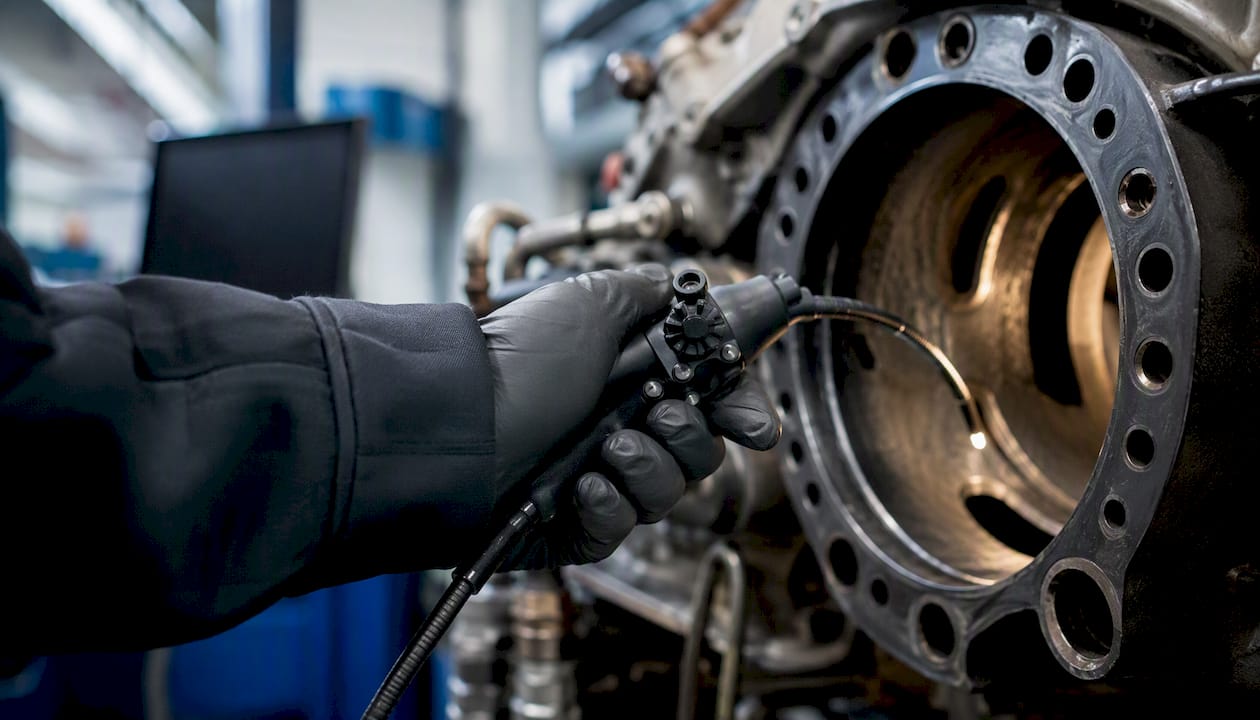
General maintenance and repair work covers everything else: checking automotive engine cylinders without disassembly, inspecting locks and mechanisms, or verifying the inside of sealed assemblies during a repair. It's a lower-stakes application in one sense, but the diameter and flexibility constraints are identical to the more specialized use cases.
The domain does dictate real constraints. Medical and veterinary use demands strict sterility protocols and sheath materials compatible with disinfection or sterilization cycles. Industrial use cares less about sterility and more about diameter limits for reaching into tight mechanical spaces, and about durability against oil, grease, and heat exposure.
What Are the Advantages and Limitations of Fiberscopes?
Fiberscopes excel at flexible access into narrow or curved paths, but they trade off some image resolution and demand careful handling compared to rigid or digital alternatives.
Strengths:
- Genuine flexibility to navigate curves and bends that stop rigid instruments cold.
- Very small outer diameters, useful for the tightest access points in both clinical and industrial work.
- A real-time optical view with essentially no processing lag, since you're looking at reflected light directly rather than a rendered digital feed.
- Generally lower upfront cost than a comparable videoscope.
Limitations:
- Resolution is capped by fiber count in the imaging bundle. More fibers means a sharper image, but you can't add fibers after manufacture.
- Individual fibers can crack or snap from repeated tight flexing or exceeding the rated bend radius, creating permanent dark spots in the image.
- Medical and veterinary units require rigorous sterilization between uses, which adds both time and cost to the workflow.
- Long fiber runs lose some brightness and clarity compared to shorter units, a real consideration for deep industrial inspections.
Pro Tip: Never exceed the scope's rated minimum bend radius, even for a moment, since fiber damage from over-flexing is cumulative and largely irreversible. Pair an older optical fiberscope with a high-intensity external light source and a quality distal optical adaptor before assuming the unit itself needs replacing; a lot of perceived "image quality" complaints actually trace back to weak illumination rather than a worn-out fiber bundle.
How Should You Clean and Handle a Fiberscope?
Proper handling and cleaning protect both the instrument and, in clinical settings, the patient. Fiberscopes are precision optical tools, and the biggest threat to their working life is mechanical stress on the fiber bundles, not general wear.
- Never coil or store a fiberscope tighter than its rated minimum bend radius, even during transport or storage between uses.
- Store scopes hanging vertically or in a dedicated case rather than coiled tightly in a drawer.
- Medical and veterinary fiberscopes require sterilization or high-level disinfection between patients, following the sheath material's specific compatibility, some tolerate certain chemical sterilants, others require different protocols entirely.
- Industrial fiberscopes need less stringent sterilization but still benefit from cleaning debris, oil, and grease off the sheath and distal lens after each use.
- Clean the working channel thoroughly on any scope equipped with one, since residue buildup there can harbor contamination or restrict suction and irrigation function.
- Inspect the image before each use: check for dark spots indicating fiber breakage, uneven illumination pointing to light-guide wear, or focus issues suggesting distal lens damage.
Always follow the specific manufacturer's cleaning and handling instructions along with your facility's clinical or workplace safety protocols, since sterilization requirements and handling limits vary by model and application.
What Do Fiberscope Specifications Actually Mean?
The core specs to check on any fiberscope are diameter, working length, fiber count, field of view, articulation range, and light source compatibility. Each one affects real-world performance in a specific, predictable way.
Diameter determines where the scope physically fits. Smaller diameters reach tighter spaces but typically pack in fewer fibers, so there's a direct tradeoff between access and resolution. Working length is how far the insertion tube extends from the control section to the tip, longer lengths reach deeper into an engine or airway but tend to lose some brightness along the way. Fiber count in the imaging bundle is the closest thing to a resolution spec on an optical fiberscope, more fibers means a clearer, more detailed picture. Field of view describes how wide an angle the distal lens captures, wider fields see more context but can distort the edges of the image. Articulation range covers how far the distal tip can bend under control input, critical for steering around sharp turns. Light source compatibility determines which illumination units will actually work with a given scope's illumination bundle.
| Specification | Typical Range | Practical Effect |
|---|---|---|
| Outer diameter | 0.35 millimeters to 1 millimeter | Smaller diameters access tighter spaces but usually carry fewer fibers |
| Imaging fiber count | Roughly 10,000 fibers in a 1 mm bundle | Higher counts produce sharper, more detailed images |
| Working length | varying from short to about a meter or more | Longer lengths reach deeper but lose some brightness over distance |
| Field of view | Varies by model | Wider views capture more context, narrower views resolve fine detail |
Diameter extremes deserve a special note. Some fiberscopes reach outer diameters as thin as 0.35 millimeters, a scale useful for the narrowest medical or mechanical access points, though cost and handling practicality push most commercial units toward diameters closer to 1 millimeter or slightly larger.
What Equipment Setups Do Professionals Actually Use?
Three standard setups cover most of the professional fiberscope work you'll encounter: a pure optical fiberscope paired with a direct eyepiece, a fiberscope fitted with a distal camera adaptor feeding a monitor, and a fully integrated videoscope with an onboard digital sensor.
The pure optical setup is the simplest and cheapest, you look through the eyepiece directly, with no camera or monitor in the chain at all. It works fine for quick visual checks but leaves no easy way to document or record what you saw. Adding a camera adaptor onto an existing fiberscope bridges that gap, letting you capture still images or video from an otherwise optical-only instrument without replacing the whole unit. A full videoscope skips the fiber relay entirely, since the sensor sits right at the tip and sends a digital feed straight to a monitor or recorder.
Common features layered onto these core setups include:
- HD capture adapters that upgrade an older optical fiberscope for digital documentation.
- Portable, battery-powered monitors for field or mobile inspection work.
- LED or xenon light source options, each with different brightness and color temperature characteristics.
- Handheld articulation controls for steering the distal tip in real time.
- Onboard SD card recording for models with integrated storage.
Pro Tip: Match your capture setup to your actual work environment rather than defaulting to the fanciest option. A distal-sensor videoscope with onboard recording makes sense for high-speed documentation where you need footage instantly, while pairing a legacy optical fiberscope with a dedicated camera adaptor is often the smarter, lower-cost move if you already own working fiberscopes and just need to add digital capture.
A Publisher's Take on Choosing and Supporting Fiberscopes
Supplying fiberscopes and accessories to veterinary clinics and industrial inspection teams surfaces the same handful of questions again and again: what diameter actually fits this job, how many fibers does a buyer really need versus what looks good on a spec sheet, and what accessories, light sources, cleaning supplies, biopsy forceps, get overlooked until the scope is already in someone's hands and the workflow stalls.
The honest answer, more often than buyers expect, is that fiber count matters less than illumination quality and sheath durability for day-to-day satisfaction. A scope with a middling fiber count paired with a strong light source and a well-fitted camera adaptor frequently outperforms a higher-spec unit fed by a weak lamp. That's a detail spec sheets rarely make obvious, and it's the kind of practical guidance that separates a good equipment recommendation from a generic one.
1800endoscope works with veterinary clinics, animal health professionals, and industrial inspection technicians on exactly this kind of product selection, alongside the accessories, light sources, and cleaning supplies that keep a fiberscope working reliably over its full service life.
Where to Find the Right Fiberscope for Your Work
1800endoscope stocks fiberscopes and related accessories built around the exact use cases covered above, from small-diameter veterinary units to industrial NDT equipment.
If your work centers on medical or veterinary airway checks, a portable airway inspection system with direct monitor and SD card recording gives you a compact, affordable setup that skips the eyepiece entirely and records straight to storage. If you're weighing rigid versus flexible options for a veterinary practice, the rigid endoscopy catalog is worth a look alongside any fiberscope you're considering. Industrial and maintenance technicians comparing scope categories for NDT work will find a full range in the borescope and endoscope catalog, covering rigid, flexible, and video options side by side so you can match diameter, working length, and image capture to the job in front of you rather than guessing from a spec sheet alone.
Further Reading and Primary Sources
For a fast, no-frills definition and typical fiber counts and lengths, the Wikipedia entry on fiberscopes is the quickest reference. Readers who want a deeper technical breakdown of the illumination and imaging bundle structure should check the ScienceDirect overview of fiberscopes. For practical failure modes like fiber breakage and image degradation from tight bends, the GlobalSpec learning center on fiberscopes offers grounded, field-level detail. Industrial buyers researching tip angulation and control mechanisms will get the most from Evident Scientific's guide to industrial fiberscopes, and anyone weighing diameter extremes against cost should read Shodensha's comparison of fiberscopes and borescopes.
Frequently Asked Questions
Is a fiberscope the same thing as a borescope? No. A fiberscope is flexible and relays its image through a bundle of optical fibers, while a borescope is typically rigid and uses a fixed lens train inside a solid tube. Both fall under the broader endoscope category, but they handle different access problems: fiberscopes for curved or narrow paths, rigid borescopes for straight-line inspection where maximum image clarity matters more than flexibility.
Is a fiberscope the same as an endoscope? "Endoscope" is the umbrella term for any scope used to see inside something otherwise inaccessible. A fiberscope is one specific type of endoscope, defined by its fiber-optic image relay, alongside rigid endoscopes and digital videoscopes.
What can a fiberscope actually see? Anywhere a thin, flexible probe can physically reach: airway and GI tract interiors in medical and veterinary use, turbine combustion chambers and jet engine interiors in industrial NDT, and tight pipework, locks, or engine cylinders in general maintenance work. The image quality depends on the imaging bundle's fiber count and the strength of the illumination source.
Can a fiberscope record video? A classic optical fiberscope cannot record on its own, you need an external camera adaptor coupled to the eyepiece to capture still images or video. Videoscopes, by contrast, have a digital sensor built into the tip and can record directly without any additional coupling hardware.
How small can a fiberscope's diameter get? Some models reach outer diameters as thin as 0.35 millimeters, though most commercially practical units run closer to 1 millimeter or slightly larger once you factor in cost and handling durability.
How long do fiberscopes typically last? Service life depends heavily on handling. Fiberscopes that stay within their rated bend radius and get proper cleaning and storage can last for years, while units regularly flexed past their limits develop fiber breakage and image dead spots much sooner.
This article provides general educational information about fiberscope technology and is not a substitute for manufacturer instructions or your facility's clinical and workplace safety protocols.
Sources
- Fiberscope — Wikipedia
- Fiberscope - an overview | ScienceDirect Topics
- Fiberscopes — GlobalSpec learning center