
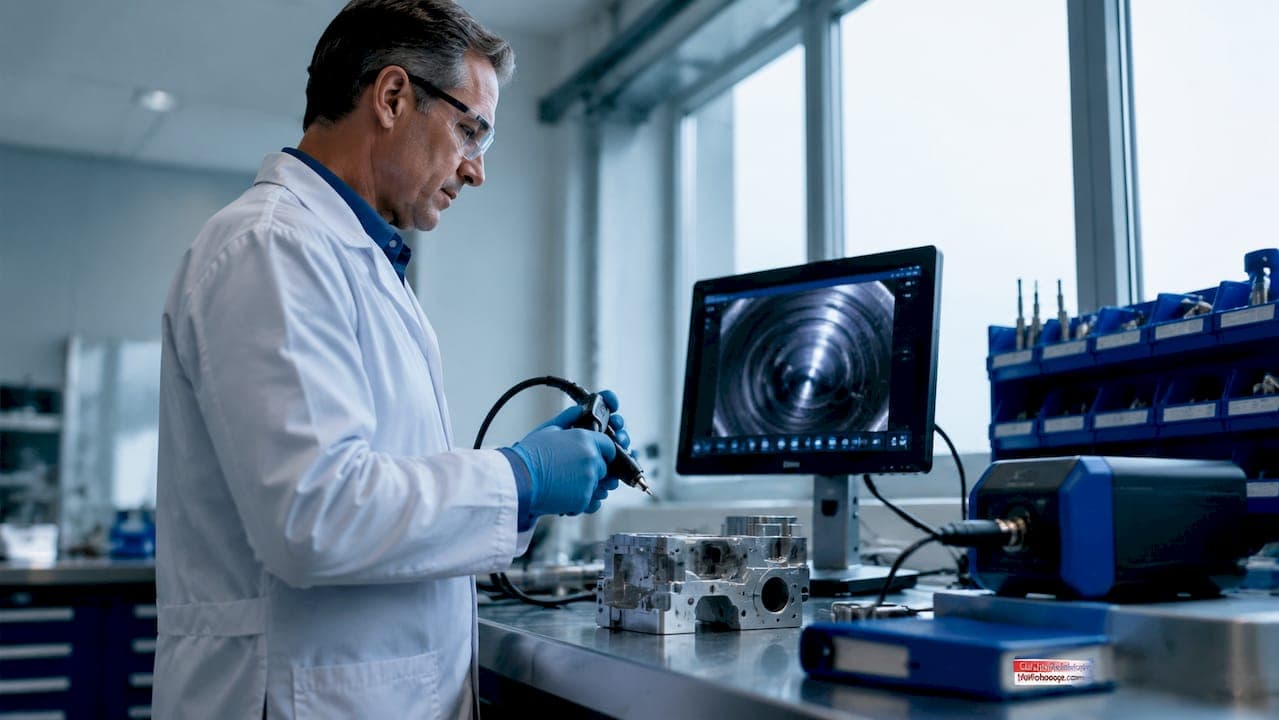
Industrial endoscopy in 2026 is defined by the convergence of 3D metrology, AI-augmented inspection, and predictive maintenance integration into a single, data-driven workflow. Remote visual inspection (RVI) professionals now face a market where borescopes are no longer standalone troubleshooting tools. They are data capture instruments feeding enterprise asset management systems. The trends in industrial endoscopy 2026 reflect a fundamental shift in how maintenance managers, NDT specialists, and technology evaluators think about inspection frequency, data traceability, and operational efficiency. Understanding these shifts is the difference between staying competitive and falling behind.
What are the major technological innovations in industrial endoscopy 2026?
The most consequential 2026 endoscopy advancements center on three hardware and software developments: sub-millimeter 3D measurement, AI-assisted navigation, and soft robotic probe design. Each addresses a distinct limitation of legacy borescope systems and together they redefine what a productive inspection looks like.
Waygate Technologies launched the Everest Mentor Flex+ with Real3D point cloud measurement, wireless connectivity, and cloud integration specifically targeting mid-market inspection workflows. The system delivers sub-millimeter defect sizing and pairs it with Menu Directed Inspection, a guided workflow protocol that standardizes operator behavior across skill levels. This matters because inspection quality has historically varied with operator experience. Standardization removes that variable.
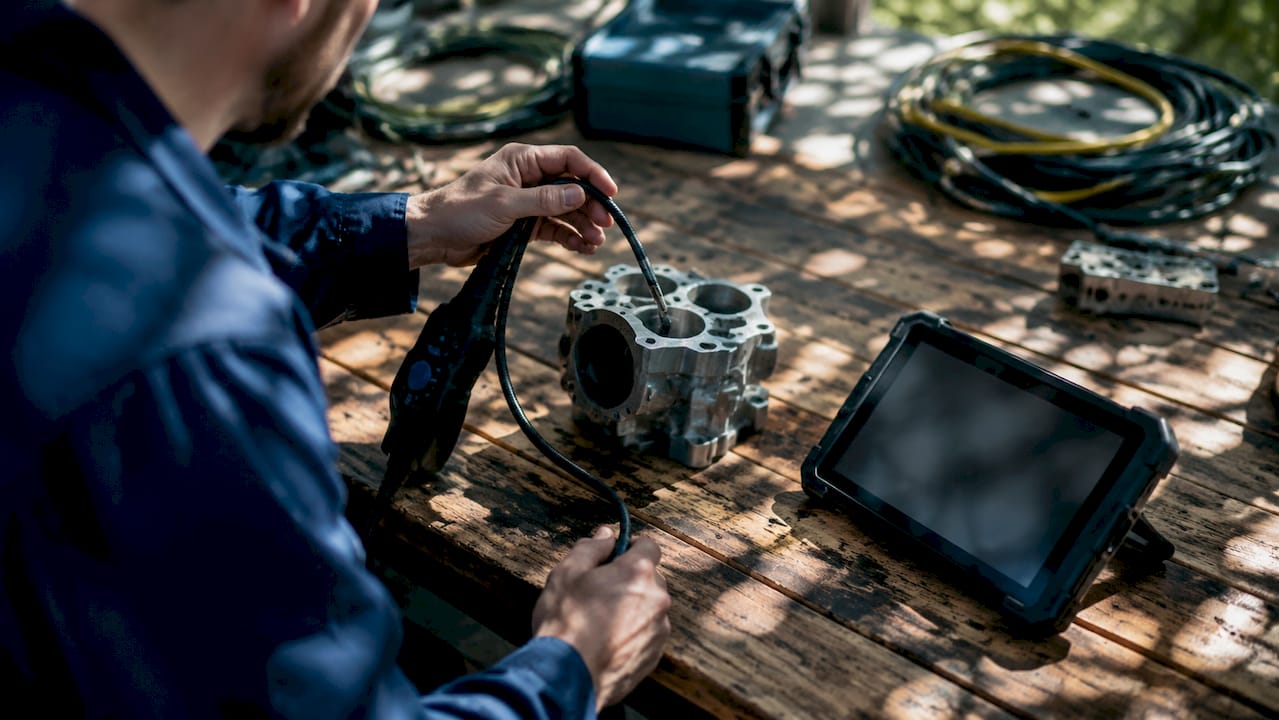
Soft robotic endoscope designs represent a parallel hardware breakthrough. Research published in Scientific Reports shows that AI-based bending prediction in soft robotic endoscopes enables enhanced articulation at lower pressures, reducing the need for physical testing iterations and improving navigation in constrained spaces. For industrial applications involving turbine blade passages, heat exchanger tubes, or aircraft engine bores, this translates directly to faster setup and fewer probe damage incidents.
Key hardware and software advances shaping 2026 industrial endoscopy innovations include:
- 3D point cloud measurement with sub-millimeter accuracy for quantitative defect sizing
- Wireless connectivity and cloud upload for automatic data tagging and real-time report generation
- Menu Directed Inspection protocols that guide operators through standardized inspection sequences
- Soft robotic probe designs with AI-driven articulation prediction for complex geometry navigation
- Interchangeable probe systems that extend platform versatility across multiple inspection diameters
- Thermal and vibration tolerance improvements enabling reliable factory floor deployment
Pro Tip: When evaluating new borescope platforms, prioritize systems that output traceable, repeatable defect measurements over those that only offer visual recording. Quantitative data is what feeds predictive maintenance models.
How is AI transforming the applications and effectiveness of industrial endoscopy?
AI's role in industrial endoscopy is not full autonomy. The near-term reality, and the smarter investment, is AI-augmented human inspection. Hybrid human-in-the-loop models offer practical improvements in accuracy and workflow efficiency without the validation burden of fully autonomous systems. This distinction matters enormously for procurement decisions in safety-critical sectors like aerospace and power generation.
The practical AI integration path in 2026 follows a clear sequence:
- Defect dimension accuracy. Machine learning models reduce measurement variability by correcting for probe angle, lighting inconsistency, and surface reflectivity. The output is a more reliable defect size estimate than manual stereo measurement alone.
- Navigation assistance. AI bending prediction models, as demonstrated in soft robotic endoscope research, support closed-loop control that enables repeatable probe positioning in complex geometries without operator guesswork.
- Workflow acceleration. AI-driven image analysis flags regions of interest during live inspection, reducing the time operators spend reviewing footage post-inspection. Faster analysis means more inspections per shift.
- Operator variability reduction. AI guidance overlays and automated measurement tools reduce the skill gap between novice and experienced inspectors, which is a significant operational benefit given the current NDT workforce shortage.
- Auditability and governance. AI adoption in industrial inspection prioritizes model explainability and dataset standardization to meet compliance requirements. Defensible, auditable measurements are the standard, not optional features.
The governance point deserves emphasis. Industrial inspection decisions carry regulatory and liability weight. An AI system that cannot explain why it flagged a defect at a specific dimension will not survive a quality audit. Vendors who treat explainability as a secondary concern are building tools that safety-critical buyers will reject.
Pro Tip: Before deploying any AI-assisted inspection tool, request documentation of the model's training dataset composition and validation methodology. If the vendor cannot provide it, the system is not ready for regulated environments.
What market and operational trends are shaping industrial endoscope deployment in 2026?
The industrial endoscopy market in 2026 is driven by one overriding operational priority: reducing unplanned downtime. IndexBox forecasts steady market growth linked to the shift from scheduled to predictive maintenance through 2035. Borescopes are now positioned as data collection instruments within broader asset integrity programs, not as reactive diagnostic tools pulled out when something breaks.
The following table compares the traditional and emerging deployment models that define current industrial endoscopy market trends:
| Dimension | Traditional deployment | 2026 predictive model |
|---|---|---|
| Inspection trigger | Scheduled interval or failure event | Condition-based, continuous monitoring data |
| Data output | Visual recording, written report | 3D point cloud, cloud-synced defect database |
| System integration | Standalone inspection record | Connected to MES, QMS, and PLM platforms |
| Operator role | Primary decision-maker | Guided by AI assistance, validates findings |
| Cost driver | Labor and downtime | Upfront system cost offset by downtime reduction |
Sector-specific growth is concentrated in aerospace, power generation, and renewable energy infrastructure. Wind turbine gearbox inspections, gas turbine hot section assessments, and heat exchanger tube surveys all require the kind of frequent, data-rich inspections that modern borescope platforms now support. Advanced manufacturing, particularly facilities running digital twin programs, is also accelerating adoption because inspection data feeds directly into virtual asset models.
Cost sensitivity remains a real constraint. Premium systems with full 3D measurement and cloud integration carry significant upfront investment. However, in sectors where a single unplanned outage costs more than the inspection system itself, the return on investment calculation is straightforward. Mid-market platforms like the Mentor Flex+ are specifically designed to close the gap between entry-level visual tools and full metrology-grade systems.
How do hardware and software advances impact practical inspection workflows?
The practical impact of 2026 endoscopy advancements on daily inspection workflows is most visible in three areas: data traceability, operator standardization, and system interoperability. These are not abstract benefits. They determine whether inspection data is usable in downstream maintenance decisions or sits in a folder no one reviews.
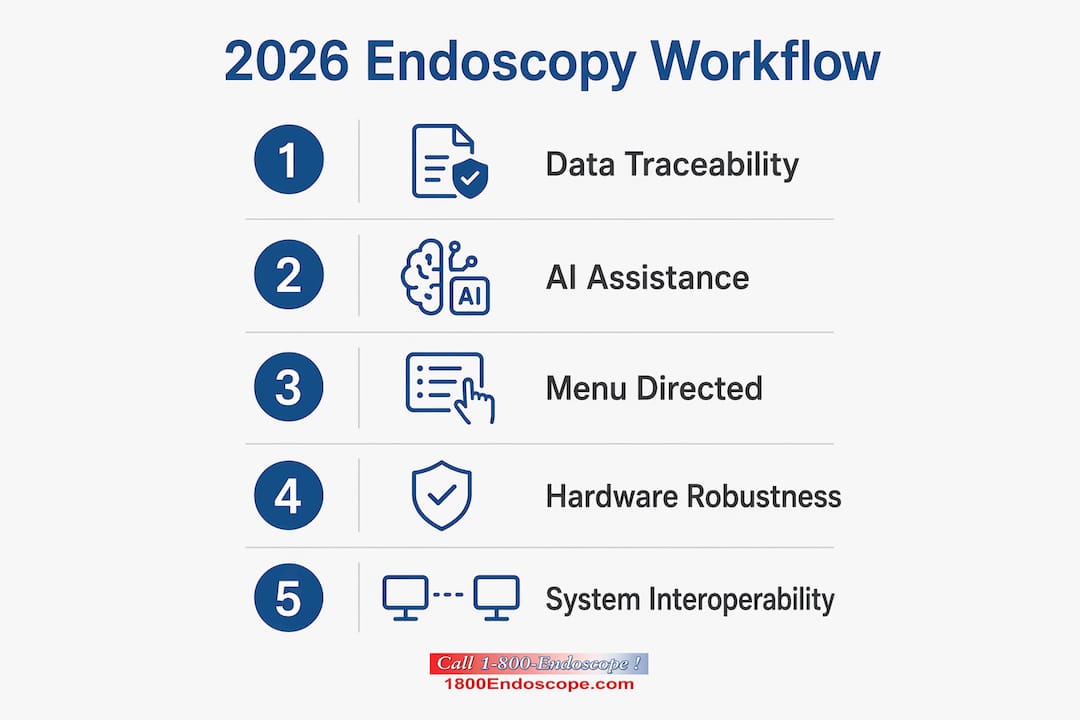
Waygate's Mentor Flex+ demonstrates the traceability model clearly. The system combines Real3D measurement with the InspectionWorks cloud platform, enabling automatic data tagging and upload at the point of inspection. Defect measurements are timestamped, geotagged to the asset, and formatted for direct import into enterprise maintenance systems. The inspector does not manually transcribe measurements into a separate report. The data flows automatically.
Menu Directed Inspection addresses a different but equally important problem: operator consistency. When inspection sequences are standardized through guided software protocols, the probability of a missed inspection point drops significantly. This is especially relevant for facilities running multiple inspection crews across shifts.
The hardware side of workflow improvement centers on environmental robustness. Industrial 3D scanner trends in 2026 prioritize tolerance to temperature variation, vibration, and contamination over laboratory-grade precision benchmarks. A system that performs at 0.01mm accuracy in a climate-controlled lab but drifts under factory floor conditions is not a reliable inspection tool. Vendors who publish factory-condition performance specifications rather than lab benchmarks are providing more honest and useful data.
Interoperability with manufacturing execution systems (MES), quality management systems (QMS), and product lifecycle management (PLM) platforms is the final workflow requirement. Inspection data that cannot be exported in standard formats or integrated via API creates data silos. For decision-makers evaluating videoscope applications across multiple facility types, interoperability should be a procurement requirement, not a nice-to-have.
The advanced videoscope features that matter most in 2026 are real-time orientation sensors, thermal tolerance ratings, and standardized data export formats. These specifications directly affect whether a system delivers value over a three-to-five-year deployment cycle.
Key takeaways
Industrial endoscopy in 2026 requires 3D measurement capability, AI-augmented workflows, and cloud-connected data traceability to deliver competitive inspection value in predictive maintenance programs.
| Point | Details |
|---|---|
| 3D measurement is now baseline | Sub-millimeter defect sizing with traceable output separates modern platforms from legacy visual tools. |
| AI means augmentation, not autonomy | Hybrid human-in-the-loop models are the practical and compliant near-term standard for safety-critical sectors. |
| Predictive maintenance drives demand | Borescopes now function as data capture instruments feeding enterprise asset management, not reactive troubleshooting tools. |
| Workflow standardization reduces errors | Menu Directed Inspection and guided protocols cut operator variability and missed inspection points. |
| Interoperability is a procurement requirement | Systems must integrate with MES, QMS, and PLM platforms to deliver usable downstream maintenance data. |
Why I think most teams are still underinvesting in inspection data infrastructure
Most industrial inspection programs I see are still optimized for the inspection event itself, not for what happens to the data afterward. Teams invest in capable borescope hardware, run thorough inspections, and then store the results in a format that no one else in the organization can use. The measurement exists. The traceability does not.
The shift that matters most in 2026 is not the 3D measurement capability or the AI navigation assist. Those are hardware features. The real differentiator is whether your inspection data connects to the systems your maintenance engineers, reliability managers, and asset owners actually use. A point cloud that lives in a proprietary viewer is not an asset management input. A standardized defect record that imports directly into your CMMS is.
I also think the industry is underestimating how quickly soft robotic endoscope designs will change the access problem. Facilities that currently schedule disassembly for inspections that could be performed through existing access ports are carrying unnecessary maintenance costs. As closed-loop robotic navigation matures, the access constraint that drives those disassembly decisions will shrink. The teams building inspection programs now should be designing for that capability, not just for what is available today.
The governance question around AI is the one I would push hardest on. Explainability is not a regulatory checkbox. It is the mechanism by which your inspection team defends a fitness-for-service decision to a regulator, an insurer, or a customer. If your AI tool cannot show its work, you cannot show yours. That is a liability, not a feature gap.
Explore portable endoscope technology trends to see how these principles apply across deployment scenarios.
— Endoscope
Explore industrial endoscopy solutions from 1800endoscope
The 2026 trends covered here, including 3D measurement precision, portable deployment, and workflow-ready connectivity, are exactly what 1800endoscope's industrial product line is built around. Whether you are sourcing a compact borescope for turbine inspection or a portable videoscope system for on-site field work, the catalog covers the full range of inspection requirements.
1800endoscope offers a broad selection of industrial borescopes and videoscopes suited for aerospace, energy, and manufacturing applications. The range includes HD video recording systems, flexible probes in multiple diameters, and portable units designed for technicians who need reliable performance outside a controlled environment. If you need a cost-effective entry point for portable field inspection, the 6mm portable inspection system delivers direct monitor output with SD card video capture at a price point that fits mid-market budgets.
FAQ
What are the top trends in industrial endoscopy 2026?
The leading trends are 3D point cloud measurement with sub-millimeter accuracy, AI-augmented inspection workflows, and cloud-connected data traceability feeding predictive maintenance programs. Soft robotic probe designs with AI-driven articulation are also emerging as a significant hardware development.
How does AI improve industrial borescope inspections?
AI improves inspections through defect dimension accuracy, navigation assistance, and operator variability reduction. Near-term AI deployment favors hybrid human-in-the-loop models over full autonomy because of validation and regulatory compliance requirements in safety-critical industries.
Why is predictive maintenance driving industrial endoscopy market growth?
Predictive maintenance programs require frequent, standardized internal inspections to build condition-trend data on critical assets. This demand converts borescopes from occasional troubleshooting tools into regular data capture instruments, directly expanding inspection frequency and system investment.
What is Menu Directed Inspection and why does it matter?
Menu Directed Inspection is a guided software protocol that walks operators through standardized inspection sequences, reducing missed inspection points and operator skill variability. Waygate Technologies' Mentor Flex+ uses this approach to deliver consistent results across different operator experience levels.
What should decision-makers prioritize when selecting an industrial borescope in 2026?
Prioritize systems that output traceable, repeatable defect measurements and support integration with enterprise maintenance platforms. Environmental robustness under factory floor conditions, standardized data export formats, and AI explainability documentation are the specifications that determine long-term operational value.