
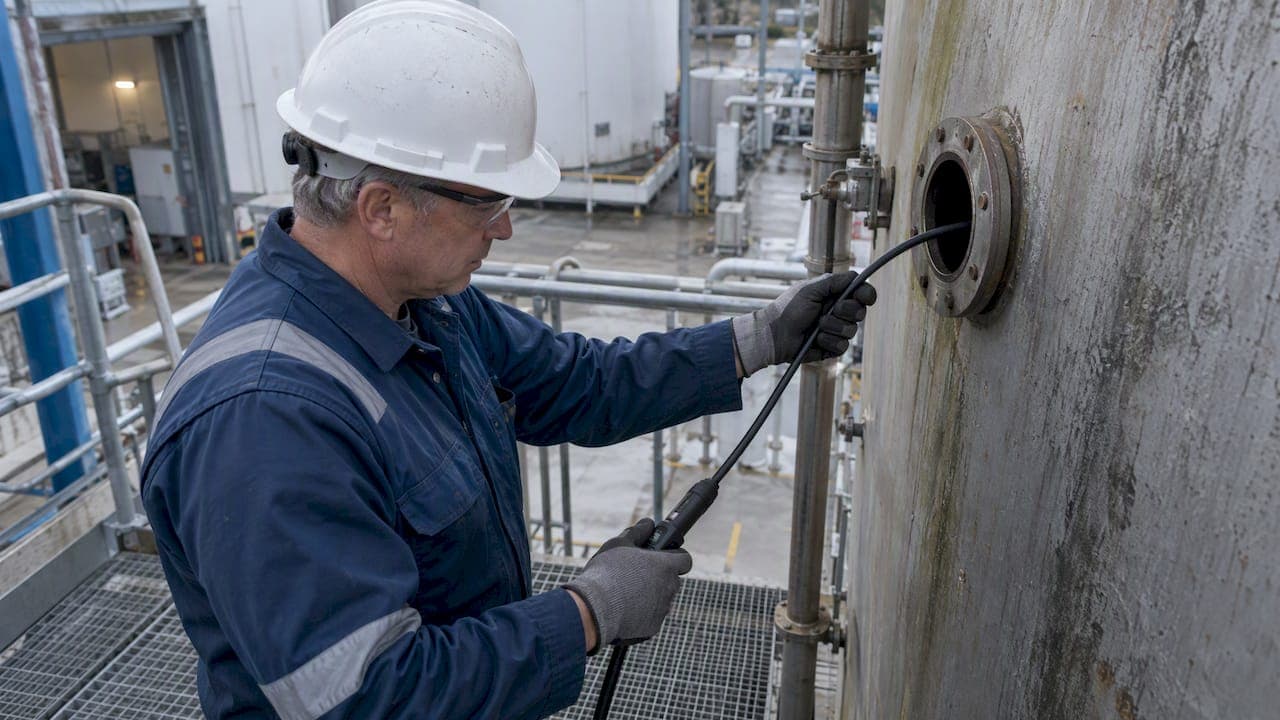
Use a borescope as your first-line remote inspection method for fuel and gas tanks, but only after you verify atmosphere and permit conditions. OSHA's permit-required confined-space standard, NFPA-aligned hot-work guidance, and API 653 all treat visual inspection as one piece of a larger safety and integrity program, not a replacement for it. Borescopes and field guides built for this exact workflow are available to support this work.
TL;DR:
- Borescopes are useful for visual inspections of tanks but cannot replace ultrasonic or radiographic testing for wall thinning or subsurface defects.
- Gas testing must be performed before any inspection, with oxygen, combustible, and toxic gases tested in that order and continuously monitored during work.
- Equipment choice depends on access size, with small probes (2-6 mm) for tight openings and longer, articulating scopes for larger vessels, all with certified explosion-proof ratings.
- Capture video and still images at every anomaly, log all atmospheric readings and probe details, and immediately decontaminate probes after use to prevent cross-contamination.
- Escalate to a certified inspector if pitting, weld anomalies, or drifting atmospheric readings that suggest potential structural issues are observed during inspection.
Table of Contents
- What a borescope can and can't tell you about a tank
- Confined space and hot work rules you cannot skip
- Choosing the right borescope specs for tank work
- Running the inspection: setup to extraction
- When a camera isn't enough: limits and escalation points
- Field guides and support behind this inspection approach
- Field perspective: speed versus thoroughness
- Equipping your team for safer tank inspections
- FAQ
- Sources
What a borescope can and can't tell you about a tank
A borescope earns its place on the truck for jobs where your eyes, not a gauge, answer the question. Vehicle fuel tanks, SCUBA and gas cylinders, small industrial vessels, and lined storage tanks all share one trait: the defect you are hunting is usually visible, not hidden beneath the metal surface.
- Contamination checks: spotting rust flakes, water, sludge, or foreign debris before refueling or recharging.
- Pre-service inspection: confirming a tank is clean and intact before it goes back into rotation.
- Leak-source search: tracing a stain, weep, or drip back to a seam, weld, or fitting.
What a borescope cannot do is measure. Wall thinning, subsurface pitting, and weld integrity require ultrasonic thickness testing or radiography, the domain of API 653 inspection programs. Treat the camera as a scouting tool that tells you where to look harder, not a pass or fail instrument.
Confined space and hot work rules you cannot skip
Before any probe goes into a tank, the atmosphere inside it decides whether you proceed at all. OSHA 1910.146 sets a strict testing order: oxygen first, then combustible gases and vapors, then toxic gases, with continuous monitoring required where conditions can change during the work. A borescope lets you look without putting your head in that atmosphere, but it does not alter what that atmosphere contains.
OSHA's enclosed tank cleaning guidance documents fatal incidents caused by oxygen depletion in tanks that looked clean and empty, which is exactly the appearance a quick borescope pass can create if you skip the air test. CSB investigations into hot-work incidents repeatedly trace fatalities back to missing or one-time-only gas monitoring, with guidance to stop work once combustible gas readings approach 10% of the lower explosive limit.
- Calibrate your gas detector before the shift, not from memory of last week's check.
- Identify and isolate supply and vent lines before testing begins.
- Test oxygen, then combustibles, then toxics, in that order, every time.
- Ventilate and retest if the tank previously held a different product or sat idle.
- Assign an attendant and confirm a rescue plan before anyone or anything enters.
Pro Tip: Treat a change in product history, like a tank that once held a different fuel, as a reason to retest atmosphere even if the last reading was clean.
Choosing the right borescope specs for tank work
Equipment choice depends more on access than ambition. A narrow fuel-filler neck calls for a different probe than a 4-foot manway on an industrial vessel, and matching the scope to the opening saves time and protects the equipment.
- Probe diameter: 2 to 6 mm for tight filler necks and small access ports, 6 to 10 mm for rugged industrial inspections where durability matters more than clearance.
- Shaft length: 1 to 3 meters covers most vehicle fuel tanks; larger storage vessels need a longer pushrod or pole-mounted option to reach across the vessel floor.
- Articulation: an articulating tip sweeps seams, baffles, and nozzle welds that a rigid shaft would miss entirely.
- Camera and lighting: HD resolution, adjustable LED rings, and solid low-light performance matter more inside a dark tank than they do in open-air inspection work. A practical overview of videoscope features breaks down what each spec actually buys you in the field.
- Safety rating: confirm intrinsically safe or explosion-proof certification before using any scope in a classified atmosphere, and choose fuel- and chemical-resistant materials for the probe sheath.
- Accessories: flap holders to protect filler necks, guide tubes for tight bends, reels for cable management, and wireless monitors for two-person inspections all earn their keep over repeated use.
Running the inspection: setup to extraction
A borescope inspection runs the same sequence every time, and skipping a step is usually what turns a routine check into an incident report.
- Isolate supply and vent lines, drain or purge as the job requires, and test the atmosphere, recording every reading rather than trusting memory.
- Confirm the attendant is in place, the rescue plan is current, and the gas detector's calibration is logged before you open the access port.
- Protect the probe tip with a flap holder at the access point, then advance slowly, sweeping seams, baffles, and nozzle welds with the articulating tip.
- Avoid disturbing settled sludge or sediment; stirring it can release vapors that shift the atmosphere mid-inspection.
- Capture a continuous video sweep, then stop at every anomaly for a still image with an orientation note and an approximate distance from a fixed reference point like the manway or filler neck.
- Log atmospheric readings, probe serial number, and calibration date in the report header alongside the inspection media.
- Clean and decontaminate the probe immediately after extraction to prevent cross-contamination on the next job.
Pro Tip: Keep feed speed constant during the video sweep and treat every anomaly as a stop point rather than scrolling past it, since a rushed pass is the easiest way to miss a hairline crack.
For techniques that transfer directly from pipeline work, the pipeline inspection borescope guide covers similar documentation habits for vessels and confined runs.
When a camera isn't enough: limits and escalation points
Remote visual inspection has a ceiling. It cannot measure wall thickness, detect subsurface corrosion, or confirm weld soundness the way ultrasonic testing, radiography, or hydrostatic testing can, which is why API 653 positions visual inspection as a trigger for further testing rather than a final verdict.
- Optic fouling from residue or condensation can hide a defect; wipe or reposition the lens rather than guessing at a blurry frame.
- Blind spots behind baffles require a longer or more articulating probe, not a wider sweep from the same angle.
- Sludge obscuring pitting means the area needs cleaning and a second pass before you clear it.
Escalate to a certified inspector or NDE technician the moment you find pitting that looks like it penetrates the wall, visible structural deformation, weld anomalies, or atmospheric readings that keep drifting on retest.
Field guides and support behind this inspection approach
The guidance above reflects the same ground-level priorities covered in our own field resources, including an industrial borescope field guide for 2026 and a dedicated borescope safety procedures guide written for technicians working in classified or confined spaces. Portable videoscopes, small-diameter borescopes, and protective accessories like flap holders and guide sheaths are designed for this kind of limited-access, safety-governed work.

Field perspective: speed versus thoroughness
Every technician feels the pull to move fast once the tank is open and the clock is running. The borescope that saves you an hour of setup is worthless if the gas detector wasn't calibrated or the attendant walked off. Certified, explosion-rated equipment costs more upfront and slows down procurement, but it is the difference between a tool that works in a classified atmosphere and one that simply looks like it does. A camera in the tank never replaces the air test before it.
— Endoscope
Equipping your team for safer tank inspections
Specialized equipment suited for this kind of work includes small-diameter borescopes for tight filler necks, rugged videoscopes for industrial vessels, and protective accessories, flap holders, guide tubes, and cleaning kits to keep probes functioning inspection after inspection without cross-contaminating the next job.
If you're not sure which shaft length or articulation setup fits your access points, the borescope and videoscope category breaks down the portable, SD-card, and micro fiber options by spec, and a repair and support page provides servicing options for probes after field use. Browse the lineup, match it to your next tank, and get the right scope on the truck before the job starts.
FAQ
What's the difference between an endoscope and a borescope?
Both use a camera on a flexible or rigid shaft to see inside confined spaces, but the terms reflect their typical markets. "Endoscope" is more common in medical and veterinary contexts, while "borescope" is the standard term for industrial and mechanical inspection work like tanks, engines, and pipes.
Can you use a borescope in a fuel tank?
Yes, a borescope is a standard tool for inspecting fuel tanks for contamination, corrosion, and leaks without physical entry. It must still be paired with atmospheric testing and, in classified atmospheres, an intrinsically safe or explosion-proof certified unit as outlined in OSHA's confined-space guidance.
What is the best borescope for cylinder inspection?
The right borescope for a gas cylinder or SCUBA tank depends on the access port size and shaft length needed to reach the full interior, typically a small-diameter, articulating probe in the 2 to 6 mm range. Our borescope product category lists portable and micro fiber options sized for narrow cylinder openings.
What does a borescope inspection do?
A borescope inspection lets a technician view the interior of a tank, cylinder, or vessel through a small access point, spotting contamination, corrosion, foreign debris, and leak sources without entering the space. It does not measure wall thickness or detect subsurface defects, which require ultrasonic testing or other methods under frameworks like API 653.
Do I still need atmospheric testing if I use a borescope first?
Yes, atmospheric testing is required regardless of whether a borescope inspection precedes entry. OSHA's permit-required confined-space standard mandates testing oxygen, combustible gases, and toxic gases before anyone enters, and a clean-looking camera feed does not change that requirement.
Sources
- 1910.146 - Permit-required confined spaces | Occupational Safety and Health Administration
- API 653 tank inspection overview and body of knowledge
- CSB hot-work safety bulletin and investigation summaries