
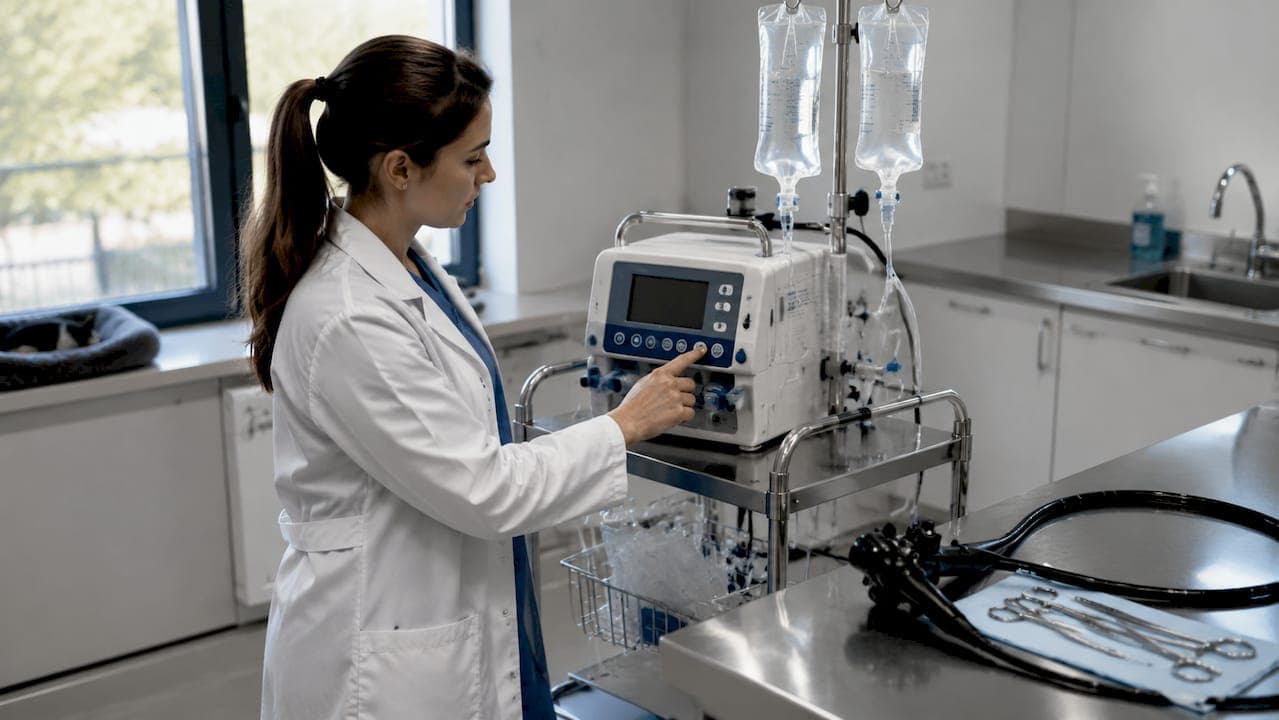
Industrial pumps for endoscopy are electromechanical or pneumatic devices that deliver controlled, pressurized sterile fluid to maintain visual clarity and tissue distension during minimally invasive procedures. The standard industry term is endoscopy irrigation pump, though professionals in veterinary and industrial fields often reference them simply as endoscopic pump systems. This guide covers the full explanation of industrial pumps for endoscopy: how they work, what types exist, what specifications matter, and why they are indispensable in both veterinary and industrial diagnostic settings. Systems like the Camjoy CY901 and regulatory frameworks like FDA 21 CFR 876.1500 define the performance and compliance standards every professional should know.
What is the explanation of industrial pumps for endoscopy?
An endoscopy irrigation pump is a powered fluid delivery device that replaces gravity-drip irrigation with active, motor-driven flow control. Gravity-drip systems provide inconsistent flow that decreases as fluid bags empty, making them unreliable during active bleeding. Active-drive pumps maintain steady output regardless of bag fill level or sudden hemorrhage. That consistency is the core reason veterinary surgeons and industrial inspection technicians choose powered pump systems over passive alternatives.
The pump connects inline between the sterile fluid source and the endoscope's irrigation channel. A microprocessor regulates motor speed to hold the target flow rate and pressure within set limits. The operator adjusts both parameters from a front panel or foot pedal, keeping both hands free for the scope. This level of control is not achievable with gravity alone.
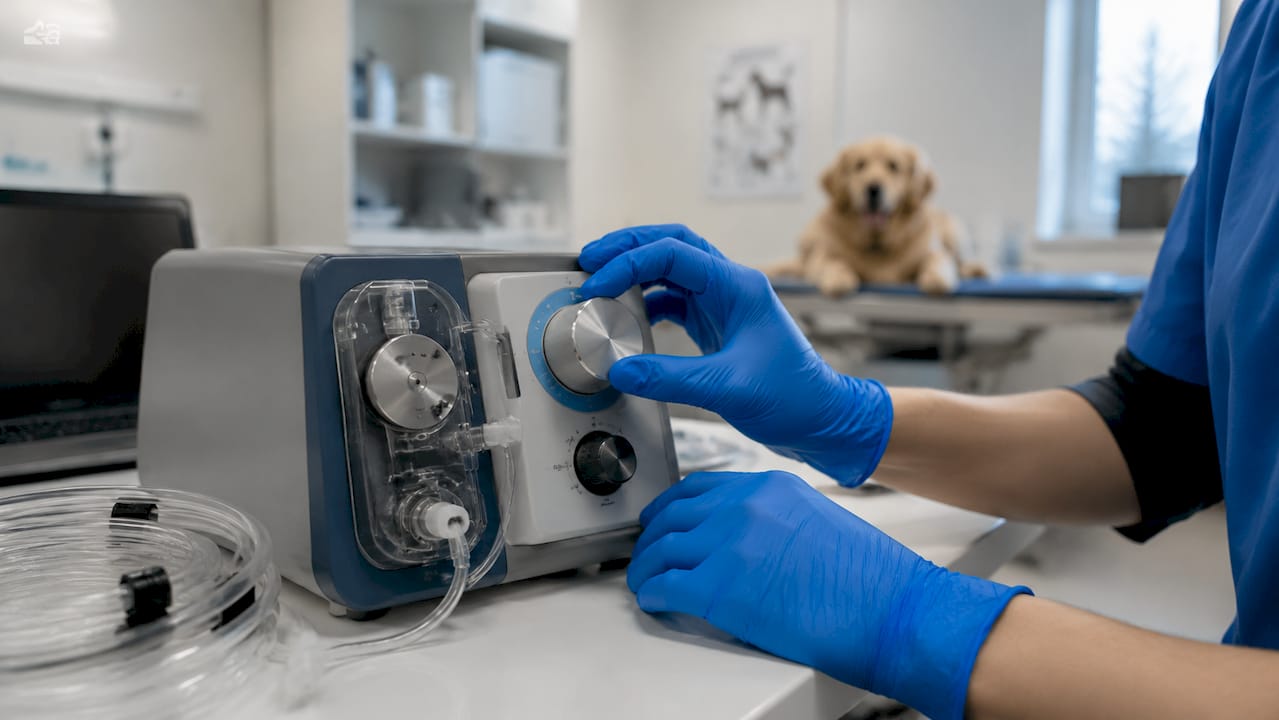
Understanding the difference between irrigation pumps and insufflators is also critical. Irrigation pumps deliver fluid, while insufflators deliver gas to distend body cavities. Confusing the two in a clinical or industrial setup creates serious procedural risk. Each device has a distinct role, and neither substitutes for the other.
What are the main types of industrial pumps used in endoscopy?
Three pump architectures dominate the market: peristaltic, electromechanical piston, and pneumatic. Each operates on a different mechanical principle, and each suits a different procedural context.
Peristaltic pumps use rotating rollers to compress a flexible tube, pushing fluid forward in a wave. They are the most common type in veterinary and outpatient settings because the fluid never contacts the motor. That design simplifies sterilization and reduces cross-contamination risk. The tradeoff is pulsation: each roller pass creates a small pressure spike.
Electromechanical piston pumps use a motor-driven piston to generate continuous, high-pressure flow. They handle higher flow rates and pressures than most peristaltic units. Hospital-grade systems like the Camjoy CY901 fall into this category, delivering up to 1,500 mL/min with a pressure range of 50–700 mmHg. That output supports rapid clearing of bleeding fields in urological and arthroscopic procedures.
Pneumatic pumps use compressed gas to drive fluid delivery. They appear in specialized industrial inspection settings where electrical power is limited or where spark-free operation is required. Their flow control is less precise than motor-driven units, making them less common in veterinary surgical applications.
Single-use vs. reusable pump architectures
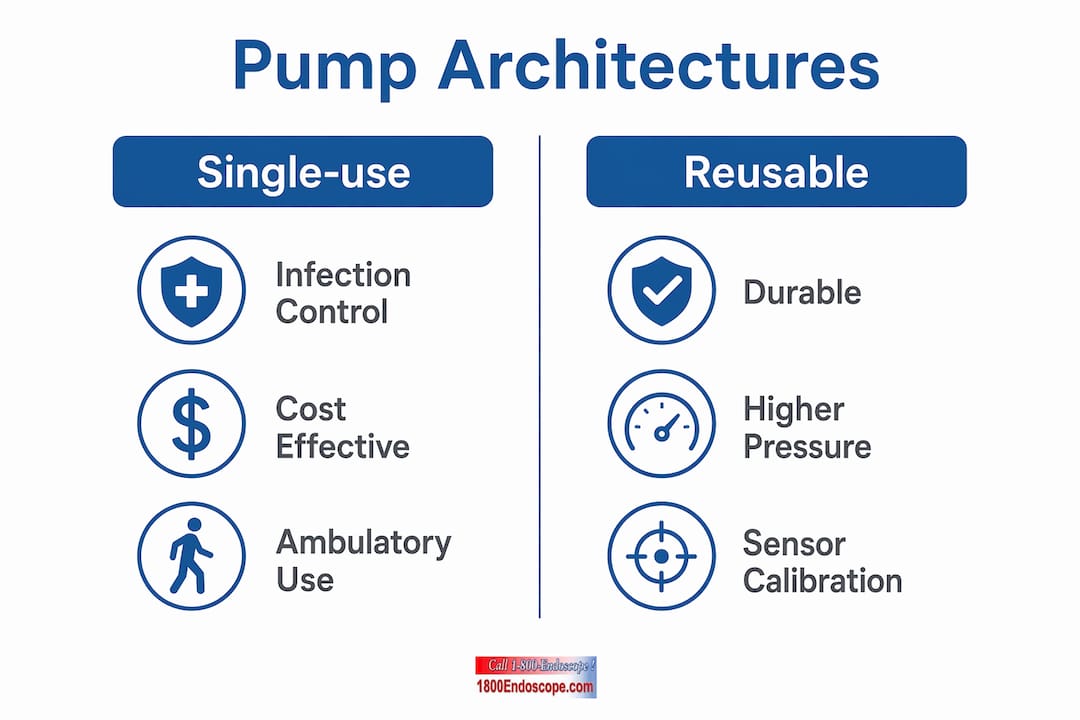
| Feature | Single-use pumps | Reusable electromechanical pumps |
|---|---|---|
| Infection control | Eliminates reprocessing risk | Requires full sterilization cycle |
| Cost per procedure | Higher consumable cost | Lower over high volume |
| Maintenance burden | None | Periodic calibration required |
| Best setting | Ambulatory surgical centers | High-volume hospital environments |
| Pulsation control | Basic | Advanced digital smoothing |
Single-use pumps are preferred in ambulatory surgical centers for easier infection control, while reusable electromechanical pumps are favored in high-volume hospital settings to amortize costs. For veterinary clinics with moderate procedure volumes, the single-use option often wins on simplicity. For large equine hospitals or specialty referral centers, reusable systems pay for themselves quickly.
What technical specifications define endoscopy pump performance?
Flow rate and pressure range are the two numbers that determine whether a pump fits a given procedure. Standard endoscopy irrigation pumps operate between 50 and 500 mL/min for most GI and urological procedures. That range covers the majority of small animal veterinary scopes and standard industrial borescope irrigation channels.
High-demand procedures, such as transurethral resection or large-animal arthroscopy, require more. The Camjoy CY901 reaches 1,500 mL/min flow and 50–700 mmHg pressure. That upper pressure limit matters as much as the flow rate. Excess pressure forces fluid into the vascular system, causing fluid intravasation and potentially TUR syndrome or pulmonary edema.
Pulsation control and microprocessor regulation
Pulsation is the hidden performance variable most professionals overlook. Multi-roller geometry and digital smoothing algorithms eliminate the rhythmic pressure spikes that cause organ wall twitching. That twitching complicates precision dissection and makes image stabilization harder for the scope camera. Advanced systems monitor back-pressure in real time and reduce motor speed automatically if the reading climbs toward the venous pressure threshold.
Microprocessor regulation also enables consistent output during sudden flow demands, such as when a bleeding vessel requires rapid irrigation. Without closed-loop control, a basic pump would either stall or overshoot pressure. The difference between a regulated and an unregulated pump shows up most clearly in those high-stress moments.
Pro Tip: Always verify the pump's maximum working pressure against the scope manufacturer's irrigation channel rating before connecting. Exceeding the channel's rated pressure can damage the endoscope's internal seals, voiding the warranty and creating a contamination pathway.
Key performance metrics at a glance
| Specification | Standard range | High-performance range |
|---|---|---|
| Flow rate | 50–500 mL/min | Up to 1,500 mL/min |
| Pressure range | 50–300 mmHg | 50–700 mmHg |
| Pulsation control | Basic roller | Multi-roller + digital smoothing |
| Pressure monitoring | Manual | Real-time microprocessor |
How are endoscopy pumps regulated and maintained?
Endoscopy irrigation pumps are Class II medical devices regulated under 21 CFR 876.1500 by the FDA. Manufacturers must obtain 510(k) clearance by demonstrating substantial equivalence to a predicate device already on the market. Clinical trials are not required for this pathway, but the device must meet performance and safety benchmarks set by the FDA. Any pump used in a clinical veterinary or human medical setting must carry valid 510(k) clearance.
Industrial-use pumps deployed in non-medical inspection contexts fall outside this framework. However, professionals who use the same pump hardware across both veterinary and industrial applications should confirm the device's regulatory status before clinical use. Regulatory gray areas create liability exposure that no clinic or inspection firm wants.
Maintenance requirements split sharply between reusable and single-use designs:
- Reusable electromechanical pumps require periodic pressure sensor recalibration to maintain accuracy. Fluid path components need full sterilization between procedures. Motor and roller assemblies need inspection for wear on a schedule set by the manufacturer.
- Single-use pumps eliminate reprocessing entirely. The fluid path is discarded after each case, removing the risk of biofilm buildup or inadequate sterilization.
- Both types require verification of tubing integrity before each use. A micro-crack in the irrigation tubing can introduce air into the fluid path, disrupting flow and creating an embolism risk.
- Calibration logs for reusable pumps must be maintained for regulatory audits. FDA inspectors and accreditation bodies check these records during facility reviews.
Pro Tip: For reusable pumps, set a calendar reminder for pressure sensor recalibration at the interval specified in the device's service manual. Drifting sensors are the most common cause of unexpected pressure excursions during procedures.
Why use endoscopy pumps in veterinary and industrial procedures?
Continuous irrigation is the single most important factor in maintaining a clear endoscopic view. In veterinary endoscopy, irrigation pumps enable continuous fluid delivery that clears debris and maintains clear views in GI, urological, and arthroscopic procedures. Without steady irrigation, mucus, blood, and tissue debris accumulate on the scope lens within seconds, forcing repeated scope withdrawal for cleaning. Each withdrawal adds procedure time and patient stress.
The practical benefits of powered pump systems in veterinary and industrial settings break down clearly:
- Consistent visual field. Active-drive pumps maintain flow even during sudden bleeding, keeping the operative field visible when it matters most.
- Tissue distension control. Adjustable pressure allows the operator to distend hollow organs or cavities to the exact volume needed for inspection without over-pressurizing fragile tissue.
- Reduced procedure time. Faster debris clearance means fewer scope withdrawals and shorter total procedure duration, which reduces anesthesia time in veterinary patients.
- Portable options for field use. Battery-powered and compact pump units support ambulatory veterinary work, such as equine gastroscopy performed at a barn or farm. Fixed-installation pumps are not practical in those settings.
- Compatibility with rigid and flexible scopes. Pump systems connect to veterinary rigid endoscopes for arthroscopy and laparoscopy, as well as to flexible videoscopes for GI and urological work.
For industrial inspection, pump-assisted irrigation clears machining fluid, debris, and particulates from bores and cavities during borescope inspection. The same principle applies: a clear field produces a reliable image. Industrial NDT professionals who skip irrigation on contaminated bores risk missing cracks or corrosion hidden beneath debris.
Pro Tip: When performing small animal endoscopy, set the pump to the lowest effective flow rate first and increase only if visibility degrades. Lower flow rates reduce the risk of over-distension in small-diameter GI tracts.
My take on where pump technology is actually heading
The shift toward single-use pump systems in outpatient and ambulatory settings is real, and I think it is accelerating faster than most equipment catalogs reflect. Infection control pressure from accreditation bodies has made reprocessing a liability that many clinics simply do not want to manage. Single-use systems remove that liability entirely, and the per-procedure cost premium is shrinking as manufacturing volumes increase.
What I find underappreciated is the value of advanced flow stabilization in complex veterinary surgeries. Pulsation-free output is not a luxury feature. In equine arthroscopy, even minor rhythmic organ movement from pump pulsation can shift the scope tip enough to compromise a critical dissection plane. Clinics that invest in multi-roller or digitally smoothed pump systems report fewer scope repositioning interruptions. That translates directly to shorter procedure times and better outcomes.
The cost amortization argument for reusable pumps is valid in high-volume referral hospitals. But for a mixed-practice clinic doing ten to fifteen endoscopic procedures per month, the maintenance overhead of a reusable system often exceeds the consumable savings. The math changes at higher volumes, but most veterinary practices never reach that threshold.
My practical advice: match the pump to the workflow, not to the price tag. A portable single-use system paired with a quality flexible videoscope covers the majority of small and large animal diagnostic cases. Reserve high-pressure electromechanical systems for surgical suites where complex urological or arthroscopic procedures justify the investment.
— Endoscope
Endoscopy pump systems and equipment at 1800endoscope
1800endoscope stocks a full range of endoscopic equipment built for veterinary clinics, animal health professionals, and industrial inspection teams. Whether you need a portable system for field diagnostics or a rigid scope setup for surgical procedures, the catalog covers both ends of the spectrum.
The veterinary rigid endoscopy catalog includes scopes designed to pair with irrigation pump systems for arthroscopic and laparoscopic procedures. For portable field applications, the portable videoscope system offers direct monitor output with SD card recording, suited for ambulatory veterinary work where compact, reliable equipment makes the difference between a completed exam and a rescheduled one. 1800endoscope also carries accessories including valves, biopsy forceps, and light sources to complete your endoscopy setup.
FAQ
What is an endoscopy irrigation pump?
An endoscopy irrigation pump is a powered device that delivers controlled, pressurized sterile fluid through an endoscope's irrigation channel to maintain a clear visual field and tissue distension during procedures.
How does an industrial endoscopy pump differ from a gravity drip system?
Active-drive pumps maintain steady flow regardless of fluid bag fill level or bleeding, while gravity-drip systems deliver inconsistent flow that decreases as the bag empties.
What flow rates do endoscopy pumps operate at?
Standard endoscopy irrigation pumps operate between 50 and 500 mL/min for most GI and urological procedures, with high-performance systems like the Camjoy CY901 reaching up to 1,500 mL/min.
Are endoscopy pumps regulated by the FDA?
Yes. Endoscopy irrigation pumps are Class II medical devices regulated under 21 CFR 876.1500, requiring FDA 510(k) clearance before clinical use.
Why do veterinary professionals use irrigation pumps during endoscopy?
Irrigation pumps clear debris, blood, and mucus from the endoscopic field continuously, improving diagnostic accuracy and reducing procedure time in GI, urological, and arthroscopic veterinary exams.
Key takeaways
Industrial endoscopy pumps require active-drive flow control, microprocessor pressure regulation, and proper FDA 510(k) clearance to deliver safe, effective irrigation across veterinary and industrial diagnostic procedures.
| Point | Details |
|---|---|
| Active-drive vs. gravity drip | Powered pumps maintain steady flow during bleeding; gravity systems cannot. |
| Flow and pressure specs | Standard range is 50–500 mL/min; high-performance systems reach 1,500 mL/min and 700 mmHg. |
| Pulsation control matters | Multi-roller and digital smoothing prevent organ twitching that disrupts precision procedures. |
| Regulatory compliance | All clinical pumps must carry FDA 510(k) clearance under 21 CFR 876.1500. |
| Single-use vs. reusable | Match pump architecture to procedure volume and infection control requirements, not price alone. |