
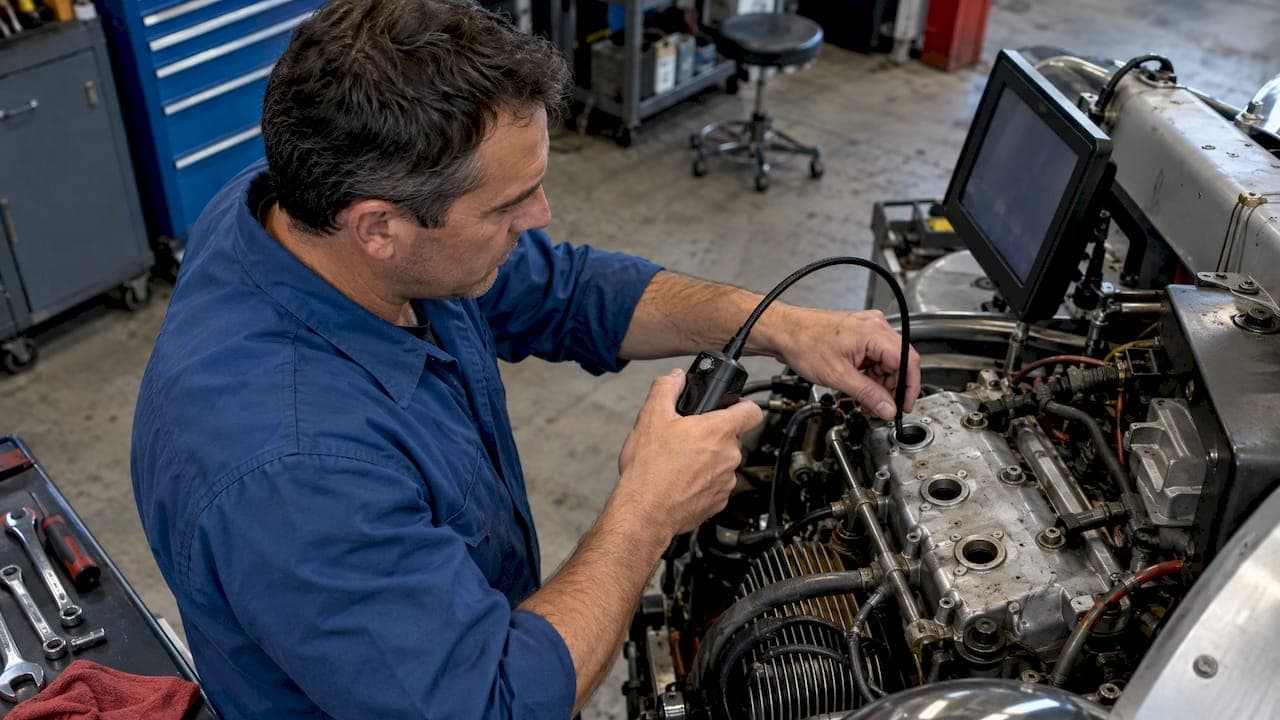
Yes, a borescope lets you inspect valve faces, seats, piston crowns, and bores without teardown when you use the proper probe and procedure. A small-diameter, articulating probe usually gets you to the valve seat edge in an engine cylinder or pump body. Position the piston correctly before you insert the probe, and save labeled photos or video of every session so you can compare wear over time.
TL;DR:
- A 2 to 6 millimeter articulating probe reaches around valve seat edges through spark plug holes, while rigid probes suit straight access.
- Set the piston at bottom dead center on the power stroke for exhaust valve views, and on the intake stroke for intake valves and crowns.
- Asymmetric exhaust valve discoloration, green oxidation, cracks, missing material, or heavy bore scoring warrant teardown or specialist evaluation, not routine monitoring.
- Label images by date, cylinder or valve, and angle, then compare repeat inspections; TCM guidance requires a differential pressure test alongside borescope checks.
- Before inspecting pumps or industrial valves, isolate and depressurize the line, let components cool, and wear eye and hand protection.
Table of Contents
- Where to Insert the Borescope for Engines, Pumps, and Valves
- What to Look for: Reading Valve Faces, Seats, Crowns, and Bores
- Choosing the Right Borescope for Valve Work
- Step-by-Step Inspection Procedure for Cylinders and Pumps
- Safety, Documentation, and When to Escalate
- What Repeated Inspections Teach You
- Finding the Right Borescope for Your Valve Inspections
- FAQ
- Sources
Where to Insert the Borescope for Engines, Pumps, and Valves
On a piston engine, the spark plug hole is your standard access point. Remove the top plug on the cylinder you want to check, then guide the probe in slowly, watching your monitor rather than pushing blind. Industrial pumps and valve bodies usually have their own inspection ports or removable covers, so route the probe through those existing openings instead of disassembling the housing.
When access is tight, a micro probe between 2 and 3 millimeters with articulation reaches around corners that a rigid shaft cannot. Straight access, like a long valve bonnet or a short plug hole, works fine with a rigid probe and gives you a steadier image.
A few habits protect both the scope and the part you are inspecting:
- Protect plug threads with a thread protector or by handling the plug carefully during removal and reinsertion.
- Use a right-angle adapter when the port sits at an awkward angle relative to your hand position.
- Mark probe depth with tape or a built-in depth stop so you never force the tip against a valve seat or cylinder wall.
What to Look for: Reading Valve Faces, Seats, Crowns, and Bores
A borescope only helps if you know what the image is telling you. Healthy valves typically show a fairly even, symmetrical deposit pattern, sometimes called a bullseye, centered on the valve face. That symmetry means the valve is rotating and seating evenly on every cycle.
- Check for asymmetric, hot-spot discoloration on an exhaust valve, which often signals the valve is not rotating and risks burning through.
- Look for erosion, pitting, small cracks, or missing material on the valve face or seat, since these conditions usually call for teardown rather than continued monitoring.
- Note the deposit type: dry carbon is normal, wet or oily deposits point to an oil control or fuel delivery issue, and greenish oxidation suggests advanced overheating.
- Scan the piston crown for localized soot, aluminum erosion consistent with detonation, or a wet oily dome that hints at ring or oil control problems.
- Examine the bore for scoring, a missing or uneven hone pattern, or corrosion, and capture the finding from more than one angle before drawing a conclusion.
Asymmetric valve deposit patterns can show up months before a compression test ever catches a problem. Borescope images reveal this uneven heating early, which is why some guidance for cylinder inspections treats the image set as the primary diagnostic rather than a backup check. Articulating probes make this easier because they let you pan from the piston dome to the valve seat edge in one continuous motion, rather than guessing at the edge condition from a single fixed angle.
Choosing the Right Borescope for Valve Work
Probe diameter has to match your access point. A spark plug hole typically takes a probe in the 2 to 6 millimeter range, while a dedicated inspection port on a pump or valve body can often accommodate something larger. Articulating probes are worth the extra cost for valve work because they let you pan around the seat edge instead of relying on a single straight-ahead view, though a rigid probe is perfectly adequate when your access lines up straight with the target.
Image quality matters as much as reach. Choose a sensor that is at least HD capable, since a soft or grainy image will not show the fine discoloration or hairline cracking that separates normal wear from an early failure.
A few accessories make routine inspections faster and safer:
- Depth stops and thread protectors that keep the probe from contacting valve seats or damaging plug threads.
- Right-angle adapters and extension cables for awkward or deep access points.
- Cleaning kits and SD or USB recording capability so every session produces a saved, dated record.
Pro Tip: Buy a portable unit for routine fleet or shop checks, and reserve rental of a high-end videoscope for the rare case that needs extreme reach or specialized optics.
Step-by-Step Inspection Procedure for Cylinders and Pumps
A repeatable sequence keeps your findings consistent from one inspection to the next, and consistency is what lets you spot a trend instead of a one-off reading.
- Gather your borescope, adapters, labeling materials, and personal protective equipment, and let the engine cool to a safe handling temperature before you start.
- On a cylinder engine, remove the top spark plug for the cylinder you are checking, then rotate the engine to the piston position specified for the view you need: bottom dead center on the power stroke to see the exhaust valve, and bottom dead center on the intake stroke to inspect the intake valve and piston crown, following the sequence outlined in documented cylinder inspection procedures.
- Insert the probe gently through the plug hole, watching the monitor the entire time, and photograph or record each valve face, the seat edge, and the piston crown.
- On a pump or industrial valve, isolate and depressurize the line first, then open the inspection port or route the probe through the existing service opening, panning systematically across each valve face and seat.
- Label every image or clip with the date, cylinder or valve number, and viewing angle, and save both stills and short video clips so future inspections have something concrete to compare against.
Borescope images work best alongside other checks rather than in place of them. TCM Service Bulletin SB03-3 requires a cylinder borescope inspection to be performed together with a differential pressure test, not as a standalone substitute, since each method catches different failure signs.
Safety, Documentation, and When to Escalate
Let components cool before you insert anything, and isolate electrical, fuel, or pressure sources on the system you are checking. Wear eye and hand protection, and keep the probe tip away from valve seats or sealing surfaces where contact could cause damage.
- Store labeled images in a dated log so you can compare trends across inspections and share records with a shop or contractor.
- Follow manufacturer guidance on inspection frequency where it exists, and inspect sooner if you notice rough running, a drop in power, or unusual noise.
- Treat asymmetric discoloration on an exhaust valve, green oxidation, visible cracking, missing material, or heavy bore scoring as signs that usually call for teardown or a specialist evaluation.
Our borescope safety procedures guide covers PPE and isolation steps in more depth for technicians who inspect multiple units in a shift.
What Repeated Inspections Teach You
The most common mistake we see is a one-time inspection with no follow-up image to compare it against. Poor lighting, skipping angles, and reaching for a rigid probe when the seat edge really calls for articulation all lead to the same result: a diagnosis made on an incomplete picture. A single image tells you the condition today, but a labeled series over several inspections tells you whether a deposit pattern is stable or getting worse, which is the detail that actually changes a maintenance decision. Our field guide to industrial borescope uses walks through more of these comparisons for technicians building that habit into their routine.
— Endoscope
Finding the Right Borescope for Your Valve Inspections
Small-diameter and articulating probes make valve seat inspection practical, without the cost of a hospital-grade or industrial-contractor system. Our borescope product line covers monitor-type SD-card videoscopes and portable pipe inspection units sized for spark plug holes, inspection ports, and tight pump housings alike, and our cleaning kits and adapters are built to match.
If a unit needs service down the line, our repair team and product support are available directly through our site, backed by 24/7 support and fast shipping. Browse our borescope lineup to match probe diameter, articulation, and image quality to the valve work in front of you, and order the kit that fits your access points.

FAQ
What's the difference between an endoscope and a borescope?
An endoscope is typically built for medical or veterinary use inside a living body, while a borescope is built for mechanical inspection inside engines, pumps, and pipes. Both use the same core design of a camera on a flexible or rigid probe, but borescopes are ruggedized for industrial environments and often paired with depth stops and thread protectors.
How much does a borescope inspection cost?
Cost depends on whether you own a unit or hire it out, and prices vary by provider and region. Buying a portable small-diameter videoscope is often more economical over time for anyone performing routine checks, since the same unit covers repeated inspections without a per-visit fee.
How do I check if my valves are bad?
Insert a borescope through the spark plug hole or an existing inspection port, position the piston as needed, and look for asymmetric discoloration, cracking, pitting, or missing material on the valve face and seat. Compare the image against a known healthy pattern, and treat any heavy asymmetry or visible damage as a reason to get a closer look from a mechanic.
What is the best borescope for cylinder inspection?
A small-diameter probe, generally in the 2 to 6 millimeter range, with articulation at the tip works best for cylinder inspection because it reaches through a spark plug hole and still pans around the valve seat edge. Our borescope product line includes several portable SD-card videoscopes sized for this kind of access.