
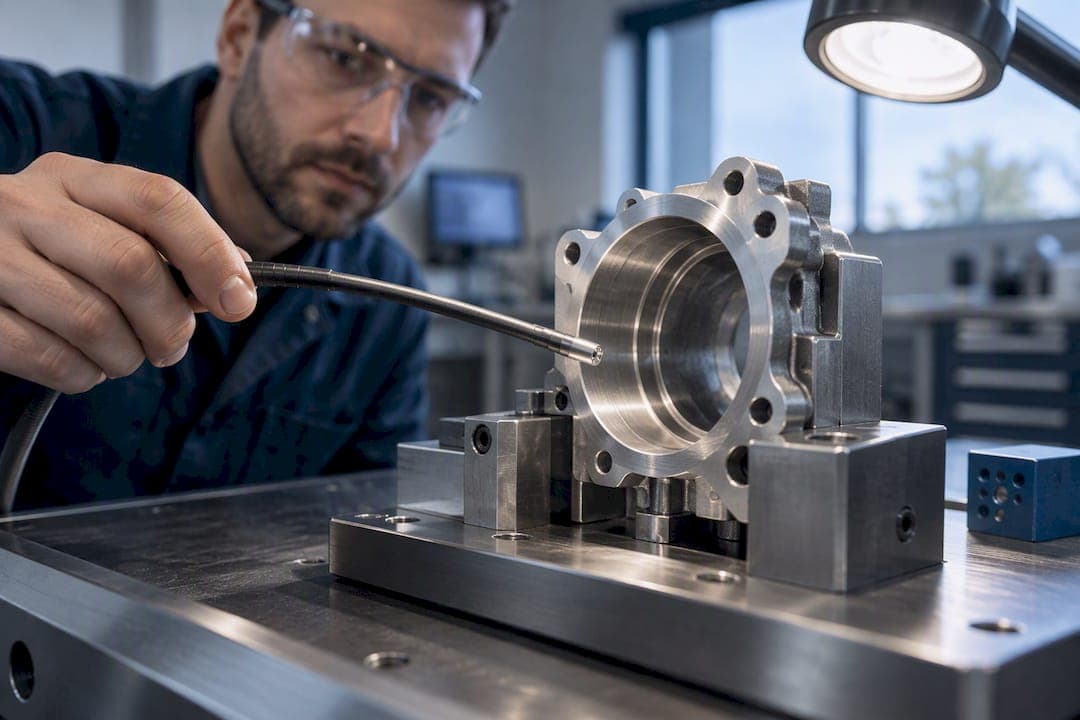
A semi-rigid borescope is a gooseneck inspection probe that holds whatever shape you bend it into, giving you a middle ground between a straight rigid rod and a fully flexible fiberscope. Technicians reach for one when a job needs a slight bend around an obstruction but not the full articulation of a videoscope, which is why it shows up so often in automotive, HVAC, manufacturing, and veterinary work.
TL;DR:
- A semi-rigid borescope balances flexibility and durability, making it suitable for inspections involving one gentle bend around an obstruction.
- Probe diameters typically range from 2.8 mm to 6 mm, with smaller sizes fitting tighter access points but offering lower image resolution.
- Image quality depends on the relay: fiber optics provide lower resolution at a lower cost, while distal cameras deliver sharper images but at a higher price.
- It is essential to match the scope's diameter and length to the specific inspection environment, prioritizing fit over maximum resolution.
- Proper cleaning, storage, and repair protocols extend the lifespan of semi-rigid scopes, especially when used daily or in harsh conditions.
Table of Contents
- How a Semi-Rigid Borescope Is Built and Works
- Semi-Rigid vs. Rigid vs. Flexible: Which One Actually Fits the Job?
- Diameters, Lengths, and Durability Ratings to Specify
- Where Semi-Rigid Borescopes Actually Get Used
- How to Choose a Semi-Rigid Borescope: A Procurement Checklist
- Cleaning, Storage, and Handling That Extend Scope Life
- Why We Think Diameter Gets Undersold in Buying Decisions
- Ready to Spec or Repair Your Next Borescope?
- Sources
- FAQ
How a Semi-Rigid Borescope Is Built and Works
The sheath is the whole story here. A woven metal or coated wire core lets the probe stay wherever you bend it, unlike a fiberscope that springs back or a rigid rod that can't bend at all. That "gooseneck memory" is what separates the category from both neighbors.
Image relay comes in two flavors. Cheaper models use a coherent fiber optic bundle, which delivers a grainy, low-resolution picture but keeps the unit compact and affordable. Better units put a small CMOS or CCD camera right at the tip, producing sharper images and often adding recording.
- Sheath: braided metal or polymer-coated wire; holds a set bend
- Image relay: fiber bundle (lower cost, lower resolution) or distal camera (sharper image, higher cost)
- Illumination: LED at the tip, sometimes adjustable brightness
- Bending radius: fine for gentle curves around a corner or baffle, not for tight serpentine paths
Expect a practical bend radius measured in inches, not a snake-like crawl through multiple turns. Push it too far and you risk kinking the sheath rather than gaining reach.
Semi-Rigid vs. Rigid vs. Flexible: Which One Actually Fits the Job?
Optical quality follows a predictable curve. Rigid borescopes use glass rod-lens relays and deliver the sharpest image available for straight-shot inspections, according to SpecForge's industrial borescope guide. Fiberscopes trade that clarity for flexibility, using a coherent fiber bundle that produces a noticeably softer image. Videoscopes split the difference with a distal camera, matching rigid-level clarity while adding full articulation and video recording.
Geometry decides the winner faster than image quality does:
- Straight or near-straight access (engine bores, pipe runs): rigid borescope
- Slight bend or obstruction to work around: semi-rigid borescope
- Convoluted, multi-turn paths (ductwork, HVAC coils, tortuous veterinary anatomy): flexible fiberscope or videoscope
Feature sets scale with price. Videoscopes bring articulation, recording, and often built-in measurement tools. Semi-rigid probes usually skip articulation and measurement but cost less and survive rough handling better, since there's no articulating cable mechanism to damage. Rigid scopes are the simplest to repair because there's no bundle or wiring to replace, just glass and a housing. Semi-rigid units sit in the middle: repairable if the sheath or LED fails, but not as bulletproof as solid rod optics.
Diameters, Lengths, and Durability Ratings to Specify
Numbers matter more than marketing copy when you're writing a purchase order. Insertion tube diameters on similar semi-rigid and articulating models include several common sizes around a few millimeters, based on spec sheets from an articulating video borescope user manual. Smaller diameters get you into tighter access points; larger ones give better image quality and a sturdier feel in the hand.
Pro Tip: Match diameter to your tightest access point first, then check if the resulting image resolution still meets your inspection standard. A scope that fits but shows nothing useful isn't a win.
Working lengths on gooseneck probes typically range from a few inches up to a couple of feet, enough for engine bays, duct sections, and gearbox housings without needing a full-length flexible run. Tip view angles usually fall between direct (0 degrees) and slight offset views, useful for looking just around a corner without needing articulation.
On the illumination and imaging side, look for LED counts and lux output listed explicitly, along with resolution specs if the model uses a distal camera. IP ratings and recording options separate field-durable tools from bench-only units. The same manual referenced above lists IP-rated housings, OLED displays, SD-card recording, and stated battery runtimes as standard disclosure items on comparable articulating models. Ask for those exact figures before you buy, because a spec sheet that omits IP rating or runtime is a spec sheet hiding something.

Where Semi-Rigid Borescopes Actually Get Used
Industry mapping is straightforward once you know the geometry rule. According to guidance on choosing industrial inspection tools, semi-rigid probes fit automotive, HVAC, and manufacturing tasks where a compact, slightly formable probe beats both a rigid rod and a full videoscope on cost and simplicity.
- Automotive: cylinder bores, intake manifolds, and cabin ductwork favor smaller diameters (2.8 to 6 mm) and shorter lengths
- HVAC and building maintenance: duct junctions and coil inspections benefit from the slight bend a gooseneck offers without committing to a fiberscope
- Manufacturing and equipment maintenance: gearbox interiors, bearing housings, and weld root inspections often need just enough bend to clear a flange or baffle
- Veterinary contexts: limited, but semi-rigid probes see occasional use in small-animal procedural work where flexibility needs are modest and durability matters more than reach
The pattern holds across all four: pick semi-rigid when you need to clear one obstruction, not navigate a maze.
How to Choose a Semi-Rigid Borescope: A Procurement Checklist
Work through the specs in this order, because getting diameter wrong makes every other decision moot.
- Confirm probe diameter against your smallest access point, leaving margin for cable stiffness.
- Set working length based on the deepest inspection point plus a few inches of handling slack.
- Check tip view angle against whether you need a straight-ahead or slightly offset view.
- Compare image relay type, fiber bundle versus distal camera, against your resolution needs.
- Verify illumination output and whether brightness is adjustable for reflective or dark cavities.
- Confirm IP rating matches your environment, particularly for wash-down or outdoor use.
- Ask about repairability, since a fiber bundle or sheath that can't be serviced turns a minor kink into a full replacement.
When you talk to a vendor, ask directly: What's the warranty term? Are spare tip lenses and sheaths stocked, or special order? What's typical repair turnaround? Can they supply a test certificate confirming the stated IP rating and LED output? Manufacturers who hesitate on any of those four questions are telling you something.
On delivery, don't just plug it in and call it done. Run the same acceptance checks referenced in comparable articulating borescope manuals: confirm image sharpness at working distance, check LED output at both dim and full brightness, and inspect the sheath and tip for shipping damage before the first real job.
Budget-wise, spend more on the sheath and image relay if the scope sees daily use. A cheap fiber bundle degrades faster under repeated bending, while a distal-camera unit holds image quality longer. For occasional, single-task use, a lower-cost fiber model is often the smarter spend.
Cleaning, Storage, and Handling That Extend Scope Life
Wipe the sheath after every use with a soft cloth and a mild, non-abrasive cleaning solution. Harsh solvents degrade the coating on the wire core faster than mechanical wear does. Never submerge the connector end or control housing unless the manufacturer explicitly rates it for immersion.
- Coil the probe loosely for storage, never in a tight loop that stresses the memory wire
- Store in a padded case away from crush points, since a flattened sheath section won't hold a bend cleanly again
- Check the tip window and LED lens for scratches before each job
- Watch for a sheath that won't hold a set shape anymore, a sign the internal wire core has fatigued and needs repair
If your work crosses into veterinary use, industrial cleaning alone isn't enough. Pair it with proper sterilization protocols for veterinary endoscopy rather than assuming a wipe-down covers both use cases.
Why We Think Diameter Gets Undersold in Buying Decisions
Most buying guides put image quality first and diameter second. We'd flip that order. A scope with excellent resolution that doesn't physically fit your access point is worthless on the job, while a slightly softer image from a smaller-diameter probe still gets the inspection done. Technicians who spec by diameter first and image quality second waste less money on returns.
The other pattern worth calling out: too many technicians assume "semi-rigid" is a downgrade from a videoscope rather than a purpose-built tool. It's not a budget version of articulation. It's the right call whenever the job needs one bend, not ten, and buying an expensive articulating unit for a one-corner inspection is often just overspending. 1800endoscope's borescope catalog reflects that range, from simple fiber-bundle probes to distal-camera videoscopes, and choosing correctly starts with being honest about how convoluted your actual access path is.
— Endoscope
Ready to Spec or Repair Your Next Borescope?
If you've read this far, you already know which category fits your inspection path. The next step is comparing actual spec sheets, not marketing photos. 1800endoscope's borescope and videoscope catalog lists insertion diameters, IP ratings, and recording options side by side, so you can match a probe to your access point without guessing at numbers a glossy brochure leaves out.
For teams that already own a semi-rigid or articulating unit with a fatigued sheath or dim LED tip, 1800endoscope also handles endoscope repairs directly, often at a fraction of what a full replacement costs. If your inspection work crosses into small-animal procedures, the rigid scope and accessory line covers that overlap too. Pull up the diameter and length you need, check the listed specs against your access point, and request a quote or repair estimate before your next inspection window closes.
Sources
For readers who want the underlying numbers behind this guide, the SpecForge industrial borescope encyclopedia breaks down image relay types in more technical detail, and the articulating video borescope user manual lists the exact diameter, IP rating, and battery specs referenced throughout this article. SCHÖLLY's terminology guide is worth a read if you need to justify correct terminology to procurement.
- Industrial Borescope Guide — Types, Specs, Selection | SpecForge
- VJ-4 articulating video borescope user manual (spec excerpts)
- How to Choose the Right Endoscope or Borescope for Industrial Use: A Complete Guide
FAQ
What Are the Two Main Types of Borescopes?
Borescopes generally split into rigid and flexible categories, with semi-rigid gooseneck probes and distal-camera videoscopes falling as subtypes of flexible design. Rigid scopes use glass rod-lens relays for straight-line access, while flexible types, including semi-rigid and fiberscope models, use a bendable relay for indirect paths, as outlined in SpecForge's borescope guide.
What's the Difference Between an Endoscope and a Borescope?
"Borescope" refers to industrial inspection instruments, while "endoscope" is the term used in medical and veterinary contexts, per SCHÖLLY's industry guidance. The internal hardware is often similar, but the terminology signals the intended field of use.
What Is a Rigid Borescope?
A rigid borescope is a solid, non-bending inspection tool built around glass rod-lens optics, offering the sharpest image quality among common borescope types for straight-shot access. It cannot navigate bends or obstructions, which limits it to engine bores, pipe runs, and similar direct-line inspection points.
Which Borescope Is Considered the Best for Industrial Work?
There's no single best borescope. The right choice depends entirely on the access path: rigid for straight lines, semi-rigid for a single gentle bend, and flexible fiberscopes or videoscopes for convoluted routes needing articulation and recording. Matching geometry to the job, as industrial borescope selection guidance recommends, matters more than any single spec.