
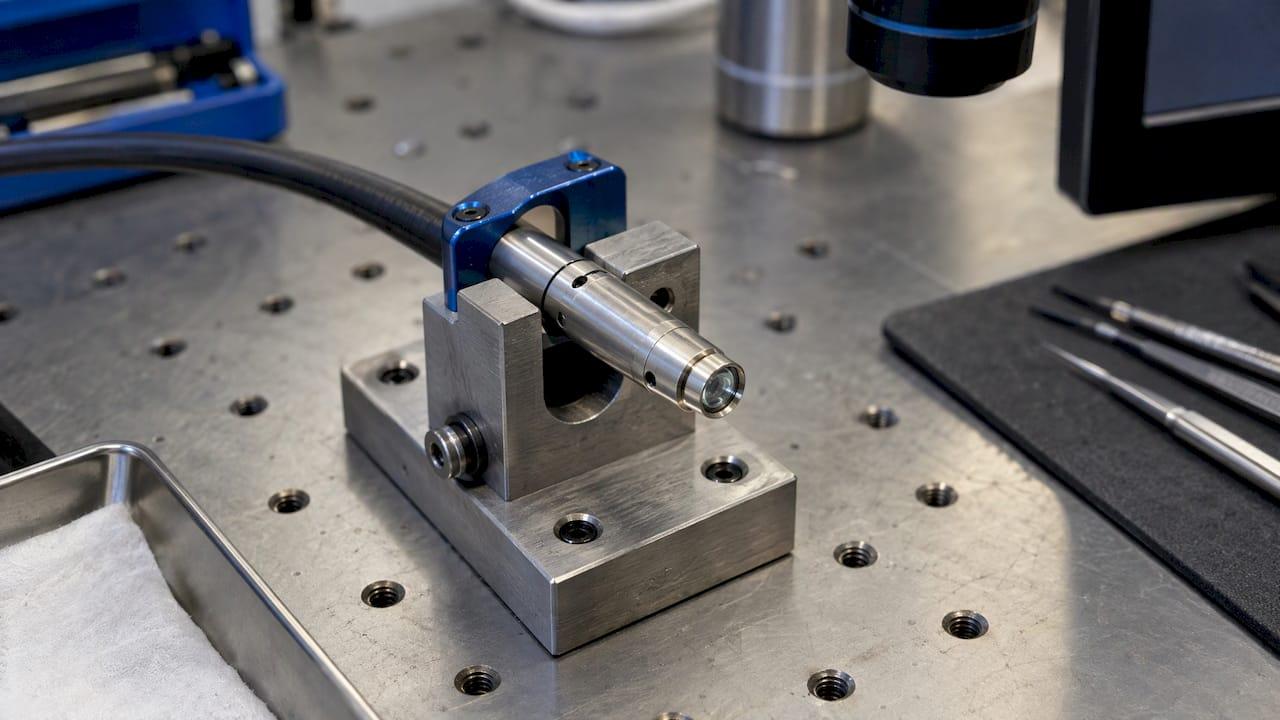
A sapphire lens window is a thin disc of synthetic crystal that sits in front of a borescope's objective lens. Its job is to take the abuse so the optics behind it don't. Sapphire is one of the hardest transparent materials available, so it resists the sand, grit, chemicals and heat that scratch or cloud ordinary glass. But a hard window only helps if you choose it for the right job and handle the tip well. This guide covers what the window does, how it compares with other materials, what still goes wrong at the tip and how to prevent it.
TL;DR
- Sapphire is Mohs 9 and about 2,200 on the Knoop scale, versus 460 for fused silica, so it stands up to abrasive debris far better than glass or quartz.
- In a documented nuclear-plant test, a sapphire window ahead of a borescope objective survived more than 250 hours in 343°C water or steam with negligible loss of resolution, while a quartz window failed.
- Hard is not tough. Sapphire can still chip or fracture from impact, edge damage or a bad mount, and a damaged anti-reflection coating can degrade the image even when the crystal is intact.
- Most tip damage comes from handling: dragging the tip over machined surfaces, tight bends, and unprotected storage. Caps, a routine and a quick tip check before every job prevent most of it.
Table of Contents
- What the window actually does
- Sapphire versus fused silica, quartz and glass
- Hard is not the same as tough
- What wears out a borescope tip
- A tip-care routine that works
- Recognizing wear before it ruins a job
- Choosing a scope for your environment
- Where we come in
- FAQ
- Sources
What the window actually does
The tip of a borescope is the most exposed part of the instrument. It leads the way into engine cylinders, pipes, turbine casings, weld seams and, on the veterinary side, airways and the digestive tract. The objective lens at the distal end collects the image, and anything that scratches, etches or fogs that surface shows up in every picture you take afterward.
A window is a sacrificial, protective surface in front of that optic. Because it is flat and sealed, it also keeps fluids and particles out of the tip assembly. Think of it as the screen protector on a phone, except that the best material for the job is the same crystal used in sight glasses for pressure vessels and in viewports for deep-diving vehicles.
Sapphire is single-crystal aluminum oxide. It is colorless and optically clear, with transmission up to 98.5% from 190 nm ultraviolet to 5 microns infrared, and it stays stable from cryogenic temperatures to well above 2,000°C. That wide band matters if your borescope uses ultraviolet or near-infrared illumination as well as ordinary white light.
Sapphire versus fused silica, quartz and glass
The choice of window material comes down to four things: hardness, optical performance, chemical resistance and how much impact the tip will see.
| Property | Sapphire | Fused silica / quartz | Optical glass (e.g. N-BK7) |
|---|---|---|---|
| Hardness | Mohs 9, Knoop 2,200 | Knoop 460 | Softer than both |
| Chemical resistance | Virtually impervious to corrosive materials | Can dissolve in hot water or steam | Varies, often attacked by hot alkalis |
| Surface reflection (uncoated) | About 7.7% per surface | Lower than sapphire | About 4.2% per surface |
| Typical weakness | Brittle at edges, costly to shape | Scratches easily | Scratches easily |
Two points in that table deserve explanation.
Hardness decides how long the window stays clear. Sand, metal swarf, scale and weld spatter are all abrasive. A window that is five times harder on the Knoop scale than fused silica will keep its polish through far more inspections before it starts to haze.
Reflection is the price of sapphire's high refractive index. Because sapphire bends light more, an uncoated surface reflects roughly 7.7% of incoming light at normal incidence, against 4.2% for common optical glass. That is why anti-reflection coatings are especially valuable on sapphire windows. In a dim cavity, lost light means a noisier picture, so a coated window matters more than the crystal alone.
Chemicals, heat and pressure
The clearest evidence comes from a test report on borescope inspection in hot, pressurized water. Researchers placed a sapphire window, 21.84 mm across and 3.05 mm thick, in front of a rod-lens borescope objective. It survived over 250 hours in 343°C water or steam at 15.2 MPa with negligible loss of resolution. A comparable quartz window lost essentially all its transmission after 2 hours and had dissolved by 31 hours.

Most of us never inspect anything that hot. The lesson still carries over: the more aggressive the medium, whether hot condensate, solvents, fuel residues or cleaning chemistry, the more the window material decides how long the tip stays useful.
Sapphire also suits harsh, abrasive settings generally. Suppliers rate custom sapphire optics for ultra-high vacuum up to 10,000 psi, and report that they are impervious to fast-moving fluids, particles and most chemicals. For a borescope tip, the practical meaning is simple: slurry, sand and detergent are not what will ruin a sapphire window.
Hard is not the same as tough
This is where many tips are lost. Hardness is resistance to scratching. Toughness is resistance to cracking. Sapphire is excellent at the first and merely average at the second. It remains brittle and can fracture from edge damage, impact or inappropriate mounting loads.
An engineering study from Bournemouth University adds that sapphire's extreme hardness and high melting point make it difficult to manufacture, so it suits small windows better than large or complex shapes. That is a good match for a borescope, where the window is small and flat.
There is a second catch. The useful question is not whether the crystal will scratch but whether the complete optical surface will keep working. A sapphire substrate under a worn anti-reflection coating can still produce a poor image, as the optical engineers at Sappoptic point out in the same comparison of sapphire and optical glass. So when you judge a tip, judge the image, not just whether you can see a scratch with your naked eye.

What wears out a borescope tip
Whether the window is sapphire or glass, the same handful of habits cause most of the damage.
- Dragging the tip. Pushing the tip across a machined bore, a rough weld or abrasive debris grinds the window. Advance on the cable, not by scraping.
- Hitting hard edges. A sapphire window rarely scratches, but a sharp knock at the rim is exactly the edge damage that starts a chip.
- Tight bends. Kinking the insertion tube at too small a radius damages the image bundle or wiring behind the window, which looks like a dim or patchy picture even though the window is perfect.
- Dirty wiping. Wiping a gritty tip with a dry cloth turns the grit into sandpaper. This hurts coatings first.
- Unprotected storage. A bare tip rolling around in a case or a vehicle is the most common way a good window gets chipped before the job even starts.
Industry guidance on this recommends replaceable windows, protective caps in transport and storage, and training technicians not to drag the tip over abrasive surfaces. Those are sound habits, and they cost almost nothing.
A tip-care routine that works
This is the routine we would hand a new technician, in the order they use it.
Before the inspection
- Look at the tip under good light. Check the window for chips at the rim, haze, film or a rainbow sheen that suggests coating wear.
- Check the picture on a clean white card or a printed test page. Streaks, dark patches or a soft focus point to the window or the optics behind it.
- Fit any articulation or guide accessory you plan to use before you insert, so you aren't handling the tip mid-job.
During the inspection
- Insert slowly and let the scope follow the path. If you meet resistance, back out rather than force it.
- Keep bends gentle. If the picture dims or shimmers at a bend, you are close to the limit of the tube.
- In wet or oily environments, pause and clear the tip rather than working through a fogged image. Moisture on a window can be a real issue in hot, wet flow; the nuclear test above noted that moisture on the window in some flow regimes can be boiled off by electrically heating it, which is a reminder that condensation is a lighting problem as much as a cleaning one.
After the inspection
- Blow loose grit off the window with clean air before any contact.
- Then wipe with a lint-free swab and an appropriate optical cleaning fluid, one pass in a single direction, using a fresh swab each time.
- Put the protective cap on and coil the tube at a generous radius.
- Store the scope in a padded case, away from tools and anything that can roll against the tip.
For a deeper look at the cleaning and wiping side, see our practical guide to endoscope lens scratch prevention.
Recognizing wear before it ruins a job
A worn tip rarely fails all at once. It gets a little worse each week until a report has to be redone. Watch for these signs.
| What you see | Likely cause | What to do |
|---|---|---|
| Fine hazing across the whole image | Coating wear or film on the window | Clean carefully; if it stays, the tip needs servicing |
| One hard line or pit in the same place on every frame | Scratch or chip on the window surface | Service; do not keep inspecting, as debris can enter a chipped edge |
| Dim or uneven brightness | Light-path or cable damage, or a dirty tip | Clean first; if it persists, stop and have the scope checked |
| Image goes soft after a bend | Kinked tube | Straighten the path, retire the scope for evaluation if it persists |
| Moisture inside the tip | Seal failure | Stop using it and arrange service |
The rule of thumb is simple: if cleaning does not restore the picture, the problem is not dirt. A scope that is serviced early costs less than one that is run until the image fails. Our endoscope repair service is there for exactly that situation.
Choosing a scope for your environment
Before you buy, match the tip to the work.
- Abrasive, dirty or chemical environments (industrial pipe, casings, exhausts, tank interiors): the hardness and chemical resistance of a sapphire window pay off most here.
- Clean, soft-tissue environments (airways, the gut, ears): scratching is less about grit and more about handling and cleaning, so routine matters more than window material.
- Small bores and long reach: tip size and tube flexibility limit what you can use, and the bend radius becomes the main wear risk.
- Recording and documentation: if you need still images or video for reports, a clean tip and good light matter as much as resolution.
Veterinary teams working on small animals will find our notes on small diameter endoscopes a useful starting point, and our guide to the best borescopes for vets covers the clinical side.
Where we come in
We sell veterinary and industrial endoscopes, videoscopes, NDT borescopes and the accessories that go with them, including light sources, valves, pumps and cleaning tools. For industrial work, our borescopes page lists monitor-type SD-card videoscopes, portable pipe inspection videoscopes and micro fiber borescopes. Our aim is high-resolution, portable equipment at lower prices than hospital-grade or human-use systems, backed by 24/7 support and rapid shipping.
For clinics, the medical endoscopes and accessories page and our rigid scopes, arthroscopes and otoscopes cover the rest of the range. If a tip is already scratched or cloudy, we also repair endoscopes.
Our view on tip protection
In our experience of supplying veterinary clinics and industrial inspection teams, the question is rarely whether a scope has a premium window. It is whether the team protects the tip every day. A hard window is a very good reason to expect longer clarity, but caps, gentle bends, clean swabs and a habit of checking the picture before each job do as much for the image as the material does.
That is why we pair affordable, portable scopes with the accessories that look after them: cleaning tools, valves, light sources and a repair service for when a tip needs attention. A well-matched scope that is cared for will outlast a more expensive one that is not.
We would rather our customers get years of clear pictures from the right instrument than replace tips every season. Tell us your environment, your bore sizes and your reporting needs, and we will help you match them to the right scope.
Endoscope
FAQ
Is a sapphire window scratch-proof?
No, but it is very scratch-resistant. Sapphire is second only to diamond in hardness, so ordinary grit and metal rarely mark it. It can still chip at the edge from impact, and its coating can wear, so protective caps and careful handling still matter.
Why does a sapphire window sometimes look dimmer than glass?
Because of its high refractive index, an uncoated sapphire surface reflects about 7.7% of light, against 4.2% for common optical glass. Anti-reflection coatings recover most of that loss. If the picture dims over time, a worn coating or a film on the surface is a likelier cause than the crystal itself.
Can I clean a borescope tip window with any cloth?
Use a lint-free swab and optical cleaning fluid, after blowing off loose grit with clean air. A dry, dirty cloth drags particles across the surface and wears the coating. Use a fresh swab for each wipe and cap the tip afterward.
When should a borescope tip be serviced?
Service it when cleaning does not restore the image, when you see a chip, pit or persistent line in the same spot, or when moisture appears inside the tip. Waiting usually makes the repair larger. Our repair service handles endoscope repairs.
Is sapphire worth it for veterinary endoscopy?
It depends on the environment. Hard, chemically inert windows matter most where grit, fluids and chemicals are present, which is typical of industrial inspection. In clinical work, careful cleaning and storage protect the tip most. Browse our veterinary endoscopy equipment to see what suits your caseload.
Sources
- Sapphire Windows | Custom and Stock | Meller Optics
- Sapphire lenses and windows for extremely demanding environments | Meller Optics
- AMSTER, borescope window test report | OSTI
- Design of optical access on pressurised chambers | Bournemouth University
- About Sight Glasses | Encole
- Sapphire vs Optical Glass for Industrial Windows | Sappoptic
- Industrial Borescope Lens Scratch Protection and Cable Bend | LatamPair