
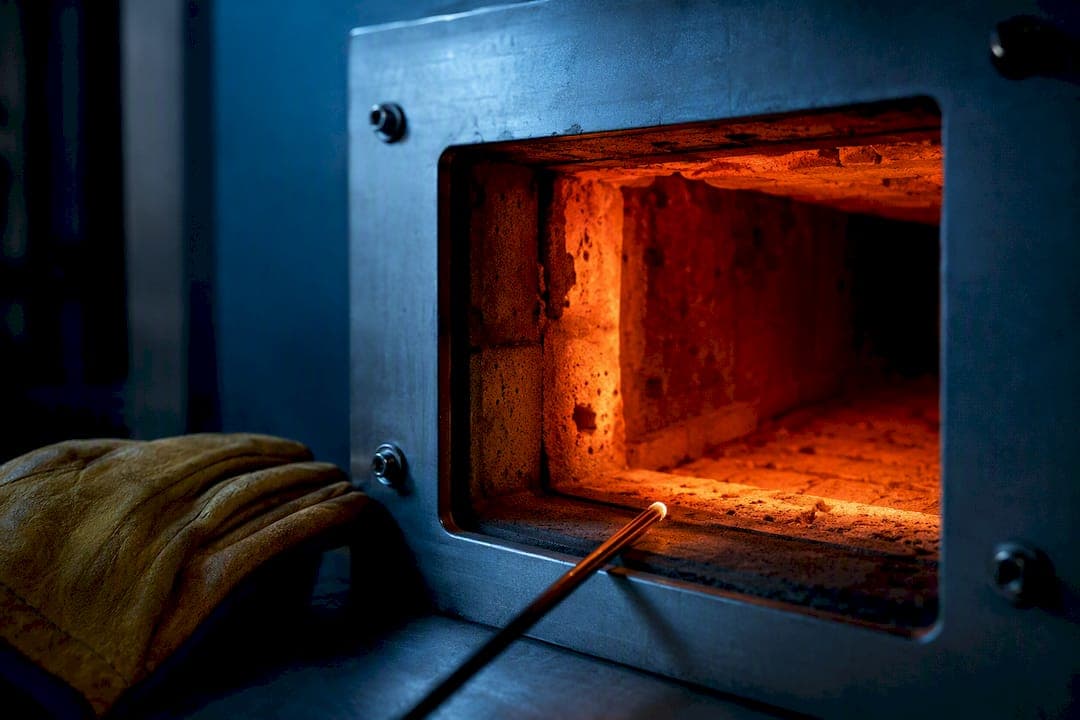
A high temperature borescope is an inspection camera or optical relay built to survive sustained heat inside furnaces, kilns, heat exchangers, or engine blocks, rather than the brief warm exposure a standard borescope tolerates. The core decision isn't brand or resolution. It's whether you need a tip-sensor video probe, a fiber or rigid optical relay, or a cooled jacket. Check the continuous temperature rating and your access-port diameter before anything else.
TL;DR:
- Rigid or fiber relay systems tolerate the highest sustained heat because they lack electronics at the probe tip, unlike tip-sensor video probes.
- The probe's sheath material and window design, especially sapphire windows and Inconel sheaths, significantly impact durability and image clarity in extreme environments.
- Cooling methods, whether air or water, extend probe life and allow for longer inspections, with water cooling suitable for furnace work but requiring additional plumbing.
- Proper sizing, access, and maintenance—including regular cleaning and checking for soot buildup—are critical to prevent premature probe failure in hot applications.
Table of Contents
- What "High Temperature" Actually Means for a Borescope Rating
- Tip-Sensor Video vs Optical Relay vs Cooled Jackets
- Probe Materials, Window Design, and Access Planning
- How to Choose the Right Borescope for a Hot Job
- Where These Scopes Actually Get Used, and Where They Don't
- Field Checklists Worth Building Into Your Routine
- Calibration and Accuracy Under Sustained Heat
- Cleaning and Maintenance That Actually Extend Probe Life
- Image Quality and Resolution: What Heat Actually Costs You
- Common Failure Modes and How to Troubleshoot Them
- Where Borescope Design Is Actually Improving
- The Trade-Offs Nobody Puts on the Spec Sheet
- How 1800endoscope Supports Technicians on Hot Jobs
- Sources
- FAQ
What "High Temperature" Actually Means for a Borescope Rating
Manufacturers rate two different things, and mixing them up is how technicians melt a probe on the first job. Continuous operating temperature is what the probe survives for the full inspection duration. Peak or brief exposure temperature is a short spike the unit tolerates for seconds, not minutes. A spec sheet that only lists peak temperature is telling you the ceiling, not the floor you can actually work from.
Rough bands you'll see across the market:
- 100 to 300°C: Moderate heat, tip-sensor video probes with basic heat shielding, ductwork and warm equipment casings.
- 300 to 800°C: Industrial heat-rated units, often fiber-relay or lightly cooled, used on engine components and mid-range process equipment.
- 600 to 2,000°C: Furnace and kiln-class systems, almost always optical relay or actively cooled, built specifically to keep electronics out of the hot zone.
Some furnace borescope systems are engineered to withstand temperatures up to 2,000°C using optical relay or actively cooled probe jackets, and NIR furnace endoscope cameras measure up to roughly 1,800°C using sapphire-protected optics paired with air or water cooling. Always confirm whether the published number applies to the sheath, the optics, or just the tip sensor. Those three components often have three different limits.
Tip-Sensor Video vs Optical Relay vs Cooled Jackets
Tip-sensor video borescopes put a camera chip right at the probe tip. That gets you live color video, easy articulation, and simple operation, but it also puts the most heat-sensitive component exactly where the heat is worse. Tip-sensor video units typically have much lower heat ceilings, often only tens of degrees above ambient for standard models, though heat-rated versions push higher with shielding.
Fiber and rigid optical relay systems solve that problem by removing the electronics entirely. A bundle of glass fiber or a rigid lens train carries the image from the hot tip back to a camera sitting in cool air outside the furnace or duct. This is why rigid relay systems tolerate the highest sustained temperatures. There's simply no sensor to protect.
Cooled jackets extend either architecture further:
- Air-cooled jackets push compressed air around the probe sheath, adequate for moderate industrial heat and shorter duty cycles.
- Water-cooled jackets circulate liquid coolant, the standard choice for furnace and kiln work approaching the top of the temperature range, but they add plumbing, pumps, and a duty-cycle limit you have to plan around.
Probe Materials, Window Design, and Access Planning
Sheath material determines how long a probe survives repeated hot insertions. Stainless steel braid is the baseline for most industrial units. Inconel and other nickel alloys hold up better against scaling and oxidation at the top of the range, which matters if you're running the same probe into a 1,500°C furnace weekly rather than once per quarter.
The window at the tip matters just as much as the sheath. Sapphire windows resist abrasion from soot and airborne particulate far better than standard glass, and they hold optical clarity at temperatures that would craze or cloud ordinary lenses. NIR furnace cameras rely on sapphire-protected optics specifically because soot buildup on a lower-grade window degrades image quality within a single inspection.
Before you order anything, work through this checklist:
- Measure the access port diameter and confirm the probe (plus jacket, if cooled) actually clears it. Furnace systems often need bores of 50 mm or more once a cooling jacket is factored in, a detail that catches inspectors off guard more often than temperature rating does.
- Confirm probe length against the actual distance to the inspection target, not the straight-line estimate.
- Check illumination output against probe diameter. Thinner probes carry less light guide fiber, which shows up as dim, grainy footage in a large furnace cavity.
- Budget for a spare probe. Hot-zone insertions are the leading cause of premature failure.
Pro Tip: Bring a physical gauge or calipers to the site visit before you buy. Access port specs on equipment drawings are frequently outdated after years of retrofits and gasket changes.
How to Choose the Right Borescope for a Hot Job
Start with the number that actually kills probes: the continuous temperature rating, not the peak figure printed in bold on the box. Confirm whether that rating covers the sheath, the optics, or just the tip sensor, because a fiber relay rated to 1,200°C paired with a standard rubber grommet at the access port won't survive the job either.
From there, work through architecture, cooling, and access as a single decision, not three separate ones:
- Match architecture to sustained temperature and path. Straight-line access into a furnace or kiln favors rigid or optical relay systems. Tortuous, bent access, like inside a heat exchanger bundle, forces a trade: you'll likely need a tip-sensor video probe with a lower temperature ceiling because articulation mechanisms carry wiring and joints that don't tolerate extreme heat well.
- Confirm the cooling method and its duty cycle. Air cooling suits shorter inspection windows; water cooling suits sustained furnace work but demands a coolant supply, pump, and hose run you need to plan for on-site, not discover once you're there.
- Measure the access port and add a 20 to 40% margin. Cooling jackets and rigid insertion tooling add real diameter. A probe that clears the port with nothing to spare will bind on thermal expansion once the equipment heats up.
- Ask vendors five direct questions: What's the continuous (not peak) temperature rating? What cooling method does it require, and what's the duty cycle? Are spare probes stocked, or built to order? What's the repair lead time? What does the warranty actually cover once a probe has been run hot?
Budget by use frequency, not by the biggest number on a spec sheet. Occasional inspections on moderately hot equipment don't justify a water-cooled rigid system. High-temperature borescopes span a wide price range, with entry-level heat-tolerant video units starting in the low hundreds of dollars, mid-tier 1080p heat-rated models running several hundred to around $1,000, and industrial cooled or articulating systems reaching into the thousands. A facility running weekly furnace inspections should weight the decision toward durability and spare-probe availability over upfront cost. A crew doing quarterly checks on warm ductwork doesn't need furnace-class equipment.
Where These Scopes Actually Get Used, and Where They Don't
Furnace and kiln walls, refractory brick, and burner assemblies are the classic proving ground for cooled and optical-relay systems. Heat exchangers, engine blocks during hot-idle diagnostics, boiler tubes, and combustion chambers in HVAC systems round out the common job list. Each of these shares one trait: sustained heat over the full inspection window, not a quick peek at a warm surface.
Limitations show up fast in these environments. Soot accumulation on the window degrades image clarity mid-inspection, especially without a purge system. Articulation, the feature that makes tip-sensor scopes so easy to steer, is also the first thing to fail under repeated heat cycling, since wiring and flexible joints are more heat-vulnerable than a rigid lens train. And probe life shortens noticeably with repeated near-limit insertions, even when the unit is rated for the temperature on paper.
Safety practices that matter every time:
- Verify actual equipment temperature before insertion, not just the process set point.
- Wear heat-rated PPE and use insulated handling tools for the probe near the access port.
- Use purge air to clear soot and retract the probe the moment image quality drops.
- Coordinate hot work with facility shutdown or lockout procedures, never as a solo task in an active thermal zone.
Field Checklists Worth Building Into Your Routine
Two practical resources shape how a hot inspection should actually run. The heat exchanger workflow behind "Bring Two Probes" makes a simple point: redundancy isn't optional when a probe failure mid-inspection means a repeat shutdown. Carrying a second probe, even a lower-spec backup, turns a ruined inspection window into a minor delay.
"Borescope Safety Procedures" lays out the pre-check sequence that catches problems before they become failures: confirming actual surface or ambient temperature against the probe's rating, inspecting the sheath and window for prior damage, and handling the probe with heat-rated gloves and insulated tooling rather than bare hands near the hot end.
For a broader view of where these tools fit across different equipment types, the 2026 field guide to industrial borescope uses walks through application-specific setups beyond furnace work, including tank and pipe inspection scenarios that call for different probe choices entirely.
Calibration and Accuracy Under Sustained Heat
Heat doesn't just threaten survival. It threatens accuracy, especially when the borescope is also reporting temperature data rather than just video. Thermal expansion inside the probe housing can shift lens alignment slightly, and prolonged exposure to near-limit temperatures accelerates that drift faster than normal use would.
For systems that combine visual inspection with temperature measurement, like NIR furnace cameras, manufacturers publish uncertainty figures that matter more than most buyers realize. PYROINC NIR systems report measurement uncertainty around 2% of the measured value within their rated range. That's a meaningful spread at 1,500°C. A 2% error at that temperature is a swing of roughly 30°C, enough to change a maintenance decision if you're using the reading to judge refractory wear or burner performance.
Recalibration schedules should track duty cycle, not just calendar time. A probe run into a 1,200°C furnace weekly needs more frequent verification than one used quarterly on warm ductwork, because thermal cycling stresses optical alignment even when the unit shows no visible damage. Compare readings against a known reference point when possible, a thermocouple placed near the inspection zone gives a useful cross-check against what the NIR system reports.
Ambient conditions on the cool end of the system matter too. If the camera housing itself sits outside its rated working ambient, typically something like -10°C to +40°C for many inspection sensors, accuracy and reliability both suffer, even though the hot-end probe is functioning normally. Cold outdoor inspections in winter can trip this just as easily as a hot mechanical room.
Cleaning and Maintenance That Actually Extend Probe Life
Soot is the enemy of every hot-zone borescope, and it accumulates faster than most technicians expect. A single furnace pass can leave enough particulate on a sapphire window to visibly degrade image sharpness before the inspection is even finished. Active purge systems, which push a thin stream of air or inert gas across the window during insertion, cut this buildup dramatically compared to passive designs.
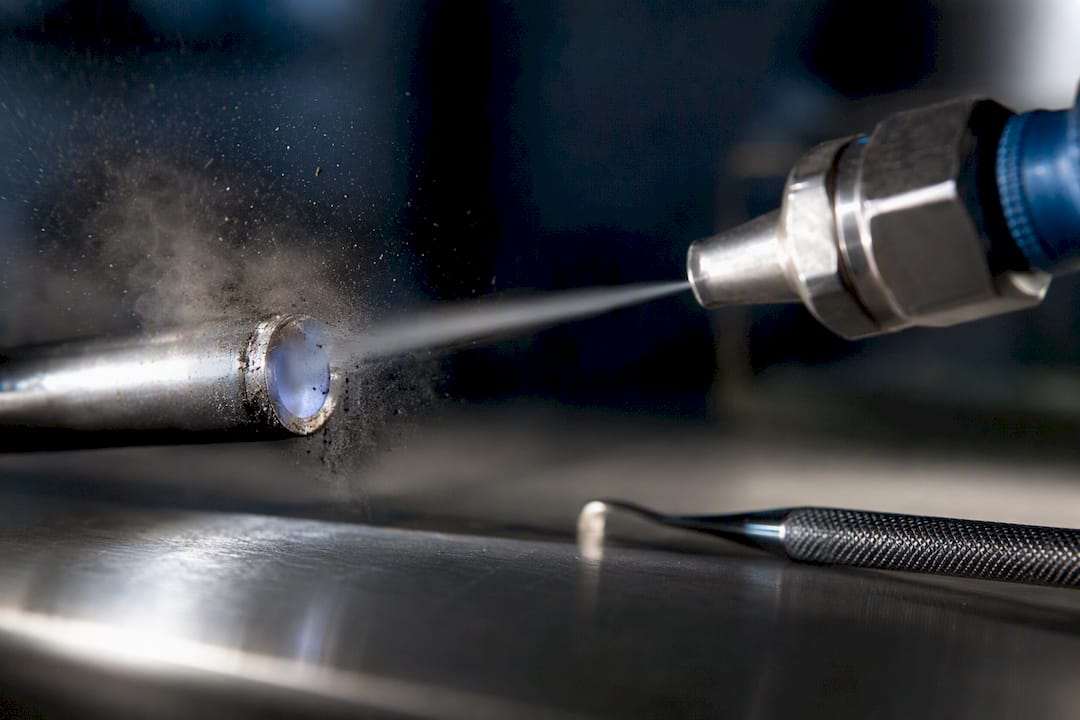
Post-inspection cleaning should happen immediately, not at the end of the shift. Soot and combustion residue bond more aggressively to a warm sheath than a cooled one, so wiping the probe down while it's still cooling, rather than after it's fully cold, generally lifts residue with less abrasive effort. Use cleaning solutions rated for the sheath material specifically. Aggressive solvents that work fine on stainless steel braid can degrade certain seal materials on cooled-jacket connections over repeated use.
Inspect the window and sheath after every use, not on a fixed schedule. Look for micro-pitting on sapphire windows, which shows up as a subtle haze under bright light before it becomes a visible crack. Check cooling jacket fittings for coolant seepage after water-cooled runs, since a slow leak at a fitting will eventually starve the cooling flow exactly when you need it most.
Service life for cooled probes varies widely depending on how hard they're worked. NIR thermal borescope systems report service lives ranging from two to ten years depending on duty cycle and operating conditions, a spread wide enough that facilities running near-daily furnace inspections should plan replacement budgets closer to the low end of that range, not the high end.
Image Quality and Resolution: What Heat Actually Costs You
Resolution specs on a spec sheet mean less than they seem to once heat enters the picture. A 1080p tip-sensor probe delivers sharp footage in a cool duct and noticeably softer, noisier footage inside a hot furnace, not because the sensor changed, but because heat-induced electronic noise and soot haze both degrade the signal before it ever reaches the recording.
Optical relay and rigid systems generally hold image quality more consistently at temperature extremes, precisely because the sensor never enters the hot zone. What you lose is resolution ceiling. Fiber bundles, in particular, carry an inherent pixelation limit tied to the number of individual fibers in the bundle, visible as a faint honeycomb texture on close inspection, something a tip-sensor video probe never shows.
Illumination compounds the problem. A thinner probe, chosen to fit a tight access port, carries less light guide capacity, and dim lighting inside a large furnace cavity or heat exchanger shell produces grainy, underexposed footage regardless of how many megapixels the sensor claims. Matching probe diameter to the actual size of the inspection cavity matters as much as any resolution spec.
Practical takeaway for comparing systems side by side: judge image quality claims against the actual operating temperature and cavity size you'll be working in, not a manufacturer's demo footage shot in a controlled test rig at room temperature. The gap between demo video and field results widens considerably once you're above 500°C.
Common Failure Modes and How to Troubleshoot Them
Window fogging or haze is usually the first sign of trouble, and it's almost always soot or thermal stress on the sapphire or glass surface rather than a sensor fault. Retract the probe, allow it to cool slightly, and clean the window before assuming the unit itself has failed.
Articulation stiffness or complete loss of steering control points to heat damage in the wiring or joint mechanism inside the bending section. This is the most common failure mode on tip-sensor video probes used near their rated temperature ceiling repeatedly, since flexible joints and wiring simply wear faster under heat cycling than a rigid lens train does. If articulation failure happens repeatedly on the same job type, that's a signal to move to a non-articulating rigid or fiber system instead of replacing probes indefinitely.
Sudden image dropout or a dead sensor, as opposed to gradual degradation, usually means the tip sensor exceeded its rated temperature, even briefly. This is the exact failure mode optical relay systems are designed to eliminate, since there's no electronic sensor in the hot zone to fail in the first place.
Coolant flow interruption on water-cooled jackets shows up as a rapid temperature spike on any integrated sensor readout, followed quickly by image or performance loss. Check fittings and pump function immediately rather than continuing the insertion, since a jacket running dry loses its protective margin within seconds at furnace-class temperatures.
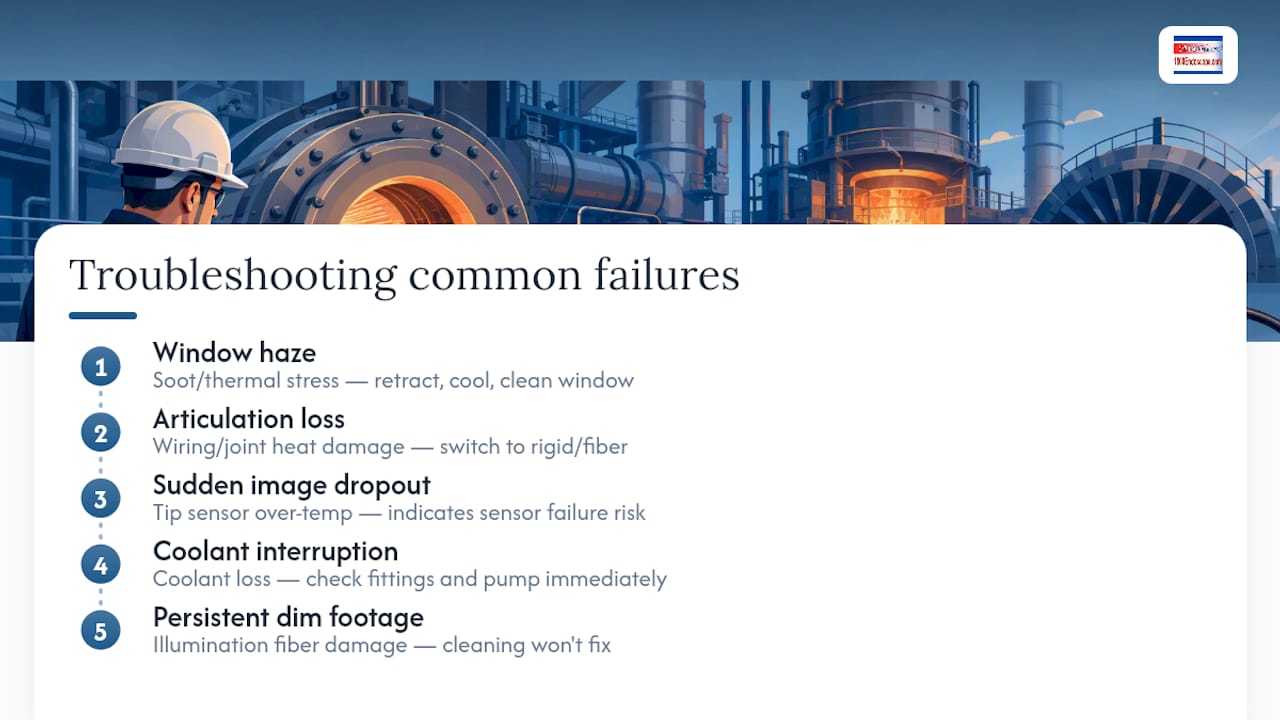
Persistent dim or grainy footage that cleaning doesn't fix often traces back to illumination fiber damage from repeated heat exposure, not a camera problem at all. Light guide fibers degrade gradually under thermal stress, and that degradation is permanent, not something a cleaning cycle reverses.
Where Borescope Design Is Actually Improving
The most meaningful advances in this category aren't about resolution numbers climbing higher. They're about extending the temperature envelope where a given architecture stays reliable. Improved sapphire window mounting techniques reduce the thermal stress fractures that used to be a leading cause of premature window failure at the upper end of the range.
Active purge systems have also gotten more efficient at soot rejection, meaning cleaner footage lasts longer into a hot inspection before particulate buildup forces a retraction and wipe. That translates directly into fewer interrupted inspections on long furnace runs.
Cooling jacket engineering keeps closing the gap between air-cooled convenience and water-cooled capability, giving technicians more flexibility on jobs that sit right at the boundary between the two. And NIR measurement integration, combining visual inspection with quantified temperature readings in a single probe pass, means fewer separate tools carried to the same job site, though the accuracy tradeoffs covered earlier still apply regardless of how integrated the system gets.
None of this changes the fundamental architecture decision covered earlier in this guide. It just pushes the practical ceiling on each option a little further out.
The Trade-Offs Nobody Puts on the Spec Sheet
Durability and flexibility pull against each other in this category, and no manufacturer's marketing copy says so plainly. A rigid or fiber relay system will outlast almost anything at extreme temperature, but it can't bend around an obstruction the way a tip-sensor probe can. Buying the most temperature-tolerant option available isn't automatically the right call if your job requires steering through a tortuous path.
Renting a specialist cooled system for a one-off furnace shutdown often makes more financial sense than buying one outright, particularly for facilities that only run this kind of inspection once or twice a year. Save the capital purchase for equipment you'll use often enough to justify spare-probe inventory and staff training, both of which cost more over time than the probe itself.
— Endoscope
How 1800endoscope Supports Technicians on Hot Jobs
Sourcing the right probe for a hot job usually comes down to matching temperature rating and access constraints correctly the first time, rather than discovering a mismatch mid-inspection. 1800endoscope carries borescope monitor-type SD-card videoscopes and portable pipe inspection systems built for technicians who need practical, field-ready options at prices well below traditional hospital-grade or industrial-only pricing structures.
Beyond the initial purchase, probes that see regular hot-zone use eventually need service, and having a repair path matters as much as the original spec sheet. 1800endoscope's endoscope repair services give technicians a place to send worn probes rather than replacing an entire system over a damaged tip or degraded window. For teams still working through the architecture decision covered above, whether a job calls for tip-sensor flexibility or a rigid relay system built for extreme heat, reaching out to sales before ordering helps match the right probe diameter, temperature class, and spare-probe plan to the actual equipment you're inspecting. Browse the full endoscope and borescope catalog or contact the team directly to get temperature-specific recommendations for your next shutdown or turnaround.
Sources
- Fiberscope Cesyco Furnace Borescope Camera — Environmental Expert
- PYROINC - High-resolution NIR furnace camera (dias-infrared PDF)
- High temp borescope: specs and uses explained — InspectandTest
- Topseven sight inspection camera sensor details
FAQ
What Kind of Camera Can Withstand High Temperatures?
Cameras built for high heat generally fall into two categories: heat-shielded tip-sensor video probes rated for moderate industrial temperatures, and optical or fiber relay systems that keep the actual sensor outside the hot zone entirely. For furnace and kiln-class heat, systems rated up to roughly 1,800 to 2,000°C rely on cooled jackets or relay optics rather than a heat-hardened sensor.
What's the Difference Between a Borescope and an Endoscope?
The terms describe the same basic tool, a flexible or rigid optical instrument for viewing inaccessible spaces, but "borescope" typically refers to industrial and mechanical inspection use, while "endoscope" is more common in medical and veterinary contexts. 1800endoscope sells both categories, including industrial borescopes and veterinary endoscopy equipment, built for their respective inspection environments.
What Is the Best Borescope for High Heat Work?
There's no single best option. The right choice depends entirely on your maximum sustained temperature and access path. Rigid or fiber optical relay systems handle the highest temperatures, up to roughly 1,800 to 2,000°C in furnace-class applications, while tip-sensor video probes suit lower-heat jobs where articulation through bent access paths matters more than absolute temperature tolerance.
What Is the Temperature Range of a Thermal Imaging Borescope?
NIR thermal borescope cameras typically measure within a range of roughly 600 to 1,800°C, depending on the specific model and sensor configuration. Measurement accuracy within that range carries an uncertainty of around 2% of the reading, which becomes a meaningful margin at the upper end of the scale.
Do I Need a Cooled Jacket for Every High-Temperature Job?
No. Cooling jackets, air or water, are necessary mainly for sustained furnace and kiln-class temperatures above roughly 600°C. Moderate industrial heat in the 100 to 300°C range is often manageable with a heat-shielded tip-sensor probe alone, without the added complexity and duty-cycle limits that cooling systems introduce.