
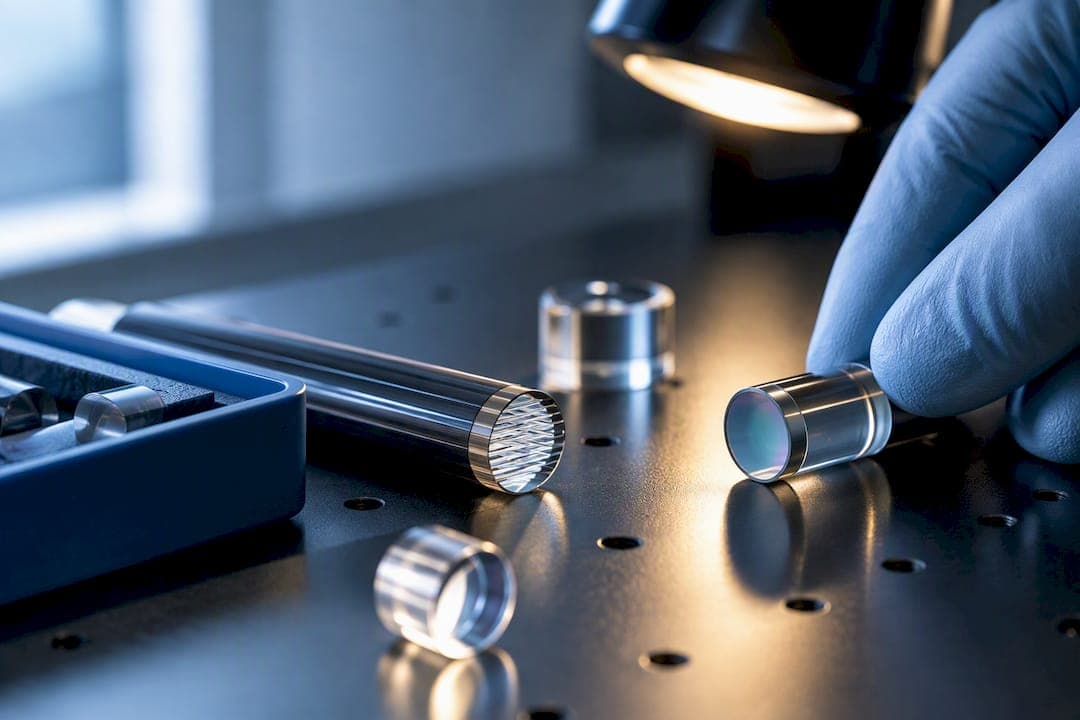
A rod lens is a cylindrical relay optic that carries the image through a rigid endoscope, and the Hopkins rod-lens relay is the standard architecture behind that transfer. Before ordering a replacement or attempting a repair, confirm the outer diameter, length, and bonding method the original assembly used. 1800endoscope stocks matched rod-lens sets and offers repair services for technicians who need either path.
TL;DR:
- Matching the outer diameter alone is insufficient; confirm the lens curvature, end-face finish, and internal spacing for proper replacement.
- A controlled inspection for chips, coating defects, and concentricity helps prevent failed repairs and ensures optimal optical performance.
- A debonded rod lens with a clean separation can usually be re-bonded using UV-curable adhesive, but damage to end faces or coatings requires replacement.
- Refinements such as field-lens modifications and higher refractive index substrates improve image sharpness more than changing rod materials.
- Suppliers should provide detailed specifications, traceability, and repair options to guarantee compatibility and maintain scope performance.
Table of Contents
- How rod-lens relay optics work and their optical trade-offs
- Materials, coatings, and tolerances behind image quality
- Standard sizes and a compatibility checklist before you order
- Repairing and re-bonding a debonded rod lens
- Procurement checklist: what to ask suppliers before you buy
- What field repairs actually teach you about rod lenses
- How 1800endoscope supports rod-lens sourcing and repair
- Sources
- FAQ
How rod-lens relay optics work and their optical trade-offs
Before Harold Hopkins introduced the rod-lens design, rigid endoscopes relayed images through chains of small air-spaced glass lenses separated by air gaps. Each junction lost light and added aberration, which limited scope diameter and image quality. The Hopkins rod-lens relay replaced those air-lens chains with long glass rods cemented to thin field lenses at each end, and that shift increased light transmission and image contrast while allowing smaller-diameter scopes with sharper resolution.
The rod itself acts as both a lens and a spacer, since its curved end faces do the focusing work that used to require multiple separate elements. This has practical consequences technicians should expect:
- Higher throughput: cemented rod-to-lens joints lose far less light at each interface than air-spaced lenses did.
- Smaller diameters possible: fewer discrete components per relay stage means scopes can shrink without sacrificing brightness.
- Off-axis compromises remain: astigmatism and field curvature still show up toward the edge of the field of view, especially in longer scopes with many relay stages.
Later refinements addressed that edge softness directly. Modifying the doublet field and aperture lenses at each rod junction, or selecting a higher refractive index substrate, produced measurable gains in image quality according to comparative optical design work. These design choices at the field-lens level often matter more for sharpness than swapping the rod material alone. Compact rigid scopes built on this relay principle now serve procedures ranging from small-animal airway exams to portable veterinary inspection work.
Materials, coatings, and tolerances behind image quality
Most rod lenses are ground from optical glass, but sapphire or specialty glass substrates show up in scopes built for higher durability or specific refractive properties. Substrate choice affects transmittance, scratch resistance, and how the rod tolerates repeated autoclave cycles.
Coatings matter as much as the base material:
- Anti-reflective coatings cut internal reflections at every rod-to-lens junction, which preserves contrast across a multi-stage relay.
- Sterilization-tolerant coatings resist clouding or delamination under repeated steam or chemical sterilization.
- Transmittance determines how much of the light source's output actually reaches the eye or camera, which is why a scratched or degraded coating can dim an image even when the light source is functioning correctly.
Manufacturing tolerances are just as unforgiving. Outer diameter, overall length, end-face flatness, and concentricity all have to stay within tight bounds, because a rod that is out of round or slightly off-length will misalign with adjoining lenses and introduce blur or a shadowed field.
A design change at the field-lens level, not the rod substrate, produced the largest measured gains in image sharpness in one comparative study. Adjusting the doublet lens design and refractive index at each junction improved MTF more than switching rod materials, which tells technicians that a "compatible" replacement rod is not automatically an optically equivalent one.
Standard sizes and a compatibility checklist before you order
Rigid endoscope rods commonly come in diameters clustered around 2.7 mm, 4 mm, and 10 mm, matching common arthroscope, laparoscope, and otoscope families, but diameter alone rarely confirms a match. Two rods of identical outer diameter can differ in lens curvature, end-face finish, or internal element spacing, all of which affect the final image.
Before ordering a replacement, request:
- Outer diameter and overall length measured to the same tolerance as the original part.
- Clear aperture at each end, since a smaller aperture than the original narrows the field of view.
- Coating specification, matched for both anti-reflective performance and sterilization compatibility.
- Substrate material, glass or sapphire, since mixed substrates in one relay chain can introduce focus shifts.
- Certificate of conformance tying the part to a traceable lot and inspection record.
On arrival, check the rod under magnification for chips or coating defects, confirm concentricity by rotating it against a flat reference, and inspect both end faces for polish quality before installation.
Pro Tip: Measure the old rod before you discard it. A worn or debonded original is still your best reference for length and end-face geometry.

Repairing and re-bonding a debonded rod lens
A debonded rod lens, where the cement joint between the rod and its field lens has failed, is often salvageable if the glass itself is undamaged and the separation is clean. Chipped end faces, internal fractures, or coating delamination across a large area usually call for replacement instead. Repair guides for rigid endoscope optics describe UV-curable optical adhesives as the standard bonding material, since they offer high light transmittance, cure quickly under controlled UV exposure, and hold up to repeated autoclave cycles once fully cured.
A typical rod-lens re-bonding workflow runs through these stages:
- Controlled heating to soften residual old adhesive without stressing the glass.
- Mechanical separation and cleaning, removing all cement residue from both mating surfaces.
- Micro-dispensing a small, bubble-free bead of UV-curable adhesive, commonly through a fine needle around 0.25 mm, according to repair tooling notes.
- Alignment under magnification, using a fixture that holds the rod and lens coaxially, since even a slight tilt introduces asymmetric blur.
- UV curing at the lamp power, distance, and duration specified for the adhesive, followed by a hold period for full cure.
- Inspection and thermal stabilization, checking the joint under magnification and letting the assembly settle before it goes back into service.
Low-volume repair shops often rely on simple fixtures, acrylic sliders, or gravity-assisted standing setups, to hold the rod and lens coaxial to within tens of microns while the adhesive cures. Precision alignment and controlled dispensing tend to matter more for the final result than the specific adhesive chemistry chosen.
Pro Tip: A bond line with no visible bubbles under magnification is a better predictor of long-term optical performance than the brand of adhesive used.

Procurement checklist: what to ask suppliers before you buy
A spec sheet that only lists diameter and length is not enough to guarantee a working replacement. Request the clear aperture, coating type, substrate, and manufacturing tolerance alongside a certificate of conformance tying the part to a traceable production lot, since traceability is what lets you challenge a bad batch later.
Beyond the spec sheet, ask suppliers:
- What lead time applies to a custom-matched rod versus a stocked standard size.
- Whether the vendor offers lot traceability if a batch of parts shows a defect.
- What the return policy covers if a delivered part fails inspection.
- Whether custom matching to an existing scope's optical configuration is available.
- Whether the same vendor offers repair or re-bonding services if the part later debonds.
1800endoscope's rigid endoscopy catalog lists matched parts by scope family, and its repair service covers re-bonding for scopes that arrive with debonded or damaged rod optics, which keeps sourcing and verification under one point of contact.
What field repairs actually teach you about rod lenses
The most common mistake in the field is not adhesive choice or curing time, it is skipping the pre-repair inspection. A rod that looks intact under normal light can still have a hairline fracture that only shows up under magnification, and bonding a compromised rod wastes the adhesive and the labor.
The single most useful habit before any reuse decision is checking end-face flatness and concentricity first, because those two measurements predict more repair failures than adhesive selection ever does.
— Endoscope
How 1800endoscope supports rod-lens sourcing and repair
Sourcing a correctly matched rod lens shouldn't mean guessing at specs from a photo. 1800endoscope carries rigid scopes, rod-lens replacement sets, and endoscopic accessories built for veterinary and industrial use, alongside a repair service for scopes with debonded or damaged optics.
- Matched rigid scope parts: browse the rigid endoscopy catalog for arthroscopes, otoscopes, and compatible rod sets.
- Repair submissions: send a debonded or damaged scope in for re-bonding rather than replacing the whole unit.
- Custom orders: request a quote when a stocked size does not match your scope's original configuration.
The Hopkins rod-lens relay design underlies both new stock and repaired parts, so matching that architecture correctly is what determines whether a fix restores full image quality.
| Need | Where to go |
|---|---|
| New or replacement rigid scope | Rigid scopes catalog |
| Debonded or damaged rod lens | Repair services |
| Full medical endoscope systems | Medical endoscopes page |
Request a quote or send in a scope for evaluation through the medical endoscopes page to get a repair or replacement path started.
Sources
The Hopkins rod-lens relay history comes from Applied Optics, and the doublet-lens design improvements cited above come from a comparative optical design study. Repair parameters and adhesive guidance draw on rigid endoscope repair documentation covering re-bonding procedures.
- A. Hopkins et al., 'Rod-lens relay' (Applied Optics)
- An easily manufactured rod-lens relay system with improved image quality (IOPscience)
FAQ
What's the difference between a rod lens endoscope and a borescope?
A rod lens endoscope uses the Hopkins rod-lens relay for medical or veterinary diagnostic imaging inside a body cavity, while a borescope applies similar rigid or flexible optics to industrial inspection of pipes, engines, or machinery. Both can share optical architecture, but their certification, sterilization requirements, and intended use differ sharply.
How much does a rod lens replacement or repair typically cost?
Pricing depends on scope model, rod size, and whether the part is a stocked size or a custom match, so it is best confirmed directly with a supplier or repair service rather than estimated. 1800endoscope provides quotes for both replacement parts and repair services once scope details are submitted.
How do rod lens endoscopes connect to a camera or monitor?
Most rigid rod-lens scopes attach to a camera head or coupler at the eyepiece, which then feeds a monitor or recording system rather than connecting directly to a phone. Some portable systems, like compact airway inspection endoscopes, integrate a direct SD-card monitor to simplify that connection.
What are the two main types of endoscopes used with rod lenses?
Rod-lens optics appear specifically in rigid endoscopes, as opposed to flexible endoscopes, which use fiber-optic or digital image sensors instead of a rigid glass relay. Rigid scopes built on the Hopkins rod-lens design generally deliver sharper resolution and higher contrast than fiber-based systems, at the cost of flexibility.
How do I know if a rod lens needs repair instead of replacement?
If the rod glass is undamaged and the failure is a clean debond between the rod and its field lens, re-bonding with a UV-curable adhesive is usually the more practical fix. Chipped end faces, internal fractures, or widespread coating damage typically call for full replacement instead.