
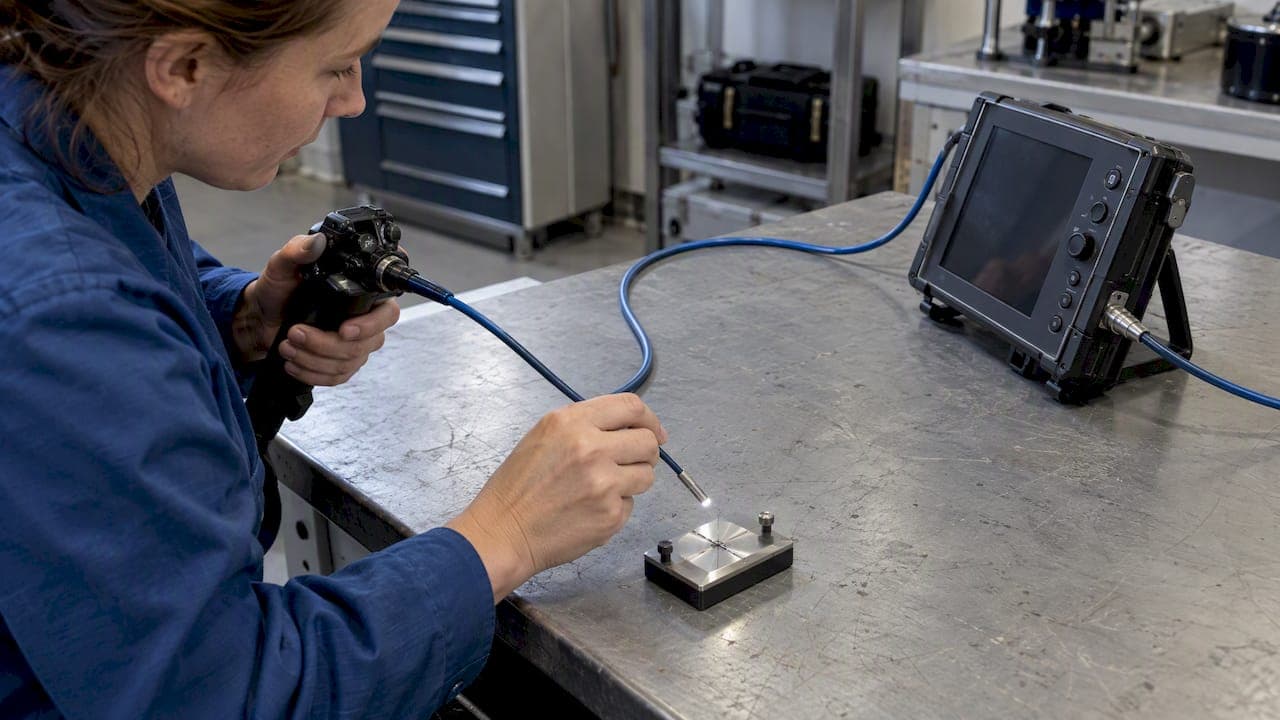
A radiation resistant borescope keeps its imaging sensor and sensitive electronics away from the dose field, either through a split-head design with a remote processor or through a hardened camera head built with minimal in-head electronics. Inspectors reach for one whenever they need to examine reactor internals, hot cells, or sterilization irradiators without the image degrading or the equipment failing mid-task.
TL;DR:
- Require before and after SRCS images showing resolution of a wire measuring 12 micrometers; NRC and EPRI guidance treats this check as acceptance evidence.
- Lead or tungsten shielding reduces gamma exposure but offers little protection against fast neutrons, which may call for sensor relocation or planned head replacement.
- Log cumulative dose per probe head, and schedule replacements against exposure rather than visible wear; repeat SRCS imaging before insertion and after withdrawal.
- Request dose tolerance as both cumulative dose and dose rate, plus pressure, temperature, and chemical resistance ratings matched to the inspection site.
Table of Contents
- 1. What makes a borescope radiation resistant
- 2. Specs and standards that actually prove performance
- 3. How radiation type and field profile change your choice
- 4. Deployment and inspection best practices for radiation environments
- 5. Publisher expertise and product resources for radiation-aware inspections
- 6. Field trade-offs and procurement shortcuts
- How we can help you source the right equipment
- FAQ
- Sources
1. What makes a borescope radiation resistant
The core trick is distance. A split-head or remote-processor design pulls the camera's active electronics away from the probe tip and routes a passive signal back to a control unit sitting outside the radiation field, which is why most systems fielded in very high-dose work favor this layout over trying to shield the sensor in place. Where miniaturization rules that out, manufacturers build a hardened head instead, with minimal electronics, radiation-tolerant sensor types, or older pickup-tube technology that tolerates dose better than a standard CMOS chip.
Optics matter just as much as sensor placement. Certain glass types and fiber bundles brown or darken under cumulative dose, which dims the image and shifts contrast long before the electronics fail, so radiation-tolerant systems typically specify glass formulations chosen to resist that browning. Cable and connector construction also needs attention: jacket materials have to resist both radiation and the decontamination chemicals used on-site, and connectors need to survive repeated wipe-down without degrading.
A few design elements separate a radiation-capable system from a standard industrial borescope:
- A split-head or remote-processor layout that isolates the sensor and electronics from the dose field.
- Radiation-tolerant optical glass or fiber chosen to resist browning and contrast loss.
- Cable jackets and connectors rated for both radiation exposure and decontamination chemicals.
- Waterproof and pressure-rated housings for submerged reactor or spent-fuel-pool work.
- Stable performance across the temperature range typical of hot cells or irradiator vaults.
Pro Tip: Ask vendors whether the camera head or the control unit carries the active electronics. If the answer is vague, assume the head is not built for sustained high-dose service.
2. Specs and standards that actually prove performance
Resolution numbers on a spec sheet mean little without a calibration method behind them. The accepted approach in nuclear visual testing uses a sensitivity, resolution, and contrast standard, commonly built around two perpendicular wires 12 micrometers in diameter, imaged before and after an inspection to confirm the system still resolves fine detail. If a vendor cannot produce an SRCS image at that wire diameter, treat any stated resolution figure as unverified.

SRCS imaging remains the recommended way to confirm a remote visual testing system's acuity before and after a reactor inspection, and NRC and EPRI guidance ties this directly to equipment acceptance rather than treating it as optional documentation.
Beyond resolution, a few other specs deserve scrutiny before procurement:
- Field of view and zoom range, since a system with no zoom capability cannot close in on a suspected flaw without repositioning the whole probe.
- Manufacturer dose-tolerance claims stated as both cumulative dose and dose rate, not just one figure.
- Waterproof and pressure ratings adequate for the depth of a reactor pool or spent-fuel pool task.
- Stable temperature performance across the range expected in a hot cell or irradiator vault.
- Written SRCS pre- and post-inspection proof, requested as a condition of acceptance, not as an afterthought.
Reported field systems for reactor component work typically land around 470 to 600 vertical lines of resolution, roughly equivalent to a 640x480 image, which is the practical baseline to compare any quoted spec against.
3. How radiation type and field profile change your choice
Gamma radiation and neutron flux damage imaging equipment through different mechanisms, and that distinction should drive the selection, not just the total dose number on a survey report. Gamma exposure tends to darken optics and degrade sensor performance gradually with cumulative dose. Neutron exposure causes displacement damage inside a sensor's silicon lattice, and experiments on CCD cameras in fusion devices found that neutron irradiation produced permanent white-pixel defects that pure gamma exposure did not reliably cause.
That matters for shielding decisions. Lead or tungsten shielding attenuates gamma dose effectively but does little against fast neutrons, so a field with a meaningful neutron component often needs a different mitigation strategy entirely, whether that means moving the sensor farther away, choosing a more neutron-tolerant sensor type, or planning for more frequent head replacement rather than relying on shielding mass.
A few questions to resolve before specifying equipment:
- What is the measured gamma dose rate and cumulative dose expected over the inspection's duration?
- Is there a meaningful neutron flux component, and if so, how fast does it accumulate?
- Does the task favor a split-head design that avoids shielding bulk, or does the geometry allow for shielding mass around the sensor?
- What cumulative dose budget should trigger a planned head swap rather than continued use?
Split-head and remote-processor designs tend to win in tight, high-dose geometries where adding shielding mass is not practical, while heavier shielding can still make sense in open hot-cell work where probe bulk is less of a constraint.
4. Deployment and inspection best practices for radiation environments
Getting good images in a dose field is as much procedure as equipment. A consistent sequence protects both the inspection's validity and the gear's service life:
- Image the SRCS target before inserting the probe to establish a documented baseline.
- Confirm lighting intensity and angle are set to maximize contrast on the surface type being examined.
- Insert and maneuver the probe using pole, rope, or motorized positioning from outside the radiation area.
- Record continuous video with time stamps and operator voice notes describing what is being viewed.
- Withdraw the probe and re-image the SRCS target to confirm resolution held steady through the inspection.
- Decontaminate the probe and cable per site procedure before storage or reuse.
Underwater reactor work follows the same sequence with added attention to water clarity, since suspended particulate degrades image contrast faster than dose does in many cases. Expendable parts, such as light guides or protective sheaths, should be budgeted for and swapped on a schedule tied to dose exposure rather than waiting for visible failure.
Pro Tip: Keep a running log of cumulative dose per probe head alongside your SRCS results. A head that still resolves the calibration target can still be nearing the end of its useful service life.
5. Publisher expertise and product resources for radiation-aware inspections
A few resources we maintain speak directly to the environmental side of this decision:
- Our guide to high-temperature borescopes covers selection criteria that overlap closely with radiation-field procurement, since both demand hardware that holds up under stress.
- Our explainer on videoscope architecture breaks down split-head versus integrated designs in more depth.
- Our remote visual inspection resource covers recording and documentation practices that transfer directly to field work.
6. Field trade-offs and procurement shortcuts
In my reading of how outages actually run, modular replaceability beats heavy shielding more often than procurement teams expect. Swapping a probe head on a planned dose budget is cheaper and faster than designing shielding around a sensor that will still degrade eventually. When schedules are tight, the one step never worth skipping is the SRCS check: run it at acceptance and again on first field deployment, because that single image tells you whether the system you bought still performs the way the spec sheet claims.
— Endoscope
How we can help you source the right equipment
Once you know your dose rate, cumulative exposure budget, and whether neutron flux is a factor, the next step is matching that profile against real hardware rather than marketing claims. Our borescopes and videoscopes catalog is the place to start comparing split-head and hardened-head options side by side, and our team can walk through datasheets with you before you commit to an SRCS acceptance test.
If a probe head is already showing wear from dose exposure, our repair services can get it back into rotation without a full replacement. Start by browsing the borescope catalog and requesting the specs you need for your next outage.
FAQ
What's the difference between an endoscope and a borescope?
Both use a camera or optical relay on a flexible or rigid shaft to see inside spaces a human eye cannot reach. "Endoscope" is the broader term used across medical and veterinary contexts, while "borescope" specifically refers to the industrial version used for inspecting pipes, engines, and reactor components.
What are the two main types of borescopes?
Borescopes split into rigid and flexible designs. Rigid borescopes use a straight optical tube best suited to line-of-sight inspection in accessible spaces, while flexible borescopes use a bendable insertion tube that can navigate curves and tight geometries like piping or reactor internals.
What's the best borescope for radiation environments?
The right choice depends on your dose rate, cumulative exposure budget, and whether neutron flux is present, since those factors determine whether a split-head design or a hardened camera head fits better. Our industrial borescope and videoscope catalog covers portable options suited to building an inspection kit around those requirements.
What are the limitations of a borescope?
Image quality depends heavily on lighting and field of view, so a borescope with no zoom capability can struggle to confirm a suspected flaw without repositioning. In radiation fields specifically, cumulative dose degrades optics and sensors over time, which is why SRCS calibration before and after use is necessary to confirm the system still performs as expected.
Sources
- Remote visual methods to detect cracking in reactor components (NUREG/CR-6860)
- Radiation damage of the PCO Pixelfly VGA CCD camera of the BES system on KSTAR tokamak