
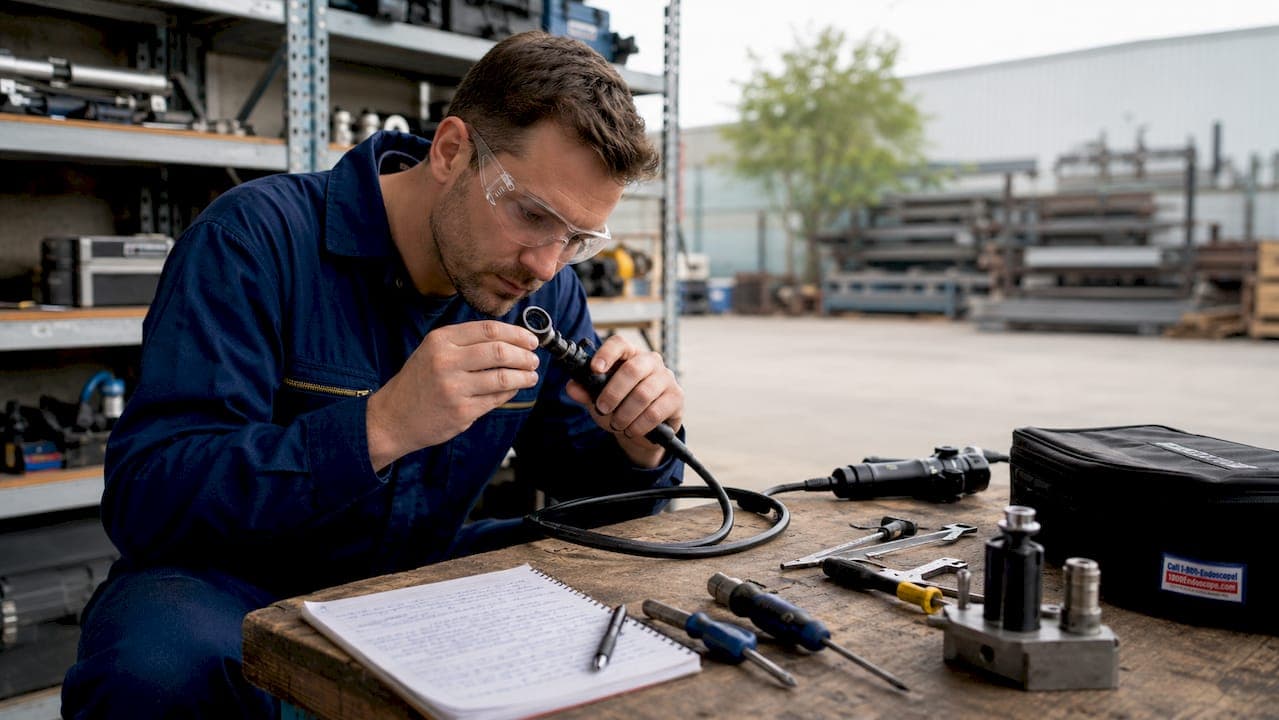
Industrial inspection equipment lifespan is determined by maintenance approach, operating environment, usage intensity, material fatigue, and technological obsolescence. These industrial inspection equipment lifespan factors interact in ways that make simple age-based replacement schedules unreliable and often costly. Procurement managers and inspection professionals who understand these dynamics can extend equipment service life, reduce unplanned downtime, and make smarter replacement decisions. The difference between a borescope or videoscope that lasts five years and one that lasts fifteen often comes down to decisions made long before the first sign of wear.
1. How maintenance strategy is the top factor in inspection equipment longevity
Maintenance approach is the single most controllable factor in how long industrial inspection tools last. The shift from preventive to predictive maintenance is not incremental. Organizations that move to predictive maintenance extend equipment longevity by 20–40% compared to traditional scheduled maintenance. That gap represents years of additional service life from the same capital investment.
Preventive maintenance runs on fixed schedules regardless of actual equipment condition. Predictive maintenance uses real-time data, such as vibration signatures, thermal readings, and optical performance metrics, to intervene only when degradation is actually occurring. The result is fewer unnecessary interventions and less wear introduced by the maintenance process itself.
- Condition monitoring: Track lens clarity, articulation resistance, and light output on videoscopes and borescopes at regular intervals.
- Thermal imaging: Detect heat anomalies in electronic components before they cause failure.
- Vibration analysis: Identify mechanical loosening in portable inspection systems early.
- Usage logging: Record insertion cycles and operating hours to build accurate wear models.
Pro Tip: AI-driven condition monitoring tools can flag degradation trends in inspection cameras weeks before visible failure, giving procurement teams time to schedule repairs without disrupting operations.
Predictive maintenance combined with accurate condition monitoring prevents both premature replacement and late catastrophic failures. Both outcomes are expensive. The goal is to act at the right moment, not the scheduled moment.
2. Environmental and operational stresses that degrade equipment durability
Operating environment is the second major driver of inspection equipment durability. Temperature extremes, humidity, vibration, chemical exposure, and dust do not act in isolation. Environmental stresses interact and compound each other, degrading sealing force and joint integrity far faster than any single condition would alone.
Thermal cycling is particularly damaging. Repeated expansion and contraction of dissimilar materials in a borescope insertion tube or camera housing creates micro-fatigue at joints and seals. Moisture ingress accelerates corrosion of electrical contacts and optical coatings. Vibration loosens mechanical connections over time, especially in equipment used on or near rotating machinery.
Environmental validation must simulate combined stresses rather than isolated conditions to accurately predict hardware durability. Testing a device for temperature resistance alone tells you almost nothing about how it will perform in a humid, vibrating, chemically active environment.
Rugged hardware design addresses these risks through sealed enclosures, corrosion-resistant materials, and shock-mounted electronics. Experts at Fictiv recommend combined environmental validation and accelerated life testing to expose failure modes before deployment. For procurement managers, this means specifying IP ratings, operating temperature ranges, and vibration tolerance as hard requirements, not optional features.
- IP67 or higher: Protects against dust ingress and temporary water immersion.
- Operating temperature range: Verify the full range matches your deployment conditions, including cold storage or furnace-adjacent inspections.
- Chemical resistance: Confirm insertion tube materials resist the specific solvents or lubricants present in your environment.
- Shock rating: Quantify drop and impact tolerance for field-portable equipment.
3. Usage patterns and material fatigue in inspection tools
How often equipment is used, and under what mechanical loads, determines fatigue life more than calendar age. Equipment lifespan is determined more by cumulative cyclic loading and thermal transients than by simple chronological age. A borescope used daily in a high-vibration environment accumulates damage far faster than one used weekly in a stable setting.
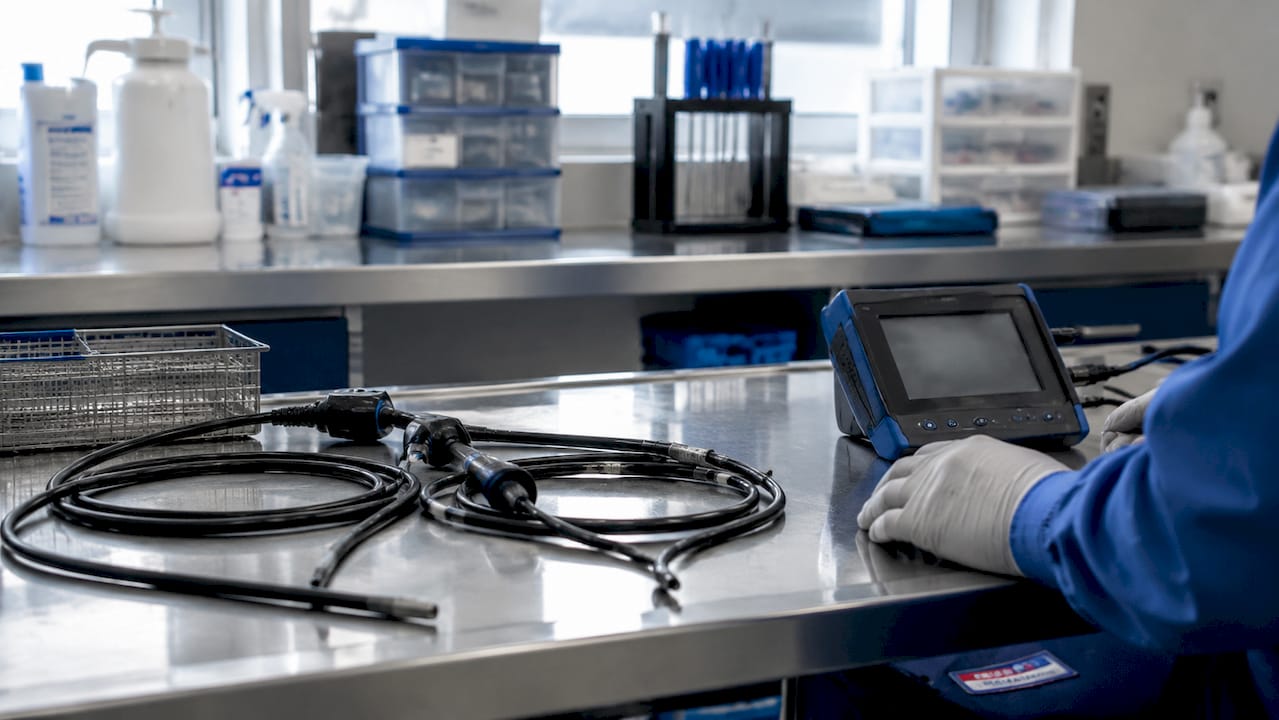
Fatigue cracks initiate at stress concentration points. These are locations where geometry changes abruptly, such as bends, welds, or connector interfaces. Engineers quantify fatigue life using S-N curves, which plot stress amplitude against the number of cycles to failure, and stress concentration factors that amplify nominal stress at these critical points. Poor weld quality can reduce fatigue life by over 70% due to stress concentration amplification. That is not a marginal difference. It means a component rated for ten years of service could fail in three.
| Failure mode | Primary cause | Equipment type most affected |
|---|---|---|
| Tooth fracture | Cyclic overload | Gear-driven inspection systems |
| Abrasive wear | Particle contact | Mining and pipeline borescopes |
| Seal degradation | Thermal cycling | Submersible and high-temp videoscopes |
| Fatigue cracking | Stress concentration at welds | Rigid inspection probes |
| Connector failure | Repeated mating cycles | Modular inspection systems |
In mining equipment specifically, tooth fracture accounts for 75% of gear failures, and abrasive wear causes over 60% of sprocket degradation. These numbers translate directly to inspection equipment operating in similar environments. Smooth geometry, high-quality welds, and design features that reduce stress concentration are not cosmetic choices. They are the primary engineering levers for extending fatigue life.
Pro Tip: When evaluating borescopes or videoscopes for high-cycle applications, ask manufacturers for S-N curve data or insertion cycle ratings. Equipment without this data has not been tested for fatigue life.
4. Technological obsolescence and the economics of service life
Mechanical durability is not the only limit on inspection equipment service life. Coordinate Measuring Machines (CMMs) often last 15–25 years mechanically, yet many are retired well before that because replacement parts become unavailable or software support ends. The same pattern applies to videoscopes, borescopes, and digital inspection cameras.
Obsolescence takes three forms. Parts obsolescence occurs when manufacturers discontinue components, making repair impossible or prohibitively expensive. Software obsolescence occurs when firmware or control software is no longer updated, creating compatibility gaps with modern data systems. Performance obsolescence occurs when newer equipment offers accuracy or resolution improvements significant enough to justify replacement on operational grounds alone.
| Obsolescence type | Trigger | Recommended action |
|---|---|---|
| Parts unavailability | Manufacturer discontinues components | Stockpile critical spares or plan replacement |
| Software end-of-life | No firmware updates available | Evaluate integration risk and upgrade timeline |
| Performance gap | New equipment offers materially better accuracy | Conduct cost-benefit analysis against current output |
| Support discontinuation | No manufacturer service available | Assess third-party repair options |
The economic decision point is clear. Replacement is recommended when cumulative repair costs exceed 50% of new equipment price. This threshold prevents the trap of pouring repair budget into aging equipment that will fail again soon. Procurement managers should track cumulative repair costs per unit and flag equipment approaching this threshold before the next failure event, not after.
5. AI-enabled inspection systems vs. human visual inspection
Human visual inspection has a well-documented accuracy ceiling. Trained inspectors achieve 70–80% accuracy under normal conditions, and that figure drops further with fatigue, poor lighting, or repetitive tasks. AI vision inspection systems maintain 95–99% accuracy without fatigue degradation. That gap directly affects how well equipment condition is assessed and how early defects are caught.
Early defect detection is the mechanism that extends equipment life. When a crack, coating failure, or seal degradation is caught at the micro-scale, repair is simple and inexpensive. Caught late, the same defect requires major intervention or full replacement. AI-enabled systems also generate consistent, timestamped inspection records that support predictive maintenance models.
- Defect detection rate: AI systems flag anomalies human inspectors miss, particularly in low-contrast or high-complexity visual fields.
- Inspection speed: Automated systems process images faster, reducing the time equipment is offline during inspection.
- Data continuity: AI systems produce structured data that feeds directly into maintenance scheduling software.
- Fatigue immunity: System accuracy does not degrade over a shift, a week, or a year.
AI vision systems achieve payback within 7–12 months of implementation. For procurement managers evaluating capital expenditure, that timeline makes AI-assisted inspection a financially defensible upgrade even on a short budget cycle. The accuracy and consistency gains also reduce the risk of missed defects that cause downstream equipment failures.
6. Design quality and fabrication standards as lifespan multipliers
Equipment design quality sets the upper bound on achievable lifespan. No maintenance program can compensate for a fundamentally poor design. Smooth geometries, tight manufacturing tolerances, and high-quality welds all reduce stress concentration and extend fatigue life. Effective fatigue life management involves design optimization, smooth geometries, high weld quality, and condition monitoring using real operating data and Miner's Rule.
Miner's Rule is the standard engineering method for estimating cumulative fatigue damage. It sums the fraction of life consumed at each stress level across all load cycles. When the sum reaches 1.0, failure is predicted. Inspection professionals do not need to run these calculations themselves, but they should ask whether equipment suppliers use this methodology in their design validation process.
Procurement decisions made on price alone often select equipment with lower design quality. The cost difference between a well-engineered borescope and a budget alternative is visible in the first year of heavy use. Insertion tube kinking, connector loosening, and optical degradation appear earlier in equipment with poor stress management. Specifying design standards, not just price points, is the procurement lever that most directly affects long-term cost per inspection.
7. Fitness-for-service assessment and remaining useful life evaluation
Equipment failure is not solely age-dependent. Assessment of flaw stability and growth rates ensures safer continued operation and avoids unnecessary replacement. Engineering expert Tina Tuggle notes that flaws must be assessed for stable growth and appropriate inspection intervals rather than triggering immediate replacement upon crack detection.
Fitness-for-service (FFS) assessment is the formal engineering process for evaluating whether equipment with known damage can continue operating safely. It requires measuring the flaw, modeling its growth rate under actual operating conditions, and calculating the remaining useful life. For high-value inspection equipment, this process can justify continued operation for years beyond what a conservative age-based schedule would allow.
For procurement managers, the practical application is straightforward. Before authorizing replacement of expensive inspection equipment based on age or a single defect finding, commission an engineering assessment. The assessment cost is typically a fraction of replacement cost. When the assessment confirms remaining useful life, the savings are direct. When it confirms replacement is needed, the decision is defensible and documented.
Key takeaways
Industrial inspection equipment lifespan is controlled by maintenance strategy, environment, usage intensity, design quality, and obsolescence, not by age alone.
| Point | Details |
|---|---|
| Predictive maintenance wins | Shifting from preventive to predictive maintenance extends equipment life by 20–40%. |
| Environment compounds damage | Temperature, vibration, and moisture interact to degrade seals and joints faster than any single factor alone. |
| Fatigue life is design-dependent | Poor weld quality and stress concentrations can cut fatigue life by over 70%. |
| Obsolescence ends service life early | Track repair costs and replace when cumulative costs exceed 50% of new equipment price. |
| AI inspection improves outcomes | AI vision systems sustain 95–99% accuracy, enabling earlier defect detection and better maintenance decisions. |
What I've learned about managing inspection equipment lifespan
The most common mistake I see procurement managers make is treating equipment lifespan as a fixed number. A borescope rated for ten years does not last ten years in a high-cycle, high-temperature pipeline inspection role. It also does not need to be replaced in five years if it operates in a clean, low-vibration environment with a disciplined videoscope maintenance program. The rating is a starting point, not a verdict.
The second mistake is conflating mechanical condition with service readiness. Equipment can be mechanically sound but operationally obsolete. When a videoscope's image resolution is no longer sufficient to detect the defect sizes your quality standard requires, it is effectively at end of life regardless of its physical condition. That distinction matters for budget planning and for audit trails.
My honest recommendation is to build a per-unit lifecycle record from day one. Log operating hours, environments, repair events, and cumulative repair costs. Review that record annually against the 50% replacement threshold and against current performance benchmarks. The data will tell you when to repair, when to replace, and when to commission a fitness-for-service assessment. Gut feel and age-based schedules leave money on the table in both directions.
— Endoscope
Extend your equipment's service life with 1800endoscope
1800endoscope supplies industrial inspection professionals with borescopes, videoscopes, and accessories built for demanding operating environments. Whether you are replacing aging equipment or building out a new inspection toolkit, the borescope catalog covers a full range of rigid and flexible options suited for pipeline, aerospace, and manufacturing applications.
The portable 6mm airway inspection system combines HD video recording, SD card storage, and a direct monitor display in a field-ready package at a price point that makes sense for both single-unit buyers and fleet procurement. 1800endoscope also carries replacement accessories, light sources, and maintenance components that support the kind of proactive care that extends equipment life. Browse the full inspection equipment catalog or contact the team directly for specification guidance.
FAQ
What factors most affect industrial inspection equipment lifespan?
Maintenance strategy, operating environment, usage intensity, design quality, and technological obsolescence are the primary factors. Predictive maintenance and controlled operating conditions have the greatest positive impact on service life.
How does predictive maintenance extend equipment life?
Predictive maintenance uses real-time condition data to intervene only when degradation is detected. This approach extends equipment longevity by 20–40% compared to fixed-schedule preventive maintenance.
When should inspection equipment be replaced rather than repaired?
Replace equipment when cumulative repair costs exceed 50% of the new unit price. Also replace when parts are no longer available or when performance no longer meets inspection accuracy requirements.
How does environment affect inspection equipment durability?
Temperature extremes, vibration, moisture, and chemical exposure interact to degrade seals, joints, and optical components faster than any single condition alone. Specifying IP ratings and operating temperature ranges at procurement reduces this risk.
Are AI vision inspection systems worth the investment?
AI vision systems maintain 95–99% inspection accuracy without fatigue degradation and typically achieve payback within 7–12 months. For high-volume inspection operations, the accuracy and consistency gains justify the capital cost.